The remarkable marquis

WE WERE FORTUNATE that we met a lady who unlocked (specially for us) the parish church of Saint John the Baptist with Our Lady and Saint Laurence in Thaxted, Essex. It was during our recent visit to the town in April 2021, when many churches tended to be kept closed most of the time. We were even luckier because this kind lady spent time with us, showing us the many interesting features within the building. Amongst these she pointed out: a cupboard colourfully painted with an Italian baroque design; an unusual lectern, also richly coloured; a decorative corona suspended from the ceiling of a southern aisle, and another above a figure next to the high altar. She told us that all these objects were made by the Marquis d’Oisy (1880-1959), who used to live in a cottage near Thaxted, an interesting man. My curiosity about the Marquis was aroused and after returning home, I looked for something about him on the Internet and found an informative article about the fellow, written by Julian Litten and published in “Saffron Walden Historical Journal”, issue number 24, Autumn 2012. Mr Litten has also recently published a book about the Marquis, which I have not yet seen.
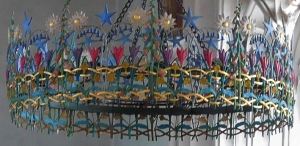
A painted corona by the Marquis d’Oisy in Thaxted Church

The 37-year-old Marquis arrived in Essex in the summer of 1917. He settled in Plegdon Green, which is close to the present Stansted Airport and just over 4 miles south west of Thaxted. He lived out the rest of his life in Plegdon. He called himself ‘Amand Edouard Ambroise Marie Lowis Etienne Phillipe d’Sant Andre Tournay, Marquis d’Oisy’, and claimed to have been born in Rio de Janeiro. However, the so-called Marquis was neither an aristocrat nor born in South America.

It is most likely that the Marquis was born in Bath (England). Julian Litten’s research suggests that most likely the Marquis was born ‘Ambrose E Merchant’ the son of Ambrose C Merchant, a gasfitter, and his wife Alice Merchant (née Thomas) in Bath. When he grew up, the Marquis often used the name ‘Ambrose Thomas’.  

By 1901, Ambrose Thomas (aka the Marquis) was living at Caldey Priory (near Tenby in Wales) where he was a Benedictine Monk. In 1902, he left the Order and most probably worked as a navvy, digging the Northern Line tunnels for the Underground Electric Railways Company of London. He did not keep this job for long.  Until 1915, when he was working for a church furnishers’ company, Louis Grossé, as a vestment maker at St Saviours Church in London’s Hoxton, his life remains a mystery. It is not impossible that he spent some of the time learning the artistic skills that he was employ later in life.

The cottage that the Marquis moved into in 1917 was part of the estate at Plegdon owned by the silent-film screen actress Irene Rook, whom he could possibly have met if, as Litten suggested, he might have had some employment designing or manufacturing theatrical sets for films. By then, the Marquis was producing decorative wares such as the things he made, which we admired in the church in Thaxted. Litten suggested that Ambrose Thomas might have adopted the seemingly posh name Marquis d’Oisy whilst working at Louis Grossé but cannot be certain of this.

During WW1, there was a shortage of work for the Grossé company. This was probably the reason that the Marquis left in 1917 and came to live rent-free in Irene Rook’s cottage. It is likely that Irene Rook had bought things made by the Marquis and felt sorry for him when he faced unemployment in 1917. On arrival in Plegdon, Litten noted:

“At first, the locals were afeared of him, some even taking him to be a spy, attributing his exotic apparel of long cloak and floppy-brimmed hat as being more French than English. With money being in very short supply, he kept a cow tethered on the green for the sake of its milk, as well as a goat, and he grew edible flowers, fruits and herbs to keep the cost of his groceries down. He also kept two elegant greyhounds, and always slept in the open, whatever the weather, on the first-floor balcony of his cottage. Now that in itself points towards the probability of him having TB.”

Few of those who knew him well after he moved to Essex found it easy to believe that Ambrose was truly aristocratic. The film director Basil Dean (1888-1978), who lived near him, wrote of the Marquis:

“Lady Warwick used to say he came not from any foreign land but from the East End of London. He was a strange creature altogether, very tall and thin, emaciated almost, with a squeaky voice and a chin beard; and obvious homosexual … artist-antiquarian, vegetarian, and decorator – extraordinary of cottage replacements of period furniture to Lady Warwick. We owed to him much of our knowledge of Little Easton Manor’s history, all of our discovery of its foundations, and enthusiastic guidance along the path of its restoration. A passionate student of peasant ways – a folk-artist, you might say …”

The Marquis worked with Conrad Noel (1869-1942), the left-wing vicar of Thaxted (between 1910 and his death), known as the ‘Red Vicar’, about whom I will write in the near future. In 1923, he began making some of the objects that we saw in the church, beginning with the vestment cupboard he decorated with the Italianate motifs. Noel helped the Marquis by commissioning him to paint and/or create the following items as listed by Litten:

“…the lectern, the niche and statue of St Lawrence, the decorative carving on the reredos in the Becket Chapel, and commissioning two painted pewter coronas for the Lady Chapel and one for the statue of Our Lady as well as a band of identical cresting for the High Altar …”

We were shown some of these items by the lady who kindly let us enter the spacious, light-filled Perpendicular-style church, which was mostly built between the 14th and 16th centuries.

As well as his work at Thaxted church, the Marquis did extensive restoration work at Basil Dean’s Little Easton Manor and organised many folkloric pageants both in Essex and in London. Notable amongst the pageants was one organised near Thaxted in 1926 to raise money for the English Folk Dance Society who were trying to build their London headquarters in what was to become Cecil Sharp House (in London’s Regents Park Road). Music for this occasion was provided by the wife of the composer Gustav Holst, herself a composer, Imogen Holst (1907-1984). Gustav had strong associations with Thaxted and Conrad Noel, about which I plan to write. The largest event, arranged by the Marquis, was held at Hatfield House in 1936. With a cast of 600 and lasting 3 hours, the Marquis designed the costumes. The composer Ralph Vaughan Williams was amongst the audience. In addition to these activities, the Marquis created painted furniture for Heals in London and Sayles in Cambridge.

Irene Rook died in 1958 and left the cottage at Plegdon to the Marquis, who was by then a very far from wealthy man. Desperately short of money, he sold the cottage for a pittance in January 1959. Suffering from prostate cancer, he was put up by his former man servant Bernard Keel in his cottage at Takely, just south of the present Stansted Airport. He died in December 1959.

I have attempted to summarise what is known about the Marquis but omitted many of the fascinating details about this remarkable man’s life, which has been well-researched by Julian Litten, whose book “The Mystery of Marquis D’oisy” was published in late 2015. Had it not been for the superb tour given us by the kind lady who admitted us to the church in Thaxted, we would have most probably remained completely ignorant of the marvellous Marquis.

A glimpse of Mersea

SOMETIMES SUBMERGED DURING high tide, a causeway connects mainland Essex with the island of Mersea in the Colne and Blackwater estuaries. Markers with measurements are posted along the causeway so that people wishing to cross it when water covers it can tell how deep the water is. Road signs on both sides of the causeway advise drivers to test their brakes, especially if the road to and from the island is wet.

I first heard of Mersea Island in the mid-1970s when a friend of mine, with whom I have lost contact, married someone who farmed sheep on Mersea Island. However, it was only in 2021 that I first set foot on the island. The largest settlement on Mersea is the small town of West Mersea. We visited on the 12th of April, which was the first day (since the latest ‘lockdown began in December last year) that people were allowed to have drinks at pubs and eat meals at restaurants, but only in the open air. Fortunately, the sun was out and the waterfront mostly south facing.

In 895 AD, the island was known as ‘Meresig’; by 995 as ‘Myresig’; and in the Domesday Book as ‘Meresai’. The Old English word ‘mere’ usually refers to a lake (e.g., Windermere) but in the case of Mersea (and Margate) it refers to the sea. Thus, Mersea comes from words meaning ‘the island in the sea’. During the Celtic era (before the Roman conquest), the island was populated mainly with folk who fished and farmed. After the Romans established their capital at nearby Colchester, they built a causeway to Mersea Island and improved an already existing Celtic track (see: “The Shell Book of the Islands of Britain”, by D Booth and D Perrott). The Romans called the island ‘Maris Insula’ and archaeological remains of their presence there have been discovered and are now in Colchester Museum. There is a museum in West Mersea (www.merseamuseum.org.uk/) but this was closed on account of covid19 regulations. It plans to re-open in June.

The Normans also visited the island. The Domesday book recorded that in about 1086 there about 100 persons living on the island along with 300 sheep. The construction of the Church of St Peter and St Paul, which occupies the highest spot in West Mersea, began in 1046. Some of the original structure forms part of the fabric of the present church, which, sadly, was closed when we visited.

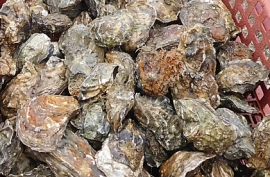
West Mersea is a holiday resort. Many fine homes, mostly modern, line the road that runs parallel to the waterfront, but which is separated from it by mudflats and salt marshes. Twenty or so large houseboats are moored at the water’s edge. Each of them has its own, often rickety-looking, boardwalk leading to it from the road. There are several pubs and eateries from which views of the boats moored by the town may be viewed. The town is famous for its oysters. We watched workmen hosing down crates filled with oysters, which look like large knobbly stones. Apparently, the Mersea oysters are highly prized internationally. Interspersed between boatyards for pleasure craft, there are yards where fishing vessels are maintained. At low tide, which is when we visited, the muddy shore is dotted with small boats of all types, some of them gently rotting away.

As it was late afternoon and we had to drive back to London and we had recently been well-fed, we spent no more than an hour in West Mersea. We hope to return when the weather warms up and then we will sample some of the local refreshment outlets. Although Mersea Island is only about 60 miles (and a lot of heavy traffic) from London’s Hyde Park Corner, it feels as if it is much further away: far away from anywhere.

Trouble in the village

TOLLESBURY IS A TINY village on the estuary of the River Blackwater in the English county of Essex, famed for its oysters, nature reserve, and sailing facilities. It is not far from Colchester and the smaller Tiptree famed for its jam manufacture.  Tiny though it is, Tollesbury appears in the Domesday Book, with the name ‘Tolesberia’ and in 1218 as ‘Tolesbir’. It is possible that the ‘Toll’ part of the name refers to a person who lived many centuries ago. The Church of St Mary the Virgin that stands at one end of the central village square was built in about 1090, possibly incorporating material from an earlier Saxon Church.

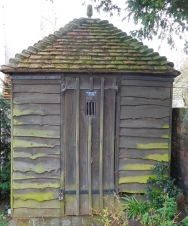
At the southern edge of the square, close to the northern boundary of the churchyard there stands a small wooden hut with a pyramidical tiled roof and one door with a small, barred window. It looks a bit like a garden shed but it was not built for storing tools and so on. For, this was the village lockup or ‘cage’. Built in 1700, it seems in remarkably good condition. The lockup, as its name suggests, was where local miscreants were locked up. It was a tiny prison. The reason that it is in a good state despite its age is that it has:

“…C20 waney weatherboarding, roofed with handmade red clay plain tiles and C20 hip tiles.” (www.prisonhistory.org/lockup/tollesbury-lock-up/)

Essex is home to plenty of village lockups. Apart the lockup from at Tollesbury, you can see village lockups at, for example, Great Bardfield, Thaxted, Canewdon, Great Dunmow, Orsett, Braintree, Roydon, and Steeple Bumpstead (hwww.essex.police.uk/SysSiteAssets/media/downloads/essex/about-us/museum/research/history-notebooks/66.pdf).  

These miniature jails were:

“… used in the eighteenth and nineteenth centuries to house criminals who were apprehended on suspicion of committing petty crime … Lock-ups were only temporary forms of imprisonment, usually for one or two people, before the local authorities of the day decided how to deal with the offender. Criminals could be released or sent to the closest large town for trial.” (www.essexlive.news/news/essex-news/historic-jails-essex-you-can-3227277)

Our friend, who lives in Tollesbury, suggested that probably the lockup was often used to house people who had drunk too much and needed to sober up. This not an unreasonable idea considering that at one time the village had six pubs.

Although there is much more that could be written about Tollesbury, I hope to do this after a future visit to this charming little place.

Oliver Cromwell in Essex

YOU CAN NO LONGER ENJOY a tankard of ale at the Sun Inn in the Essex town of Saffron Walden. However, you can still enjoy the fine pargetting (moulded sculptured plasterwork) that adorns it.

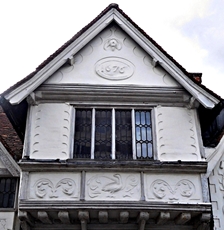
The building that housed the former Sun Inn was built in the 15th century. Late in the 16th or early in the 17th century, an upper floor was added. Indeed, one of the gables with fine pargetting bears the date 1676. This might have been the date when the present pargetting was created or when the upper floor was added, or even both. The former inn has an opening that allowed wagons and other traffic to enter the yard behind it.

The pargetting is described well in a website (www.british-history.ac.uk/rchme/essex/vol1/pp228-260) as follows:
“… in the middle bay are two late 17th-century panels in plaster, one with a design of foliage and birds, and the other with a stocking; in the S.W. gable is a design of the same date in plaster, which consists of a circular panel divided into twelve segments; on each side is the figure of a man in a long coat, knee-breeches and high-heeled shoes; one figure holds a sword and buckler, the other a long club.”

One of the panels, that with the man with a sword and the other with a long club, respectively represent Thomas Hickathrift and the Wisbech giant (https://heritagerecords.nationaltrust.org.uk/HBSMR/MonRecord.aspx?uid=MNA108635). Thomas (‘Tom’) Hickathrift was a mythical East Anglian giant-killer, a giant of a man, whose exploits included slaying the Wisbech Giant.

Today (late 2020), the group of beautifully decorated houses that includes the former Sun Inn is empty. The ground floor of part of the building bears a shop sign ‘Lankester Antiques & Books’. Run by Paul Lankester of Thaxted in Essex, the shop closed after 48 years of business in July 2015. Another sign near it reads ‘The 14th century Old Sun Inn. Oliver Cromwell’s Headquarters 1647’. In 1647, when Cromwell’s New Model Army had won the first civil war for the Parliamentarians, they gathered in Saffron Walden. For various reasons the war weary army was becoming dissatisfied. Cromwell and his officers arrived in Saffron Walden on the 2nd of May 1647 to try to satisfy the troops’ various demands and to deal with their grievances (www.saffronwaldenreporter.co.uk/news/a-lasting-place-in-history-1-377880). He was unable to do so and returned to London after staying in the town for 19 days. 

Although the town has many other attractions, seeing this old building with its exquisite external decorations is on its own an excellent reason to pay a visit to Saffron Walden.

Amazing maze or labyrinth

SIGNS IN SAFFRON WALDEN, a town in Essex, pointed to ‘The Turf Maze’. We followed these from the centre of the town’s attractive market square and across The Common, a large grassy expanse, to its eastern edge, where we came across the Turf Maze. I was expecting to see a maze with paths separated by hedges, but what we found is quite different, and might not be a maze at all.

The maze was cut unto the ground in the form of grooves separated from each other by low mounds of earth on which grass grows. A reliable website, https://historicengland.org.uk/listing/the-list/list-entry/1000741#:~:text=A%20turf%20maze%2C%20thought%20to,%2Dcut%20(Matthews%201922), describes it as follows:

“The maze … consists of a series of concentric circles cut into turf, surrounded by a low bank. It measures c 43m from corner to corner, the main areas of circular paths being c 29m in diameter. It is laid in a unicursal pattern formed of seventeen linked circles, and has four linked outer horseshoe-shaped bastions or ‘bellows’ which are, like the centre of the maze, raised slightly above the main circular paths. The narrow shallow grooves which form the paths are marked by bricks and begin on the north or south sides of the maze.”

The word ‘unicursal’ means that the pathway through the ‘maze’ forms a single route without branching, typical of a labyrinth. This is in contrast with a true maze in which the path is ‘multicursal’, meaning that the pathway has branches. An elderly lady whom we met walking on The Common told us that once she walked from the beginning of the ‘maze’ to its centre, following its path and confirmed to us that although the path is long and winding, it never branches.

The Turf Maze at Saffron Walden, which is really a labyrinth, was already in existence by 1699, but is believed to have first been created in mediaeval times. If it had a purpose, this has been long forgotten. Since then, it has been re-cut numerous times. When this was done in 1911, bricks were laid along the path of the labyrinth to help preserve its form. These have been replaced from time to time and more recently cemented together. In 2000, the so-called maze was put into the ownership of the Town Council of Saffron Walden.

Jeff Saward, writing in “The Saffron Walden Historical Journal” in Autumn 2012 (https://saffronwaldenhistoricalsociety.files.wordpress.com/2018/01/saffron-walden-turf-maze.pdf), notes that the labyrinth in Saffron Walden differs from other such labyrinths in the British Isles in that its path runs between the turf ridges and not along them as is the case in most others. He also discusses the age of the labyrinth, suggesting it may have been created later than the mediaeval era, possibly in the 16th century. It might have been designed from a labyrinth, almost identical to that in Saffron Walden, illustrated in “The Profitable Art of Gardening”, by Thomas Hill, published in about 1563. Hill’s design was not original as it can be found illustrated in “Le Théatre des bon engins, auquel sont contenuz cent Emblemes moraulx” by Guillaume de la Perrière, published in 1539. Whatever its date of construction, the labyrinth is a fine thing to see in the small Essex town.

Talking to some ladies who were feeding the ducks at a pond near one of the town’s car parks, we learned that Saffron Walden has three other mazes (or labyrinths) apart from the ill-named Turf Maze. We hope to explore these on a subsequent visit to the town. While trying to find the entrance to the car park of the local Waitrose supermarket, we discovered yet another maze, namely the one-way road system of Saffron Walden.

Decorated walls

DURING RECENT TRIPS TO villages and small towns in Essex and Suffolk, we have noticed that some of the plastering on the external walls of buildings is decorated with patterns and illustrations in bas-relief instead of being flat and featureless, as it often is. I first became aware of this decorative plasterwork on a house in the tiny village of Tollesbury in Essex. As we begun to see more examples, my curiosity about it grew. When we visited Saffron Walden, we saw that the outer wall of a bookshop was covered with plasterwork with patterns and symbols. I decided that if anyone would know about this kind of plastering, it would be someone working in what looked like a serious bookshop.

PARG 12 Saf

In Saffron Walden

I entered Harts bookshop and noticed two things. Firstly, the shop was very well stocked. It was a place where one might spend quite a long time browsing. Secondly, the shelving units looked very familiar. I mentioned to the sales assistant that the shelving resembled that used by branches of the excellent Daunt’s bookshop chain. She replied that despite its name, Hart’s is now a branch of Daunt’s. Saffron Walden is lucky to have such a fine bookstore. I asked the assistant about the plasterwork with decorations that was on her shop and other buildings in the area. Another customer overheard me and explained that what I was asking about is called ‘parget(t)ing’. According to Wikipedia:

“Pargeting derives from the word ‘parget’, a Middle English term that is probably derived from the Old French pargeter or parjeter, to throw about, or porgeter, to roughcast a wall.”

However, the frequently fine and intricate patterns and illustrations created on the plaster suggest that creating pargetting involves little if any ‘throwing about’ of plaster but rather much care in its application.

The patterns or drawings were/are often produced by filling moulds with plaster while the wall is being plastered. An important ingredient in the plaster used to create these three-dimensional images and to give them some cohesive strength is fibre. 

The website http://www.buildingconservation.com suggests that:

“English plasterwork became increasingly elaborate in the 16th century and the dramatic external decoration of Henry VIII’s Nonsuch Palace (1538) was contemporary with early plaster friezes in the great houses. Some of the most opulent pargeting was produced over the next 150 years with a high point around 1660 (for example, Ancient House, Ipswich, and the Sun Inn, Saffron Walden), then the technique began to fall out of fashion.”

Later in the 19th century, some architects like Norman Shaw who were involved in the Arts and Crafts Movement revived pargetting, but the effects produced were far less spontaneous looking than those produced by earlier craftsmen. The same website explains:

“The simplest pargeting takes the form of lines scratched with a stick across wet plaster to create, for example, a lattice within a border. More complexity comes from using fingers and combs or moulded templates, incising or impressing chevrons, scallops, herringbones, guilloches, fantails, rope patterns and interchanging squares.”

To create the images that can be seen in pargetting, the plaster used needs to have sufficient cohesive strength. This can be achieved by adding fibre to the plaster mix. According to the http://www.plasterersnews.com website:

“Early pargeting was always worked in lime plaster which had three main ingredients; lime, aggregate and hair … Traditionally it was probably cow or horse hair but BSE stopped them being used and imported goat and yak hair became popular.”

Modern craftsmen conserving pargetting sometimes use synthetic fibres instead of natural hair because some of the modern sources of natural hair have been washed and this removes natural oils, which prevent the hair dissolving in the plaster.

If you, like me, did not know about pargetting before, now you do. When the man in Harts bookshop mentioned ‘pargetting’, “The Archers”, the British radio serial set in a country village, sprung to mind. One of the memorable characters in this series, which was first broadcast in 1950, is a man called Nigel Pargetter. Sadly, his death was recorded in The Guardian newspaper on the 3rd of January 2011. The paper recorded:

“Pargetter, played by Graham Seed for almost 30 years, was felled by the combination of a loose slate, a flapping happy new year banner on the roof of his home, and the need for a rousing climax to the special half-hour 60th anniversary episode, which the producers promised would ‘shake Ambridge to the core’. It had been, the BBC said, ‘a tough decision’”

You will be relieved to learn that Grahame Seed, the actor who played the role of Nigel Pargetter, still thrives.  Nigel might be dead but pargetting still survives and serves to add visual interest to many buildings in East Anglia.


A beautiful bank

FOUR THOUSAND THREE HUNDRED FLOWERS of Crocus sativus needed to be picked in order to produce an ounce (about 28 grams) of saffron in the sixteenth century. I learned this from a magnificent guidebook to East Anglia, written by Peter Sager. The fields surrounding the town of Saffron Walden in Essex used to be filled with the crocuses that were the source of the precious food additive saffron. The saffron industry flourished around the town during the 16th and 17th centuries, but by the 19th century the fields that had once been filled with crocuses became filled with barley. Even though the precious product saffron is hardly produced any more, Saffron Walden is a pleasant small town filled with interesting old buildings. One of these, which is far from being the oldest, now houses the local branch of Barclays Bank.

The centre of the square marketplace in Saffron Walden contains a tall ornate Victorian drinking fountain. This was designed by J F Bentley (1839-1902; architect of London’s Westminster Cathedral) and erected in 1862 to commemorate the marriage of Edward, Prince of Wales. The sides of the marketplace are lined with interesting eye-catching buildings. The Saffron Walden Library on the west side of the square is striking. This building was once the Corn Exchange. It was built in about 1847, possibly designed by R Tress. There is a sculpted ram’s head above the neo-classical pillar-flanked main entrance, which is below an ornate clock tower. I noticed that depictions of animals also adorn the façade of the former Corn Exchange in Bury St Edmunds.  Peter Sager wrote that the ram is placed there in memory of the former, now demolished Woolstaplers Hall that once stood where the library now stands. During the 20th century, the building’s interior was modified to accommodate the town’s library, which was founded in 1832.

SAF 2

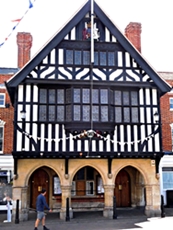
The south side of the square has a building with a ground level loggia and elegant half-timbering covering the upper storeys.  It looks mediaeval at first glance. But it is much too well-preserved to be that old.  This Victorian construction, now the Saffron Walden Tourist Information Centre, is also the Town Hall. The structure was built in 1761 and then extensively remodelled and enlarged in 1879 with money donated by George Stacey Gibson (1818-1883), a former Mayor of the town about whom I will soon reveal more.

The Saffron Walden branch of Barclays Bank is on the east side of the square and faces the library. The brick building that houses it, and which was designed by WE Nesfield (1835-1888) and built in 1874, is imposing. It has a large area of windows, each one framed by white masonry. A decorated lead frieze runs above the second floor and below the tiled roof with dormer windows and attractive brick chimney stacks. The main entrance is beneath a gothic arch, which is flanked by bas-relief depictions of birds with long necks and beaks, probably pelicans. Wooden doors near the entrance bear wood carvings that depict the letters “TG” and the date “1874”. Well-worn brass plates on the bank’s inner set of entrance doors read “Gibsons Bank”.

The first room that is reached from the entrance contains its original decorative features. These include a patterned stuccoed ceiling, a stone-framed fireplace with a colourfully tiled interior and fancy brass fire irons. There is wood panelling above the hearth and along the top of the windows in the wall separating this room from others deeper inside the building. The strip of panelling above the internal windows is richly carved with a variety of animals and birds. The rooms further inside the bank have been modernised to serve the requirements of current banking procedures.

Gibsons Bank, or to give it its full name ‘Gibson, Tuke and Gibson’, was also known as ‘Saffron Walden and North Essex Bank’, and ‘Saffron Walden and Bishop’s Stortford Bank’. It was established in 1824 by the Gibsons, a local Quaker brewing family. In 1863, Murray Tuke joined the surviving member of the Gibson family as a partner in the bank, hence the ‘TG’ we noticed on the door. That surviving Gibson was Tuke’s brother-in-law, George Stacey Gibson.

George joined the family bank in 1836 and became a partner in 1840. In addition to attending to the bank and innumerable civic duties, he became a renowned book collector and a serious botanist. In 1862, he published a flora of Essex. “This identified over 1,000 species of flowering plants and ferns, including four that were found only in Essex. “Flora of Essex” sealed Gibson’s reputation as a botanist and for the next century it was regarded as the definitive work on Essex botany” (see: http://www.hundredparishes.org.uk/). He was also the ‘discoverer’ of five flowering plant species that were new to Britain in the early 1840s.  

After his father died in 1862, George had to dedicate most of his time to the bank, his work on the Town Council, and charitable commitments, many of which related to the Society of Friends. He died at the Devonshire House Temperance Hotel in Bishopsgate Street, City of London, from inflammation of the kidneys.

In 1896, the bank, which had been associated with Fordham, Gibson and Co of Royston since 1880, became one of the twenty banks that joined together to form the Barclays Bank consortium. Another bank to join this group in 1896 was Goslings in London’s Fleet Street. Happily, Barclays have managed to preserve some of the original architectural features of both Gosling’s and Gibson’s historic premises. Even if you do not need to cash a cheque or deposit some money, visits to both of these formerly independent banks will provide a feast for the eyes.

PS: I have concentrated on the buildings in the marketplace of Saffron Walden, but must tell you, dear reader, that there is plenty more to see in the town including a fine parish church, many picturesque old buildings,  and the impressive ruins of a mediaeval castle.

A quaint country town near London

I WONDER WHAT KIND OF MUSIC the composer Gustav Holst (1874-1934) who is famous for “The Planets” suite, would have written had he lived in Thaxted under the flight path of most planes landing at London Stansted Airport. Fortunately for him, he lived in this charming Essex town between 1917 and 1925, long before the airport was built. Despite its proximity to an airport that is very busy in ‘normal’ times and not far from a major motorway, picturesque Thaxted feels as if the progress of time has left it alone. Recently, we visited Thaxted for a couple of hours and felt that we had ‘discovered’ a gem of a place rich in half-timbered buildings and other historic edifices. And, it is less than a couple of hours drive from west London.

blog thax

The construction of the huge cathedral-like Gothic parish church of St John the Baptist, St Mary & St Laurence began in the 14th century. Much of the financing of this building, which we were only able to enter for about one minute, was derived from the profits of the local industry, cutlery. By the 13th century, Thaxted, which is noted in the 11th century Domesday Book, became a centre for cutlery manufacture. It then rivalled a now more famous centre for that industry, Sheffield. The poll tax returns of 1379 recorded that of 249 males living in Thaxted, 79 were cutlers, 4 were sheath makers, and 2 were goldsmiths (see; “Mesters to Masters: A History of the Company of Cutlers in Hallamshire”, edited by C Binfield and D Hay). The cutlers lived in some of the fine buildings in the town. The well-preserved timber-framed Cutlers Guildhall makes for an interesting and beautiful focal point in the town’s broad high street, where Gustav Holst lived for a few years. The moot hall of this building stands above pillars below which there is a space open to the elements. Although simpler in construction, it brought to mind similar structures in Gujarat, the ‘mandvi’ in Vadodara and the ruined city of Champaner. We sheltered from a heavy rain shower under the arches of the Guildhall while we ate delicious sandwiches prepared at Parrish’s restaurant across the road.

It is not known why Thaxted became a centre of the cutlery industry for a few centuries. However, most are agreed that it was not because there were substantial deposits of the raw materials needed. The hamlet of Cutlers End a few miles outside Thaxted is a lasting reminder of an important source of Thaxted’s wealth in the Middle Ages.

An incredibly picturesque half-timbered building stands close to the Guildhall. Above one its doors, there is a name plate that reads: ‘Dick Turpin’s Cottage’. Unlike one of Thaxted’s famous inhabitants, Gustav Holst, it is unlikely that the highwayman Dick Turpin (1705-1739) either lived in the cottage or even in the town.

Apart from the splendid array of lovely old buildings that line the few streets that make up the town, there is another attraction within a short walk from the parish church. This is John Webb’s windmill, which was built in 1804. Its four long wooden blades (the ‘sweeps’) drive the milling equipment housed within a conical brick tower. It continued milling until 1907, when running it became uneconomical. It is the last survivor of several windmills that served the Thaxted district.

There are two quaint buildings near to the mill and the parish church. One of these is the long, low Chantry. This has a wonderful thatched roof and is at least three hundred years old. Opposite it, is another single-storeyed building, which was built in about 1714. It serves as an Almshouse. An informative website about Thaxted, www.thaxted.co.uk, states that this building was in 1830: “… occupied by sixteen aged persons: ‘13 widows, a man, a wife and a maid’”.

We saw all the places described in a leisurely couple of hours. We felt that we could have easily stayed much longer in this attractive place. Sadly, many who do not live in Essex or have not bothered to explore the county, feel that Essex has a poor reputation. This has no doubt been encouraged by bad-taste humour relating to ‘Essex man’ and ‘Essex girls’. The villages and towns in rural Essex easily outrival the busier and much more ‘twee’ villages in the Cotswolds.

PS Thaxted hosts an annual music festival, which cannot be held this year of the Covid pandemic.