
They never returned to the Netherlands and the slaves they sold never saw India again

PULICAT IS ABOUT FORTY miles north of the centre of Chennai.  It is one of the very few natural harbours on the Coromandel Coast (east coast of India). As early as the third century BC, it was a thriving port. The unknown author of the “Periplus of the Erythraean Sea” wrote that Pulicat was one of only three ports on the east coast of India. 


Today, it is a busy little village where freshly caught fish and other seafood are packed with ice before being transported elsewhere.  In earlier times, it was an important trading centre.


Between 1502 and 1609, the Portuguese had a trading station (‘factory’) in Pulicat. They built a fort there. In 1609, the Dutch defeated the Portuguese,  and took over Pulicat. They controlled it until 1825, when Dutch possessions on the Coromandel Coast were handed over to the British.


The Dutch built a fort, Fort Geldria, at Pulicat. This is in ruins today, and what is left is covered by seemingly impenetrable vegetation.  I did not feel intrepid enough to enter the tangled plants that cover the site of the fort. The Dutch also built a gunpowder factory in the town.


Pulicat was a port from which the Dutch exported a wide variety of goods from India, including for example, textiles, coins, and gunpowder. They also exported Indians as slaves to work in some of the other Dutch colonies in places as far apart as Ceylon and the West Indies. It is said that between 1625 and 1665 alone, over 38000 slaves, procured mostly by brokers in Pulicat,  were exported in Dutch boats. Many more were carried away from India after that.
 

Seeing Pulicat today, as we did in January 2025, it is difficult to imagine that this large village was once a thriving centre of international trade, and even more impossible to realise that it was an important market place for selling slaves. However, there is one very visible reminder of the erstwhile Dutch presence in the town: a small cemetery containing many well-preserved graves and mausoleums of Dutch people who died in the district.


Before describing the cemetery,  I will mention the small museum near it, and next door to a school named ‘Dutch Academy Nursery and Primary School’. The very basic museum is housed in what must have once been a small shop. Its  walls have some interesting informative panels attached to them. These outline the history of Pulicat. As for the exhibits, they are a rather shambolic assembly of unlabelled odds and ends. In one glass fronted cabinet, there were some fragments of ceramic vessels. I wondered whether these were bits of things left behind by the Dutch. On close examination, I noticed one of these broken pieces was labelled “made in Japan”.


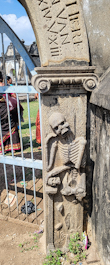
The Dutch cemetery is a fantastic sight. It is well worth making the 2 hour road trip from Chennai to see it. The entrance to the walled graveyard is made of carved stone. On each side, it is flanked by stone carvings of skeletons. One is resting its skull on its right hand and holding another in his left, and the other is balancing a double-sided drum or tabla on its skull. Although there are several obelisks and elaborate mausoleums in the cemetery,  most of the graves are marked by horizontal stones upon which there are carved inscriptions. The inscriptions, which are all easy to read, are often framed with decorative floral carvings. Most of the inscriptions are in Dutch. A few are in Latin. The oldest of the deceased died in the mid to late 1650s. At the far end of the cemetery, we found two graves of British people. Although  the British took over Pulicat in 1825, they used it more as a place for picnics than as a trading station.


The Dutch cemetery is a reminder that not every Dutch person who came to India to make a fortune returned home. What it does not recall is the vast numbers of Indians who were exported by the Dutch as slaves, and had no hope of ever seeing their homes again.

Going Dutch in the fort at Bikaner

UNLIKE JAIPUR, JODHPUR, and Jaisalmer, the city of Bikaner in Rajasthan is not (yet) overrun with tourists. We have been in Bikaner for three days and apart from at the Junagarh Fort (Bikaner’s most significant historical attraction), we have seen only one European visitor. Bikaner differs from the three Rajasthani cities mentioned in the first sentence in that its streets are not lined with shops designed to attract tourists. Apart from the fort the rest of the city is a fascinating, busy working environment, which someone, like me, who enjoys observing everyday scenes of life in India, has plenty to see.

Many of the older buildings that can be seen in the streets of Bikaner have jharokas – decorative, stone-framed windows that project over the street. They are commonly seen features of the Rajput style of architecture and are still being constructed.

The Junagarh Fort is rich in jharokas. Many of them overlook courtyards within it. One of them is of great interest. From a distance it looked to me like it was decorated with blue and white tiling, like Portuguese azulejo work. Close up, it can be seen to be something else.

A huge consignment of Dutch blue and white Delft ceramic plates had been ordered for the royal family of Bikaner. When that was, I do not know. While they were being transported to India by sea, they were damaged, and arrived broken. Instead of throwing them away, the thrifty maharajah had them cut up to produce tiles, all of which bore details from the pictures that had decorated the plates. The tiles were then used to decorate both the inside and the outside of the jharoka overlooking a courtyard that contains an elaborate water feature: a pool with fountains.

Although there is much more to be seen in the fort, this example of repurposing broken plates intrigued me. The Junagarh Fort is definitely a must-see attraction in Bikaner, but it it is now merely a museum-like remnant of the past. Visitors to the city should see this, but also set aside at least a few hours to absorb the busy atmosphere of enterprise, both traditional and contemporary, in the older districts of Bikaner.

A Dutch name on a gravestone in the City of London

AT THE OLD BAILEY court on the 18th of February 1767, Edward Wild was formally accused (indicted) of stealing 25 yards of woollen cloth worth £10 from the widow, Winifred Vanderplank (https://www.oldbaileyonline.org/record/17670218), and found guilty. At the trial, Winefred’s son Bartholomew Vanderplank told the court:

“I live in Bartholomew-close with my mother; I am a cloth-worker. Last Monday three weeks, the piece of cloth mentioned was taken away; the prisoner at the bar was stopped with it; I was before Justice Welch when he and the cloth was; he there confessed he took it away.”

According to “The records of St. Bartholomew’s priory and of the church and parish of St. Bartholomew the Great, West Smithfield” (publ. 1921), Mr Vanderplank lived close to the Church of St Bartholomew the Great, formerly part of the Priory that existed there until it was disbanded and partially demolished during the reign of King Henry VIII. The records stated:

“… The house of  Mr.  Vanderplank close by (he  lived  at  No.  54 [ i.e., Bartholomew Close])  was  the  monastery  kitchen  from  which  a  subterranean  passage communicated  with  the  church,  persons  having  passed  through  it to  the  knowledge  of  the  proprietor.”

The same records revealed that the Vanderplanks lived at 54 Bartholomew Close:

“In the London Directory  of  1770, No.  54 was in the occupation of the Vanderplanks,  cloth  workers, who  lived  in  the  parish  until  the  middle  of  the  nineteenth  century.”

You might be wondering why I should be telling you about a family whose surname indicates that it probably has Dutch origins. Well, the reason is that yesterday (the 2nd of April 2024), I was in the church of St Bartholomew the Great (near Smithfield Market) when I looked at the floor and spotted the gravestone recording the deaths of several members of the Vanderplank family, including that of Bartholomew, who appeared in court on the 18th of February 1767. 

Regarding Bartholomew, he was affiliated to the City of London’s Clothworker Company (guild) (https://londonroll.org/search), as were some other members of the family, who lived in Bartholomew Close. I have not yet been able to find out when exactly the Vanderplank family settled in England,  but I have read (www.ourmigrationstory.org.uk/oms/londons-evil-may-day-riots):

“The Flemish and Dutch arrived in England in large numbers in the fourteenth and fifteenth centuries and were primarily artisans, especially weavers and other cloth workers. This was partly due to ‘pull’ factors in the form of royal invitations and ‘letters of protection’ issued by the king. The Crown was keen to boost the English cloth industry by encouraging the arrival of skilled foreign workers. However, immigrants from the Low Countries also came due to ‘push’ factors, especially the hardships caused by warfare in the region and sentences of mass exile in the late fourteenth century for participating in revolts in Flanders.”

The top of the stone reads:

“Here lieth the Body of Barthow Vanderplank Late of the Parish who died July 19 1792 aged 48 years.”

The stone also commemorates the deaths of other members of his family – his wife and children. Because I was curious about the surname, I did a little research on the Internet, and found what I have just described.

Six-pointed stars in Kochi (Kerala)

SIX-POINTED STARS IN KOCHI

MY FIRST VISIT TO Fort Kochi (Fort Cochin) in Kerala was in 1994. By then, I already knew that there was one or more Jewish communitis in Fort Kochi (‘Kochi’). As we drove into Kochi, I noticed many six-pointed stars, all identical to Jewish Stars of David (‘Magen David’). For a while I was amazed by the sight of so many of what I believed then to be Jewish shops and other establishments. Not long after this, I became aware that like the Om and the swastika, the six pointed star is a commonly used Hindu symbol. For example, the Canara Bank, not a Jewish outfit, uses the six pointed star as its logo.

Several communities of Jewish people lived in Jew Town, which is in the district of Mattancherry. Today, flocks of tourists visit the area to explore its numerous handicraft shops and the beautifully preserved Dutch (Paradesi) Synagogue, whose floor is paved with blue and white tiles made many centuries ago in Holland.

Apart from the much-visited synagogue, there are very few other buildings that have recognisable marks that indicate their former Jewish connections. On previous visits, I spotted what must have been another synagogue; a house bearing Magen Davids; and a locked up, well maintained Jewish cemetery.

Today, the 10th of February 2023, I spotted a building with Hebrew lettering above its main door. This edifice, which is undergoing restoration, is close to the Masjid Aisha on Jew Street, and about 0.5 miles south of the Dutch Synagogue. In need of much work, this is what remains of the Kadavumbhagam Mattancherry Synagogue (constructed by 1544 AD).

Kadavumbhagam Synagogue under restoration

Another building with well-documented Jewish connections, but no obvious marks, is currently being used to house exhibitions contemporary with the 2022/23 Kochi Muziris Art Biennale. Called the Kashi Hallegua House, this grand dwelling is about 150 yards south of the Dutch Synagogue. Above its carved wooden framed front door is the date 1761. This was during the period that the Dutch were the dominant European presence in the area: they were intimately connected with Kochi between 1663 and 1814.

For over 250 years, the Dutch house, formerly known as Krathi Veedu, was home to many generations of the Hallegua family. From where they originated, I have not yet found out but they were Paradesi – European Jews who arrived in Kerala from abroad, as opposed to Jewish people whose origins were other than European (no one knows from where they arrived in Kerala).

The last Jewish residents of the house, 85 year old Mrs Juliet Hallegua and her daughter Yael, left for Israel in 2019. The place was then purchased by Edgar Pinto, who converted the huge family home into an art gallery. Although the furnishings used by the Hallegua family have been removed, many of the original wooden window frames and cupboard doors are in place. The kitchen, now a gallery space, has a huge oven and a special carved stone workspace used for grinding food ingredients with a stone rolling pin.

The two Hallegua women were amongst the last of the Kochi Jews living in the town. There was another, Sarah Cohen (1922-2019) who lived very close to the Dutch Synagogue. Until she was in her nineties, she had a shop selling tablecloths and other handmade cloth items, many of them with Jewish decoration. Today, the only Jews in Kochi’s Jew Town are visiting Jewish tourists, a few of whom might have had ancestors who lived there.

Since our last visit in 2019, a couple of shops have opened. Named Shalom, their signboards bear the Jewish six pointed star. The company sells ready-made garments, but I suspect that apart from the name, it has no Jewish connections … but I might be wrong!

EUROPEAN HAUNTS ON THE HOOGHLY RIVER: Former European trading posts

PLEASE TAKE TIME TO READ INDIGO SEXY”, so announces a sweet female voice over the public address system in the passenger cabins of aeroplanes flown by Indigo Airlines. Actually, this voice is encouraging flyers to read Indigo’s in house magazine “Indigo 6E”. The November 2029 issue of this well produced monthly had an article about places that I have long wanted to visit: the places on the banks of the River Hooghly that were once occupied as trading posts by Europeans from various parts of that continent.
I knew that, apart from Britain, at various times the following nations had had tiny colonies on the banks of the River Hooghly (north of Calcutta): Holland, France and Denmark. Until I read an article in “Indigo 6E”, I was only barely aware that Portugal also claimed a parcel of land. That was at Bandel.
One day, we rented a car with driver to explore the former haunts of the nations listed above. We commenced at Bandel. To reach this place we drive pat endless numbers of heavy trucks north along the National Highway that links Calcutta with Delhi until we reached a road to Bandel.
To our grumpy driver’s indignation the road to the centre of Bandel was amazingly congested with cycles, tricycle rickshaws, autorickshaws, pedestrians, a variety of motorised three wheelers, dogs, trucks, buses, and so on.

Eventually, we reached the imposing church of the Miracle of Our Lady of Bandel that is separated from the Hooghly by a large garden. The church, which was built on a piece of land gifted to the Portuguese in exchange for military assistance given to a local ruler, was built at the very end of the 16th century.

The original church, one of the oldest in Bengal, still stands but has been heavily restored. It has been buried beneath shiny tiling, both outside and inside. The only original feature visible is an altar piece that looks as if it was created many centuries ago. The church was part of an Augustinian monastery, and is now part of a Salesian institution. The cloisters, like the church, are lined with tiling.

We drove south, following the Hooghly, to Chinsura, which the Dutch had occupied from 1656 to 1825. Apparently, there are several Dutch buildings in the town, but we did not find them. Instead, we managed to see the exterior of the town’s Armenian church, which is the second oldest church on Bengal. It is surrounded by a high wall surmounted by fierce looking spikes. A local informed us it wasonly opened up once a year, and we were not in Chinsura on that day! Later, we learnt that it is open for masses one Sunday in three.

Between Bandel and Chinsura, we came across an elegant house standing next to but high above the Hooghly. It was the place that Bankim Chandra Chatterjee (1838-94) lived for several years. Some say it was the place where he composed the patriotic poem “Vande Mataram” in the 1870s. It was set to music by Rabindranath Tagore. The British imperialist authorities made it a punishable offence to sing in the esrly part of the 20th century.

We drove south along congested roads that more or less followed the Hooghly until we arrived at Chandernagore, which was a French enclave until 1947.

The Institut de Chandanagor, a fine colonial building that could do with a little restoration, was once Dupleix House the former residence of the French governor. It now houses a museum that has many exhibits that recall the history of European trading settlements along the Hooghly. It stands in gardens, where once stood a fortress built by the French. The museum faces a lovely riverside promenade that includes a late 19th century pavilion built with French funding. This edifice is adorned with sculptures depicting elephant heads. At the southern end of the promenade, there stands a house, which Rabindranath Tagore has mentioned several times in his writings. When the river rises, its lower storey fills with water, by design.

The church of Sacre Coeur stands about 100 metres back from the promenade. It was built in the late 19th century, but was first established in 1691. Its interior has recently been redecorated with garish colour paint.

It was a long drive to Serampore on the Hooghly. We drove there along through narrow winding lanes and a stretch of the Grand Trunk Road. The Grand Trunk runs from Chittagong, now in Bangladesh, to Kabul in Afghanistan, passing through Calcutta and Delhi. It has existed for at least 2500 years and is one of the longest roads in Asia (almost 3000 miles).

Between 1755 and 1845, Serampore was under Danish control. The Danes knew it as Frederiknagore. We visited the church of St Olave, whose design resembles that of St Martins in the Fields in London. The internal walls of it plain but elegant interior bear memorials to several Danes who worked either for the Danes or for the British, who inherited Serampore from the Danes, or fir both. Serampore is also the home of Serampore College, which was founded in 1818 by Joshua Marsham and William Carey (1761-1834). Carey was born in Paulerspury in Northamptonshire. This village is the home of friends of ours. It was following a visit to them that we were first alerted to the existence of the former Danish colony on the Hooghly.

Before returning to Calcutta, we had coffee at the recently restored Denmark Tavern that overlooks a lovely stretch of the Hooghly. The tavern was first opened in 1786 and appears in a painting by Peter Anker dated 1790. The original building has been beautifully restored and is still serving its original purpose.

Although we only saw a few of the haunts of the former non-British European settlements on the bank of the Hooghly, our visit has made us want to revisit them in the future.