A small detail in a large painting by an artist from Flanders

DURING A VISIT to the Frieze Masters art fair in London’s Regents Park in October 2025, we looked at a collection of Flemish paintings being exhibited by the De Jonckheere Gallery. One of these was “Allegory of Sight: A Collector’s Cabinet with Venus and Cupid”. It was painted in Antwerp between 1601 and 1678 by “Workshop of Jan Brueghel the Younger”. It is an example of several paintings with this title. According to Wikipedia, these artworks:

“… showcases varied objects associated with sight, the arts, and navigation. The painting was heavily influenced by The Five Senses, a series of allegorical paintings done by the younger Brueghel’s father, Jan Brueghel the Elder.”

Indeed, the picture we saw at Frieze is chockfull of objects: paintings, sculptures (many of them portrait busts), navigational & astronomical instruments, documents, animals, a mirror, and many other things. The painting is a depiction of a Kunstkammer, which is (https://galleryintell.com/artex/allegory-of-sight-by-jan-brueghel-the-elder-and-peter-paul-rubens/):

“…translated as “rooms of art” and are meant to offer a glimpse into the depth and variety of these collections accumulated by the Dutch aristocracy.

The painting at Frieze contains a gold chandelier that hangs from the ceiling. It is a decorative example, which includes an object that has interested me greatly since I was a teenager. At the top of the chandelier there is a double-headed eagle (‘DHE’). This is a bird with two heads, each on its own neck. In the painting, each of the heads is surmounted by a crown topped with a small cross. My interest in the DHE began when my fascination with Albania, whose flag contains a DHE, began in the mid-1960s. Chandeliers with  DHEs appear in several other paintings by members of the Brueghel family (and their studios) in which the subject matter described above was depicted. I asked one of the gallery assistants about the DHE on the chandelier, and she had no idea about it. I was hoping that she would confirm my suspicion that the two-headed bird in the painting was related to the Holy Roman Empire and the Habsburgs, both of whose emblems included the DHE.

On returning home, I investigated further, and found a book (available online), “Rubens & Brueghel, A Working Friendship” by Anne T. Woollett and Ariane van Suchtelen. It deals mainly with paintings by Rubens and Jan Brueghel the Elder (1568-1625), the father of Jan Brueghel the Younger (1601-1678). In relation to the painting of “Sight” by Brueghel the Elder, it noted:

It has often been assumed that this costly series of paintings was commissioned by Archdukes Albert and Isabella. Rubens had, after all, held the post of court painter since his return from Italy in 1 6 0 8, and Brueghel regularly worked for the court at Brussels. The couple’s palaces serve as background scenery in three of the five depictions, and Sight contains a double portrait of the regents and an equestrian portrait of Albert, as well as a brass chandelier crowned with the Habsburgs’ double-headed eagle.”

This being the case and because Brueghel’s son (and his workshop) would have been influenced by his father’s art, it is perhaps unsurprising to see the DHE on the chandelier in the painting we viewed at Frieze.
Birds with two heads in Lancashire

I HAVE LONG been fascinated by the double-headed eagle (‘DHE’). The earliest evidence of its use as a symbol is on Mesopotamian seal rings made as long ago as c3000 BC. Since then, it has been used by the Seljuk Turks, the Byzantine Empire, the kingdom of Mysore, Russia, Austro-Hungary, Serbia, Montenegro, Albania, and many other peoples.

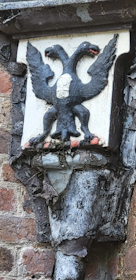
In England, aristocratic families such as the Killigrews and the Godolphins in Cornwall have incorporated it in their coats-of-arms. Today, we visited Rufford Old Hall in Lancashire. It was once the seat of the Hesketh family. And their original coat-of-arms included the DHE. This two headed bird can be seen in many places on the building.

For those less interested in the DHE than me, the main attraction of the place is the 16th century Hall with its hammer beam ceiling and its amazing timber screen.

When we decided to visit Rufford Old Hall today, I had no idea that I would be seeing yet another British family’s use of the DHE. I have no idea what if anything caused these families to incorporate this creature in their crests. It is far less used in Englush heraldry than other creatures such as, for example, the lion, the eagle, the unicorn, and the griffin.

DOUBLE-HEADED EAGLE ON A DRAIN PIPE

THE DOUBLE-HEADED EAGLE symbol, which dates back to ancient Babylon, and is used as the national symbol of Russia, Serbia, Albania, and other places, can be found in England. This example is on the drain pipe of The Museum of Archaeology and Anthropology in Cambridge. The building stands on the corner of Pembroke Street and Tennis Court Road. The double-headed eagles on the drain pipe can be viewed from Tennis Court Road. I have not yet found out why this symbol was chosen to decorate the drainage pipe.

A bird with two heads in London’s Earls Court

COLEHERNE COURT IS a large block of flats located on the corner of Old Brompton Road and Redcliffe Gardens. The late Princess Diana lived there before she married Prince Charles. At the corner of the building there is an entrance surmounted by a carving of a bird with two heads each on a long neck.

A map surveyed in 1916 indicates that there was a bank at this corner, The two headed bird was probably above its entrance. The only British bank I know of that uses the double-headed eagle as its symbol is Hoare’s Bank. There may have been others, but I do not know about them.

If anybody knows any more about the double-headed bird on the corner of Coleherne Court, do please let me know.

She wore it a Diwali party in London

AN ARTICLE IN “The Ahmedabad Times” newspaper, dated 18th of November 2023, discussed what the British Prime Minister’s wife, Mrs Sunak, was wearing at a recent Diwali party in London. Over her tasteful blue sari she was wearing a pearl necklace, which was attached to a golden pendant.

The pendant is a Hindu mythological creature, a ganderberunda. This is a bird with two heads – a double-headed eagle. It is the symbol of the Indian State of Karnataka. It is also a national symbol of places including Albania, Serbia, and Montenegro. It was also a symbol used by the Holy Roman Empire.

I wonder if Mrs Sunak was aware that the double-headed eagle is also a national emblem of Russia, against whom Rishi Sunak and his government are providing much military assistance.

Double-headed eagle in Dartmouth

THE NATIONAL SYMBOL of Russia, both before and after the Communist era, is a bird with two heads, two necks, and a single body – the double-headed eagle (‘DHE’). I have long been interested in this imagined creature because it appears on the flag of Albania, a place that has interested me for many years.

While walking along the riverfront in Dartmouth (Devon), our friend pointed out a historic cannon positioned with its barrel pointing towards the water. On the top of the barrel there is a small bas-relief depicting a DHE.

The cannon was manufactured in the Russian city of Briansk in 1826. It was captured from the Russians in the Crimean War (1854-1856) and is one of several Russian cannons brought to England after or during that conflict.

We have visited Dartmouth many times before, but barely noticed the old cannon. Had our friend not told us of the origin of that cannon, one of many disused artillery pieces that can be found serving as ornaments all over England, I would have been unaware of this example of a double-headed eagle in Dartmouth.

A marriage recorded on stained glass

THE GREAT HALL of Lytes Cary Manor House in Somerset has some stained glass windows decorated with crests relating to the Lyte family, who owned the property between the 15th and 18th centuries. One of the crests caught my eye because the crest contains a double-headed eagle. This is a symbol that began to interest me in my teens when I first became fascinated by the Balkans. The double-headed eagle figures on the flags of Albania and some of its neighbours. The earliest known use of this peculiar creature is on seals used to secure goods in Babylon during the 3rd century BC.

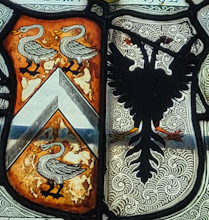
The crest at Lytes Cary Manor is a combination of the Lyte family crest and that of the Worth family, which incorporates the two headed bird.

In 1592, Thomas Lyte (c1568-1638) married Frances Worth (1580-1615) who was born in Charlton Mackrell in Somerset. Thus, the double-headed eagle of the Worth family became joined with the three swans of the Lyte family crest. This marriage which was celebrated so long ago, is recorded in glass on a window of the Great Hall at Lytes Cary.

Why the Worths employed the double-headed eagle on their crest is something I would like to know, and will investigate. The double-headed eagle appears on British crests less frequently than other heraldic creatures. Possibly, andI am only guessing, it relates to the fact that a son of King John, Richard, Duke of Cornwall (1209-1272) was appointed King of The Germans, that was a senior position in the Holy Roman Empire. The symbol of that empire was the double-headed eagle.

A church with maps in Venice

SANTA MARIA DEL GIGLIO, or ‘Santa Maria Zobenigo’ as it is commonly named in Venice, is a baroque church with a magnificent façade. It was built between 1678 and 1681. The edifice was constructed by Giuseppe Sardi for Admiral Antonio Barbaro, who died in 1679. Amongst his many achievements he was Provveditore Generale (Governor General) of Venetian Dalmatia and Venetian Albania in 1670-71.

During my many visits to Venice, most of which were made annually with my parents during the 1960s, I have passed the church and noted an interesting feature of its façade. The base of this is decorated with six carved stone bas-relief maps. These have always fascinated me, but it was only after our recent trip to Venice in September 2022 that I finally got around to investigating them.

The maps are of Spalato (Split in Croatia); Corfu; Roma (Rome); Padoa (Padua); Candia (Haraklion in Crete); and Zara (Zadar in Croatia). Except for Rome, these are all places that were once governed by Venice. The maps depict places where Antonio Barbaro served in one capacity or another.

Wnen James (later Jan) Morris wrote “Venice” (published 1960), which is I believe the best book written about Venice, he/she noted of the façade of Santa Maria Zobenigo that:

“… it is notorious because not one item of its convoluted design has any religious significance whatsoever.”

Morris also pointed out something I have never noticed on that façade. Namely, that it bears a crest with a double-headed eagle, the crest of the Barbaro family. As this symbol interests me, I checked it out. The Barbaro family might have used it because of their connection to the Vlasto family, who were prominent in Rome by the end of 2nd century AD (see; www.christopherlong.co.uk/per/vlasto.byzantium.html). By the end of the 11th century, the Vlasto family was members of important families including the Barbaro’s. The Vlasto family crest includes the double-headed eagle, which amongst other things, was a Byzantine symbol. Interestingly, the Vlasto’s had already begun using it in the early 1st century AD, while the Byzantines only began using it in the 12th – 13th centuries. Maybe I never noticed the double-headed eagle because whenever I have passed the church, my eyes have been drawn to the maps on its fine façade. They fascinated me so much that I never bothered to look upwards.

Going up in smoke

CORNWALL’S COAST WITH its numerous, sometimes almost inaccessible, coves is perfect for smuggling. It is not by chance that Gilbert and Sullivan’s opera is named “The Pirates of Penzance”, rather than, say, “The Pirates of Suffolk”.  When we visited Falmouth, a Cornish seaport, in May 2022, I noticed a souvenir of an era of smuggling, now long past.

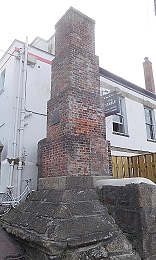
Next to the old customs house (now a pub) on the Town Quay, the old harbour of Falmouth, there is a tall brick structure. On a square base, it is built in four sections, each one slenderer than the one beneath it. The tall object bears a plaque inscribed with an anchor framed by a shield and above it a double-headed eagle. Below these symbols are the words:

“King’s Pipe. Formerly used for the destruction of contraband tobacco.”

According to the website historicengland.org.uk, the King’s Pipe was likely to have been constructed in about 1814, when the customs house was built. The tall chimney stands on a base that contained a furnace that was accessible from the courtyard of the customs house. Overshadowing the town and its harbour, I imagine that many of the townsfolk were far from happy when they saw and smelled the tobacco smoke, which they would have enjoyed creating in their pipes, being emitted from the King’s Pipe.

The double-headed eagle on the plaque affixed to the former chimney interested me. Two major families in Cornwall use this mythical creature in their heraldry: the Godolphins and the Killigrews. It is most likely the latter to which the creature on the plaque refers because in the early 17th century (1613), Sir John Killigrew (1583-1633), helped create the port of Falmouth.

Although we had spent several pleasant days in Falmouth a few years ago, we did not spot the King’s Pipe on that visit. It only goes to show that revisiting places can enhance one’s enjoyment of, and interest in, them.

Fallen leaves amongst the fallen: Field of Remembrance

I HAVE LIVED in London for well over 60 years, but it was only this November (2021) that I first became aware of, and experienced, something that has been happening annually on the north side of Westminster Abbey since November 1928 (www.poppyfactory.org/about-us/history-timeline/#). For eight days following the Thursday preceding Remembrance Sunday, the Sunday closest to Armistice Day, the 11th of November, the day on which WW1 ended, the field bounded by Westminster Abbey and its neighbour, the church of St Margaret’s Westminster, is covered with a myriad of mostly tiny wooden memorials hammered into the grass. The memorials are mostly cross-shaped, but some are in the form of crescents, six-pointed stars, and other shapes including some that bear the Sanskrit symbol representing ‘aum’ (or ‘om’). Each of these tiny wooden items commemorates a fallen service person or other victim of war. The shapes of the wooden pieces denote the religion of the person or persons being remembered, be they Christian, Hindu, Sikh, Moslem, Jewish, or of no religion. Many of the wooden memorials have red poppies attached. Oddly, few if any of the Islamic crescents had poppies on them. The small wooden memorials are arranged in groups, according to which service or regiment or organisation the remembered people were members of, or associated with. The whole ‘event’ is organised by The British Legion Poppy Factory. This annual garden of memorials is called The Field of Remembrance.

The Poppy Factory, a charity, was founded in 1922 by Major George Howson (1886-1936) to provide employment for veterans injured during WW1. He bought a site in Richmond (south-west London), where he established a factory to manufacture Remembrance poppies and other related items to be sold to raise money for The British Legion’s Red Poppy Appeal, a charity that supports the Armed Forces community.

Apart from the small wooden memorials, there are many badges and emblems of the groups in which those remembered were members. Looking at these and the small wooden memorials is both fascinating and extremely moving. The fascination lies in the huge variety of regiments and organisations, too many to list, which lost people during military conflicts (and terrorist incidents) since the onset of WW1.

One group of memorials interested me because of their emblem that incorporates a heraldic creature, which has fascinated me for several decades. The creature is the double-headed eagle (‘DHE’), currently used as an emblem by countries including Albania, Serbia, Montenegro, the Indian state of Karnataka, and Russia. The DHE appears on the crests of some of the various regiments of The Royal Dragoon Guards. The Dragoon Guard regiments were first established in the 18th century, in 1746, and consist of mounted infantry. While the Austro-Hungarian Empire existed, it also used the DHE. In 1896, Emperor Franz Joseph I of Austria (1830-1916) of Austria-Hungary was appointed Commander-in-Chief of the 1st King’s Dragoon Guards, some of whose members are remembered in the Field of Remembrance. The emperor allowed the regiment to wear his empire’s emblem (https://web.archive.org/web/20130303033912/http://www.qdg.org.uk/pages/Uniform-1843-Onwards-81.php), the DHE. In addition, the regiment adopted “The Radetzky March” as one of its official march tunes; it is still used today. It was sad that in 1914, Franz Joseph, became the ruler of one of the powers against whom Britain and its allies were fighting. Some of those who fought in the British Royal Dragoon Guard regiments with the DHE on their headwear were killed by allies of the emperor in WW1, who had earlier been appointed their C-in-C. They are commemorated the Field of Remembrance. Judging by the small wooden memorials planted in the Royal Dragoon Guard’s section of the Field of Remembrance, members of at least four religions fell while serving in these regiments. I wondered why the DHE was retained even after Austria-Hungary became one of Britain’s opponents in war.

Returning to the Field of Remembrance as a whole, it is a poignant sight to behold. Although war is both horrific and ugly, this annual memorial is both moving and beautiful. The Field is laid out beneath trees lining its northern edge. Seeing the dead leaves from these trees lying fallen amongst the thousands of tiny memorials to victims of war seemed most apt to me.