Not really…

American and English

similar lingos

sometimes different  

USA

Some years ago, I practised dentistry in a surgery near Ladbroke Grove in West London. One day while I was waiting for the next patient to arrive, I found myself alone at the reception desk, the receptionists having gone off somewhere briefly. The telephone rang. Being a helpful sort of person, I picked it up.

“Hello, this is the dental surgery,” I said.

A man with an American accent said to me:

“I want to speak with June Courtney.”

June was a dentist, who used to work in the practice.

“I am afraid she does not work here anymore,” I replied.

“Well, maybe you’re her husband?”

“No, I am not.”

“Well, maybe I can interest you in buying some bonds,” continued the trans-Atlantic caller.

“I’m not really interested,” I replied.

“Well, that means you might be a little bit interested,” the caller replied.

“let me explain something to you,” I began, “if someone English says that they are not really interested, it does not mean that they are ‘slightly interested. It is a polite way of saying that they are not at all interested; they are totally uninterested.”

“Well, thank you for explaining that, sir,” the caller said before ending the call.

I guess that sometimes it pays to speak bluntly.

A bit too far

Drill a bit,  not too far.

In the tooth is a nerve:

do not disturb it


DRILL 1


It would not have been fair to my patients if I had written what follows before I had retired from practising dentistry. If I had been one of my patients, I might have lost confidence in my dentist after reading this.

Before dental students are allowed to drill teeth on living patients, much training is required. A great deal of this is done using plastic teeth mounted in the jaws of the heads of a mannequin, known as a ‘phantom head’. The plastic teeth are held in the artificial jaws with metal screws. The screws fit into holes on the undersides of the teeth so that the crowns of the teeth appear intact. As a dental student, I spent many hours each week practicing cutting standardised cavities. The cavities had to be cut to very precise dimensions, which were neither to be exceeded nor the opposite. I recall that certain parts of the plastic teeth had to be cut to exactly two millimetres deep and much the same width. At first, I found this extremely difficult. Not only was I not yet used to using dental drills, but also the plastic cuts in an awkward way.

Eventually, the time arrived for a practical test. Unsupervised, we were required to cut one of the several cavities that we had been learning to prepare. Disaster struck. Within a few seconds of starting my tooth, I had cut too deep. The metal of the screw retaining the plastic tooth in the phantom head was staring me in the face. I called over the examiners. They studied the tooth carefully, and then one of them said to me:

“I think you have exposed the nerve, Mr Yamey.”

“We might be looking at a root treatment, here, don’t you think?” asked the other examiner.

I could not believe what I was hearing.

“I think we’re looking at a failure here,” I replied.

They agreed.

I spent another few weeks in the phantom head room, and retook the exam, which I passed with flying colours, you will be relieved to learn. Now, I was deemed ready to treat dental cavities on real teeth in real patients – under supervision, of course.

The first tooth that I had to work on had only a little decay. Nevertheless, after the intense training, which emphasised cutting teeth should be done as conservatively as possible, cutting only as little of healthy tooth tissue as was strictly necessary to retain the restoration (‘filling’), I approached my first ‘real’ tooth with much trepidation. After boring down to the two-millimetre depth that was ingrained in my mind, I could see nothing but healthy tooth – no sign of decay. I summoned the clinical teacher (the ‘demonstrator’). He looked at the tiny hole I had created with great care and laughed.

“You have not yet cut through the enamel. Keep going,” he said.

The enamel, for those who are uncertain about dental anatomy, is the outer covering of the part of the tooth that is visible in the mouth. Beneath it, is the dentine, and below that the dental pulp chamber, which contains nerves and blood vessels. Decay spreads much more rapidly through dentine than through enamel.

I looked at the demonstrator, and said:

“But in the phantom head room we were told never to go deeper than two millimetres.”

“Those were just plastic teeth,” the demonstrator replied, “forget all that.”


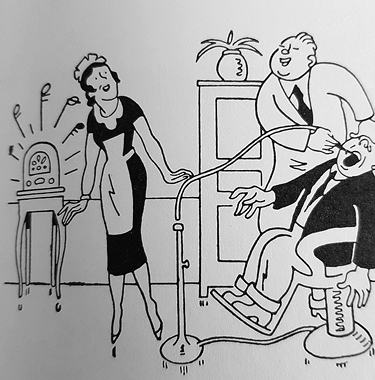
[Picture from “Der Zahnarzt in der Karikatur” by E Henrich]

The road to Hogsback

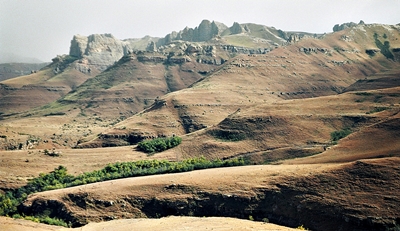
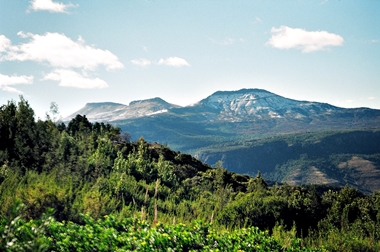
In August 2003, the middle of winter in South Africa, we made a long tour around the Cape Province, visiting small places that figured in the history of my family’s sojourn (beginning 1849) in South Africa. Here is an account of our journey to Hogsback in the Eastern Cape. The writer JRR Tolkien is supposed to have been inspired by the landscape near Hogsback, but not all are agreed on this. The author was born in South Africa (in Bloemfontein), but left the country aged less than three years.

HOG 0

Between Barkly East and Dordrecht

We sped on from Barkly East to Dordrecht. It was at Dordrecht in 1884 that my great grand uncle Sigmund Seligmann with his partner, another Jewish gentleman, Moss Vallentine opened their first business, a retail store. Later, he opened a general store in Barkly East, where his nephew, my mother’s father, became the town’s only Jewish Mayor.

HOG 1

Dordrecht Museum

Dordrecht, a smallish place, still has several nineteenth century buildings including one with an elegant arcade supported by cast-iron pillars that serves as a museum. Andre Coetzee, the museum’s curator, pointed out an old shop opposite the museum that he believed had originally been Seligmann’s.  He seemed very certain that this was the building, but he could not show me any evidence to confirm this.

The rain and snow continued to shoot past us, propelled by a fierce wind. Between Dordrecht and Queenstown, we crossed a plain that was quite different to anywhere we had been so far. The plain was quite literally dotted with thousands of ‘black’ peoples’ dwellings, some with rondavels as out-houses. There were few fences. People and animals wandered across the road. The countryside was much less manicured than any other inhabited places we had so far visited in the Cape. Derelict cars were frequently seen. We were in Chris Hani District that includes the town of Queenstown and was under the Apartheid regime part of one of the so-called ‘Homelands’. 

Queenstown is not an attractive town but has a lively buzz and good shops. A sign in the town centre advised motorists to pay for parking at a “mobile parking meter”. This meter turned out to be a person who hangs around the parking area carrying a machine on which he or she records your arrival and departure times and based on these determines how large a parking fee needed to be collected. We found a wonderful spice shop run by a Pakistani man. He had a special table on which he can make spice mixtures to order and, also, had ready-made mixtures including one, very strong in flavour apparently, called “Mother-in-law Masala”. We visited a large branch of Woolworths as many people had commended this chain store to us. We were disappointed: it was like Marks and Spencer’s used to be in the UK many years ago.

We drove via Whittlesea to the tiny village of Seymour. A road marked incorrectly on our map as “narrow but with tarmac, not for four-wheel drive vehicles alone”, led from Seymour up the side of a mountain to Hogsback. This road proved to be the worst surface that I have ever driven on. Compared to it, Joubert’s Pass (near Lady Grey), was a motorway. It got progressively worse as we painfully slowly approached Hogsback.

The road had everything against it and us. There were potholes, and deep furrows where streams of water had eroded the gravel. Bare rock showed through the road and made steps that had to be carefully negotiated. Worst of all were large rounded boulders, which were difficult to drive around as the narrow road was bounded either by ditches or by walls of rock. We were lucky that we neither capsized the car nor grounded it, nor damaged the sump or some other vulnerable part of its under surface. Navigating around or across some of these dangerous obstacles reminded me of performing a particularly difficult surgical dental extraction. Just as I had to take care not to damage a hidden nerve or blood vessel during an extraction, I had to drive to avoid injuring some important part beneath the car. Had we broken down on this deserted, barely frequented road, we would have been in big trouble. There was no mobile ‘phone coverage in the area. Hair raising to say the least: I still shudder when I remember this journey. Later, a cousin in Cape Town told me that when he had used this road, he had grounded his vehicle and thereby damaged its fuel line. Things improved at the end of the road. We were amused to see a road sign at the Hogsback end of this road that advised “Road not recommended for caravans.”

HOG 2

A view from Hogsback

We found our accommodation: a collection of cottages called The Edge. The name refers to the position of the cottages which is at the very edge of the summit of the Hogsback ridge over which can be seen a view of the coastal plain over a thousand feet below. Our cottage was large but unheated except for a small, inadequate fireplace poorly located in one corner of the cottage remote from the bedrooms. We ate an excellent curry made by Dion and Shane who own a restaurant near our cottage. All night the snow fell, and the wind howled.

HOG 3

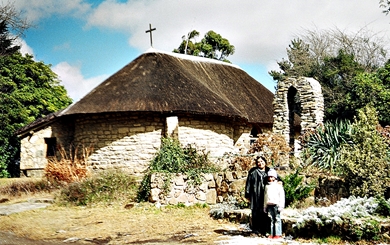
A church in Hogsback

I thought it was a bean

Is fear of the needle 

worse than fear of the mask?

Without them, we suffer

business care clean clinic

Photo by Pixabay on Pexels.com

Many of my adult patients remembered going to the dentist when they were children and having to be put asleep under a black face-mask. This memory instilled in them a life-long fear of visiting dentists.

The day after the 17th of March 1982, when I qualified as a dentist, I was legally allowed to administer general anaesthetics for dental procedures without an anaesthetist being present. General anaesthesia is hazardous enough but without the assistance of an anaesthetist, the risks of problems multiply. I could have accidentally killed a patient on my first day in practice. For the record, I have never ever administered general anaesthetics with or without an anaesthetist.

For a brief while, a few months in the 1990s, I worked in a practice that specialised in treating dental patients while they were under general anaesthesia. The anaesthetics were administered by a visiting hospital anaesthetist, who was assisted by a fully trained anaesthetics technician. The patients, when unconscious, were intubated to maintain their breathing and all the right things were done to ensure their safety. When the patients were ‘under’, I worked on their teeth, as quickly as I could because the anaesthetist wanted to keep the patients ‘under’ for as short a time as possible.

Children were given gaseous anaesthesia through a face mask. Once, I sniffed the gas briefly. It was terrible stuff. It felt as if a knife were shooting up my nose. Most children were, quite naturally, terrified at the prospect of anything that was happening in our clinic. Getting them to accept the black mask with its attached rubber tube was often difficult. The anaesthetist was a friendly man from the Middle East. He would say to the children things like:

“This smells of peppermint.”

The child might reply:

“I don’t like peppermint.”

The doctor would then say:

“I’ve got strawberry flavour.”

“I don’t like strawberry.”

“How about some lovely banana?”

And so, it went on.

One mother impressed me. She said to her child that if he allowed the mask to be put on by the count of three, he could have a treat at McDonalds later. She counted “one”, and the child refused. And, then “two”, but the child still resisted. Then, I wondered how different it would be when she got to “three.”

I was impressed when she said:

“Two and a quarter,” and then “Two and a third”, and so on without ever reaching “three”. Eventually, her child cooperated.


I must to admit that although we got a lot of work done on fully anaesthetised patients, I did not enjoy working under these conditions. However, I enjoyed my weekly encounters with the friendly anaesthetist, ‘Dr A’. He was extremely fond of fiery chillies, which he consumed during our lunch breaks. He was always seeking hotter chillies. This was probably because his taste-buds had become partially damaged by his excessive consumption of these almost corrosive chillies.

One lunchtime, Dr A and I were sitting in the staff room with a male anaesthetic technician from an agency. Wickedly, Dr A passed him a long, thin fresh green chilli, saying:

“Try this.”

The young man put the whole green chilli in his mouth and started chewing it. Soon, his face went bright red, and he rushed to the sink to fill a glass of water. When he recovered, he turned to Dr A, and said:

“I thought it was a bean.”

PS: Nowadays, general anaesthetics for dentistry cannot be administered anywhere in the UK except in a fully-equipped hospital.

Through the tongue

During my three and a half decades working as a dentist, I have been assisted by numerous ladies varying in age from sixteen to over seventy years. ‘Carly’ was one of them. When she joined me in a practice west of London, it was the first time she had worked in a dental practice. She was a quick learner, but far from discreet.

CARLY

When we had a new patient, we recorded the person’s details on the outside of a record card. One day, a smart-looking woman sat down in my dental chair, a new patient, and I asked her for her personal details: name, date of birth, address, and so on. Carly entered the information on the record card. When we had finished, Carly asked the patient:

“Are you M.R.S. or M.I.S.S?”

The lady replied:

“Miss.”

Quick as a flash, Carly said:

“I can’t see why you ain’t married. You ain’t ugly or anythink.”

The lady took this quite well. She could see that Carly meant no harm.

One Monday morning, Carly arrived and said to me:

“Ere, look at this”

She stuck out her tongue, which had a shiny silver-coloured metal stud pierced through it. I was lost for words for a moment, and then asked her if it was uncomfortable.

“No, it ain’t,” she replied, “It makes eating spaghetti difficult, though. It gets caught up on it.”

All morning, whenever a patient sat in my dental chair, she would tap the patient’s shoulder, and then say: “Wht d’ya think?” before sticking her tongue out to display her stud to the person in the chair. Most of the patients were either politely complimentary of just smiled. By now, my regular patients had got used to Carly and her friendly but cheeky manners.

Another day, Carly arrived at work. Very excitedly, she told me:

“You’ll never guess how much I paid for a large pack of prawns at Tesco’s.”

“Four pounds?” I guessed.

“No, just a quid.”

“That’s a good bargain,” I said.

“What me and me boyfriend do,” Carly explained, “is we swap the labels on the packets in the chiller so that we get the special offer prices instead.”

“Be careful,” I advised.

On yet another occasion, Carly arrived at work looking distressed. I asked her what was wrong.

“I crashed me boyfriend’s car.”

“But you haven’t got a license have you, Carly?”

“No, but I was drunk. I got in his car and drove it backwards into a lamppost.”

I am sure that the boyfriend was not pleased because throughout the day Carly was rung up by him on her mobile ‘phone. She would go out into the corridor, but because she was screaming at her chap so loudly, everyone could hear her.

During one appointment, I was beginning to scale (remove the dental tartar or calculus) a lady’s teeth. After a few minutes, while I changed instruments the lady, a well-dressed woman with airs and graces, asked me:

“Excuse me, Mr Yamey, but what exactly are you doing to my teeth?”

Before I could answer, Carly replied quickly:

“E’s cleaning the crap off yer teeth.”

The patient seemed quite happy with this simple summary.

Despite Carly’s occasional rather undignified comments, she was an excellent assistant. Patients appreciated her unpretentious, friendly, open approach and the fact that she was rarely silent. After a few months, when she had gained some experience, Carly left our practice to take up a better paid position in another dental practice. Some weeks after she had been working there, she dropped into our surgery to say ‘hallo’. I asked her how she was getting on in her new job. She replied:

“It’s ok, but they have told me not to open my mouth during the day.”

Picture source: “Der Zahnarzt in der Karikatur” by E Hinrich (1963)

Pull it out…

After qualifying at University College Hospital Dental School in early 1982, I practised dentistry for another thirty-five and a half years. I never owned my own practice but worked in those owned by other people. I worked in a total of five practices. With exception of one practice, where I worked for less than eight months, I enjoyed the conditions of the rest. None of my ‘bosses’ (i.e. the practice owners) appeared to mind how much or how little I earned for them and how much time I took off for travelling. I am grateful to them for their tolerant attitudes towards my laid-back approach to work.

My first boss, ‘J’, provided gave me a smooth introduction to the trials and tribulations of general dental practice. He was always ready to give me advice if I needed it, but gently encouraged me to take control of my decision making so that I became in charge of what I was doing.

During the first few months of being in practice, I often encountered difficulties when extracting teeth. Maybe, at that time I had insufficient experience to know when an extraction was likely to be too difficult for me to perform. Maybe, some teeth are just very hard to extract. This is the case.

If I got stuck midway through an extraction, I would ask my dental nurse to summon J. When J, who was very skilled at extracting teeth, arrived, he would work on the tooth up to a certain point. Then he would say to me that I should finish the job. He could have easily completed the extraction himself, but he wanted me to do it so that my patient would not lose confidence in me. I feel that this was extremely kind of him and will always be grateful for his sensitive approach. Later in the day, when there were no patients about, he used to take me aside and explain what he had done to loosen the tooth. Thus, I learned how to improve my technique.

As the years passed, my ability to perform extractions, even difficult ones, increased. Often, I would extract teeth that my colleagues would have referred to specialists. Although some of my other dental skills improved over the years, It is sad to relate that what I became best at was removing teeth rather than saving them!

PS: dentists never PULL out teeth; they use various techniques to widen the tooth socket and to split the collagen fibres that hold the tooth in the socket.

Picture source: “Der Zahnarzt in der Karikatur” by E Heinrich (1963)

I love you…

Teeth_500

In the second half of the 1990s, I worked in a dental practice in West London, not far from Ladbroke Grove. It was also not far from a home or shelter for mentally-compromised people. In those days,  patients with psychiatric problems mixed with the other people in the local community. Many of these people attended our practice as dental patients.

‘P’, one young man, a schizophrenic so he told me, was a regular patient of mine. Usually, treating him presented no problems other than those relating to the technical details of sorting out his dental problems.

One morning, P attended my surgery. He sat in the chair, which I then set to the reclining position. Lying down, he said to me, out of the blue and without any prompting:

“Mr Yamey, I have decided to become a homosexual.”

At a loss as to how to respond adequately, I said:

“That’s nice.”

Then in a strong voice, P exclaimed:

“Mr Yamey, I love you.”

“Thank you,” I responded lamely, adding: “Let’s get on with your treatment now”.

At that moment, my dental assistant, ‘Gemma’, walked into the surgery, ready to assist me with the treatment I was about to provide P. Within seconds, P began unzipping the fly on his trousers.

“Put that away immediately,” I ordered, “otherwise we will have to summon the Police.”

P followed my instruction and behaved perfectly normally throughout the rest of the treatment session.

When the appointment was over, P sat up from the reclining position, and placed a pile of low denomination coins on the armrest closest to me.

“That’s a tip for you, Mr Yamey.”

I thanked him, and then returned the coins, knowing that he could ill afford to waste money on me.

If he were a dog…

dog

‘D’ had terrible teeth. Not only were they broken, but they were also worn down in such a way that they looked like an aged rodent’s teeth.

He had worked for many years in a place where there were high levels of atomic radiation. Naturally, he was concerned about how much radiation he had been exposed to over the years.  On one of his many visits, he asked me somewhat irritably: “How many more x-ray pictures do you need to take?”

I replied: “I have enough pictures to take out your bad teeth, but not enough to save them.”

D seemed reasonably satisfied with my answer. At least, he never raised the subject again.

Some weeks later, D’s wife, who was also one of my patients, asked me why her husband had to make such an enormous number of visits to my surgery. I explained that the repair work was extensive and complicated, each tooth requiring several appointments. She replied quickly:

“If he were a dog with so many problems, I’d have had him put down ages ago.”

Teach yourself anatomy

Dr Thomas A Quilliam, who died in 2008, taught me general human anatomy during my first year as a dental student at University College London (‘UCL’). His teaching method was quite unlike anything I had encountered before.

Quilliam

At our first meeting with him, Quilliam told us that as he was lazy, he preferred the students to give the lectures whilst he sat and listened at the back of the lecture theatre. He was not kidding, because this is exactly what happened.

We had anatomy ‘lectures’ five days a week and did dissections of a human cadaver on several afternoons. Each week, several students were assigned particular topics chosen from the syllabus. Each student was required to compose a twenty-minute talk on his or her topic, as well as designing simple diagrams, which could be drawn quickly on examination scripts, to illustrate it. For example, I can remember being asked to talk about the lymphatic drainage of the mammary glands. You might well wonder whether this was ever any use during my 35 years in dental practice. I am not sure that it was.

At each class in the lecture theatre, three students gave their presentations. Before that, Quilliam would treat us to short extracts from (usually) American medical education films. I can remember one with the thrilling title “The surgical anatomy of the kidney”. We would watch the first few minutes, before Quilliam switched off the projector. Then, each of the three students who had prepared for that day, gave their presentations. Most students, even the shyest in the class, did a good job, and made useful drawings and diagrams. Some enterprising students even prepared informative models of the anatomical structure they were describing. Every now and then, Quilliam, who sat at the back of the banked seats in the lecture theatre, used to ask a question to clarify what the speaker was saying. If the student answered “maybe” or “perhaps”, Quilliam would say: “That’s a typical University College answer.” Actually, it was. When I was studying physiology at UCL, we were taught to question everything and be reserved about stating that something was a certain fact.

QUILL

There were 50 students in my year. In all, we must have had at least 150 hours of ‘lecture’ sessions. As three students gave talks each session, this meant that everyone on the course had to prepare about nine topics from the syllabus. This ensured that everyone was likely to encounter at least one of his or her own topics in the final written or viva-voce examination.

You might be thinking that Quilliam really was a bit lazy, but you would be wrong. What his method achieved was very clever, and an important preparation for the clinical environment. Not only did his method avoid hours of having to listen to the same person giving the same lectures that he might have given year after year, but it also taught us to communicate ideas. Quilliam’s method of making us, the students, give presentations was a good training in the art of presenting unfamiliar topics clearly and comprehensibly. In dentistry, especially nowadays (and even when I entered practice), patients like to be kept informed about the nature of their problems and how they can be resolved.

Do exams maketh man?

STUDY 0

Today, getting a place to study a clinical subject (medicine, dentistry, and veterinary science) requires the candidate to achieve very high grades in the state university entrance exams (the ‘A Levels’). Grades lower than A or A* (the highest) greatly reduce a candidate’s chances of obtaining a place on a course to study for any of these three professions.

Note: in the A Levels, the top grade is A or A*, the lowest is E. Thus, A is better than B, and B beter than C … and so on

In 1969, I applied to study physiology at University College London (‘UCL’). In those days, most departments at the college required applicants to attend an interview session before they gave the candidate an offer conditional on the person achieving specified A Level grades. The Physiology Department invited prospective students to spend a whole day at the college. I turned up, not knowing what to expect.

During my day at the department, I was interviewed one-to-one by two different sets of staff members. They did not ask straightforward questions that could be answered if you had learnt the A Level syllabus by rote. For example, I was asked: “What would limit the size of the largest insect?” This is not something covered by the A Level syllabus. To answer this, I had to think ‘out of the box’, using my knowledge of insect anatomy and physiology. Another interviewer asked me about my hobbies. One of them was, and still is, collecting maps. “How interesting,” the questioner answered a bit dubiously, “It is also my hobby. What exactly interests you about maps?” I cannot remember my answer, but it seemed to satisfy him.

In addition to these intimate interviews, there were group sessions, during which small groups of candidates discussed topics with some of the academic staff. We were also given coffee, lunch, and tea. At each of these refreshment breaks, we mingled with students and academic staff, all of whom engaged each of us in conversation. By the end of the day, the members of the department must have gained a fairly detailed impression of the candidates they had met.

After a few days, I received a letter (there was no email in 1969) offering me a place conditional on my achieving at least three E grades (lowest grade of pass) at A Level. The Physiology Department and others at UCL made this kind of ridiculously low offer if they wanted a candidate. They knew from the extensive interview process what kind of student they were going to get and did not want him or her to have to worry about achieving high grades. Of course, they preferred their students to obtain high grades at A Level, and we all did. They would have accepted us with lower grades, but this was rarely necessary. Most of the graduates of the Physiology Department eventually moved on to completing higher degrees (masters and doctorates).

Until the early 1980s, candidates wishing to study dentistry or medicine were interviewed and offered places providing they achieved a minimum of C grades in their A Levels.

During the 1970s, I became friendly with someone who used to interview prospective dental students at UCL. She sat on an interviewing panel with the then Dental Dean, Mr Prophet, and another senior dental clinical academic. Each candidate was asked about aspects of his or her life, anything to get them talking. Each candidate was also asked whether they either played a musical instrument or did some kind of handicraft (for example sewing or model-making). Anyone who did either of these things was likely to be sufficiently dextrous to be able to practise dentistry. After the candidate left the room, the interviewers asked themselves only one question, providing the youngster they had just seen had satisfied them that he or she was dextrous. The question they asked themselves was: “Would we be comfortable being treated by him or her?”

Candidates, who had satisfied the interviewing panel, were offered places on the dental course conditional on them achieving mid-range grades at A Level: three grade Cs. The admissions panel were quite lenient. If someone they wanted under-achieved at A Level, say they only manged to get two Cs and one D, they admitted the candidate. It is worth noting that of all the dental schools in London at that time, that at UCL produced a higher proportion of dentists who went on to become dental academics than any of the other dental schools, all of which asked for students to achieve grades higher than Cs for admission.

I qualified as a dentist in March 1982. A couple of years later, I re-connected with ‘Mr G’, the technical tutor, who taught me the art and science of removable prosthetics (i.e. making dentures). I used to see him regularly because he carried out some prosthetic laboratory work for my patients.

In the mid-1980s, things had changed at UCL. To gain admission into the dental course, candidates were required to achieve top grades (all As) at A Level. The first year of the dental course was then, as it had been in my time, not clinical: it was taught in departments other than those in the Dental School. The subjects studied were academic (rather than clinical): biochemistry, general anatomy, physiology, and special dental anatomy. In the second year, the students moved into the Dental School, where they began clinical their studies on patients without teeth – in the Prosthetics Department, which is where I first met Mr G.

During the second year, we burnt our fingers and got covered with plaster of Paris while making dentures for our toothless patients. We also studied dental materials, both practically in the lab and theoretically in the lecture theatre. The materials course involved some essay writing, as did most of the other courses we had to take. Nobody in my class year struggled over these. We might have resented spending time on them, but we managed.

One day in the mid-eighties, by which time all the students in the second year of the dental course had achieved high grades at A Level, Mr G told me something that surprised me. He said that many of the students entering the second year, were incapable of writing essays. So much so, that the Prosthetics Department had to put on a course of essay-writing to teach these high achievers how to write. Worse than that, when the students were told to look up things in the library, they turned around to Mr G and said things like: “Why should we? You do it. You’re paid to teach us.”

With such an arrogant attitude, how were these people going to handle the often-nervous patients in their dental chair?
STUDY 1

When our daughter and her class-mates applied for (non-clinical) undergraduate studies, the criterion for getting considered at all, was predicted A Level grades. If the predicted grades were low, universities would not even begin to consider a candidate. If they were high enough, then the chances of being given a conditional offer increased. Few universities bothered to interview candidates. They tended to rely on grade predictions, teachers’ reports, and ‘personal statements’ written by the candidates. It is said that a picture is worth a thousand words. I would say that a face-to-face interview  far more  valuable than any grade predictions or ‘personal statements’ as a means of selecting people seeking admission to a university, or even a job.

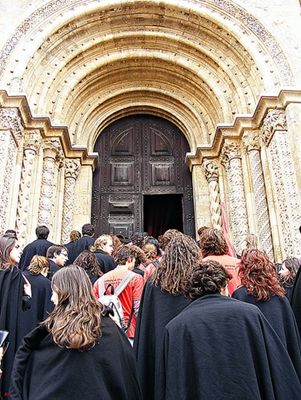
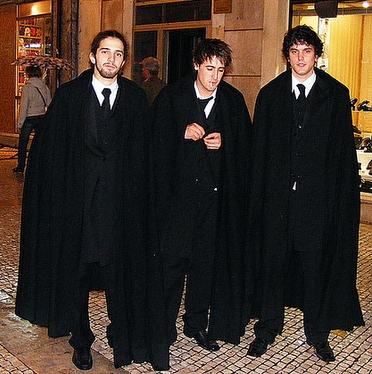
Photographs of students in Coimbra (Portugal), taken by Adam Yamey