Turn it off!

When I first qualified as a dentist and went into practice in 1982, nobody possessed mobile telephones (cell-phones). By the time I retired in 2017, practically all of my patients, even some of the children, carried and used these ‘phones. Believe it or not, my patients often tried using their ‘phones during my appointments.

phon

It was very annoying and ruinous for concentration when a patient stopped me in the midst of performing a delicate operation in his or her mouth in order to answer the ‘phone. Some patients even attempted speaking on their mobiles when their mouths were full of impression materials.


One day, I met my next patient at the reception desk. He had arrived punctually, but had his ‘phone up to his ear. He smiled at me, and then said:

“Give me a minute, I am in the middle of a telephone interview for a job.”

“Ok,” I replied, “come into my surgery when you are finished.”

Ten minutes of his half an hour appointment passed, then fifteen, and then twenty…

At the end of half an hour, I returned to the reception desk. My patient laid down his ‘phone, smiled, and said:

“I’m ready now. My interview is over.”

I replied:

“So is your dental appointment. You had better book another one another day.”

Even more annoying were those who insisted on asking me a question and then, instead of listening to my reply, began sending SMS messages. I recall one lady, who had very complex dental problems, which required much explanation of treatment options before I could proceed any further with helping her. Did she listen to me? Oh, no she did not. For half an hour, she sent a series of SMS messages whilst I spoke. At the end of her appointment, she asked me to repeat what I had been telling her because she had had to send a series of “very important” messages. After that experience, I put up a notice in my surgery, forbidding the use of mobile ‘phones. It was a successful move. Patients would reach for their ‘phones, and then my assistant or I would point at the notice. The patient would then apologise, and turn off the ‘phone.

Dentistry and dictatorship

Between 1944 and 1991, Albania was ruled by a Stalinist dictatorship under the leadership of Enver Hoxha until his death in 1985, and then under Ramiz Alia. The country was even more isolated from the rest of the world than North Korea is today. It was impossible for individuals to visit the country unless they were members of a tour group. In May 1984, I joined one of these groups and spent a most interesting fortnight in the country. Our hosts, the state-run Albturist company, made sure that we had little or no contact with Albanians other than our tour guides and driver, who was a trusted Communist party member. Our hosts hoped that we would only see what the authorities wanted us to see. Their aim was to make us come away from Albania feeling that its repressive regime was one to be admired. I was the only dentist in our group. I managed to gain a tiny insight into the state of dentistry in Albania. The following extracts from my book “Albania on my Mind” reveal something of what I learned. ‘Aferdita’ and ‘Eduard’, mentioned below, were our Albanian tour guides. Although their job included keeping us ‘under control’ and away from other Albanians, they were curious about the world beyond Albania’a watertight borders.
ALBDENT 0

Our tour began in the northern city of Shkodër.

“Our coach headed out of Shkodër along the main road leading southwards. Once we were out of town, Aferdita delivered the first of her brief daily lectures. Every day, she treated us to a discourse on one of a variety of different aspects of life in Albania. The one that I can recall best was on the subject of medicine. She informed us, whilst we were travelling towards Sarandë some days well into our tour, that since the advent of the communists not only had malaria been eradicated, but also tuberculosis and syphilis. After extolling the virtues of her country’s medical facilities, she offered to answer any questions that had arisen in our minds as a result of her lecture. No one said anything. Then, Julian, our British chaperone, knowing already that the young lady doctor travelling with us was a reticent person, asked me, the dentist on board, to pose a question. I asked whether antibiotics were readily available in Albania. My reason for asking this was that I believed that the country, which was clearly trying to be totally self-reliant, would have been reluctant to import costly pharmaceuticals. Aferdita replied indignantly: “Why, of course they are.”

And then, spreading her hands wide apart, she exclaimed:

“When we reach the next town, I will get you a packet of antibiotics this large.”

Sadly, she never fulfilled this unusually generous offer.”
ALBDENT 1

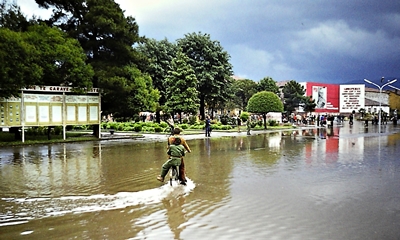
Flash flood in Shkodër, 1984

“After an unexceptional lunch, I roamed around the streets of Shkodër. I came across a small public garden, which was dominated by a chunky statue of Joseph Stalin. Even 30 years after his death, Albania continued to honour him. It was the only country in Europe still revering that illustrious Georgian. There was even a town, Qyteti Stalin (now known by its pre-Communist name as ‘Kuçovë’), named in his memory, but we did not visit it. I am pleased that I saw this statue, because although I did see many other statues on our trip, they were mostly depictions of Enver Hoxha.

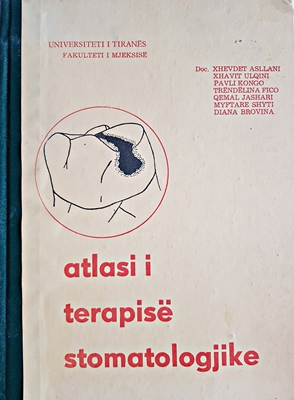
I discovered a bookshop near to Stalin’s monument, and being addicted to such establishments, I entered. I was surprised to find an Albanian textbook of dentistry prominently displayed there. Though crudely illustrated with line-drawings, I could make out that it was quite up-to-date. To the evident surprise of the shop’s staff, I purchased it and another dental book. I still treasure these two unusual souvenirs from Shkodër.”

ALBDENT 2

Backstreet in Gjirokastër

Later during our tour, we visited the historic city of Gjirokastër. Its hotel, like others in Albania, was equipped with a night club, where we, the foreign guests, were entertained by musical ensembles in splendid isolation: no Albanians apart from our guides and a waiter were permitted to enter the club. Incidentally, wherever our group ate in Albania, we were isolated by screens or curtains from other (i.e. Albanian) diners. I later learnt that this was because in 1984 there were great food shortages in the country. We were well-fed, but it was important that Albanians were not able to see that.

“That evening after dinner, a number of us sat with Aferdita and Eduart in the hotel’s night club. Each of the hotels in which we stayed had one of these. With the exception of our two guides and the musicians who performed in them, these clubs were out of bounds for Albanians. This evening we were entertained by a small band that played western pop music, mainly tunes originally performed by the Beatles. The noisy background of these clubs provided our two young guides with opportunities to ask us about life beyond their country’s tightly sealed borders. However, it was clear that Aferdita was trying to eavesdrop on Eduart and vice-versa. As the musicians strummed away in the semi-gloom of the club in Gjirokastër, Aferdita turned to me, rolled her lower lip away from her teeth, and asked my opinion of her gums. She wanted to know if they had been treated properly. I told her that I was unable to give her an opinion in such poor light.

The following morning, I spotted some tubes of Albanian toothpaste on display in a locked glass display case near the hotel’s main entrance. I tried to communicate to the receptionist (who did not understand English) that I wished to purchase a tube. I used to collect toothpastes from wherever I travelled and was curious to taste its contents. Whilst I was doing this, Aferdita appeared, and asked me what I wanted. I told her. She explained my desire to the receptionist, and moments later I had become the proud owner of a tube of Albanian dentifrice.”

ALBDENT 3

Many years later…

“In 2001, long after my trip to Albania, I began working in a dental practice in west London. Many of my patients were, and still are, refugees from the places in the world, which are stricken by military and political conflicts. Algerians, Iraqis, Afghans, Kurds, Palestinians, Eritreans, and many other others who have fled their far-off disturbed homes sit in my surgery and reveal the ravages that life has inflicted on their teeth. During the terrible conflicts in the former Yugoslavia, many of my patients hailed from Kosovo, and usually spoke poor English in addition to their native Albanian. Many were the smiles that I elicited from them when I quoted the old party slogans, undoubtedly poorly pronounced, and wished them ‘Mir u pafshim’ instead of ‘Goodbye’ at the end of their appointments.”


ALBANIA ON MY MIND” by Adam YAMEY may be purchased from Amazon, lulu.com, bookdepository.com, your bookshop. It is also available as a Kindle

Not really…

American and English

similar lingos

sometimes different  

USA

Some years ago, I practised dentistry in a surgery near Ladbroke Grove in West London. One day while I was waiting for the next patient to arrive, I found myself alone at the reception desk, the receptionists having gone off somewhere briefly. The telephone rang. Being a helpful sort of person, I picked it up.

“Hello, this is the dental surgery,” I said.

A man with an American accent said to me:

“I want to speak with June Courtney.”

June was a dentist, who used to work in the practice.

“I am afraid she does not work here anymore,” I replied.

“Well, maybe you’re her husband?”

“No, I am not.”

“Well, maybe I can interest you in buying some bonds,” continued the trans-Atlantic caller.

“I’m not really interested,” I replied.

“Well, that means you might be a little bit interested,” the caller replied.

“let me explain something to you,” I began, “if someone English says that they are not really interested, it does not mean that they are ‘slightly interested. It is a polite way of saying that they are not at all interested; they are totally uninterested.”

“Well, thank you for explaining that, sir,” the caller said before ending the call.

I guess that sometimes it pays to speak bluntly.

A bit too far

Drill a bit,  not too far.

In the tooth is a nerve:

do not disturb it


DRILL 1


It would not have been fair to my patients if I had written what follows before I had retired from practising dentistry. If I had been one of my patients, I might have lost confidence in my dentist after reading this.

Before dental students are allowed to drill teeth on living patients, much training is required. A great deal of this is done using plastic teeth mounted in the jaws of the heads of a mannequin, known as a ‘phantom head’. The plastic teeth are held in the artificial jaws with metal screws. The screws fit into holes on the undersides of the teeth so that the crowns of the teeth appear intact. As a dental student, I spent many hours each week practicing cutting standardised cavities. The cavities had to be cut to very precise dimensions, which were neither to be exceeded nor the opposite. I recall that certain parts of the plastic teeth had to be cut to exactly two millimetres deep and much the same width. At first, I found this extremely difficult. Not only was I not yet used to using dental drills, but also the plastic cuts in an awkward way.

Eventually, the time arrived for a practical test. Unsupervised, we were required to cut one of the several cavities that we had been learning to prepare. Disaster struck. Within a few seconds of starting my tooth, I had cut too deep. The metal of the screw retaining the plastic tooth in the phantom head was staring me in the face. I called over the examiners. They studied the tooth carefully, and then one of them said to me:

“I think you have exposed the nerve, Mr Yamey.”

“We might be looking at a root treatment, here, don’t you think?” asked the other examiner.

I could not believe what I was hearing.

“I think we’re looking at a failure here,” I replied.

They agreed.

I spent another few weeks in the phantom head room, and retook the exam, which I passed with flying colours, you will be relieved to learn. Now, I was deemed ready to treat dental cavities on real teeth in real patients – under supervision, of course.

The first tooth that I had to work on had only a little decay. Nevertheless, after the intense training, which emphasised cutting teeth should be done as conservatively as possible, cutting only as little of healthy tooth tissue as was strictly necessary to retain the restoration (‘filling’), I approached my first ‘real’ tooth with much trepidation. After boring down to the two-millimetre depth that was ingrained in my mind, I could see nothing but healthy tooth – no sign of decay. I summoned the clinical teacher (the ‘demonstrator’). He looked at the tiny hole I had created with great care and laughed.

“You have not yet cut through the enamel. Keep going,” he said.

The enamel, for those who are uncertain about dental anatomy, is the outer covering of the part of the tooth that is visible in the mouth. Beneath it, is the dentine, and below that the dental pulp chamber, which contains nerves and blood vessels. Decay spreads much more rapidly through dentine than through enamel.

I looked at the demonstrator, and said:

“But in the phantom head room we were told never to go deeper than two millimetres.”

“Those were just plastic teeth,” the demonstrator replied, “forget all that.”


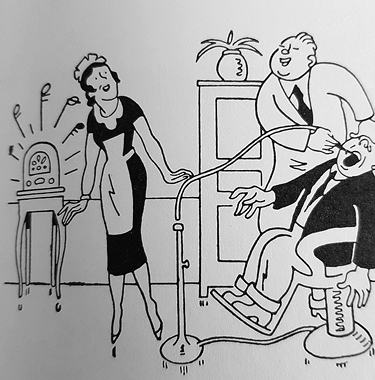
[Picture from “Der Zahnarzt in der Karikatur” by E Henrich]

I thought it was a bean

Is fear of the needle 

worse than fear of the mask?

Without them, we suffer

business care clean clinic

Photo by Pixabay on Pexels.com

Many of my adult patients remembered going to the dentist when they were children and having to be put asleep under a black face-mask. This memory instilled in them a life-long fear of visiting dentists.

The day after the 17th of March 1982, when I qualified as a dentist, I was legally allowed to administer general anaesthetics for dental procedures without an anaesthetist being present. General anaesthesia is hazardous enough but without the assistance of an anaesthetist, the risks of problems multiply. I could have accidentally killed a patient on my first day in practice. For the record, I have never ever administered general anaesthetics with or without an anaesthetist.

For a brief while, a few months in the 1990s, I worked in a practice that specialised in treating dental patients while they were under general anaesthesia. The anaesthetics were administered by a visiting hospital anaesthetist, who was assisted by a fully trained anaesthetics technician. The patients, when unconscious, were intubated to maintain their breathing and all the right things were done to ensure their safety. When the patients were ‘under’, I worked on their teeth, as quickly as I could because the anaesthetist wanted to keep the patients ‘under’ for as short a time as possible.

Children were given gaseous anaesthesia through a face mask. Once, I sniffed the gas briefly. It was terrible stuff. It felt as if a knife were shooting up my nose. Most children were, quite naturally, terrified at the prospect of anything that was happening in our clinic. Getting them to accept the black mask with its attached rubber tube was often difficult. The anaesthetist was a friendly man from the Middle East. He would say to the children things like:

“This smells of peppermint.”

The child might reply:

“I don’t like peppermint.”

The doctor would then say:

“I’ve got strawberry flavour.”

“I don’t like strawberry.”

“How about some lovely banana?”

And so, it went on.

One mother impressed me. She said to her child that if he allowed the mask to be put on by the count of three, he could have a treat at McDonalds later. She counted “one”, and the child refused. And, then “two”, but the child still resisted. Then, I wondered how different it would be when she got to “three.”

I was impressed when she said:

“Two and a quarter,” and then “Two and a third”, and so on without ever reaching “three”. Eventually, her child cooperated.


I must to admit that although we got a lot of work done on fully anaesthetised patients, I did not enjoy working under these conditions. However, I enjoyed my weekly encounters with the friendly anaesthetist, ‘Dr A’. He was extremely fond of fiery chillies, which he consumed during our lunch breaks. He was always seeking hotter chillies. This was probably because his taste-buds had become partially damaged by his excessive consumption of these almost corrosive chillies.

One lunchtime, Dr A and I were sitting in the staff room with a male anaesthetic technician from an agency. Wickedly, Dr A passed him a long, thin fresh green chilli, saying:

“Try this.”

The young man put the whole green chilli in his mouth and started chewing it. Soon, his face went bright red, and he rushed to the sink to fill a glass of water. When he recovered, he turned to Dr A, and said:

“I thought it was a bean.”

PS: Nowadays, general anaesthetics for dentistry cannot be administered anywhere in the UK except in a fully-equipped hospital.

Through the tongue

During my three and a half decades working as a dentist, I have been assisted by numerous ladies varying in age from sixteen to over seventy years. ‘Carly’ was one of them. When she joined me in a practice west of London, it was the first time she had worked in a dental practice. She was a quick learner, but far from discreet.

CARLY

When we had a new patient, we recorded the person’s details on the outside of a record card. One day, a smart-looking woman sat down in my dental chair, a new patient, and I asked her for her personal details: name, date of birth, address, and so on. Carly entered the information on the record card. When we had finished, Carly asked the patient:

“Are you M.R.S. or M.I.S.S?”

The lady replied:

“Miss.”

Quick as a flash, Carly said:

“I can’t see why you ain’t married. You ain’t ugly or anythink.”

The lady took this quite well. She could see that Carly meant no harm.

One Monday morning, Carly arrived and said to me:

“Ere, look at this”

She stuck out her tongue, which had a shiny silver-coloured metal stud pierced through it. I was lost for words for a moment, and then asked her if it was uncomfortable.

“No, it ain’t,” she replied, “It makes eating spaghetti difficult, though. It gets caught up on it.”

All morning, whenever a patient sat in my dental chair, she would tap the patient’s shoulder, and then say: “Wht d’ya think?” before sticking her tongue out to display her stud to the person in the chair. Most of the patients were either politely complimentary of just smiled. By now, my regular patients had got used to Carly and her friendly but cheeky manners.

Another day, Carly arrived at work. Very excitedly, she told me:

“You’ll never guess how much I paid for a large pack of prawns at Tesco’s.”

“Four pounds?” I guessed.

“No, just a quid.”

“That’s a good bargain,” I said.

“What me and me boyfriend do,” Carly explained, “is we swap the labels on the packets in the chiller so that we get the special offer prices instead.”

“Be careful,” I advised.

On yet another occasion, Carly arrived at work looking distressed. I asked her what was wrong.

“I crashed me boyfriend’s car.”

“But you haven’t got a license have you, Carly?”

“No, but I was drunk. I got in his car and drove it backwards into a lamppost.”

I am sure that the boyfriend was not pleased because throughout the day Carly was rung up by him on her mobile ‘phone. She would go out into the corridor, but because she was screaming at her chap so loudly, everyone could hear her.

During one appointment, I was beginning to scale (remove the dental tartar or calculus) a lady’s teeth. After a few minutes, while I changed instruments the lady, a well-dressed woman with airs and graces, asked me:

“Excuse me, Mr Yamey, but what exactly are you doing to my teeth?”

Before I could answer, Carly replied quickly:

“E’s cleaning the crap off yer teeth.”

The patient seemed quite happy with this simple summary.

Despite Carly’s occasional rather undignified comments, she was an excellent assistant. Patients appreciated her unpretentious, friendly, open approach and the fact that she was rarely silent. After a few months, when she had gained some experience, Carly left our practice to take up a better paid position in another dental practice. Some weeks after she had been working there, she dropped into our surgery to say ‘hallo’. I asked her how she was getting on in her new job. She replied:

“It’s ok, but they have told me not to open my mouth during the day.”

Picture source: “Der Zahnarzt in der Karikatur” by E Hinrich (1963)

Pull it out…

After qualifying at University College Hospital Dental School in early 1982, I practised dentistry for another thirty-five and a half years. I never owned my own practice but worked in those owned by other people. I worked in a total of five practices. With exception of one practice, where I worked for less than eight months, I enjoyed the conditions of the rest. None of my ‘bosses’ (i.e. the practice owners) appeared to mind how much or how little I earned for them and how much time I took off for travelling. I am grateful to them for their tolerant attitudes towards my laid-back approach to work.

My first boss, ‘J’, provided gave me a smooth introduction to the trials and tribulations of general dental practice. He was always ready to give me advice if I needed it, but gently encouraged me to take control of my decision making so that I became in charge of what I was doing.

During the first few months of being in practice, I often encountered difficulties when extracting teeth. Maybe, at that time I had insufficient experience to know when an extraction was likely to be too difficult for me to perform. Maybe, some teeth are just very hard to extract. This is the case.

If I got stuck midway through an extraction, I would ask my dental nurse to summon J. When J, who was very skilled at extracting teeth, arrived, he would work on the tooth up to a certain point. Then he would say to me that I should finish the job. He could have easily completed the extraction himself, but he wanted me to do it so that my patient would not lose confidence in me. I feel that this was extremely kind of him and will always be grateful for his sensitive approach. Later in the day, when there were no patients about, he used to take me aside and explain what he had done to loosen the tooth. Thus, I learned how to improve my technique.

As the years passed, my ability to perform extractions, even difficult ones, increased. Often, I would extract teeth that my colleagues would have referred to specialists. Although some of my other dental skills improved over the years, It is sad to relate that what I became best at was removing teeth rather than saving them!

PS: dentists never PULL out teeth; they use various techniques to widen the tooth socket and to split the collagen fibres that hold the tooth in the socket.

Picture source: “Der Zahnarzt in der Karikatur” by E Heinrich (1963)

I love you…

Teeth_500

In the second half of the 1990s, I worked in a dental practice in West London, not far from Ladbroke Grove. It was also not far from a home or shelter for mentally-compromised people. In those days,  patients with psychiatric problems mixed with the other people in the local community. Many of these people attended our practice as dental patients.

‘P’, one young man, a schizophrenic so he told me, was a regular patient of mine. Usually, treating him presented no problems other than those relating to the technical details of sorting out his dental problems.

One morning, P attended my surgery. He sat in the chair, which I then set to the reclining position. Lying down, he said to me, out of the blue and without any prompting:

“Mr Yamey, I have decided to become a homosexual.”

At a loss as to how to respond adequately, I said:

“That’s nice.”

Then in a strong voice, P exclaimed:

“Mr Yamey, I love you.”

“Thank you,” I responded lamely, adding: “Let’s get on with your treatment now”.

At that moment, my dental assistant, ‘Gemma’, walked into the surgery, ready to assist me with the treatment I was about to provide P. Within seconds, P began unzipping the fly on his trousers.

“Put that away immediately,” I ordered, “otherwise we will have to summon the Police.”

P followed my instruction and behaved perfectly normally throughout the rest of the treatment session.

When the appointment was over, P sat up from the reclining position, and placed a pile of low denomination coins on the armrest closest to me.

“That’s a tip for you, Mr Yamey.”

I thanked him, and then returned the coins, knowing that he could ill afford to waste money on me.

If he were a dog…

dog

‘D’ had terrible teeth. Not only were they broken, but they were also worn down in such a way that they looked like an aged rodent’s teeth.

He had worked for many years in a place where there were high levels of atomic radiation. Naturally, he was concerned about how much radiation he had been exposed to over the years.  On one of his many visits, he asked me somewhat irritably: “How many more x-ray pictures do you need to take?”

I replied: “I have enough pictures to take out your bad teeth, but not enough to save them.”

D seemed reasonably satisfied with my answer. At least, he never raised the subject again.

Some weeks later, D’s wife, who was also one of my patients, asked me why her husband had to make such an enormous number of visits to my surgery. I explained that the repair work was extensive and complicated, each tooth requiring several appointments. She replied quickly:

“If he were a dog with so many problems, I’d have had him put down ages ago.”

Learning by teaching

DOC 1

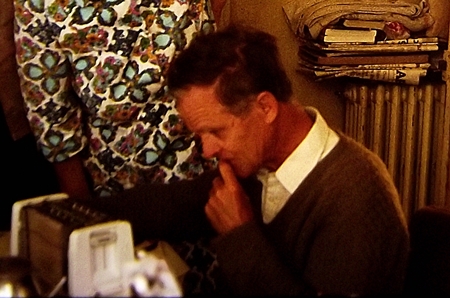
‘Doc’ mending a toaster in a friend’s home near Paris in 1978

Although my PhD supervisor was a full university professor of physiology, most people called him ‘Doc’. He was the pre-clinical tutor of the dental students, who undertook courses in academic rather than clinical departments of University College London (‘UCL’) during their first year of study. Doc’s PhD students were asked to volunteer to help teaching the basics of mammalian physiology to the dental students. I did this willingly. Once a week, I conducted tutorials for a group of six to eight dental students. Although I learnt a lot – teaching is the best was to learn, it was a case of the blind leading the blind. It was while doing this teaching that I met two of the people, who were to become owners of practices where I worked. They remembered me, but I did not remember them.

Once a week, the dental students carried out experiments in the physiology teaching lab. I assisted in the supervision of these classes. One of the experiments that the students undertook was pedalling on a bicycle rigged up to an electrical generator, which in turn was wired to a domestic lamp. The youngsters had to pedal furiously to get the lamp to glow, and while they did this their pulse rate and blood pressure was monitored.

Another experiment was connected with taste. The students had to prepare different dilutions of a chemical and used this to determine taste thresholds. The chemical used was phenylthiourea.  Some of the students could not taste this at any dilution. These people were lacking a certain dominant gene that allows people to taste this substance. The point of the experiment was to teach the students both about taste and, also, about genetic variation. Doc was keen for the future practitioners to learn that we are not all ‘built’ the same way.

Another experiment was examining the effects of various chemicals on the strength and frequency of contractions of short lengths of rodent gut in oxygenated tissue media. When we did this experiment and ones like it during our BSc physiology course, we attached the contracting gut too electronic force transducers which sent electric signals to an electronic graph drawing machine.

DOC 2

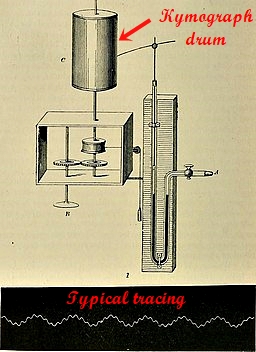
A kymograph attached to a pressure-measuring tube

Doc did not use this simple method when his dental students performed the experiment. The contractile tissue was tied to a long delicate metal lever which had a sharp point at the end of it furthest away from the fulcrum to which it was attached. Movements of the tissue caused the lever to move up and down. These movements were recorded on the smoked paper tightly attached to the cylinder (or drum) of an old-fashioned kymograph. As the lever moved in response to the contractions, the fine point at its end moved up and down and displaced the charcoal attached to the smoked paper producing a white tracing where the carbon had been removed.

Handling the kymograph drum was a tricky business. First the special plain white paper had to be tightly attached to the metal drum. Next, the drum was rotated above burning paraffin so that it became completely coated with the black particles in the smoke coming from the paraffin. When blackened, the drum and paper had to be removed from the smoking area and placed carefully on the spindle of the kymograph without touching the blackened paper so as to avoid removing the carbon coating. Attaching the gut to the kymograph lever was also tricky.

After the experiment, the paper covered with tracings had to be removed from the drum, again taking great care not to smudge the delicate layer of carbon and thereby obliterate parts of the tracings. Finally, the tracings had to be immersed briefly in a liquid lacquer that later evaporated and fixed the tracings (i.e made them immune to smudging). Only then could the students begin to make measurements of the amplitudes and frequencies of the contractions of the experimental material.

Doc had an ulterior motive in making his dental students use this highly obsolete measuring device. It was, he decided, an excellent way for future dentists to develop their manual dexterity.

As part of the pre-clinical course, Doc required that each of his students carry out a practical research project. He preferred simple projects such as measuring the blink rates of people sitting on Underground trains or assessing the rates at which peoples’ jaws moved whilst they were chewing gum. One group of students tested the theory (which has been proven) that people’s height was shorter at the end of the day than at the beginning. The main thing that concerned Doc was that his students were learning how to observe scientifically and systematically. It is most important, he felt strongly, for a clinician to be observant. He hoped that these projects would help to make these future dentists into skilled observers and therefore better clinicians.

Another reason for this project was for the students’ more immediate benefit. In the end of year physiology examination paper that he set for the dental students, he always inserted a question, which asked the student to write an essay about any aspect of physiology that interested him or her. Thus, simply by writing about the project undertaken, the student was guaranteed up to 25% of the marks.

Doc and his wife were perfect guides and became great friends during the time I was working on my PhD. I saw them socially often  for many years afterwards until their deaths. It was meeting and getting to know the dental student whom I attempted to teach that was one of the reasons that I strayed into dentistry.