THE ANNELY JUDA Fine Art Gallery is currently in London’s Dering Street, but it will soon be moving to a new location in Mayfair’s Hanover Square. To celebrate the gallery’s forthcoming departure from Dering Street, its final exhibition at that address is called “Demolition”. It is a collection of artworks created by Tadashi Kawamata (born 1953 in Japan). He lives and works in Paris (France).
The name of the exhibition describes what the viewer will see: demolition. The artist has dismantled the gallery’s walls and panelling and used the fragments and debris from them to create a series of art works, which together make the gallery look like a building site. This might sound ridiculous, but the sculptural forms he created from the fragments of the gallery’s structure are both intriguing and exciting. It looks like someone had exploded a bomb within the gallery. However, certain elements remain untouched: cctv cameras, light switches, smoke detectors, and electrical sockets. Kawamata is well known for his site-specific creations. In addition to the sculptural ensembles that he created using the fabric of the gallery, there are several beautifully intricate three-dimensional maquettes of other projects the artist has planned or carried out.
Now, Annely Juda is a commercial gallery. I asked a member of its staff whether the amazing works that were on view in the gallery were for sale. He said that they are, and the artist will recreate the works for clients in their own spaces.
This amazingly unusual exhibition will continue until 5 July 2025.
FIRST THE DUTCH demolished it in 1693. Then, it was replaced on the same site, only to be demolished again in about 1730. Once more, a new one was constructed on the same site, and this was then demolished by the British in 1761. The current version of this building, the Immaculate Conception Cathedral in Pondicherry, was completed in 1791, and is still in use today. Regular Roman Catholic services are held here in the Tamil, French and English languages.
Today (3 February 2025), while waiting for a nearby shop to open, we sat quietly in the cool aisle of the Cathedral. After a while, some beautifully dressed people entered. They walked up to the front of the church close to the high altar, and posed for photographs. It was obvious that amongst them was a just married couple. The bride was wearing a sari, had flowers in her hair, and a luxuriant flower garland around her neck.
As they walked away from the altar towards the open west door, they passed us, and my wife asked them if they had just married. They accepted our congratulations and asked us to join them. We did and as we stood next to the newlyweds, who had just married in another church, the four of us posed for photographs. Then, the bride asked us to bless them by touching their foreheads. We were moved by this request.
The marriage party went on their way, and we crossed the road to enter the huge bookshop that had just opened.
I HAVE PASSED IT SO many times whilst travelling by bus along London’s Oxford Street, and wondered what it is. I am referring to a well-maintained brickwork tower-like structure surmounted by a recumbent stone lion. It is a few yards east of Selfridges department store. Eighteenth century in appearance, it looks incongruous standing flush against an undistinguished modern brick building. The object of interest stands on the eastern corner of the intersection of Oxford Street and a short cul-de-sac, Stratford Place, about which I will write more in the future.
Stratford Place runs in a north/south direction. Its eastern side is lined with a row of Georgian terraced houses. Prior to the twentieth century and the development of Oxford Street as a shopping district, the row of Georgian houses would have extended south with the southernmost of them having a façade on Oxford Street. In 1890, the Georgian villa that stood on the eastern corner of Oxford Street and Stratford Place was demolished. All that remained was the lion-topped gate house (or porter’s lodge), which I have seen so often whilst travelling past on the bus. The west side of Stratford Place was demolished to build a huge Lyons Corner House eatery. The demolition included the loss of the western gatehouse that used to face the still standing one, which has been preserved.
SITUATED AT THE northwest corner of Heathrow Airport (and within sight of it), is the former village of Longford. Now in the Borough of Hillingdon, it lies on what was once the main road between London and Bath. Its name derives from a ford which used to cross the River Colne. James Thorne, writing in 1876, noted that there were then three roadside inns and that:
“The fishery here is in good repute among anglers; as is also the Kings Head Inn.”
Today, there are only two pubs in Longford, The Kings Arms and The White Horse. The Kings Head, marked on a map surveyed in 1875, no longer exists. It stood just east of the Duke of Northumberland’s River, near the boundary fence of The Thistle Terminal 5 Hotel. Nearby, next to a bus stop (Stop J), stands the now disused Longford Pump. This is almost 10 feet tall and was used to top up the tanks of steam-powered traction engines. Of the two surviving inns, The White Horse looks to be the oldest. According to a notice attached to this picturesque old pub, it was probably built as a smokehouse (for curing meat) in 1534 and became an inn in 1601.
Cottage in Longford
Across the road from The White Horse, there is a magnificent half-timbered building. This Elizabethan (16th century) edifice is Yeomans House. The historian Wendy Tibbits wrote (www.wendytibbitts.info):
“In 1542 Leland in his ‘Itineraries’ describes a building about a mile north of the wooden bridge over the Colne between Longford and Colnbrook, which suggests it could be the building now known as Yeomans. At the time it was the manor house of Colham and owned by the Earl of Derby who died there on 23 May 1521. He had built the Tudor Manor House on the site of a medieval house. At that time the manor of Colham had extensive land extending from Hillingdon southwards … In the mid-eighteenth century this house was owned by Thomas Streeting who died there in 1773. It was inherited by his daughter, Elizabeth, who had married the other prominent Longford farmer, Thomas Weekly. Thomas, his wife, and their nine children were living in the Weekly house, a hundred meters along the Bath Road, and so they decided that the Elizabethan would be divided into three dwellings and rented to their farm labourers’ families …”
Between The White Horse and The Kings Arms, there is a charming, thatched cottage. Almost opposite this, there is a three-storey brick building, now next to the entrance of the Heathrow Medical Aeromedical Centre. According to Ms Tibbits, this is the house built by a wealthy London cloth merchant, Thomas Weekly, about 10 years after the 1666 Great Fire of London. The Weekly family lived here from the late 17th century until 1899. The house had its own farm, which was compulsorily purchased during WW2 to use the land for the construction of an airfield in the neighbouring, now demolished, hamlet of Heathrow.
The Kings Arms Pub faces Heathrow Close. Immediately to the east of the hostelry, there is an old long barn with a sagging roof. This is one of the few reminders of the era when Longford was in the midst of agricultural terrain. To the west of this pub, the old road to bath crosses the River Colne over a bridge with elegant cast-iron railings and roundels, each with a crown and beneath it, the following: “WR IV 1834”. This is marked on old maps as “The King’s Bridge”.
Longford contains the remnants of what was once a small country village. Ms Tibbits noted that:
“… its four inns provided travellers with hospitality. Six miles from Windsor Castle the village was the usual stopping place for the Royals to change their horses on the way to and from London and Windsor … Highwaymen prayed on the coach travellers who had to cross the notorious Hounslow Heath to get to Longford, but if any villagers were aware of the culprits they kept it to themselves.”
Sadly, like nearby Harmondsworth, Longford’s future might well be bleak. Should the projected extension of Heathrow Airport finally get the ‘go-ahead’, much of Longford, if not all of it, will be demolished. This would be a great pity as it would involve the displacement of a small community and the loss of several buildings of historical interest.
PADDINGTON RECREATION GROUND, located between West Kilburn and St John’s Wood, was formally established in 1893. It was London’s first public athletic ground. From 1860 to 1893, it was a parish cricket ground. In 1888, a cricket pavilion was constructed. It is now named after Richard Beachcroft who was Secretary of the cricket club in the 1880s. Also in 1888, the grounds were opened to public access and a cycle track was laid out, which remained in existence until 1987 when the position of the cricket pitch was moved. In 1893, the Paddington Recreation Act was passed, authorising:
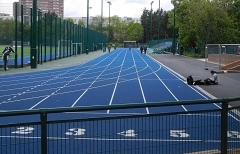
In 2006, the grounds were completely refurbished by Westminster City Council. The centrally located cricket pitch and its Victorian pavilion are now surrounded by a children’s playground; tennis courts; an outdoor gymnasium; a running track; hockey pitches; a bandstand; a bowling green; and various fenced off enclosures containing gardens and an ‘environmental area’. The pleasant park with its café and other facilities covers 27 acres and is well used by locals.
The Paddington Recreation Ground was a place where two world famous sportsmen trained. One was the professional road and track cyclist Sir Bradley Marc Wiggins (born 1980), who won the Tour de France in 2009. He learned to ride a bicycle in the grounds. He attended the St Augustines Church of England School nearby. The other sportsman was a medical student at the nearby St Marys Hospital when he trained on a running track at the Recreation Grounds, and on the 6th of May 1954, he became the first man to run a mile in under 4 minutes. This man was Sir Roger Bannister (1929-2018).
The Recreation Ground has several entrances. One of these is a short path leading from Carlton Vale. It runs past a pub called ‘The Carlton Tavern’, which has a curious recent history. In 1918, a German bomb destroyed a pub that stood on this site. In 1921, this was replaced for the Charrington Brewery by a newer building designed by Frank J Potter (1871-1948), who also designed the observatory in Hampstead. During WW2, the pub was the only building in the street not to have been destroyed during The Blitz. This plucky little pub’s luck ran out in 2015.
In 2015, developers bought the Tavern with a view to demolishing it to create space to build luxury flats. A week before the pub was due to become a protected historical edifice, the developers, no doubt having learned what was in the offing, reduced it to rubble. They hoped that they would get away with being fined an amount, which they could easily recoup when they sold the luxury accommodation they were planning to build. Things did not work out in their favour. Local action groups fought for the pub’s reconstruction and won. The courts ordered the developers to reconstruct the pub brick-by-brick (www.standard.co.uk/news/london/developer-told-to-rebuild-maida-vale-pub-brick-by-brick-after-site-torn-down-without-notice-10211892.html). They did a good job, and today it looks much as it did before it was hurriedly demolished.
Both the pub and the Recreation Ground stand in the shadow of the tall tower of the Anglo-Catholic Church of St Augustin. Known as ‘the cathedral of north London’, the church was designed in the gothic revival style by John Loughborough Pearson (1817-1897), who also designed Truro Cathedral in Cornwall. St Augustin was consecrated in 1880, but the tower and spire were not completed until 1897-98. I have never been inside this building, but I have seen photographs of its interior, which looks superb.
The places described above are almost all that remains of an area which has been subject to much rebuilding since WW2. Visiting these places can make an interesting detour when walking near Little Venice along the Paddington Arm (branch) of The Grand Union Canal. I doubt that I would have visited the Recreation Grounds had I not been alerted to it and encouraged to pay it a visit by two sets of friends, to whom I am grateful.



 yamey
yamey 