KALIM REPAIRS JEWELLERY in Jewellers Street in the Commercial Street district of Bangalore (Bengaluru). He sits on the pavement on the shaded east side of the street in the morning and in the afternoon, he moves to the west side to keep out of the sun. He can mend almost every kind of jewellery. When restringing necklaces, he uses both his hands and his feet, to keep the thread taut.
Kalim at work
Kalim is one of many people we visit in the Commercial Street area to get repairs done. These craftsmen include tailors, a bag repairer, dyers, darners, watch repairers, locksmiths, and jewellers. We have known all of them for years.
The great thing about these skilled workers is that they will skilfully repair almost anything. On the UK, people like this are few and far between.
You can read about these wonderful people in and around Commercial Street in my book “88 DAYS IN INDIA: A JOURNEY OF MEMORY AND DISCOVERY”.
THE CHARMINAR IS a tall four-sided tower in the centre of Hyderabad (India). It was constructed in an Indo-Islamic style in 1591, soon after the capital of the Golconda Sultanate was moved to Hyderabad by Muhammad Quli Qutb Shah (c1565-1612). Today this impressive, elegant building is surrounded by market stalls and many shops. Whenever we visit Hyderabad we spend some time around the Charminar.
Since the first time we visited the city (2012), there has been what looks like a makeshift Hindu temple attached to one corner of the Charminar. During our most recent visit in January 2025, it was still present and looking as makeshift as when we first saw it. On one of our several visits to Charminar, the square in which it is located was surrounded by armed police and many armoured vehicles. It was during Ramazan and the police had erected barriers around the makeshift temple. The atmosphere was tense.
This January (2025), the Charminar area was peaceful and felt as relaxed as can be in a busy Indian market place. As we strolled along, I heard loud rhythmic tapping coming from a small shop. We wandered over to see what was going on.
The small shop had four men squatting on its floor. Each one held a hefty mallet. They were rapidly banging the mallets on small square, thick leather pads, which they supported with fingers. How they managed to avoid crushing their fingers with the mallets amazed me. We asked them what they were doing. They told us that they were flattening silver and gold to produce sheets of silver and gold leaf/foil. These ultra-thin (0.2-0.8 microns) metal sheets, which are edible, are sold to caterers, who use them to decorate Indian sweets and other food items.
Known as ‘vark’ (also varak Waraq, or warq) , these thin foils are made by putting silver or gold particles between two sheets of thin paper, and then pounding them with mallets as we observed. Later, the papers support the incredibly fragile foils, and can be peeled off when they metal is applied to foods.
We had never seen vark being made before. Had we not visited Charminar once again, it might have been a long time before we saw that process elsewhere.
THE CERAMIC ARTIST, our friend Falguni Bhatt, works in Calcutta. While visiting her studio, she suggested that we visit Kumartuli in north Calcutta. Close to the Hooghly River – part of the Ganges – this district of the city is a warren of narrow lanes lined with the workshops of craftsmen who make Hindu idols out of the grey clay collected from the shores of the Ganges. We went there and were amazed by the huge amount of creative activity that confronted us.
Mounds of damp dark grey clay are carried on the heads of porters to the workshops. Others carry bundles of straw to the artisans. The straw is used to make armatures – these are shaped roughly like the finished idols. A completed armature, which can sometimes include supporting metal rods, looks sufficiently like the idol being created.
Clay is applied to the straw armatures. Gradually, the straw is hidden by the clay. The surface of the clay is either smoothed to resemble fine skin and/or inscribed to create bodily details – for example finger nails and the creases on the palms of hands or facial details or clothing and footwear. Creatures and objects associated with the depicted deity – for example, veenas and snakes – are created in the same way, starting with straw armatures.
The completed idols, which are frequently very detailed and of complex shapes, are left to dry and harden. The clay idols are not fired in a kiln.
Detailing on a clay idol
Later, the idols are painted according to tradition, and then decorated with elaborate costumes and jewellery. The jewellery is made from hand cut cardboard often with sequins and mirrors applied. A small section of Kumartuli is dedicated to workshops creating these intricate, attractive ornaments.
Each of the clay idols is an exquisite work of art. Each of them displays evidence of the highly skilled workmanship that created them. They rival the superb ancient Hindu stone carvings that can be found carefully displayed and conserved in museums. Yet, each of these clay masterpieces is destined to have but a very short life.
The idols are created in Kumartuli for use in important Hindu festivals such as Durga Puja, Kali Puja, and Saraswati Puja. We saw idols being prepared for the last mentioned. Most of the idols being created include the stringed musical instrument played by Saraswati – the veena. Her puja is to be held next in February 2024.
During these ceremonies, the carefully crafted idols – fully painted and decorated with elaborate hand made ornaments – are dropped into the Ganges. When I expressed my surprise at hearing about this, Falguni said something like: “Life is transient.”
WHEN SOMETHING GOES WRONG with a product in the UK, it is usually simpler and cheaper to discard it and buy a new one. In my experience of visiting India many times since 1994, I have discovered that there is often someone, who can mend what would normally be thrown away in the UK. Only recently, I spotted a poorly dressed man sitting by the side of MG Road (in Bangalore). He was painstakingly repairing what looked like totally decrepit umbrellas.
We use combination locks (‘number locks’ in Indian English) to secure our baggage whilst travelling. In December 2022 when we were in Panjim (Goa), we found one of ours, which would not open, even when using the correct combination. It looked as if it had become corroded.
Because we have great faith in the ingenuity of Indian craftsmen, we took it to a locksmith in Panjim. He was unwilling to work on our lock, and another lock seller advised us to throw it away. Undeterred, we carried the defective item to Bangalore.
In the Commercial Street district of Bangalore we approached a couple of locksmiths, who were unwilling to spend time on our lock. A third one accepted it, and said he would have a go. We told him the combination, and left him whilst he fiddled with the lock as if it were as enjoyable as a Rubik Cube. On the 2nd of January 2023, we set off on a long trip, returning to Bangalore on the 15th of February 2023.
A few days later, we visited the locksmith, who remembered us and fetched our lock from a glass-fronted cupboard. He had managed to open the lock, but could not remember which combination allowed him to unlock it. He said: “You take it home and try a few numbers.” He refused to accept any payment for his efforts.
Back at our accommodation, I tried what I remembered had been the lock’s combination, and discovered that the locksmith had rendered the once useless lock fully functional. As the tourist board slogan (Incredible!ndia) suggests, the country is truly incredible.
PS These locks are cheap to buy new in India. It was not to save money that we visited so many locksmiths, but it was for the enjoyment of the challenge to find someone to do the job that we spent the time going from one to another. Some people enjoy passing time playing games on their phones. We choose to have our timepass (Indian English) in other ways
WHILE WANDERING THROUGH the large rambling bazaar in Mandvi, which is in the former Kingdom of Kutch (now part of Gujarat), we came across a workshop where bandhani textiles for clothing were being made.
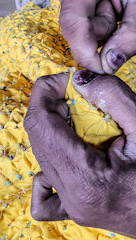
Making a knot for bandhani dyeing
Bandhani is a method of producing patterned dyed silks and cotton. Put simply, a piece of cloth, already dyed one colour or not at all, is prepared as follows. Parts of the cloth are gathered up to form tight bundles fastened by fine threads. The bundles, which look like small pimples are distributed to form patterns. The tied cloth is then dyed. The dye reaches all parts of the cloth except those enclosed in the tiny bundles. When the bundles are untied the patches of the cloth that had been shielded from the dye remain the original colour. This process can be repeated several times using different dyes to create an interesting pattern.
The shop the looked at, Khatri Ibrahim Siddik & Co, is the oldest bandhani workshop in Mandvi. It has been run by the same family for fifteen generations .
During our recent visit (January 2023), we have come across several businesses that have passed from generation to generation. In Bhuj, the Shivam Daining (sic) restaurant is run by chefs whose great grandfathers, grandfathers, and fathers, have all been cooks to the Maharaos of Kutch. Likewise, there is a bakery in Bhuj with an ancient wood fired stove. This business has passed through at least four generations. Nearby, there is a knife, scissors, and sword maker, who is the fourth or fifth generation of a family, which has been in this trade for over more than a century.
I am certain that there are plenty more examples of families in Kutch specialising in skills that have been passed from one generation to the next. I wonder whether these skills are in the genes, or simply taught by one generation to the next, and so on.



 yamey
yamey 