There was trouble in the Indian Ocean

EVER SINCE ROMAN times (and probably before), people in Europe yearned for products from Asia. Before 1498, highly prized goods such as spices and precious stones reached Europe from India and places further east via the Indian Ocean, and then overland, passing through places in the Middle East like Egypt and Turkey, before crossing the Mediterranean. Another route used for transporting these wares between India and Europe involved the use of rivers and overland caravan trails that carried them to the Caspian and Black Seas, and thence to Europe. At many points along these routes, the goods attracted taxes, which greatly increased the prices that people in Europe had to pay to purchase them.

In 1498, the Portuguese explorer Vasco da Gama (c1460s – 1524) discovered a sea route from Portugal to India via the Cape of Good Hope. This discovery allowed Portuguese vessels to carry the highly prized goods from India to Europe by sea without having to pass through the lands where hitherto they had attracted high taxes and customs duties. Thus, the Portuguese were able to import the spices and other precious goods from the Orient at much lower prices than prior to Vasco’s discovery of the Atlantic route.

However, the Portuguese found that they were not the only traders making use of the Indian Ocean during the 16th century. Their competitors included Gujaratis, Egyptians, Arabs, Turks, and many others. It was not long before the Portuguese instituted measures to stifle competition and monopolise trade in the Indian Ocean. Naturally, this upset the merchants of other nations who traded in this sea. To stifle competition, the Portuguese resorted to harsh measures designed to make it almost impossible for their competitors to trade by sea. Over many years during the 16th century, attempts were made to oppose the monopolistic measures being forcibly imposed by the Portuguese, whose military and naval prowess was very formidable.

In 1508, a man called Khwaja Safar travelled from Egypt to begin trading in the Sultanate of Cambay (now ‘Gujarat’). Born in the south of Italy, his parents were Albanians. Having fought in armies in Europe in his youth, he was well-informed about the latest military techniques of European armies. By 1530, he began offering his services and military advice to the Sultan of Cambay. It was not long before he became involved both with negotiating with the Portuguese in India whilst simultaneously plotting against them. With the military experience he had gained as a young man in Europe, he became the commander of forces that repeatedly attacked the Portuguese, particularly in their important stronghold on the island of Diu – a place from which the Portuguese were able to watch and exert control on shipping to and from India.

My book, “An Albanian in India”, follows Khwaja from his birth in the ‘Heel of Italy’ to Egypt, then to Yemen, from there to Gujarat where he became a man of importance, and then to his untimely end during the attack on a Portuguese fortress on the coast of Gujarat. My book is available from Amazon, e.g.: https://www.amazon.co.uk/dp/B0D7HX2B8Q

It pays to be honest

Mug shot_640


A long time ago, a friend asked me to read a short story that he had written. He was hoping to submit it as an entry to a short story competition. I agreed to read it for him.

Fortunately, it was short enough for me to read it fairly quickly. Unfortunately, I did not feel that its quality was up to much.

When I saw my friend a few days later, he was eager to know what I had thought of his story. I was not sure what to say. I wondered whether I should be polite, and say that I quite liked it, and would wish him luck. Or, should I risk hurting his feelings by being frank about my opinion of his work? I made up my mind to do the latter. Trying to be as tactful as possible, I told him that I thought his story was not bad, but that there was not much chance of his story winning the competition.

My friend was surprisingly pleased by my opinion. He said:

Thank you, Adam. Thank you very much. You are the first of my friends to say what you really think about my story. All of the others have tried to be polite and say they like it.”

I was relieved by his reaction to my honest but adverse comment. It paid to have been honest. It usually does!

Albania’s got talent…

ALBTAL 1

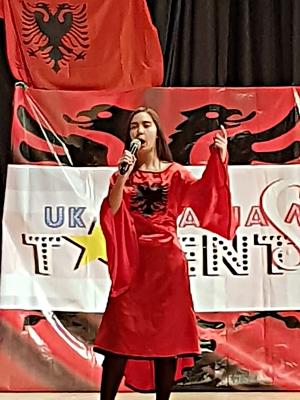
The Albanian community in the UK has been in the country long enough for some of their children to have been born in the country. It would be easy for the first generation born in the UK, who have to attend British schools and mix with non-Albanians, to begin to forget their cultural heritage. However, thanks to various organizations that some of the children of Albanian heritage attend, Albanian language and cultural traditions are being kept alive in the UK. On the 27th of October 2018, I was invited to attend the finals of the, which was held in a school hall in London’s Chalk Farm.

The Albanian Ambassador to the UK, Mr Qirjako Qirko, was one of several well-known personalities who introduced the show in Albanian. He ended his speech with a few words in English. The gist of what he said was as follows. He thanked the Queen and her Government for allowing Albanians to maintain their traditions and language, which is not the case in every other country. The show which followed the speeches certainly demonstrated that despite being far from their traditional homes and many years away from them, the Albanian community is encouraging their children to keep alive the traditions of their forefathers.

ALBTAL 2

The show consisted of a series of performances by young people whose parents came from Albania or Kosovo. There were songs (traditional and contemporary Albanian as well as renderings of current and not so current popular songs in English). Small troupes of youngsters in traditional Albanian garb performed traditional Albanian dances. Others danced routines that they had choreographed themselves. Several youngsters declaimed poetry in Albanian. Naturally, the quality of performance was not uniform. Some of the young people were dazzlingly competent, the rest were not bad. None of the performers was shy or overtly lacking in confidence. Each of them performed with an enthusiasm that was refreshing to observe. The large audience around me encouraged each of the contestants as they performed on stage, cheering and clapping to the rhythm of the music. The five judges praised and gave friendly encouragement (in Albanian) to each of the performers when their act was over. Three of the judges were for singing, one for poetry recital, and one for dancing. The atmosphere in the hall was joyful and friendly. Everyone who passed my wife and me, greeted us warmly even if they had no idea who we are. It was great to discover that the famed hospitality of the Albanian people has been preserved in its British diaspora.

ALB TAL 3

Many, if not all, of the performers, who sung or recited in Albanian or who dressed up in traditional costumes and performed the dances of their ancestors, use English in their day to day life. They have given up parts of their precious spare time to learn Albanian and to help Albanian cultural traditions remain vital and vibrant. They set an example that many children of British ancestry might profitably follow.