A FRIEND INVITED us to dine one evening at the exclusive Mosimann’s Club in West Halkin Street in London’s elegant Belgravia district. As it was dark when we arrived and I was too busy chatting with our host, I failed to notice the exterior of the establishment. Years later, I noticed that the narrow façade of this fancy eatery, named ‘The Belfry’, is that of a Victorian gothic church with a slender spire.
The church was being used by the Presbyterians in 1866, so wrote Edward Walford in the 1880s. The website of The London Metropolitan Archives catalogue reveals more:
“…a chapel was built on Lower George Street, called the Ranelagh Chapel. In 1845, on the death of the Methodist minister, the church joined the English Presbyterian Church and was renamed Ranelagh Presbyterian Church. The lease on the Lower George Street chapel expired in 1866 and the church merged with a Presbyterian Mission in West Halkin Street, Belgrave Square. The name Belgrave Presbyterian Church was adopted. The church was rebuilt in 1881. In 1923 the church moved to premises in Emperor’s Gate, Kensington.”
The former church is an unusual structure in that the end facing the entrance is considerably wider than the façade. As to when it was originally built, I am uncertain. Nikolaus Pevsner, the architectural historian, does not give it a mention in his extremely detailed guide to the buildings of the City of Westminster in which it is located. However, he does mention the chapel’s neighbour, to the left of it as you face the façade. Far more attractive than the chapel is the façade of its neighbour which is decorated in a neoclassical style. It has two porticos supported by pillars with Doric capitals. This building was built in about 1830.
Today, the Doric pillars flank entrances to a branch of Waitrose food stores. This shop also has an entrance on the street parallel to West Halkin Street, Motcombe Street. Thus, two temples of food stand side by side. If you cannot afford to dine in the former church, then you can console yourself and appease your appetite by acquiring something edible in Waitrose by stepping between the Doric pillars. In case you are wondering what we ate at Mosimann’s, I am afraid I cannot recall as it was so long ago, but I do remember enjoying it.
IF YOUR TRAIN FROM CAMBRIDGE to London stops at Shepreth and Meldreth, you can be sure that you are in for a longish journey because only the slower trains halt at these stations. Over the course of many years, we have been travelling to and from Cambridge by train and as I enjoy looking out of the window, I have always noticed this pair of oddly named stations. Only recently, we visited both places by car and took a look around these lovely villages between Cambridge and Royston and close to the A10 road, which runs from London Bridge to Kings Lynn via Cambridge.
The ‘reth’ suffix in the two villages names means ‘stream’. Shepreth means ‘sheep stream’ and Meldreth means ‘mill stream’. There is archaeological evidence of settlements in both places long before the Romans invaded England. The Romans may have occupied part of the parish of Shepreth and their successors, the Saxons, developed the village of Meldreth. Both villages are listed in the Domesday Book (1086). Little appears to have been recorded in the history books about events in tiny Shepreth. The larger village of Meldreth also played no great role in the history of England but, in the 16th century, Christ College of Cambridge moved to its estate near the village to escape from the plague. Members of the Meldreth Local History Group might disagree with my assessment of Meldreth’s place in British history. Their superb website (meldrethhistory.org.uk/) details many aspects of the place’s past, but most of them are about the village rather than the wider world.
I imagine that the building and opening of railway stations in the two villages in 1851 were major events in their history and development. Currently, the stations are served by Thameslink trains. The villages are popular places for commuters to both London and Cambridge.
Both villages are rich in historic buildings of great beauty. Many features of vernacular architecture can be found including many fine thatched roofs. A particularly charming old, thatched edifice In Shepreth is Corner Cottage, which is close to a more aristocratic looking building, Docwra House. This former manor house was built in the 17th century and then provided with later additions (www.docwrasmanorgarden.co.uk/history.htm). The village sign at Shepreth is suitably adorned with sheep, bales of fleece, a stream, a bridge, a water mill, and a leaping fish. The bridge, which we did not see, was built in the 17th century. It crossed the River Rhee, a tributary of the River Cam, in which sheep were washed, and was used by farmers taking sheep to the market in Cambridge.
At Meldreth, through which flows the tiny River Mel, a tributary of the Cam, we entered the parish church of Holy Trinity, whose construction began in the mid-12th century on the site of an 8th century church. Its square tower, nave, and chancel were all constructed in the 12th century. The church contains some fine brass chandeliers; an elaborately carved pulpit and choir stalls with wooden carvings; fragments of pre-Reformation frescoes; a lovely timber beam ceiling; some heavily whitewashed carvings supporting some of the ceiling timbers; and a mediaeval parish chest. The latter is one of about 150 surviving examples. It was made in Baltic pine with iron bands between about 1400 and 1420 and was used for securely storing valuable liturgical items (e.g., silverware, books, and vestments). In addition to visiting the church, we drove through long village to its station, which up until our visit by car, we had only ever seen whilst speeding through it by train. However, we did not see any mills as suggested by the meaning of the name Meldreth.
We did not spend nearly enough time in the two villages as we fitted them into an already busy day of sightseeing. However, having sampled them, we feel that they merit a longer visit in the future. Once again, these places provide good examples of the wealth of historical features to be discovered in England’s rural areas.
THE PARISH CHURCH in Thaxted, Essex, which was built in the English Perpendicular Style between about 1380 and 1510, is at first sight simply an impressive, attractive, typical example of this era of church construction. Recently, we were able to enter it and the lady who showed us around revealed that this was no ordinary, ‘common or garden’ church. During the early 20th century, it had been home to activity that you might not expect in a building such as this.
Conrad Noel
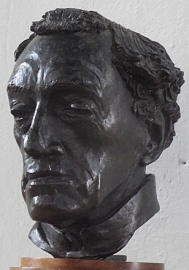
Within the church, there is a bronze sculpture by Gertrude Hermes (1901-1983). Mounted on a small wooden shelf, it depicts the head of Conrad Noel (1869-1942), who was the vicar at Thaxted from 1910 until his death.
Conrad was the grandson of the Earl of Gainsborough and son of Roden Noel (1834-1894), a Groom in the Privy Chamber, who left his exalted position after discovering radicalism. It was Roden who translated the words of “The Red Flag” into English. As a student at Cambridge, he had been a Cambridge Apostle. Conrad’s mother Alice (née de Broe) was daughter of a banker. Conrad was sent to school first at Wellington College and then at Cheltenham College. Then he entered Corpus Christi College Cambridge but failed to complete his course. After leaving Cambridge, he studied at Chichester Theological College, a high church Anglican establishment (https://en.wikipedia.org/wiki/Chichester_Theological_College). It was here that Conrad began to conceive his unique ideas about socialist Anglo-Catholicism. By 1893, he defined his theology as ‘Liberal Catholic’, which Edward Poole explained in “Troublesome Priests: Christianity and Marxism in the Church of England, 1906-1969”, his master’s thesis in 2014, was:
“…a theology that looks to the orthodox teaching of the Christian Church, that of Jesus and the Early Fathers, combined with a democratic approach to churchmanship and the active participation of the congregation in worship.”
At first, Conrad found it difficult to become ordained because of his radical, socialist ideas. In 1894, the Bishop of Chester ordained him, and he became a curate in Salford, where Poole related:
“Noel began giving lectures on Catholic Socialism which were boycotted by the ordinary congregation but … were successful in drawing in large numbers of working people who had never attended Church. The indignant Church Wardens referred the matter to Bishop Jayne, resulting in an acrimonious interview between Curate and Bishop. Jayne accused Noel of having no respect for the long-standing congregation, and of irreverence by encouraging attendees to ask questions about Christianity in Church. Noel reminded Jayne of Jesus’ invitation to ‘all and sundry’, but Jayne dismissed the argument.”
Conrad married Miriam Greenwood in 1894.
Jumping ahead, in 1910 the socialist cleric, Conrad, was appointed Vicar of the Parish Church in Thaxted. His appointment to this position was offered to him by a local aristocrat, a former mistress of King Edward VII, Frances Evelyn (‘Daisy Greville’), Countess of Warwick (1861-1938), who had become to quote Christopher Hibbert in his biography of Edward VII: “… a dedicated socialist…” by 1906. Thaxted’s new vicar began revolutionising his parish almost as soon as he accepted the post. Mark Chapman, author of “Liturgy, Socialism, and Life” wrote that Conrad’s: “…first great battle was over the bible boxes, which were used by the richer parishioners to reserve their places in church, and which deprived many of the poorer members of the congregation of the best seats.”
Actions such as these caused some of the wealthier members to leave the congregation, but this did not worry Conrad. He made many changes in the church and its liturgical practices in order to democratise his parish church. He wanted the church to be for all, for the common people, a recreation of the spirit of the earliest Christians. To do this, he introduced music and dancing and folkloric activities. John Millbank wrote in relation to this:
“The joy of Thaxted was a wise joy. The liturgy and the music and the dancing were as essential to Christian socialism as work amongst the poor” (quoted from Chapman).
Conrad had a strong disregard for the church hierarchy, who, on the whole, disapproved of his methods of helping people to believe they were an integral part of Christianity rather than only its recipients.
Socialism flowed through Conrad’s veins. In 1918, he set up the ‘Catholic Crusade’, which was a socialist movement that would:
“… work through the Church for a new economic society basing itself on the laws and principles of the gospels and the prophets. “(Chapman).
In addition, Conrad was strongly against imperialism, especially the British Empire, and also firmly in favour of reviving the Arts and Craft aspects of the socialism of William Morris and John Ruskin. The latter could be seen in many of the activities organised under his guidance at Thaxted.
Poole explains that Conrad’s socialism was based on Marxism and he was in favour of public ownership of the means of production, distribution, and exchange. His formation of the Catholic Crusade in 1918 followed the Bolshevik Revolution of 1917, which Poole notes:
“Noel saw the Revolutions… which brought the Bolsheviks to power, as evidence of a spiritual revival in Russia.”
Conrad hoped that a similar revolution would soon happen in the UK. Poole relates that later Conrad met Ivy Litvinov, wife of the Soviet Ambassador in London. She:
“…expressed to Noel surprise that a clergyman would celebrate the Bolsheviks despite their professed atheism. Noel responded that “dialectical materialism gave no true inspiration for the revolution, and that it was in spite of Marxist philosophy, rather than because of it, that those changes had taken place.”
Later when writing his autobiography, Conrad explained:
“I believe that the mystical element in the Russian people was much more the inspiration of the Russian Revolution than the appeal to the Marxian dialectic.”
By then, although still a socialist at heart, he was appalled by the Stalin-Trotsky split in about 1936 and he joined other clerics in the formation of the Anti-Stalinist Order of the Church Militant.
There is much more that could be discussed regarding Conrad’s idiosyncratic take on Socaialism and the Church, but I will concentrate on an incident that brought his church in Thaxted into the news in 1921. He had placed three flags in his chancel: the flag of St George, the tricolour of the Irish Sinn Fein, and the Red Flag of Communism. Students from Cambridge and also the ecclesiastical courts tried to remove them, but in vain. He preferred the flag of St George to the Union Jack, because the latter, he felt, ignored England and favoured plutocracy and British imperialism. As for the Irish flag, Chapman explained that it emphasised Conrad’s anti-colonialist ideals and the rights of national self-determination, for which WW1 had been fought. The Red Flag was chosen by Conrad because he felt that it:
“… was there to serve as a pointer to something more universal than a nation … it emphasised the notion of God as fellowship, and of the commonwealth and democracy of nations, none of which could be allowed to exist as an isolated entity…” (Chapman).
Poole noted:
“During the First World War, Noel displayed the flags of the Allies in Thaxted Church. After the Russian Revolutions, he added a plain red flag to represent the workers of the world, and by 1921, it hung with the cross of St. George and the Sinn Fein tricolour on the chancel arch, and on May Day that year it was paraded in the church. By the following morning it, and the tricolour, had been stolen by Cambridge University students, leading Noel to place a notice outside reading “Stolen! Two flags from Thaxted church and two universities (Oxford and Cambridge) from the people by the rich.””
The flags chosen by Conrad caused great strife (known as the ‘Battle of the Flags’) in Thaxted, as Poole describes:
“On 24 May, Empire Day, some residents hung the churchyard with Union flags, which Noel then replaced with ‘mutilated’ versions in which St Patrick’s cross had been removed. At a meeting at the Thaxted Guildhall, protestors demanded that Noel cease preaching political and seditious themes. A crowd gathered outside the Church, and fights broke out between them and former policemen defending the church. Noel’s friends called on him to leave Thaxted for his own safety, but he refused. After a night of unrest, Noel wrote to his wife to describe the excitement of the evening, and to reassure her that “the flags of our religion are still flying.” Further scuffles followed when protestors tried to remove a new flag on 20 June, and on 26 June when demonstrators successfully burnt the red flag and hung more Union flags in the church. In July the red flag was burnt again, but local moderates finally took control of the opposition to prevent further violence. In January 1922, a petition calling for the removal of the flags was sent to Chelmsford consistory court and Noel defended his right to fly the flags, but by July he was instructed to remove them, and complied.”
Many years later, when WW2 was declared, Conrad:
“…mused on the irony that the flag that had been so reviled by his parishioners was cheerfully displayed alongside the Union flag as Britain and the Soviet Union fought Nazi Germany. In his view, “the very people who opposed it are now grateful that the USSR is pulling our chestnuts out of the fire”” (Poole).
The only flag of note that we noticed during our visit to Thaxted’s church is a banner sewn in 1917 by Conrad’s wife Miriam. It bears some words of JS Bach that were chosen by the composer Gustav Holst who had a house in Thaxted (I will discuss Holt’s involvement with Thaxted in a future essay).
When visiting Thaxted and its lovely church, it is hard to imagine that the place was once the location of so much violence and controversy. I am glad to see that Thaxted’s highly original parish priest is remembered respectfully within his church. A plaque next to his sculpted head reads:
“Conrad Noel. Vicar of Thaxted 1910-1942. He loved justice and hated oppression.”
These are fitting words by which to remember an unusual man who espoused both Communism and Christianity, who saw no incompatibility between these two belief systems that many others believe to mutually opposed. To summarise, quoting Mark Chapman:
“… it seems to me that Noel was a genuine visionary, although his practical solutions may have neglected some or even most of the complexities or realpolitik, he nevertheless sought to make the church an expression of the kingdom of righteousness, justice, and equality and thus a beacon in a desperate world.”
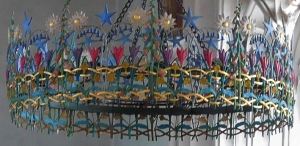
WE WERE FORTUNATE that we met a lady who unlocked (specially for us) the parish church of Saint John the Baptist with Our Lady and Saint Laurence in Thaxted, Essex. It was during our recent visit to the town in April 2021, when many churches tended to be kept closed most of the time. We were even luckier because this kind lady spent time with us, showing us the many interesting features within the building. Amongst these she pointed out: a cupboard colourfully painted with an Italian baroque design; an unusual lectern, also richly coloured; a decorative corona suspended from the ceiling of a southern aisle, and another above a figure next to the high altar. She told us that all these objects were made by the Marquis d’Oisy (1880-1959), who used to live in a cottage near Thaxted, an interesting man. My curiosity about the Marquis was aroused and after returning home, I looked for something about him on the Internet and found an informative article about the fellow, written by Julian Litten and published in “Saffron Walden Historical Journal”, issue number 24, Autumn 2012. Mr Litten has also recently published a book about the Marquis, which I have not yet seen.
A painted corona by the Marquis d’Oisy in Thaxted Church
The 37-year-old Marquis arrived in Essex in the summer of 1917. He settled in Plegdon Green, which is close to the present Stansted Airport and just over 4 miles south west of Thaxted. He lived out the rest of his life in Plegdon. He called himself ‘Amand Edouard Ambroise Marie Lowis Etienne Phillipe d’Sant Andre Tournay, Marquis d’Oisy’, and claimed to have been born in Rio de Janeiro. However, the so-called Marquis was neither an aristocrat nor born in South America.
It is most likely that the Marquis was born in Bath (England). Julian Litten’s research suggests that most likely the Marquis was born ‘Ambrose E Merchant’ the son of Ambrose C Merchant, a gasfitter, and his wife Alice Merchant (née Thomas) in Bath. When he grew up, the Marquis often used the name ‘Ambrose Thomas’.
By 1901, Ambrose Thomas (aka the Marquis) was living at Caldey Priory (near Tenby in Wales) where he was a Benedictine Monk. In 1902, he left the Order and most probably worked as a navvy, digging the Northern Line tunnels for the Underground Electric Railways Company of London. He did not keep this job for long. Until 1915, when he was working for a church furnishers’ company, Louis Grossé, as a vestment maker at St Saviours Church in London’s Hoxton, his life remains a mystery. It is not impossible that he spent some of the time learning the artistic skills that he was employ later in life.
The cottage that the Marquis moved into in 1917 was part of the estate at Plegdon owned by the silent-film screen actress Irene Rook, whom he could possibly have met if, as Litten suggested, he might have had some employment designing or manufacturing theatrical sets for films. By then, the Marquis was producing decorative wares such as the things he made, which we admired in the church in Thaxted. Litten suggested that Ambrose Thomas might have adopted the seemingly posh name Marquis d’Oisy whilst working at Louis Grossé but cannot be certain of this.
During WW1, there was a shortage of work for the Grossé company. This was probably the reason that the Marquis left in 1917 and came to live rent-free in Irene Rook’s cottage. It is likely that Irene Rook had bought things made by the Marquis and felt sorry for him when he faced unemployment in 1917. On arrival in Plegdon, Litten noted:
“At first, the locals were afeared of him, some even taking him to be a spy, attributing his exotic apparel of long cloak and floppy-brimmed hat as being more French than English. With money being in very short supply, he kept a cow tethered on the green for the sake of its milk, as well as a goat, and he grew edible flowers, fruits and herbs to keep the cost of his groceries down. He also kept two elegant greyhounds, and always slept in the open, whatever the weather, on the first-floor balcony of his cottage. Now that in itself points towards the probability of him having TB.”
Few of those who knew him well after he moved to Essex found it easy to believe that Ambrose was truly aristocratic. The film director Basil Dean (1888-1978), who lived near him, wrote of the Marquis:
“Lady Warwick used to say he came not from any foreign land but from the East End of London. He was a strange creature altogether, very tall and thin, emaciated almost, with a squeaky voice and a chin beard; and obvious homosexual … artist-antiquarian, vegetarian, and decorator – extraordinary of cottage replacements of period furniture to Lady Warwick. We owed to him much of our knowledge of Little Easton Manor’s history, all of our discovery of its foundations, and enthusiastic guidance along the path of its restoration. A passionate student of peasant ways – a folk-artist, you might say …”
The Marquis worked with Conrad Noel (1869-1942), the left-wing vicar of Thaxted (between 1910 and his death), known as the ‘Red Vicar’, about whom I will write in the near future. In 1923, he began making some of the objects that we saw in the church, beginning with the vestment cupboard he decorated with the Italianate motifs. Noel helped the Marquis by commissioning him to paint and/or create the following items as listed by Litten:
“…the lectern, the niche and statue of St Lawrence, the decorative carving on the reredos in the Becket Chapel, and commissioning two painted pewter coronas for the Lady Chapel and one for the statue of Our Lady as well as a band of identical cresting for the High Altar …”
We were shown some of these items by the lady who kindly let us enter the spacious, light-filled Perpendicular-style church, which was mostly built between the 14th and 16th centuries.
As well as his work at Thaxted church, the Marquis did extensive restoration work at Basil Dean’s Little Easton Manor and organised many folkloric pageants both in Essex and in London. Notable amongst the pageants was one organised near Thaxted in 1926 to raise money for the English Folk Dance Society who were trying to build their London headquarters in what was to become Cecil Sharp House (in London’s Regents Park Road). Music for this occasion was provided by the wife of the composer Gustav Holst, herself a composer, Imogen Holst (1907-1984). Gustav had strong associations with Thaxted and Conrad Noel, about which I plan to write. The largest event, arranged by the Marquis, was held at Hatfield House in 1936. With a cast of 600 and lasting 3 hours, the Marquis designed the costumes. The composer Ralph Vaughan Williams was amongst the audience. In addition to these activities, the Marquis created painted furniture for Heals in London and Sayles in Cambridge.
Irene Rook died in 1958 and left the cottage at Plegdon to the Marquis, who was by then a very far from wealthy man. Desperately short of money, he sold the cottage for a pittance in January 1959. Suffering from prostate cancer, he was put up by his former man servant Bernard Keel in his cottage at Takely, just south of the present Stansted Airport. He died in December 1959.
I have attempted to summarise what is known about the Marquis but omitted many of the fascinating details about this remarkable man’s life, which has been well-researched by Julian Litten, whose book “The Mystery of Marquis D’oisy” was published in late 2015. Had it not been for the superb tour given us by the kind lady who admitted us to the church in Thaxted, we would have most probably remained completely ignorant of the marvellous Marquis.
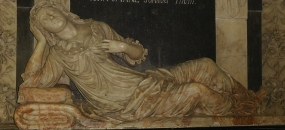
HER HEAD RESTS ON her stone-cold right hand with her elbow on a carved alabaster cushion. Her left hand is held lightly and limply against her left breast. She is a carved alabaster effigy of Dame Jane Cotton (1630-1692), widow of Sir John Cotton of Landwade (1615-1689). This sculpture of Jane Cotton lies against the north wall of the chancel of the Church of St Mary Magdalene in the village of Madingley, close to Cambridge. The church is open until 4pm most days and we got there by 3.45 pm a few days ago in April 2021. So, we were able to have a good look at the interior of this building whose construction commenced in the late 13th century (https://historicengland.org.uk/listing/the-list/list-entry/1127740).
Jane Cotton, who reclines close to the high altar, was the daughter and sole heir of Edward Hinde (c1598-1631) of the Parish of Madingley. Edward lived at Madingley Hall (www.thepeerage.com/p34969.htm#i349687), which is a few yards uphill from the church. Sir John Cotton did well by marrying Jane because by doing so, he acquired the manor of Madingley.
Sir John Hinde (or ‘Hynde’; c1480-1550; see: http://www.geni.com/people/Sir-John-Hynde-MP/6000000090158312935), Serjeant-at-Law and Member of Parliament, had been buying land at Madingley since the 1520s (www.british-history.ac.uk/vch/cambs/vol9/pp166-171). In 1544, the manor of Madingley, which had been held by several trustees for about 100 years, was bestowed on him by law. He commissioned the building of the lovely Madingley Hall, which was constructed between 1543 and 1547. Edward Hinde, Jane Cotton’s father, was a grandson of Sir John Hinde.
Sir John left Madingley to his son Francis, who left it to his son William, who married a widow, Elizabeth. When William died childless in 1606, his widow Elizabeth took over all of the Hinde estates. She remarried and leased Madingley Hall to Edward, who was son of William Hinde’s brother Edward (died 1633).
Jane’s father Edward (died 1633) settled his lands on his eldest son Anthony, who died before him, fighting in Denmark, in 1612, when Denmark was fighting Sweden for control of part of Norway. Anne, Anthony’s widow, ‘sold’ her interests in the lands to her father-in-law Edward (died 1633). Anne and Anthony had a son Edward, to whom Anthony’s father (Edward, died 1633) had left all his lands, but the grandson, Edward, died in an accident in 1631. Jane Hinde then became the heir to her father’s lands. Had Anthony and his son not pre-deceased Jane’s father, she would not have come into possession of the Hinde’s estates, and neither would have they come into the hands of Sir John Cotton. The lands at Madingley remained in the Cotton family until the beginning of the 20th century.
Sir John, husband of Jane, was buried with his ancestors at Landwade in eastern Cambridgeshire. His daughter Jane is interred in the church at Madingley. Her monument stands near the northwest corner of the nave. She is depicted kneeling with a small book in her left hand. Jane was a spinster. She died in 1707. Not far from her monument stands a lovely carved stone font. Covered with geometric decoration, this was made in the 12th century and probably stood in an earlier version of the church. Nearby, the internal walls of the bell tower are decorated with damaged sculptures made of wood. They are:
Although there is much to enjoy in the church at Madingley, it was Lady Jane Cotton’s reclining effigy that most sparked my curiosity. Looking into what is known of Jane’s heritage has revealed a little bit about the complexities faced by the ‘landed gentry’ when they considered who was to inherit their land.
The families mentioned are what some might describe, often expressing a sense of deference, as ‘old families’. What this means is that the family has sufficient documentary information to trace it back, maybe over many centuries, for many generations. Well, if you think about it ‘old families’ are no different from other families because all of them must go back an awfully long way in history, even if the documentary evidence no longer exists.
DURING THE COVID19 ‘lockdowns’, it is often impossible to venture within a church. On several occasions, especially when there are builders at work within a church, we have been lucky enough to be able to enter it. Otherwise, they are usually locked up. Not too long ago, I wrote about General De Gaulle’s brief period of residence in Hampstead and mentioned that he attended mass at Hampstead’s Roman Catholic St Mary’s Church (https://adam-yamey-writes.com/2021/03/22/french-connections/). Oddly, given how often we have visited Hampstead, I had never seen St Mary’s until we visited it in late March 2021. The church is located on Holly Walk about 180 yards north of Hampstead’s Anglican Parish Church.
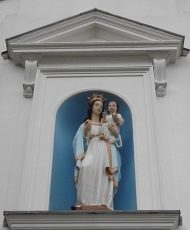
St Mary’s is set back from the road and its tall narrow façade is wedged between two terraced Georgian houses. The white painted façade with neo-classical ornamentation and a niche containing a large sculpture of the Virgin and Child, and a belfry with a single bell, has a Mediterranean or southern European look to it. It adds an exotic touch to its otherwise British surroundings. The façade was designed by the architect William Wardell (1823-1899), many of whose creations are in Australia. Born a Protestant, he was influenced by his friend the great Victorian architect Augustus Pugin (1812-1852), who converted to Roman Catholicism. Wardell followed in Pugin’s footsteps and became a Catholic, building several Catholic churches in England, including St Mary’s in Hampstead, before he moved to Australia in about 1858 (https://en.wikipedia.org/wiki/William_Wardell). In the 1840s, after becoming a Catholic, he became a parishioner at St Mary’s.
Prior to the construction of St Mary’s, the Roman Catholics in Hampstead worshipped in Oriel House in Little Church Row. When this became too small to accommodate the congregation, the present church was constructed in under a year and was ready for use in August 1816. At that time, the congregation was led by a French refugee, the Abbé Jean-Jacques Morel, whom I described in the article to which I referred above. While he was still officiating at St Marys, a Papal Bull, the “Restoration of the Hierarchy to England and Wales”, was issued in 1850. Included in this document was permission for bells to be rung from Catholic churches in England for the first time since the Reformation. It was this that led to the creation of the façade, designed by Wardell, which we see today.
Fortunately for us the door to the church was open when we arrived. A couple of workmen were doing some repairs and did not mind us entering the small church. According to Nikolaus Pevsner and Bridget Cherry in their “London 4: North” architectural guide, the interior was altered in 1878, and a sanctuary as well as two side chapels were added in 1907. The nave faces a baldachino supported by four pillars coloured black with gold-coloured decoration. The baldachino was designed by Adrian Gilbert Scott (1882-1963) in 1935. His family were parishioners of St Mary’s. Adrian lived in Frognal Way in a neo-Georgian house called Shepherd’s Well. Sir George Gilbert Scott (1811-1872), Adrian’s grandfather, also lived in Hampstead, at Admirals House close to Fenton House. There is a painting above the high altar that depicts the Assumption of the Virgin. This was painted by a student of Bartolomé Murillo (1617-1682) and presented to the church by one of its founders Mr George Armstrong.
There is a stone effigy in the northern side chapel, the Lady Chapel. It depicts a figure with hands together as in prayer, with a lion at his feet. Although Abbé Morel had requested to be buried under a simple marble slab, this effigy of him was commissioned by the architect Wardell. The lion at the feet of the cleric indicates that he died outside the country of his birth.
Although the interior of the church is not so old, it evokes the feeling of much older churches I have seen in Italy. As with the façade, the inside of St Mary’s feels as if it is in a country close to the Mediterranean. While visiting its interior, I popped a donation into a box in exchange for a copy of a booklet about the church, from which much of my information has been gleaned. The booklet includes information about some notable members of the church’s congregation, including General De Gaulle, the Duchess of Angouleme, William Wardell, the Gilbert-Scott family, the landscape artist Thomas Clarkson Stansfield (who lived on Hampstead High Street), the novelist Grahame Greene (1904-1991), and Baron Friedrich Von Hugel (1852-1925).
Greene, an agnostic, became converted to Catholicism and was baptised in February 1926, partly because of the influence of Vivien Dayrell-Browning, whom he married in October 1927 in the Church of St Mary’s in Hampstead.
Von Hugel, who lived in Holford Road, which runs east of Heath Street, was, like Greene, a convert to Catholicism. He was born in Florence, Italy, and moved to England when he was 15 years old. He was an influential religious historian and philosopher both inside and beyond the Roman Catholic Church. He was a leading proponent of Catholic Modernism, which:
Less cerebral than Von Hugel, but greatly skilled was Gino Masera (1915-1996), who worshipped at St Mary’s. The booklet describing the church notes that when working at London’s Savoy Hotel:
“His artistic talent was revealed when he was asked to carve a block of salt for table decoration. He regarded the commission to carve the Stations of the Cross [in St Mary’s] as a turning point in his career and went on to carve the statue of Christ the King which stands above the High Altar in St Paul’s Cathedral.”
St Mary’s Church stands above a large burial ground that lines the east side of most of Holly Walk. Less picturesque than St Mary’s, this cemetery contains some interesting gravestones including those of the actor Anton Wohlbrueck (Walbrook) who died in Germany but whose ashes are buried in Hampstead; the cartoonist George du Maurier; and the Labour politician Hugh Gaitskell.
Once again, visiting Hampstead, a district with a rich history has proved interesting. Each time we make a trip to the area, we see things we had not noticed before and this has resulted in gradually expanding our knowledge of a place that has attracted fascinating people as residents over several centuries.
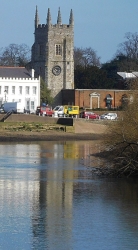
THE TOWER CAN BE seen from far away. From a distance, the visitor to Old Isleworth on the River Thames might be fooled into believing that the 14th century stone square church tower topped with four pinnacles, one at each corner, is attached to an equally venerable church, but this is no longer the case. The mediaeval tower is almost all that remains of the mediaeval church of All Saints in Isleworth. It is attached to a twentieth century structure that now serves as the church. When I saw this, I wondered what disaster had befallen the rest of the original pre-20th century church.
The origin of the name Isleworth is unknown. In the Domesday Book, it is listed as ‘Gistelworde’ and Norden, writing in 1591, named it both ‘Thistleworth’ and ‘Istleworth’. Simon de Montfort (c1205-1265), who expelled the Jews from Leicester in 1231, and his barons are known to have camped in Isleworth Park in 1263. To digress, maybe, in view of his anti-Semitism, the authorities of De Montfort University in Leicester, ought to reconsider its name. Getting back to Isleworth, the Domesday Book records that there was Christian worship in Isleworth (https://allsaints-isleworth.org/about-us/church-history/) and a vicarage is mentioned in records compiled in 1290 (www.british-history.ac.uk/vch/middx/vol3/pp122-129). The church, whose tower is still standing, was dedicated to ‘All saints’ in 1485 and was connected to Syon Abbey, a Bridgettine establishment, founded in 1415 in Isleworth, which was disbanded by Henry VIII. Interestingly, it was in the Abbey’s chapel that the body of Henry VIII lay overnight on its journey from Westminster to St Georges Chapel in Windsor (https://en.wikipedia.org/wiki/Syon_Abbey). The abbey stood where Syon House stands today.
The church is said to have been ‘very ancient’. Its chancel was rebuilt in 1398-99. By 1701, the church was in a poor condition and needed rebuilding. Christopher Wren, architect of London’s St Paul’s Cathedral, was invited to redesign the church. His design was deemed to costly to be carried out and was discarded. Eventually, the churchwardens brought out Wren’s plans and modified them to make the construction of the church more economical. James Thorne, author of “Handbook to the Environs of London” (published 1876), wrote that:
“Apart from its ivy-covered tower, there could not well have been an uglier ch[urch] than that of Isleworth a few years ago…”
However, he added:
“…but it has been transformed, the windows altered, a new roof of higher pitch, and a lofty white-brick Dec. [i.e. gothic revival] chancel added, greatly to the benefit of the general effect.”
He also described many improvements to its interior and noted the existence of a fine organ built by Father Schmidt (Bernard Schmidt: c1630-1708). Alas, none of what Thorne described, apart from the tower, can ever be seen again.
Except for the tower, the church was destroyed by fire in 1943 during WW2. The fire was not the result of military activity but was caused by two young boys. These same two miscreants also set fire to Holy Trinity Church in Hounslow a few days later. This is what happened (https://stmargarets.london/archives/2013/05/fire_starter.html):
“In the early hours of Friday, 28th May 1943, All Saints Church, standing by the Thames in Old Isleworth, was destroyed by fire. The alarm was given at 2.30am by Miss Burrage who lived next door and again by Mr. McDonald, the publican of the “London Apprentice”. Against the darkness of the wartime black-out the glow of the huge fire could be seen for miles.
Three days later, on the afternoon of Tuesday 1st of June 1943, the Parish Church of Hounslow (Holy Trinity) was completely destroyed by fire. Shortly after 5.00pm smoke was reported to be issuing from the church … The police noted that an attempt had been made to open the church safe…”
Two boys, one aged 12 and the other 13, were arrested and tried at Brentford in the old courthouse, which is now home to a restaurant/café called The Verdict. These two youngsters had been in court several times before for crimes of petty theft. In court, they admitted:
“…that they only set fire to the churches out of spite and only if they found no money to steal. They told the chairman Mr. A. J. Chard J.P, how easy it was to break into churches and how easy it was to burn them down. At the Mission Hall they set fire to the curtains. At Broadway Baptist Church they set eight separate fires. At Holy Trinity it was five. The older boy also confessed to burning down a haystack in a coal yard a year earlier.”
The two arsonists were sent to approved schools. The Chairman of the Court recommended:
“…to the Home Office that the two lads should go to separate schools and that the schools should be of the strictest kind; further, that they should be kept there for the full period of three years.”
All Saints Church was rebuilt yet again in 1970 to the designs of architect Michael Blee (1931-1996), who built several churches. From the outside it is quite an attractive structure attached to the mediaeval tower.
While wandering around the church, two things caught my eye. One is a stone placed close to a large yew tree in the churchyard. The stone informs us that the yew tree is growing upon the site where 49 people, who died in the Great Plague of 1665, were buried. The other feature that interested me was a group of stones set in the wall surrounding the churchyard. Each of these records the level to which water reached when the Thames flooded on various years between 1774 and 1965. The building of The Thames Barrier, completed in 1984, brought an end to these flooding events.
All Saints Church stands a few yards away from the riverbank from where there are wonderful views of the Thames and Isleworth Ait and a rich selection of waterfowl swimming in the river. Given how close the old part of Isleworth is to suburban west London, it has a remarkably rustic feeling, and is a peaceful place, providing you ignore the low-flying aircraft that pass above every few minutes.
IN SEPTEMBER 1940, a 17th century church in London’s Soho was destroyed by fire because of aerial bombardment by the Luftwaffe. All that remained intact was the tower at the west end of the church, St Anne’s Soho. Today, the tower still stands and overlooks a small but interesting churchyard.
St Anne’s was completed in 1686 during the period when Soho was becoming urbanised as London grew in a westerly direction. It had been designed either by (more likely) Sir Christopher Wren (1632-1723) or by William Talman (1650-1719), or maybe they collaborated (www.british-history.ac.uk/survey-london/vols33-4/pp256-277). According to John Timbs, writing in “Curiosities of London”, published in 1867, when the church was standing:
“The interior is very handsome and has a finely painted window at its east end.”
Sadly, this no longer exists. The tower, which we see today, was built in about 1806 to the design of Samuel Pepys Cockerell (1753-1827), great-great nephew of the diarist Samuel Pepys, to replace an earlier one that had become unstable.
The pleasant rectangular churchyard that extends from the tower to Wardour Street measures approximately 150 feet by 80 feet. It contains several fascinating memorials, some of which used to be inside the church before it was bombed. Standing near the northern edge of the churchyard is the prominent gravestone for the essayist William Hazlitt (1778-1830), one of my favourite writers, who died in a house in Frith Street, not far from the church. His gravestone bears an extremely lengthy inscription, which might have been composed by a lawyer and poet called Charles Jeremiah Wells (c1800-1879; http://www.lordbyron.org/persRec.php?choose=PersRefs&selectPerson=ChWells1879), who had become a “devoted acolyte” of Hazlitt (according to his biographer AC Grayling). Amongst many other positive attributes, the inscription describes Hazlitt as:
“… The unconquered Champion of Truth, Liberty, and Humanity…”
There is a second monument to Hazlitt, which is attached to the wall of the tower. This has less of an inscription, but includes the words:
“Restored by his grandson February 1901”.
Near to this and also attached to the tower, there is a small rectangular metal plate in memory of the Welsh philosopher David Williams (1738-1816), who founded The Royal Literary Fund in 1790, lived in Gerrard Street, and is buried somewhere in the churchyard.
The most curious memorial in the churchyard is to Theodore, King of Corsica. The monument informs that Theodore died in the Parish of St Annes soon after his release from the King’s Bench Prison in 1756. This man, Theodore Anthony Neuhoff, who was born in Prussia, disembarked from an English vessel on the coast of Corsica in Spring 1836. He had with him a considerable supply of arms and money. He led the Corsicans in a successful revolt against their Genoese rulers and was crowned ‘King of Corsica’. After a short time of peace, the Genoese returned, and Theodore travelled around Europe trying to seek foreign supplies and aid. His journey took him to Livonia, France, and Holland, where he managed to obtain a frigate armed with 52 guns and an army of 150 men. Sadly, the Neapolitans arrested him and imprisoned him in the north African town of Ceuta. Unable to help his Corsican subjects, he fled to London, where problems with debt landed him in prison (for full story, see: “The Patrician, Vol. 1”, 1846, edited by Bernard and John Burke). His memorial states that after getting into debt, he “registered the Kingdom of Corsica for use of his creditors”. His memorial was financed by the writer and politician Horace Walpole (1717-1797), whose words about Theodore, who died a pauper, are inscribed on the stone:
“The grave, great teacher, to a level brings
Heroes and beggars, galley-slaves and kings;
But Theodore this moral learn’d ere dead;
Fate pour’d its lesson on his living head,
Bestow’d a kingdom, and denied him bread.”
The bodies of Hazlitt, Williams, and the King of Corsica, are amongst the 60,000 corpses buried in the graveyard, which his why the level of the ground in the churchyard is much higher than the pavement in Wardour Street that runs alongside it.
Hidden from sight because it is below the ground floor of the tower are the ashes of the author Dorothy L Sayers (1897-1957), who was a churchwarden at St Anne’s between 1952 and 1957. I have not yet discovered her connection with Soho.
More recent monuments are also of interest. There is a list of those of the parish, who died in WW1. Beneath that there is one to those who died in active service in WW2, which includes several with probably non-English surnames: Rosenfeld, Grossman, Kosky, and Masser. This monument also remembers those in the parish who died during the Blitz. A small plaque on a post in a flower bed records the names of three young people who were killed on the 30th of April 1999 when the Admiral Duncan pub in nearby Old Compton Street was bombed by a racist homophobe, David Copeland (https://www.bbc.co.uk/news/uk-england-london-47216594). A triangular wooden bench near the monument to the victims bears a plaque that reads:
“This triangular bench represents Brixton, Brick Lane, and Soho, three places brought together by acts of hate, made stronger by acts of love. 17 – 24 – 30 April 1999”.
The three places were all sites of horrific nail bombings that April.
So much for the churchyard, but what about the church? After many years of having used the site of the bombed church as a car park, which I can dimly recall, a new building that contains social housing as well as a small chapel was built in the early 1990s. The new church is entered from Dean Street. Apart from being a site of many historical associations, the churchyard is a peaceful haven in the heart of a normally busy part of central London.
SOHO SQUARE IN London’s West End contains two places for Christian worship: St Patricks Church (Roman Catholic); and The French Protestant Church. After Henry VIII came to the throne, life in Britain began to become awkward and sometimes dangerous for Roman Catholics. At around the same time, the same was the case for French Protestants (the Huguenots) across the English Channel in France. Life for the Huguenots was perilous in their native land. For example, in 1545 several hundred Waldensians, people who questioned the truth of the teachings of the Catholic Church, were massacred in Provence, and about ten years before that, more than 35 Lutherans were burnt elsewhere in France. Things got worse for the French Protestants during The Eight Wars of Religion (1562-1598; https://museeprotestant.org/en/notice/the-eight-wars-of-religion-1562-1598/). Even before the war broke out, Huguenots began fleeing to places where Protestantism was either tolerated or encouraged. England was one of these. Under the Tudors, the country became home to Huguenot refugees from France and Holland.
When the Huguenots began arriving in London, that is during the 16th century, the metropolis covered mainly what is now the City of London and areas just east of it such as Spitalfields. So, it was in what is now the City and East End that the Huguenots settled and added significantly to the richness of London life. Fournier Street in Spitalfields is one of several streets where they worked and lived. As the centuries passed, London expanded westwards and what some now call the West End began to be developed. Soho Square was built in the 1670s. As increasing numbers of Protestant refugees arrived in England, some of them settled in the newly developed western parts of London. Writing in his “Huguenot Heritage” Robin D Gwynn noted:
“If Huguenot taste made an impression in the cramped quarters of Spitalfields, it was stamped more deeply on the life of the nation through the work of the refugee settlement in Westminster and Soho. Here was the centre of French fashion, cuisine and high society in England, located conveniently near Court and Parliament.”
The churches used by the Huguenots in London were mainly in Spitalfields before the West End was built. By the 18th century, there about 14 in Westminster and Soho. By the 18th century, there were 31 Huguenot churches and their number increased to such an extent that the Anglican Church began to feel that its churches were becoming outnumbered in London. A version of the Marriage Act that was in force between 1753 and 1856:
“…required marriages other than those of Jews and Quakers to take place in a Church of England church, and led to the demise of some French churches. Some Huguenots of Spitalfields chose Christ Church as their place of worship. It was also the case that Huguenots gradually assimilated and intermarried into English society during the century since their arrival, eliminating the need for separate French churches.” (www.thehistoryoflondon.co.uk/huguenots/2/)
By the latter part of the 19th century:
“Soho was London’s major French neighbourhood and was therefore the obvious setting to build a new church …” (www.egliseprotestantelondres.org.uk/en/heritage/history-2/huguenot-refuge-england/)
The church that was constructed is that which is located on the west side of the northern edge of Soho Square and was completed in 1893. It was designed by Aston Webb (1849-1930), who also designed a façade on the Victoria and Albert Museum in South Kensington. The ornamental details on the mainly red stone façade were created by William Aumonier (1841-1914), a sculptor with some Huguenot ancestry. A bas-relief in the demi-lune above the main entrance attracted my attention. On the left, there is a depiction of a crowded sailing ship. On the right, there is a man holding a document, which is being signed by a man (a king) holding a quill pen. Both panels are surmounted by angels. The base of the sculpted demi-lune has the following inscription:
“To the glory of God & in grateful memory of HM King Edward VI who by his charter of 1550 granted asylum to the Huguenots of France.”
Edward the Sixth (lived 1537-1553) was only nine years old when he succeeded his father King Henry VIII, yet even at this tender age he was an ardent promoter of Protestantism as the state religion. Following the visits to London by Protestant leaders such as John Laski (Jan Łaski or Johannes à Lasco (1499 – 1560), King Edward VI issued Letters Patent, which permitted the establishment of the (protestant) Dutch and French churches of London. Robin Gwynn wrote that:
“The nature of the letters patent was most unusual. In an age which set great store on stringent religious conformity, they allowed foreigners in London to worship … freed even from the jurisdiction of the Bishop of London.”
A reason that Edward VI might well have sanctioned these foreign Protestant churches was because he hoped that they would be, to quote Gwynn:
“… the model, the blueprint, for a pure, reformed Church of England. The twin refugee churches [i.e. French and Dutch*] offer us a window into the future envisaged by Edward, a future in which there might be superintendents but not bishops.”
Laski had been a superintendent in Emden before he came to England. As such, he:
“… instituted the first example in England of fully-fledged reformed Protestant discipline, based on elected, ordained ‘elders’.”
At the end of Edward’s short reign and his successor Lady Jane Grey’s even shorter one, Queen Mary, a committed Catholic, temporarily put the brakes on the advancement of Protestantism in Britain, and Laski fled to the European mainland with some of his congregation.
The Roman Catholic Church of St Patricks that stands close to the French church was designed by John Kelly (1840-1904) and built between 1891 and 1893 on the site of one of the first Catholic buildings to be allowed in England after the Reformation (which countered Catholicism). It is interesting to note that many of the Catholics who came to London (from, for example Italy and Ireland) over the centuries were economic refugees rather than religious fugitives, as were the Huguenots.
Despite the passage of time, Soho remains a richly cosmopolitan district of London. Although there are fewer than in than in the past, the area is still home to some fine purveyors of imported foods, notably delicious ingredients from Italy. Back in the 1960s, when I was a child, my mother used to do much our food shopping in these stores as well as in French and Belgian shops, which have long since closed. The disappearance of shops such as these is probably partly a reflection of the migration of members of communities such as the Huguenots out from the centre of town to the suburbs.
*Note: the Dutch Church is currently in Austin Friars in the City. It was first established in 1550.
One of the daughters of my former PhD supervisor was about to get married. As a friend of his family, I was asked to be one of the four ushers at the service, which was to be held at St Giles and St Andrews, better known as ‘Stoke Poges Church’, whose graveyard has been immortalised by the poet Gray in his “Elegy Written in a Country Churchyard”. The church stands on land that was once owned by William Penn (1644-1718) after whom the American state of Pennsylvania is named.
Stoke Poges Church
As an usher, I was required to wear formal ‘black tie’. So, not possessing such clothes, I had to hire the necessary formal attire. I went to a branch of Moss Brothers, who hire clothing, and was fitted out with all the trimmings, morning suit, trousers, waistcoat, shirt, bow tie, and a top hat, but no cummerbund. Getting a top hat that fitted properly presented great difficulty to the assistant at the clothes hire shop. He looked at my head knowledgeably with an air that suggested to me that he was an experienced clothing fitter. After a moment’s contemplation, he decided that I needed a certain size. The hat he chose by eye was far too small. It wobbled uneasily on the crown of my head. He selected another size. At this stage, I was still impressed that he appeared to be able to judge head size by eye. The next hat was far too large. It slipped right over my ears. I became less impressed with the fellow. Eventually, he found one that almost fitted my head; its rim rested on the tops of my ear lobes. That was the best he could do. I hired this and all the rest of the required ‘gear’.
Just before the wedding, I got dressed in my formal wear at the bride’s parents’ home. I had endless difficulties trying to get dressed in the two-piece waistcoat, which seemed to separate into two separate items whatever I did. One of my fellow ushers managed to get this on to me correctly as well as to fasten my bow tie (another skill I have yet to master). Sadly, I do not possess any pictures of me in this ‘get up’. Then, we set off for the church.
Of the four ushers, two were Christian and two were Jewish. The two Christians were on duty outside the church. The two ushers inside the church were Jewish by birth. I was one of them and the other was Victor, a friend of the bride. Victor, whom I had not seen for several decades, was one of my classmates at primary school in Golders Green back in the 1950s. My duty as usher was to help people find a seat in the church and to hand out leaflets, which I referred to as ‘programmes’ until one lady with a plummy voice told me sternly:
“They’re not programmes, dear; they’re Orders of Service, don’t you know.”
Well, you learn something every day.
About 25 years later, I communicated with Victor, whom I had not seen since the wedding, via the LinkedIn website. We agreed to meet for lunch at an Italian restaurant near London’s Charing Cross Station as Victor was coming up to London from his home on the south coast. I arrived at the restaurant a few minutes before Victor. When he came through the door, I recognised him. He had aged but was still recognisably Victor, even though his hair which had been red when we were children was no longer that colour. Red hair, or ‘orange’ as I used to call it as a child, fascinated me in my young days. I greeted him, and he shook my hand, saying:
“Hmmm … you are not the person I was expecting to meet.”
I was not sure whether to feel pleased or upset that he had mixed me up with someone else from his past.





 yamey
yamey 