Is there a Picasso on your plate?

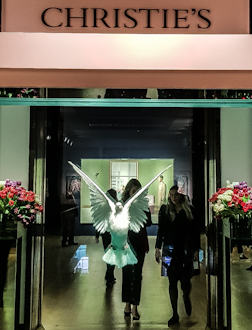
IT IS ALWAYS WORTH ‘popping’ into Christie’s auction house in London’s Mayfair because there is usually a display of interesting objects being displayed prior to being auctioned. When we visited the place on 16 May 2025, there was a collection of ceramics created by Pablo Picasso (1881-1973). They included plates, jugs, and decorative objects.

Picasso began producing ceramic objects in 1947. The Madoura pottery studio in Vallauris, France produced blank ceramic items, which Picasso then decorated. A website dedicated to Picasso’s ceramics (https://picasso-ceramics.org/) gives much information about the artist’s involvement in this form of art, and I have quoted from it below. The website explained that Picasso began producing ceramics because:

“… the high prices and relative rarity of Picasso’s paintings meant that most people would never be able to own one, the artist liked the idea of working in a medium that would be more accessible to the average person. He realized that pottery could be produced on a scale that his paintings could not. With prices of around $100 in the 1950s and 1960s, Picasso’s ceramic series were far more financially accessible than his previous artworks. The utilitarian nature of his pottery also made the art form more appealing to the general public, who may not understand the appeal of an abstract painting, but who could appreciate the value of a beautiful plate or pitcher.”

As he had never worked with ceramics before this, he had to develop his techniques and learn how materials behaved when they were incorporated with ceramics. However, his experience with lithography assisted him, as the following explained:

“Since Picasso had no prior training in ceramics, professional potters at Madoura would create blank ceramic objects for him to work with. He would then reshape, paint, and engrave the pottery to create his original designs. Picasso had previous experience engraving lithographs, which informed the methods he used to engrave his pottery, as well as his choice to release the pottery in numbered editions. While this numbering practice was common for lithographs at the time, it was relatively unheard of for pottery.”

The designs on Picasso’s attractive ceramics were largely inspired by Spanish folk art. The auction house beautifully displayed the objects that will come up for sale on 22 May 2025. If you are interested in owning a piece, it is an online auction: https://onlineonly.christies.com/s/picasso-ceramics/lots/3722

When two holy men meet in a picture from Afghanistan

VISITING CHRISTIE’S AUCTION house near London’s Piccadilly is never disappointing. There are usually items on display, waiting to be auctioned, which are of great interest. Today (25 April 2025), we viewed the items awaiting a sale that will be held on the first of May. The sale is called “Art of the Islamic and Indian Worlds Including Rugs and Carpets”. Standing alone in one room is a folio (page) with coloured paintings on its front and back. This item has been called “The Prophet Muhammad Meets Jesus in the Beit Al-Ma’mur and the Arrival at the The Fourth Heaven”. It was created in Afghanistan in about 1466, and is in remarkably good condition.

The images show two episodes in the Mi’raj, which as the Christie’s website explained is:

“… one of the most important moments in the life of the Prophet Mohammed. In the Qur’an, sura al-‘Isra alludes to the fact that Allah transported ‘his servant Muhammad by night from the Masjid al-Haram to the Masjid al-Aqsa, whose surroundings we have blessed, so that We may show him some of Our signs’. Though traditions vary, most take this to be a reference to the Prophet being miraculously taken from Mecca to Jerusalem and thence to Heaven.”

Muhammad is depicted as riding on Buraq, his quadruped mount. In the picture at Christie’s, Buraq has been shown as having a human head. In one picture, the Prophet Muhammad is dressed in green and can be seen riding on Buraq and meeting a man dressed in brown robes, who is Jesus (Isa) Christ. In between Jesus and the Prophet, there is a figure with wings, the angel Jibra’il (Gabriel). These holy men are shown meeting in the Beit Al-Ma’mur, which is a celestial form of the Holy Kaaba at Mecca. The picture on the reverse of the folio, we find the Angel Gabriel depicted again. He seems to be heading for a group of angels, followed by the Prophet dressed in green and riding on Buraq.  The angels in the picture are shown greeting the Prophet and Gabriel as they make their way through the tiers of heaven.

Apart from being amazingly beautiful, there were some details that caught my eye. Jesus is depicted with a face that could be Arabic. All the other faces, including that of Muhammad, have oriental eyes typical of Central Asia or further east. The faces of others in the pictures, including that of Buraq, are typically Far Eastern in type. I suppose that in 15th century Afghanistan, Central Asian faces were a familiar sight.  In the picture that depicts Muhammad moving towards the angels, much of the space surrounding the figures is filled with swirling golden clouds which makes the picture look like a Chinese creation at first sight. Another detail that interested me, and which I spotted in some other pictures on display at Christies, was that although the artist had drawn a frame around the image, one angel seemed to be standing partly outside the frame.

One of the delightful features about Christie’s is that if one asks a member of staff a question about an exhibit, he or she will go out of their way to answer it accurately. In the case of the pictures described above, a gallery assistant asked one of the specialists who dealt with it to come from her office to discuss it with us. This lady answered our questions and explained that what we were looking at is extremely rare. The folio at Christie’s was from a book, whose pages have been dispersed to many different places over time.  In Paris there is another very similar but slightly older example of that book, but the page with the episodes I have just described has been lost from it.  

The auction whose lots we saw on display contains many fine Mughal and other Indian pictures and objects, as well as items, such as the folio, which originated in Islamic countries such as Persia, Turkey, and places in Central Asia. Once again, a visit to Christie’s has proved most rewarding.

Some sculptures at an auction house in London’s Mayfair

THE FAMOUS SCULPTOR Elisabeth Frink (1930-1993) was a regular visitor to our family home in Hampstead Garden Suburb during the 1960s. During that period, I met her whenever she was invited home for dinner, but then I was too young to realise how famous an artist she had become. She was a good friend of my mother, Helen Yamey (1920-1980), who was also a sculptor. Elisabeth and my mother got to know each other when they were both creating art in the Sculpture Department of the St Martins School of Art, when it was in Charing Cross Road.

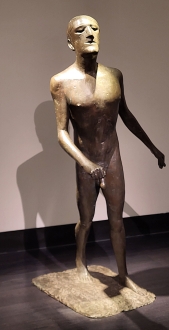
By Elisabeth Frink

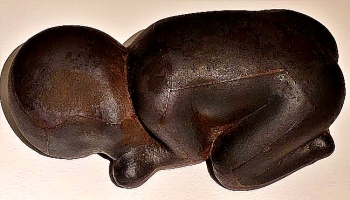
Today (15th of November 2024), I was reminded of my mother’s friendship with Frink when we entered Christie’s auction house in Mayfair. We always enter this place when we are passing near it to see some of the works of art that are on display prior to being auctioned. You never know what gems you are likely to see. Today, there was a small collection of British art created during the past 100 years. Amongst the works on display were two by Elisabeth Frink. There were also some pieces by Henry Moore (1898-1986) and by Barbara Hepworth (1903-1975). One of the works by Hepworth was a painting, the other two were sculptures. Each of these artists has become some of the greatest of 20th century British artists.

During the first half of the 1960s, my mother’s sculptures were chosen to be exhibited in prestigious exhibitions, mainly in London. In these various exhibitions, her work was selected to be exhibited alongside the creations of the three artists mentioned above, as well as other artists, who have now achieved fame (e.g., David Hockney, Paula Rego, Michael Ayrton, and Bridget Riley). Despite this, my mother’s artistic work is now largely forgotten. In my recent book about her, “Remembering Helen: My Mother the Artist”, I describe her life, her character, and consider why her art, which was judged worthy of display with the best artists of the time, has faded into obscurity.

[The book is available from Amazon: https://www.amazon.co.uk/REMEMBERING-HELEN-MY-MOTHER-ARTIST/dp/B0DKCZ7J7X/]

Catherine the Great and the extravagant earl

MANY MARKET PLACES in English and Scottish towns have what is called a ‘market cross’. These are often elaborate and ornate structures. One definition of such a building is (according to Wikipedia): “… a structure used to mark a market square in market towns”. Some of them include crosses (of the Christian variety), others do not. A market cross can range in design from a simple cross or obelisk to a significant structure, sometimes serving as a covered shelter.

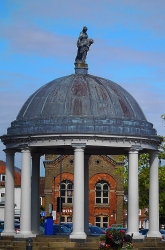
The market cross in Swaffham, Norfolk, is in the form of a circular shelter topped with a lead covered dome supported by eight plain columns with Doric capitals. The dome is surmounted by a statue of the Roman goddess of corn and agriculture, Ceres. She is depicted holding in her left hand a cornucopia filled with vegetables, and in her right a bundle of heads of corn. This market cross with its statue that harks back to pre-Christian religion does not contain or otherwise display the cross associated with Christianity.

The market cross is a distinctive and attractive feature in the centre of Swaffham’s large, triangular marketplace. Also known as the Butter Cross, it was designed by a Mr Wyatt, who might possibly have been the architect James Wyatt (1746-1813), who specialised in both neo-classical and gothic revival styles. It was completed in 1783 for the politician George Walpole, 3rd Earl of Orford (1730-1791), grandson of Sir Robert Walpole, 1st Earl of Orford (1676-1745), who became Britain’s first prime minister. George Walpole, founder of The Swaffham Coursing Club (i.e., hare coursing) in 1776, the first such club in England, was extremely extravagant. To raise money, this decadent and bankrupt fellow sold his grandfather’s collection of 204 old master paintings, which used to hang in Houghton Hall (Norfolk), to Catherine the Great of Russia in 1778. The sale was arranged by James Christie, founder of Christie’s auction house and raised £40,555. Seventy of these paintings were returned briefly to Houghton Hall for a temporary exhibition held there in 2013 (www.tretyakovgallerymagazine.com/articles/%E2%84%964-2013-41/walpole-paintings-houghton-hall-brief-homecoming).  

According to a brief history of Swaffham by David C Butler, the market cross in Swaffham was known as the Butter Cross because trading in butter was carried out beneath its dome. In the 18th century, large amounts of locally produced butter were sent to London, where it and other butter from the district was known as ‘Cambridge Butter’.

Restored in 1984, the eye-catching domed structure is, according to David Butler, now a designated scheduled ancient monument. However, it appears to have been ‘de-scheduled’ and re-designated as a ‘listed building’ (https://historicengland.org.uk/listing/the-list/list-entry/1269570). I am unsure what to make of this, but that need not bother you should you happen to pass through Swaffham, the childhood home of Howard Carter, the discoverer of the grave of Tutankhamun, and the birthplace of Admiral Sir Arthur Knyvet Wilson (1842-1921), a hero of the Anglo-Egyptian War of 1882. Should you wish to sit and contemplate the decadent earl’s contribution to Swaffham, I suggest you have a refreshment at an outside table next to a café named after the Ancient Egyptian king discovered by Carter.

How sad is that?

I was visiting Christie’s auction house in London to view some modern art being displayed prior to an auction.

Seated by a large painting by David Hockney, there was a well dressed man looking at his mobile phone.

A decorous young lady sauntered up to him and said in a French accent:

“Do you follow me on Instagram?”.

The man looked up and said:

“No. Who are you?”

How sad is that?

Shaped by nature, not by man

The word GOGOTTE is pronounced ‘go-got’

gogotte 1


Quartz and chalk were fused

millions of years ago

to create  gogottes


gogotte 2


These two gogottes were from Fontainbleu. They were on sale at Christies auction house in London