IT IS ALWAYS WORTH ‘popping’ into Christie’s auction house in London’s Mayfair because there is usually a display of interesting objects being displayed prior to being auctioned. When we visited the place on 16 May 2025, there was a collection of ceramics created by Pablo Picasso (1881-1973). They included plates, jugs, and decorative objects.
Picasso began producing ceramic objects in 1947. The Madoura pottery studio in Vallauris, France produced blank ceramic items, which Picasso then decorated. A website dedicated to Picasso’s ceramics (https://picasso-ceramics.org/) gives much information about the artist’s involvement in this form of art, and I have quoted from it below. The website explained that Picasso began producing ceramics because:
“… the high prices and relative rarity of Picasso’s paintings meant that most people would never be able to own one, the artist liked the idea of working in a medium that would be more accessible to the average person. He realized that pottery could be produced on a scale that his paintings could not. With prices of around $100 in the 1950s and 1960s, Picasso’s ceramic series were far more financially accessible than his previous artworks. The utilitarian nature of his pottery also made the art form more appealing to the general public, who may not understand the appeal of an abstract painting, but who could appreciate the value of a beautiful plate or pitcher.”
As he had never worked with ceramics before this, he had to develop his techniques and learn how materials behaved when they were incorporated with ceramics. However, his experience with lithography assisted him, as the following explained:
“Since Picasso had no prior training in ceramics, professional potters at Madoura would create blank ceramic objects for him to work with. He would then reshape, paint, and engrave the pottery to create his original designs. Picasso had previous experience engraving lithographs, which informed the methods he used to engrave his pottery, as well as his choice to release the pottery in numbered editions. While this numbering practice was common for lithographs at the time, it was relatively unheard of for pottery.”
The designs on Picasso’s attractive ceramics were largely inspired by Spanish folk art. The auction house beautifully displayed the objects that will come up for sale on 22 May 2025. If you are interested in owning a piece, it is an online auction: https://onlineonly.christies.com/s/picasso-ceramics/lots/3722
HITCHIN IN HERTFORDSHIRE is the home of the North Hertfordshire Museum. Until 25 May 2025, it is holding an exhibition of the ceramic artworks of Abdo Nagi (1941-2001). He began life in Yemen, where during his early years he was a goatherd. When he was 12 years old, against his father’s wishes, he moved to Aden, where he worked for British ‘ex-pat’ families living there. In 1967, he moved to the UK with his then employer, and eventually settled in Letchworth (Hertfordshire). To earn a living, he worked in a Wimpy bar, then a hotel, and then an engineering firm.
After passing O’level and then A’ level examinations in art, Nagi was appointed Assistant art Technician at North Hertfordshire College. It was here that his creativity began to flower. He began creating ceramic artworks that were inspired by his Yemeni background, and made money by selling them. Then he took a degree in ceramics at Middlesex, graduating in 1988. From then on, his artistic career took off. His work was exhibited in important shows all over the country. The North Hertfordshire Museum bought three of them for their collection. Sadly, a heart attack killed him at the age of 60.
The works currently on show in Hitchin’s fine museum are well-displayed alongside pictures of Abdo at work and various portraits of him painted by local artists. I liked almost all of the works on display. Some of them are unusually shaped, possibly inspired by the crafts of his native land. There is nothing in the exhibition that I would not like to possess – and some of the works are on sale. If you happen to be passing anywhere near Hitchin (a lovely historic town), making a detour to see this show would be worthwhile.
IN 1961 MY MOTHER, Helen Yamey (1920-1980) was invited to exhibit some of her sculptures in the prestigious London Group (‘LG’) annual exhibition. The LG, founded in 1913, staged artists whose work was good, but too adventurous or experimental for the Royal Academy. It was the first group in Britain to actively promote Modernism in British art. Her warks were exhibited alongside those of now famous artists such as Frank Bowling, David Hockney, Howard Hodgkin, Francis Newton Souza, Eileen Agar, Frank Auerbach, Duncan Grant, LS Lowry, Julian Trevelyan, and Vanessa Bell. Because of the last name mentioned, it was with great interest to me that we visited the exhibition of works by Vanessa Bell which was being held at the Milton Keynes Gallery until 23 February 2025.
Vanessa Bell (1879-1961), a niece of the famous Victorian photographer Julia Margaret Cameron, was in the final year of her life when the above-mentioned LG exhibition was held. It would be interesting to know whether she met my mother at this show. There is a small chance that this meeting might have happened because the LG exhibition was held in March 1961 and Bell died (of a brief illness) in early April that year.
The exhibition at Milton Keynes was well-curated and beautifully laid-out. In a series of interconnecting rooms, the visitor was able to follow Bell’s creative output from the beginning of the twentieth century until near the end of her life. The show demonstrates Bell’s great versatility as an artist. One of the earliest of her paintings is a portrait of her father, Sir Leslie Stephen. It is an extremely competent painting in the style of the Old Masters. Soon after painting this, her style changed because of being influenced by the styles of early twentieth century European avant-garde artists. Her paintings began to acquire a tendency towards abstraction, but with a few exceptions on display at the exhibition, they never ceased to be even slightly figurative. In 1912, she exhibited her works in the Second Post Impressionist Exhibition alongside those of, for example, Matisse, Braque, and Picasso. A few of the paintings we saw reminded us of Modigliani.
Shortly before the outbreak of WW1, Vanessa moved out to Charleston in Sussex along with her husband Clive Bell, Duncan Grant, and Duncan’s lover David Garnett. She hired a cottage so that Duncan and David could work as farm labourers and thus avoid being conscripted into the military. After WW1, when the more adventurous styles of what was then ‘modern art’ went out of fashion in the English art market, Bell’s paintings reverted to being more figurative in style. The exhibition includes many examples of art which were created collaboratively by Vanessa Bell and Duncan Grant. These works include furnishings (many for decorating the house in Charleston) and ceramic works, including a series of 50 plates, each with a portrait of a famous woman. These were commissioned by the art historian Kenneth Clark and were all on display in the exhibition. Bell also designed many book covers, notably for her sister, the author Virginia Woolf,
Bell’s later paintings were all beautifully executed, many of them being depictions of domestic scenes. Although my favourites were her earlier paintings that tended towards abstraction, I was also very much taken by some of her later paintings executed in the 1950s. Having declared that, I must say that I am very pleased that I managed to see the wonderful exhibition at Milton Keynes in the ‘nick of time’.
Returning to my mother, whose works were exhibited in the same show as Vanessa Bell’s in 1961, you can read all about her and her activities at the forefront of British sculpture in the 1950s and early 1960s in my book “Remembering Helen: My Mother the Artist”, which is available from Amazon, e.g.:https://www.amazon.co.uk/REMEMBERING-HELEN-MY-MOTHER-ARTIST/dp/B0DKCZ7J7X/
DURING OUR TRIP to India in late 2023 and early 2024, we saw works of art that have been created using ceramics. The creators of these ceramic artworks shape clay into a form that they have in mind, glaze it, and fire the object in a kiln. The artists hope that what emerges from the kiln after firing and cooling will resemble what they had in mind. The resulting sculptures and other artworks bear the conceptual imprints of the artists’ visions – usually with considerable accuracy.
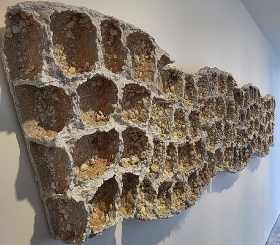
Today, the 7th of February 2024, we visited an exhibition in London’s Lisson Gallery in Paddington. On until the 10th of February 2024, it is a display of the creations of the Japanese sculptor Masaomi Yasunaga (born 1982), who works in Japan. All the exhibits are bizarre but beautiful – quite unlike anything I have ever seen.
Yasunaga is part of an avant-garde group of Japanese artists, Sodeisha, which was formed after WW2. The movement rejected and challenged previous Japanese artistic traditions. It also introduced non-functional ceramic objects as an artform. The objects on display at the Lisson Gallery were created as follows. Yasunaga used glaze rather than clay as his starting material. Combining it with raw materials such as feldspar, whole rocks, metal and glass powders, he created artistic forms. Then, he buried the creations in layers of sand and kaolin, before subjecting the whole lot to heat in a high temperature kiln. After the firing and cooling, the sculptures were carefully excavated from the beds (of kaolin and sand) in which they were fired.
Apart from fusing the various elements of each artwork, the heat of the furnace also produces unexpected transformations (both chemical and morphological) of the work so that although it bears some resemblance to what existed before firing, it has acquired characteristics that the artist would not have been able to foretell. The action of the fire in destroying the artist’s original conception is described by Yasunaga as follows:
“…melting the material and letting gravity take hold of its shape once again, eradicating the ego along the way …”
Further, he explained:
“… the ultimate goal of my art is not self-expression but what’s left of self, after being filtered through fire.”
The effects of the heat are uncontrollable, but as the website of the Lisson Gallery explained:
“… Yasunaga describes how beauty can be discovered in the most uncontrollable situations, referring to the process of his sculptures transitioning in the fire, evolving from something artificial to natural, and yielding a beauty that is perfectly pure.”
Regardless of how and why these sculptures have been created, they are a joy to behold. One of the many roles of an artist is to show us the world in a new light and to open our minds to new ideas. Yasunaga has achieved both aims in a wonderful way.
YESTERDAY, WE ADMIRED paintings created by the Great Masters of European art, which hang on the walls of the rooms of 18th century Kenwood House in north London. Today, the 12th of April 2023, we enjoyed artworks of a completely different nature within the almost spartan spaces of the White Cube Gallery in Bermondsey Street. Currently, three artists’ works are on display. Three areas in the gallery are dedicated to one of them – Marguerite Humeau. She was born in 1986 in France, and received her MA from the Royal College of Art in London – the city in which she now lives and works.
Humeau creates works in a wide variety of materials. She also makes video art, one example of which was on show in the smallest of the three spaces. A larger room contained panels made with one or more ceramic tiles. The glazed surfaces of these tiles are not flat but contain hand-sculpted three-dimensional features including textural variations and curvy striations, which protrude from the flattish background surface.
The largest room of the show must be seen to believed. Entering is like setting foot on an alien planet inhabited by weird organic shapes that suggested to me plants, fungi, and insects, but all of them greatly magnified. These shapes are sculptures created by Humeau. Some of them were emitting musical sounds. I found the sculptures both intriguing because of their allusions to biological structures and also quite satisfying visually. As to what led to their creation, the gallery’s website (https://whitecube.com/artists/artist/Marguerite_Humeau) explained: “The artist was inspired by eusocial insects such as ants, termites and bees, whose complex cooperative societies enable them to build huge structures and to cultivate other organisms in symbiotic relationships. Reflecting on the ants shepherding their aphids and the termites tending their fungus gardens, Humeau found an equivalent in the place yeast has assumed in human societies, as the essential ingredient of bread and beer around which our human collective has gathered. Contemplating the probability of our imminent, self-inflicted extinction as a species, Humeau sees insect societies as both the inheritors of our ravaged environment, and a prompt to consider how interdependence and cooperation might offer a means to avert our fate.” Fair enough; but even if the works are portents of a gloomy future, my spirits were uplifted by seeing them. The exhibition continues until the 14th of May 2023. If you plan to visit it, save a bit of time for the interesting and attractive, abstract paintings and sculptures by Samuel Ross (born 1991 in London), which are on show in another of the gallery’s spaces.
The thing that amazes me is that even though the paintings by the Great Masters, who painted many centuries ago and which we saw 24 hours ago at Kenwood are immensely satisfying visually, seeing the artworks by Marguerite Humeau today was an equally enjoyable experience. I wonder what it is that happens in the brain to produce the same amount of enjoyment from seeing such widely differing artistic creations.
ONE OF MY UNCLES commissioned a ceramic work by the celebrated potter Lucie Rie (née Gomperz; 1902-1995). This used to be on display in my aunt and uncle’s house, which I used to visit often. Thus, I became familiar with the name Lucy Rie.
Lucie was born in Vienna (Austria), where she attended an avant-garde school of arts and crafts from 1922. After graduating, she set up her own studio in Vienna. Bring Jewish, she left Vienna in the late 1930s, and settled in London.
Encouraged by Bernard Leach, she established a studio in London. For a while she worked with the potter Hans Coper, but the artistic styles of the two artists differed considerably. Over the years, Lucie created objects in a variety of styles. She experimented with glazes and other techniques, creating pottery which was truly 20th century. Unlike Leach, whose works reference ancient Chinese and Japanese ceramics and mediaeval English, Lucie was innovative and inventive.
Until the 25th of June 2023, you can see a good exhibition of Lucie’s works, from her earliest to her later creations, at Kettles Yard in Cambridge. Undoubtedly, her works are of a high quality, both artistically and technically, but I was not particularly excited by the show. A video of David Attenborough interviewing Lucie in her studio interested me far more than her works on display.
By all means visit the exhibition, but in my opinion this is a show for Lucie Rie enthusiasts, rather than for the average exhibition goer.
HAMPSTEAD IN NORTH London is full of interesting nooks and crannies.
At the west end of Well Walk in Hampstead, near the lower end of Flask Walk, there is a corner building with a Georgian shop front. It is now a small theatre but was once the Well Walk Pottery, which occupied this place for many years. The pottery was started by the potter Christopher Magarshack in 1959. According to Bohm and Norrie, writing in their “Hampstead: London Hill Town”, published in 1980, Elsie, the widow of the Russian Jewish translator and writer David Magarshack (1899-1977), lived there. She bought this corner building, which had formerly been Sidney Spall’s grocery shop in 1957, for Christopher to use as his pottery. His father, David, left his birthplace Riga, then in Russia in 1918 and later lived above the shop. Elsie died in 1999, aged 100. In addition to selling pottery there, the pottery also held classes for ceramicists, some of whom now have good reputations. David’s daughter Stella, a fine artist, was the Head Art Teacher at King Alfred’s, a ‘progressive’ school situated between Hampstead and Golders Green. In 2016, aged 87, she was brutally attacked in the street close to her home. Now, the premises is to be home to a theatrical enterprise, The Wells Theatre. Its present owners have decorated one of its windows has been decorated with a pictorial history of the premises.
Before returning uphill along Flask Walk towards the pub, you will pass a pair of doors covered in metal studs arranged neatly in geometric patterns. According to an article in the January 2018 issue of “Heath and Hampstead Society Newsletter”, this pair of studded doors:
BETWEEN 1960 AND 1965, I was a pupil at The Hall School in London’s Swiss Cottage. I used to travel between it and home by buses that ran along Finchley Road between Golders Green and Swiss Cottage Underground station. For most of the time I was at the school, Finchley Road between Childs Hill and my destination was plagued by road works connected with widening the road. The bus used to move slowly, and I began to learn by heart what lined both sides of the road. Oddly, one building on the corner of Arkwright Road and the main road escaped my attention. Unbeknownst to me, this Victorian gothic building, erected in 1897, was the Hampstead Central Library, which functioned until 1964 when a newly constructed library, which I remember well from its earliest days, was opened close to Swiss Cottage station. It was at this time that the old Edwardian Swimming Pool that used to stand on the west side of Finchley Road between Swiss Cottage Station and John Barnes (now a large branch of Waitrose food stores) was closed and replaced by a brand new one next to the new library.
Exhibition of works by Phoebe Collings at the Camden Arts Centre
In 1965, the abandoned library on the west end of Arkwright Road became a nucleus for local artists and artistic activity, The Hampstead Arts Centre, which was given its present name, The Camden Arts Centre in 1967 (https://camdenartcentre.org/about/history/). Soon after its creation, the centre became an important hub for artistic education and activities as well as exhibitions. In 2004, the centre underwent a major refurbishment, which was supervised by Tony Fretton Architects.
Today, the Camden Arts Centre is a very pleasant place to visit. Its exhibition spaces are large and airy. It has a fine bookshop and a lovely café with food and beverages that offers seating both indoors and outside next to a well landscaped hillside garden.
During our latest visit, on the 10th of October 2021, we saw three very different exhibitions at the Camden Arts Centre. One was a multi-media installation (photographs, video, sculpture, and music) related to the memories and concerns of its creator, Adam Farah. It is called “What I’ve learnt from You and Myself (Peak Momentations/Inside my velvet Rope Mix)” and was somewhat puzzling at first, but, Jay, one of the invigilators, helped make some sense of it. More easily accessible to my mind was “Softest place (on earth)” a collection of handmade images by Zaineb Saleh. The exhibition I liked most of the three on offer was “James – A Scratch! A Scratch”, a collection of mainly ceramic sculptures by Phoebe Collings. These three shows continue until the 23rd of December 2021 and are worth seeing if you happen to be in the neighbourhood. If these do not appeal to you, then head straight for the centre’s wonderful café!
After enjoying artworks at the Camden Arts Centre, a short, pleasant stroll up Arkwright Road will bring you into the heart of old Hampstead, a district that has been home to artists of all kinds for several centuries, although these days only a very few artists are likely to afford the area’s high property prices.
AN UNUSUAL CRUCIFIX hands within the church of St Mary in Bruton, Somerset. It is a sculpture typical of early 20th century German Expressionism, yet it was created in 1969, long after the heyday of this artistic trend. The creator of this religious sculpture was Ernst Blensdorf (1896-1976). He was born Ernst Müller in North Germany, but after his marriage to his first wife, Ilse Blensdorf, in 1923, he changed his surname to ‘Müller-Blensdorf’, then later to ‘Blensdorf’.
At first, Blensdorf became a seaman. After having been interned as an enemy alien by the British during WW1, Ernst travelled to Johannesburg in South Africa with a fellow internee. It was here that he made a table-top wood carving of an African village. On his return to Germany, this fine carving persuaded Ernst’s father that his son had a future as an artist and was willing to support him towards this aim. While in Africa, Ernst had seen African art first-hand and exposure to this certainly helped influenced his future creations.
After a brief spell at an art school in Barmen, he left to become apprenticed to a master joiner. By 1922, he had become a journeyman for a furniture company, which specialised in manufacturing luxury items. During this period, he was influenced by the Bauhaus artist Paul Klee and the sculptor Alexander Archipenko. The skill that Ernest acquired and developed whilst manufacturing wooden objects for the furniture company became useful as he moved from applied craftsmanship to artistic endeavours. In addition to other activities, he taught at the art school in Barmen during the 1920s. By the 1930s, he had become an established sculptor and had exhibited his works at various exhibitions in Germany, where he received both private and public commissions.
When the Nazis took power in Germany, Blensdorf became one of the first artists whose works were categorised as ‘degenerate’ by Hitler and his regime. This led to him losing his teaching post at Barmen and his studio being wrecked by the Nazi’s loutish followers. Ernst, his wife, and children, moved to Norway, where he was planning a giant peace monument to honour the Norwegian statesman and Nobel Peace prize winner Fridjtof Nansen. In Norway, he worked on this project and made a living creating and selling artistic ceramic works, alongside the Norwegian ceramicist Eilif Whist.
When the Germans invaded Norway in spring 1940, Blensdorf and his children fled to Scotland. His wife, Ilse, remained behind, saying that she was a follower of Adolf Hitler. Following his arrival in the UK, Blensdorf was once again interned as an ‘enemy alien’. Along with many others, including a good number of men with artistic talent and German nationality, he was interned on the Isle of Man (from 1940 to 1941). His children were placed in a couple of orphanages. While interned, he, along with fellow artists, were allowed to satisfy their creative urges and even to sell their creations. Using whatever materials he could find during this period of scarcity, Blensdorf’s creative output was impressively large. For the first time in his life, he had plenty of time to undertake artistic work in the absence of anxieties such as he had experienced before arriving on the Isle of Man.
Blensdorf was released from internment in 1941. He went to live with an Austrian couple, the Schreiners, whom he had met in the internment camp. They lived in Charlton Musgrove in Somerset. With him, the Schreiners planned to set up an art school, but this failed for financial reasons. Ernst remained in Somerset. His first job was teaching pottery at a school in Bratton Seymour. It was here that he met his second wife, Jane Lawson. They married in 1942 and moved into a house near Wincanton, where they were joined by his children. Blensdorf taught in various schools in Somerset including the King’s School in Bruton.
In 1943, Blensdorf and his family bought a run-down 17th century house close to Bruton. Gradually, the house was restored and improved. It remained his home for the rest of his life. Although he exhibited often and in prestigious venues, Blensdorf never realised the great reputations that other artists, such as Henry Moore, Elizabeth Frink, Anthony Caro, and Barbara Hepworth, gained in the UK and beyond. For this reason, seeing his work for the first time during my first visit to the lovely Bruton Museum in July 2021, was a wonderful surprise and an exciting eye-opener. In one corner of this small museum, there is a large glass cabinet that contains examples of Blensdorf’s sketches, ceramics, and sculptures. When I told the lady, who was looking after the museum, how much I liked what I had seen of his works, she told me about the crucifix in the local church, which fortunately I was able to see. She also sold me a copy of a well-illustrated catalogue of an exhibition of his works that was held some time ago in the Bruton Museum. It is from this publication that I have extracted much of the information above. Bruton is a gem of a town. Visiting its museum is a ‘must’ because not only does it allow you to ‘discover’ the works of Blensdorf but also to see a display of artefacts relating to the author John Steinbeck, who lived close to Bruton between March and September 1959 … but that is another story.





 yamey
yamey 