A DRINK ENJOYED BY ATATURK IN ISTANBUL, AND DEVELOPED BY A MAN FROM PRIZREN IN OTTOMAN ALBANIA

BOZA IS A TURKISH drink, popular both in Turkey and in the Balkans. It is made from fermented grains – such as millet and wheat. It originated in Central Asia. We tried some today. It was light yellow, had the consistency of custard, and tasted both sweet and slightly sour. It was also slightly fizzy (because of the fermentation). It was mixed with cinnamon powder and another customer told us that it is usually drunk with dried chickpea seeds.

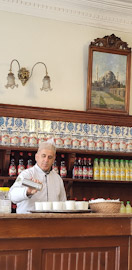
We came across the boza shop – an old-fashioned place with tiling – in the Vefa district of Fatih in the European part of Istanbul. The shop is called “Vefa Bogacisi” and it was founded by Haci Sadik Bey.

Haci Sadik Bey came from Prizren in Ottoman Albania (now in Kosova) in 1870. He noticed that the boza then sold in Istanbul (by numerous sellers) was fairly runny, dark in colour, and sour. He developed a new version of it, which was lighter in colour, and as already described in my first paragraph.

At first, like other vendors of boza, he sold it on street corners. Eventually, his customers encouraged him to open a shop in the then upmarket district of Vefa. This he did in 1876. It was in this shop, which we encountered quite by chance, that we sampled boza. The business is still run by the same family – the fourth generation since Haci Sadik Bey opened his shop. Opposite this shop, there is another, which sells the chickpeas (‘leblebicisi’).

Finally, although Haci Sadik Bey (died1933) and his brother Ibrahim (died 1944) came to Istanbul (during the Turco-Russian War), I have not yet discovered whether or not they had Albanian heritage.

Within the shop, locked in a glass case, there is a glass drinking vessel from which the father of Modern Turkey Mustafa Kemal Atatürk (1881-1938) drank boza on Monday the 4th of January 1937. It was good to know that we tried boza in the same place as that great man.

Golden guesswork: the Scythians in Cambridge

THE SCYTHIANS ROAMED around the steppes of Central Asia from about 800 BC to about 300 BC. I write “about” because very little is known for certain about this group of people, also known as the Saka-Scythians or Saka. My interest in the Scythians, who were dependant on horse riding for their not inconsiderable exploits including ruling most of Central Asia, was aroused by discovering that they used the double-headed eagle, a symbol that fascinates me, in their handiwork. So, it was with great excitement that I visited the special exhibition of Scythian gold at the Fitzwilliam Museum in Cambridge. The show, “Gold of the Great Steppe”, is on until the 30th of January 2022.

The exhibition is well worth seeing. The gold and other items found in Scythian grave mounds in Kazakhstan are superb examples of sophisticated technology and fine craftsmanship and they are displayed beautifully. The labelling is clear and easy to read. However, what is very clear from what is written on these labels is that almost nothing concrete is known about the people who created the exhibits. The curators make numerous reasonable-sounding suggestions about the possible ways of life that the items suggest, but these seem to me to be mainly intelligent guesswork. The Scythians left no written records. What we know about them depends mainly on metallurgical and genetic findings, as well as a few linguistic studies. Various Ancient Greek writers have written about them, but their opinions were often biased against them. So, it is not surprising that visitors to the exhibition are left little wiser about the people who created the magnificent artefacts on display. Interspersed amongst the items found in the graves in Kazakhstan there are modern recreations of how the Scythians and their horses might have looked in life. I felt that these mock-ups were rather too speculative for my taste. That said, I was pleased to have seen the show.