AFTER HAVING EATEN lunch at Munnar’s High Range Club, which I will describe at a future date, we walked along the road that runs along a bank of the Muthirappuzhayar River. As we walked along the road from the club, away from Munnar town, we spotted some graves near to the Chokanad Estate tea factory.
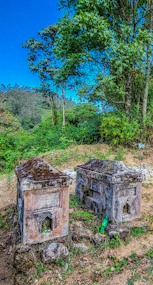
One of the graves, an elaborate enclosure painted blue, is the final resting place of I Krishnan (1932-1980). He was “factory watcher”.
There were a few other substantial, simple funerary monuments, each of which had a small niche in which a diya (oil lamp) can be placed. The other graves in this rustic graveyard are simple mounds, mostly without informative markers. All of them had been sprinkled with a white powder.
None of the graves resemble any Muslim grave that I have seen. And none of them have the crosses one would expect if they were marking burial sites of Christians.
The two names we could read in the cemetery could well be those of Hindus: Krishnan and Shanmugathai. This and the absence of any Muslim or Christian symbols made me guess that this small rural graveyard is where Hindus have been buried.
Now, before some of you tell me that Hindus are cremated, not buried, let me set you right on this. Many Hindus are cremated, but not all. There are some sects that favour burial. And if you need proof of this, visit the very large Hindu Cemetery which is close to Hosur Road in Bangalore. The Hindu graves in that cemetery are far more elaborate and colourful than those we spotted surrounded by tea plantations in the hills of Kerala.
I would like to know more about the tiny graveyard by the river. However, it might be a long time before (if ever) I find out. The place, which is about 400 yards from the nearest houses, is not even marked on maps.
THE CITY OF Indore has a population of about 3.1 to 3.5 million. Of these, about 17750 are Roman Catholics. Indore is a diocese in the Ecclesiastical province of Bhopal. The diocese was established in 1952, having formerly been Mission Sui Iuris of Indore established in 1931. There are well over 12 Catholic churches in Indore.
It so happens that the hotel where we are staying in Indore (in December 2025) is a few hundred yards away from the Kanchanbagh Roman Catholic cemetery, which we took a look at today.
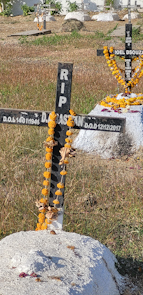
Flower garlands on graves
The older graves are raised mounds not too dissimilar from Sephardic gravestones. However, each grave is surmounted by a cross. What interested me was that on many graves there were fresh flowers. There is nothing surprising about this except that many of the flowers are ‘malas’ (garlands) such as are commonly found draped around Hindu effigies and shrines.
At the far end of the cemetery there is a large hall in which funeral masses are held. There is a bas-relief depicting the Last Supper at the altar within the hall.
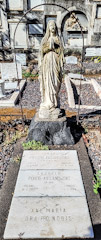
On one side of the hall, there are the newer graves. These consist of flat rectangular slabs on which names are listed. These are the names and dates of the people buried beneath a slab. The idea is that several people will be interred beneath each slab, and their names recorded on it. No doubt, the new system is designed to make efficient use of the burial ground. I wondered about this because there seemed to be plenty of unused land in the graveyard.
I am pleased that we entered the cemetery because seeing it made me become aware of the surprisingly large number of Roman Catholics in Indore.
HAPPY NEW YEAR TO ALL OF MY READERS
I HOPE THAT 2026 WILL BRING YOU CONTENTMENT, GOOD HEALTH AND PROSPERITY
PULICAT IS ABOUT FORTY miles north of the centre of Chennai. It is one of the very few natural harbours on the Coromandel Coast (east coast of India). As early as the third century BC, it was a thriving port. The unknown author of the “Periplus of the Erythraean Sea” wrote that Pulicat was one of only three ports on the east coast of India.
Today, it is a busy little village where freshly caught fish and other seafood are packed with ice before being transported elsewhere. In earlier times, it was an important trading centre.
Between 1502 and 1609, the Portuguese had a trading station (‘factory’) in Pulicat. They built a fort there. In 1609, the Dutch defeated the Portuguese, and took over Pulicat. They controlled it until 1825, when Dutch possessions on the Coromandel Coast were handed over to the British.
The Dutch built a fort, Fort Geldria, at Pulicat. This is in ruins today, and what is left is covered by seemingly impenetrable vegetation. I did not feel intrepid enough to enter the tangled plants that cover the site of the fort. The Dutch also built a gunpowder factory in the town.
Pulicat was a port from which the Dutch exported a wide variety of goods from India, including for example, textiles, coins, and gunpowder. They also exported Indians as slaves to work in some of the other Dutch colonies in places as far apart as Ceylon and the West Indies. It is said that between 1625 and 1665 alone, over 38000 slaves, procured mostly by brokers in Pulicat, were exported in Dutch boats. Many more were carried away from India after that.
Seeing Pulicat today, as we did in January 2025, it is difficult to imagine that this large village was once a thriving centre of international trade, and even more impossible to realise that it was an important market place for selling slaves. However, there is one very visible reminder of the erstwhile Dutch presence in the town: a small cemetery containing many well-preserved graves and mausoleums of Dutch people who died in the district.
Before describing the cemetery, I will mention the small museum near it, and next door to a school named ‘Dutch Academy Nursery and Primary School’. The very basic museum is housed in what must have once been a small shop. Its walls have some interesting informative panels attached to them. These outline the history of Pulicat. As for the exhibits, they are a rather shambolic assembly of unlabelled odds and ends. In one glass fronted cabinet, there were some fragments of ceramic vessels. I wondered whether these were bits of things left behind by the Dutch. On close examination, I noticed one of these broken pieces was labelled “made in Japan”.
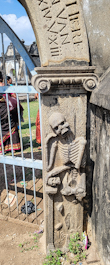
The Dutch cemetery is a fantastic sight. It is well worth making the 2 hour road trip from Chennai to see it. The entrance to the walled graveyard is made of carved stone. On each side, it is flanked by stone carvings of skeletons. One is resting its skull on its right hand and holding another in his left, and the other is balancing a double-sided drum or tabla on its skull. Although there are several obelisks and elaborate mausoleums in the cemetery, most of the graves are marked by horizontal stones upon which there are carved inscriptions. The inscriptions, which are all easy to read, are often framed with decorative floral carvings. Most of the inscriptions are in Dutch. A few are in Latin. The oldest of the deceased died in the mid to late 1650s. At the far end of the cemetery, we found two graves of British people. Although the British took over Pulicat in 1825, they used it more as a place for picnics than as a trading station.
The Dutch cemetery is a reminder that not every Dutch person who came to India to make a fortune returned home. What it does not recall is the vast numbers of Indians who were exported by the Dutch as slaves, and had no hope of ever seeing their homes again.
AS EARLY AS THE SEVENTEENTH century, the French, Dutch, and English set up factories (trading stations) at Cossimbazar, which is beside the Hooghly River in the north part of West Bengal. It existed before what is now Murshidabad became capital of Bengal. Today, what was once an important trading centre, where European merchants acquired goods to bring from India to Europe, is now no more than a rustic village.
Cossimbazar is home to a small cemetery, the Old English Cemetery, which contains the graves of about 30 Brits who died between 1730 and about 1800. Within this small graveyard, which is maintained by the Archaeological Survey of India, there is one above the burial place of Mary Hastings and her young daughter Elizabeth. The gravestone has been restored and is legible.
Mary, who died in 1759 (as did her daughter), was the first wife of Warren Hastings (1732-1818). He was a senior British East India Company administrator: the first governor of the Presidency of Fort William (Bengal), the head of the Supreme Council of Bengal, and so the first governor-general of Bengal in 1772–1785. He lived in Cossimbazar for a short time.
“Prager had come to Calcutta in 1786 on behalf of a London firm of Israel Levin Salomons, an Ashkenazi Jew. Diamonds were just one of the things Salomons traded in his India business; pearls and drugs were others.”
Stones cut in Benares by experts from Gujarat were sent down the Ganges to merchants and traders at Cossimbazar and other places further down the Hooghly. Most probably when Lyon Prager took ill at Cossimbazar he was there for undertaking business dealings.
Unlike Mary Hastings’s gravestone, the writing on Prager’s is now illegible. I have seen a photograph of his monument that is surmounted by an obelisk, which was taken when the grave was still identifiable. Without knowing that it was Prager’s grave, I photographed it when we visited the cemetery in January 2025.
When I was researching my book about Jewish migration to South Africa, I learned that the Dutch East India Company did not permit Jewish people to travel to their trading stations in the Cape of Good Hope and elsewhere unless they had converted to Christianity. The presence in India of a Jewish trader, such as Lyon Prager suggests that in the eighteenth century, Jews were not barred from joining trading expeditions by the British East India Company.
IN ITS HEYDAY, the Jewish community of Kolkata consisted of as much as 6000 people. That was in the early 1940s. Today, less than about 20 Jewish people reside in the city. Most of Kolkata’s Jewish inhabitants were members of families that had migrated mainly from Iraq, but also from Syria. They were all Sephardic, rather than Ashkenazi, Jews. They began arriving in Kolkata in the very late eighteenth century. Most of Kolkata’s Jewish people have migrated to other countries – not because of anti-Semitism, but for economic reasons (as have many other Indians of all religions).
One can get an idea of the size of Kolkata’s Jewish community of yesteryear by visiting the Jewish Cemetery on Narkeldanga Main Road. It contains at least 2000 gravestones. We visited it on New Year’s Day 2025.
The genizah standing amongst the gravestones
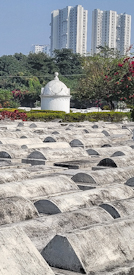
The cemetery is beautifully maintained. Flowering bushes, trellises, and trees punctuate the sea of white gravestones. According to Sephardic tradition, the stones are horizontal, rather than vertical. Most of them consist of a rectangular base surmounted by a hemi-cylinder. Each grave bears the name of the deceased in Hebrew and/or Latin script. It seemed to me that all of the graves are oriented in the same direction: roughly speaking the long axis of each grave runs in an east/west direction (more accurately, the west end of each gravestone is slightly north of the east). The majority of the gravestones are simple, without ornament. A few of them are ornamented often with a stone carving of an open book.
Several of the stones record the deaths of military service personnel, who died in action. Notices on these record that the bodies of these people were buried in military cemeteries elsewhere, at Ranchi.
In the centre of the gently undulating burial ground, there stands a circular tower, which is higher than all of the other graves. The tower, looking a bit like an enlarged pillar box (letter box). has a rectangular opening like that found on post boxes. This structure is a genizah.
A genizah is a place for disposing of worn out or no longer required sacred texts. These can include any documents that contain the name of God. These can be anything from holy texts to commercial contracts, legal documents, and personal letters. If you wish to know more about the contents of a genizah, you could do well to read “In an Antique Land” by Amitabh Ghosh. I have read this autobiographical novel that includes much about a very ancient genizah discovered in Cairo, and was very excited to see a real genizah in Kolkata.
I am not sure how easy it would have been to visit this fascinating Cemetery – a record of a once thriving community – had we not known one of Kolkata’s few remaining Jewish inhabitants. Mentioning this person’s name persuaded the security officials to allow us to enter.
THE SOUTH PARK Street Cemetery in Kolkata was opened in 1767 and was used as a burial ground for Europeans (mainly British) until 1830. It contains a large collection of funerary sculpture (mostly mausoleums and obelisks), much of which is in the neoclassical style. This now peaceful oasis in central Kolkata with much greenery is the final resting place of many people who had roles in the British East India Company (including its armies) and their families. Although the place contains the remains of many interesting people I will concentrate on two of them, both of whom had military careers.
Tomb of Hindoo Stuart
Charles Stuart (c1758-1828) was born in Ireland (Dublin) and joined the East India Company when aged 19. He served in one of its armies, reaching the rank of Lieutenant Colonel. In India, he was attracted to, and fascinated by, Hindu culture and traditions. He adopted many Hindu ways of life including religious practices. For example, when off duty, he wore Indian clothes and bathed in the Ganges (the Hooghly) daily. In addition, he wrote many articles, published in the newspapers of Calcutta, which extolled the Indian ways of living, and encouraged Europeans to wear Indian garb rather than western clothing. He felt that ladies from Europe would feel more comfortable and look better wearing saris in India. His sympathy for the Indian modes of life and admiration of Indians earned him the nickname ‘Hindoo Stuart’, but did not impede his military career. His funerary monument in the South Park Street Cemetery is in the form of a small Hindu temple, quite different in form from all of the other monuments in the graveyard.
The other military person commemorated at South Park Street has a very modest, barely legible gravestone. It records the death of the short-lived Walter Landor Dickens (1841-1863). He was the fourth child and second son of the author of “Oliver Twist” and many other famous novels: Charles Dickens. Walter became an officer cadet in the East India Company armies, arriving in India in 1857, just before the so-called Indian Mutiny began. After the end of this revolutionary activity and the end of the Company’s rule in India and the start of the British government’s control of the country, he became a soldier in the British Army. Illness resulted in his death in a military hospital in Calcutta.
Walter was buried at the Bhowanipore Military Cemetery in Calcutta. In 1987, some students at Kolkata’s Jadavpur University raised funds and had Walter’s gravestone moved to the South Park Street Cemetery. This was done because it was not being cared for and to honour his father, the famous author.
Having recently become a fan of the novels of Charles Dickens, I was pleased to have been able to view Walter’s gravestone. The lettering on it is legible, but not too easy to read.
During our recent visit to the Cemetery, which we made in December 2024, we saw the two graves mentioned above and many others which we had not noticed on previous visits. For those interested in the early history of Kolkata during its British occupation, the South Park Street Cemetery should not be missed.
FURNIVALL GARDENS IS a pleasant grassy open space that lies between the busy Great West Road (part of the A4) and Hammersmith’s riverside at Lower Mall. The park was created as part of the Festival of Britain (1951). Prior to WW2, the area upon which the garden now stands was mostly occupied by industrial premises and slums. Part of this area was occupied by the Quakers (of Hammersmith) Friends’ Meeting House and its adjoining Friends’ burial ground. A little bit of the land owned by the Quakers is now covered by the carriageways of the A4. The Quakers gave up their land to Hammersmith Borough Council when they were planning Furnivall Gardens.
There have been Quakers living and worshipping in Hammersmith since 1658 (see: https://hammersmithquakers.org.uk/history/). In 1677, they built their first Meeting House at number 28 Lower Mall near Hammersmith Creek (now covered up), which used to run along the western edge of what is now Furnivall Gardens. This tributary of the Thames ran through a very poor area of Hammersmith. In 1765, the meeting House was rebuilt and remained in use until a few years after the Creek was covered over in 1936. On the 24th of July 1944, this venerable Meeting House was destroyed by a flying bomb.
I have walked through Furnivall Gardens many times, but it was only today (the 18th of February 2024) that we took time to look at a noticeboard with its history. My wife noticed that the former Quaker Meeting House and burial ground are mentioned on this informative board. It indicated an area of the Gardens, where a memorial stone can be found. The simple monument in an area walled off from the rest of the park is surmounted by a circular metal plate on which the following words are inscribed:
“This garden is on the site of the Friends’ Meeting House and burial ground 1765-1944”.
It is an unassuming little memorial, which you might not notice if you did not know it existed. It has taken me several decades to become aware of it. I have driven along the stretch of the A4 that runs alongside Furnivall Gardens many times. And until today, I had no idea that my car’s tyres were racing over land where once Quakers were buried.
MANY PEOPLE VISIT Madeira to improve their health or to retire. Some of these people die on the island and are buried there. Today (5th of May 2023), we took a look at the small English Cemetery in central Funchal. This well tended burial ground, founded in 1770, contains graves of British and some Portuguese people – Protestants mainly. In addition, there are graves of men and women born outside Portugal in places including Germany, Finland, Romania, USA, Holland, Sweden, and Poland.
One of the Americans buried in the cemetery is Harry C Stone “Late Captain Cavalry USA”. His simple yet moving gravestone bears the date 1972 and the words: “He believed in God”
Three graves particularly intrigued me. One of them marks the burial place of Lady Sarah Bonetta Davies (née Forbes). She was born in Ogun State in 1843 and died in Funchal in 1880. The gravestone informs that she was: “Princess of the Egbada Omoba people, West Africa. God-daughter of HM Queen Victoria.” She was born an aristocratic member of the Egbada clan of the Yoruba people and was enslaved by King Ghezo of Dahomey, who ‘gifted’ her to Captain Frederick Forbes of the British Royal Navy. She became a god-daughter of Queen Victoria, and later married the Nigerian businessman James Pinson Labulo Davies of Lagos in West Africa. She died of tuberculosis in Funchal.
Another black African, George Oruigbiji Pepple, also lies buried in the cemetery. Between 1866 and 1883, he was the King of Bonny which was a small state in the Niger River delta. He was deposed in 1883 and restored to the throne in 1887. Why he was buried in Funchal , I have not yet discovered.
The third grave that interested me greatly is that of Paul Langerhans (1847-1888). This German pathologist and physiologist is best known for his discovery of the cells in the pancreas that produce insulin. Although he was unaware of the function of these distinctive cells, they have been named in his honour as The Islets of Langerhans.
Langerhans came to Madeira in 1875, having contracted tuberculosis. He recovered a little, researched marine worms, and practised medicine. In 1885, he married the widow of one of his patients. They lived together until his death. According to his wishes, he was buried in the English Cemetery in Funchal.
The cemetery is a lovely place to visit. It has plenty of flowers and is peaceful. On a future visit to Madeira, I would like to spend more time investigating the biographies of those whose remains lie there.
IT IS PLEASANT to stroll beside the Thames along Chiswick Mall. Occasionally, we take a look at the graveyard of Chiswick’s St Nicholas Church. On a recent visit to this place, we walked deeper into it than usual and spotted a grave marked by a remarkable sculpture.
The idyllic, romantic, leafy churchyard by the river is chock full of graves. Several of them caught my attention. One is that for the artist William Hogarth, who lived close-by. His monument is protected by a cast-iron fence. An urn on a plinth decorated with an artist’s palette and brushes. It was erected after the death of his sister in 1781 (who is also commemorated on this monument) and was restored by a William Hogarth of Aberdeen in 1856. Another painter, Philippe Jacques de Loutherbourg (1740-1812), who was born in Strasbourg, is buried with his wife Lucy de Loutherborg (née Paget). Like Hogarth’s, their decaying monument on the north side of the cemetery is surrounded by cast iron railings. In 1789, Philippe gave up painting temporarily to develop his interest in alchemy and the supernatural. Later, he and his wife took up faith-healing. The remains of yet another painter, James Abbott McNeill Whistler (1834-1903), lie in the cemetery.
Private Frederick Hitch (1856-1913) is less famous than these artists. He was awarded the Victoria Cross for his brave actions during the Battle of Rorke’s Drift (January 1879) in the Anglo-Zulu War fought in South Africa. He is also buried in this large cemetery.
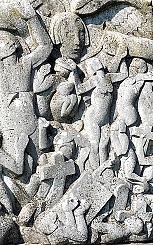
Amongst the more recent graves is the one with the unusual sculpture. It is that of Baronet Percy Harris (1876-1952), who was a Liberal politician. Son of a Polish immigrant, he was born in Kensington, and died there after a long career in parliamentary politics. According to a website listing British Jews in WW1, Percy was Jewish, yet his grave is distinctly Christian in sentiment. Aesthetically, his grave is the most remarkable one in the cemetery next to St Nicholas. It includes a semi-abstract, vorticist carving of The Resurrection of the Dead, created by the sculptor Edward Bainbridge Copnall (1903-1973) in the 1920s. Harris had acquired it for display in his garden long before it was moved to adorn his grave.
Although Percy Harris was born Jewish, he is buried in the graveyard of a Church of England parish church. Despite searching the Internet, including reading his extensive entry in the Dictionary of National Biography, I cannot determine whether or not he converted to Christianity sometime during his life.
HENLEY-ON-THAMES is located at the Oxford end of a bridge across the River Thames, which separates the county of Oxfordshire from its neighbour Berkshire. Located on the old main road between London and Oxford, it retains much ‘olde-worlde’ charm. Its streets are lined with many buildings that were constructed in the 18th century and before. Some of these used to be coaching inns but are no longer. However, some of the hostelries that served wayfarers in times long ago are still serving thirsty and hungry customers today, for example: The Red Lion, where William III might have visited, now an upmarket restaurant; and The Catherine Wheel, now a branch of the Wetherspoons company. On a recent visit in April 2022, we enjoyed superb coffee at Pavilion on The Market Place, close to the Town Hall.
Beer lovers will not need reminding that Henley is the home of Brakspear & Sons, the brewery company. Founded in Henley in 1722, beer was brewed in the town since then, although some of the comapany’s products are now brewed elsewhere. Many of the brewery’s older buildings, now converted for new purposes, can be seen alongside New Street. The company’s offices are now located on Bull Courtyard off Bell Street.
The stone bridge across the river was built in 1788. It is the finishing place of the annual Henley Royal Regatta held in summer, ever since its inception in 1839. Near the bridge, stands Henley’s parish church of St Mary the Virgin, which has a 16th century tower. The exterior walls of the southeast corner of the church is an eye-catching chequerboard of alternating masonry and flint squares. The church’s interior has been much modified by the Victorians. The churchyard north of the church is surrounded mainly by almshouses. Immediately next to the north side of the church stands a two-storied, half-timbered building, the Chantry House, some of whose beams come from trees felled in 1461 (according to scientific dating methods). Between 1552 and 1778, this edifice housed a school. Since 1923, it has housed the Parish Rooms.
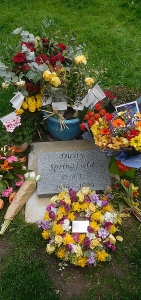
The churchyard is filled with many gravestones. One of them immediately attracts the visitor as it is surrounded by generous amounts of fresh flowers. It is a memorial to the singer Dusty Springfield (1939-1999), who died in Henley. In the 1990s, Dusty lived by the Thames at Hurley near Henley. While in the area, she suffered from several bouts of breast cancer, the cause of her demise. Her funeral at St Mary’s in Henley was attended by many of her fans and leading lights in the British popular music scene including Elvis Costello, Lulu and the Pet Shop Boys. According to her wishes, Dusty was cremated, and some of her ashes were scattered in Henley and the rest in Ireland.
Dusty was not the only music celebrity to have lived in Henley. A man we met outside his house in the town reminded us that the Beatle George Harrison (1943-2001) had also lived in the town. He also mentioned that Henley’s former MP, the present Prime Minister Boris Johnson, had attended meetings in his home, and that he could tell us a thing or two … but he did not!




 yamey
yamey 