This photograph I took in Cornwall reminds me of lines from the first verse of a poem, “Elegy Written in a Country Churchyard”, written by Thomas Gray (1716–1771). The lines are:
COPENHAGEN FIELDS WAS an open space north of the Barnsbury district of London’s Islington. In the 17th century, the place was beyond the northern edge of London. As with other open spaces in 17th century Islington, it was an area where people whose homes had been destroyed in the Great Fire of 1666 congregated with what belongings they managed to salvage. By the 18th century, Copenhagen Fields had become a place where large numbers of Londoners used to gather for political meetings.
Animals being led to Caledonian Market
According to William Howitt writing in his “The Northern Heights of London” (published in 1869), the fields acquired its name following a visit of the King of Denmark to his relative King James I (reigned over England, Scotland and Ireland from 1603 to 1625). A Dane built a house on the open space, Copenhagen House. The name ‘Copenhagen’ appears on a map published in 1695. Howitt reveals that Copenhagen Fields and its house became a place of recreation for Londoners:
“It became a great tea house and resort of the Londoners to play skittles and Dutch-pins. It commanded a splendid view over the metropolis, the heights of Highgate and Hampstead …”
As mentioned, Copenhagen Fields was connected with political activity; it was a place of mass protests. Not long after the French Revolution, there was a meeting in the open space:
“On the 12th of November 1795 a public meeting was summoned by the London Corresponding Society in Copenhagen Fields which was attended by more than a hundred thousand persons. Five rostra or tribunes were erected, and Mr. Ashley, the secretary, informed the meeting that it at each of them petitions to the King, Lords and Commons against the Bill for preventing seditious meetings would be offered to their consideration.” (www.historyhome.co.uk/c-eight/france/copenhagen.htm).
The best remembered protest that occurred in Copenhagen Fields was on the 21st of April 1834. Thousands of people commenced marching from there to central London in support of the Tolpuddle Martyrs, who lived in Dorset:
“In 1834, farm workers in west Dorset formed a trade union. Unions were lawful and growing fast but six leaders of the union were arrested and sentenced to seven years’ transportation for taking an oath of secrecy. A massive protest swept across the country. Thousands of people marched through London and many more organised petitions and protest meetings to demand their freedom.” (www.tolpuddlemartyrs.org.uk/).
Many of those marchers began their procession from Copenhagen Fields:
“Up to 100,000 people assembled in Copenhagen Fields near King’s Cross. Fearing disorder, the Government took extraordinary precautions. Lifeguards, the Household Cavalry, detachments of Lancers, two troops of Dragoons, eight battalions of infantry and 29 pieces of ordnance or cannon were mustered. More than 5,000 special constables were sworn in. The city looked like an armed camp.
By 7am the protesters began to gather marshalled by trade union stewards on horseback. Robert Owen, the leader of the Grand Consolidated Union and the father of the Co-operative Movement arrived.
The grand procession with banners flying marched to Parliament in strict discipline. Loud cheers came from spectators lining the streets and crowding the roof tops. At Whitehall the petition, borne on the shoulders of twelve unionists, was taken to the office of the Home Secretary, Lord Melbourne. He hid behind his curtains and refused to accept the massive petition.” (www.tolpuddlemartyrs.org.uk/story/mounting-protest)
In June 1855, Queen Victoria’s Consort, Prince Albert, opened the Metropolitan Cattle Market (later known as ‘Caledonian Market’). This market occupied most of the area of Copenhagen Fields. It was built to ease the congestion caused by driving live animals into the more centrally located Smithfield Market. Although at first many animals walked to the market from the fields where they were raised, the market was built close to the goods yards of the recently built Great Northern and North London railways (https://en.wikipedia.org/wiki/Metropolitan_Cattle_Market).
Cattle travelled (under their own ‘steam’) two hundred miles from Devon at two miles per hour, walking twelve hours a day. Sheep from Wales, also two hundred miles from Copenhagen Fields, would be trotting across England to London for twenty days. Some cattle travelled even further: over five hundred miles from Scotland. These fascinating figures can be seen on a sign located in the park that stands where the cattle market stood between 1855 and the early 20th century, when trade in live animals began to decrease. Later, the market area was used for selling antiques and bric-a-brac. The Caledonian Market finally closed in 1963.
Much of the old market area is now used for recreation. On the south side of Market Road, there are enclosed sporting areas. The northern side is an attractive little park. All that remains of the market are the Victorian cast-iron railings, which are in various states of decay, and the market’s clock tower, which has been beautifully restored. The tower is 151 feet tall. It used to stand amidst the now-demolished dealers’ offices and close to the also demolished abattoirs.
Just north of the tower, there is a small café which is named in honour of the Tolpuddle Martyrs. Within it, there is a wall facing the serving counter. This has two murals commemorating mass protest. One of them, painted in a style reminiscent of social realism depicts people of many different ethnicities marching beneath a banner of The Islington Trades Union Council. This bears the words:
“Reclaim our past. Organise our future”.
The other mural commemorates the Tolpuddle Martyrs.
Panels on the walls of the café and around the north entrance to the park are decorated with scenes from the history of the area in the form of silhouettes. Some of them show animals being driven through the countryside. Others depict market scenes and the shops in which the meat was sold. Circular panels mounted on the walls of the tower show old photographs of the market in its heyday.
Although the park is not as spectacular as many other London parks, it is worth visiting to see the magnificently restored market clock tower and the several plaques and illustrations that provide clear explanations of the area’s historical importance. In addition, the small café and surrounding buildings within the park are good examples of contemporary architecture. The Caledonian Park, the former Copenhagen Fields, is yet another fascinating feature that contributes to what is wonderful about London.
WALKING HAS ALWAYS been my favourite and almost only form of exercise. I do not enjoy games, gyms, or swimming, or any other sport, but I love to stroll through towns, villages, and rustic landscapes, exercising my body and especially my eyes. I always carry a camera to record anything I consider of interest or picturesque or curious. With the current (January 2021) restrictions on moving far afield from home to take exercise, I must confine myself to wandering around within a short distance of home. Luckily, the borough, within which I live, and its neighbours are full of fascinating places to see, photograph, and investigate. One of these is Justice Walk, a short (77 yards) passageway leading from Chelsea’s Old Church Street to Lawrence Street.
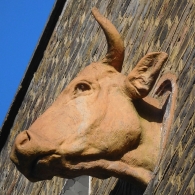
But first, let me tell you about number 46 Old Church Street close to the beginning of Justice Walk. This building has a sculpture of a cow’s head attached to its façade as well as two pictures made with coloured tiling. One of them, with the words ‘An early mower’, depicts a man holding a scythe and taking a drink from a small barrel. The other shows a milkmaid carrying a wooden pail on her head. An alleyway on the north side of the building leads to a modern gateway. On the north wall of the house there is a name plate that reads ‘The Old Dairy Chelsea’ and near this there is another tiled painting showing a milkmaid watching cattle standing in a stream with ducks and ducklings. Behind the gates, there is a larger brick building with a pediment bearing a cow’s head as well as the date ‘1908’ and ‘estd. 1796’.
“The dairy was one of the first in Chelsea and was erected on Cook’s Grounds (the site of Glebe’s Place today) in 1796. Around 50 cows and two goats grazed nearby, providing milk for the dairy … A frequent visitor to the dairy was Scottish philosopher and writer Thomas Carlyle (1795-1881), who lived a few minutes walk away on Cheyne Row … The Old Dairy was forced to move slightly west due to rapid redevelopment in the late 1800s, with Cook’s Ground and the nearby kitchen gardens of the Chelsea Rectory being swallowed up by housing. Wright’s Dairy set up their headquarters and a shop at 38-48 Church Street (now Old Church Street). The fields behind the dairy were used for the grazing cows.”
The cow’s head on the former dairy looks out at pictures of pigs across the road. These adorn a pub with the name ‘The Chelsea Pig’. Originally called ‘The Black Lion’, the establishment is said to date back to the 17th century.
Justice Walk is extremely picturesque. It is dominated by a large brick building, whose appearance is suggestive of authority, topped with a triangular pediment. This was formerly a Wesleyan chapel, which was built in 1841. It was used as a chapel and a Sunday school between 1843 and 1903 (https://chelseasociety.org.uk/wp-content/uploads/2013/11/1997-Annual-Report-1.pdf). Many estate agents have misrepresented this building as a former courthouse, glamourising with words such as these (www.russellsimpson.co.uk/stylist-the-court-house/):
“A historic courthouse and jail that once held highway robbers and thieves before they were transported to the British penal colonies in the 18th Century has been transformed into a luxury £14.5 million home.
The Court House, on the aptly-named Justice Walk in Chelsea, is one of London’s last surviving courthouses and gaols and has been dubbed “Britain’s most expensive prison cell” after undergoing a designer restoration and makeover. Built in the early 18th Century, the majestic house of justice tried hundreds of criminals with highway robbery, drunken behaviour and petty theft – of a kind similar to legendary highwayman Dick Turpin (who was executed in 1739 for horse theft).”
So much for Dick Turpin and other exciting misinformation. Opposite the former chapel, there is a house whose front door is surmounted by a scallop shell and other ornate decoration. The door bears the name ‘Judge’s House’. Given what I have learnt about the so-called courtroom, which was really a chapel, I wonder whether a judge ever lived in the house. My doubt is increased when I read (in “The London Encyclopaedia, edited by B Weinreb and C Hibbert) that Justice Walk is most probably named after John Gregory, a Justice of the Peace, who owned property in nearby Gregory Place and in Kensington Church Street.
Several houses at the corner of Justice Walk and Lawrence Street stand where there was a factory and showrooms for the renowned Chelsea china. The china establishment was demolished at the end of the 18th century (www.british-history.ac.uk/old-new-london/vol5/pp84-100). Although the china works are long gone, the Cross Keys pub still exists, though closed during the ‘lockdown’. Established in 1708, it is Chelsea’s oldest pub. Its customers have included JMW Turner, John Singer Sargent, and James McNeill Whistler, painters; Dylan Thomas, poet; Bob Marley, musician; and Agatha Christie, novelist.
Seeing all that I have described took about fifteen minutes, but you could easily miss it all if you walked past in a hurry. Although I did not perform much exercise looking at this tiny part of London, seeing it provided plenty of food for thought. After exploring this area, my wife and I walked out of Lawrence Street and began a vigorous stroll along the Thames embankment which provided lovely vistas in the hazy winter sunshine.
Driving in India may seem somewhat chaotic to visitors from northern Europe including the UK. It might seem less so to visitors from the southern parts of Europe or from Egypt. However, there is some order in the apparent mayhem that can often be observed on Indian roads.
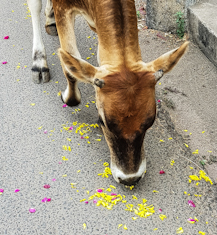
One unwritten rule is that it is advisable to give way to something bigger than you. If you are driving a car, it is best to yield to a lorry or a bus. If a cow or bullock or even an elephant wanders into your path, it is best to avoid it. If you collide with a large beast, your vehicle might suffer greater injury than the beast. Best to give the creature the right of way.
If you should happen to be an autorickshaw (‘tuk tuk’) driver, you are likely to have superbly fast reflexes, the courage of a lion, and nerves of steel. Drivers of these vehicles take risks on the road that sometimes seem suicidal, but overehelmingly they know what they are doing.
One autorickshaw driver in Bangalore once told me that he had been a truck driver before taking up his present occupation. He said that to drive an autorickshaw it was necessary to employ all of the senses. He said that his whole body had to be fully aware of what is going on around him.
However, even the skilfully adventurous autorickshaw drivers will give way to, or avoid cattle in the street. This is not because they hold the cow to be sacred nor because they are believers in animal rights, but because they have a sensible regard for self-preservation.





 yamey
yamey 