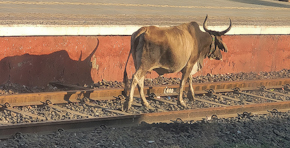
This hot brown cow
Is walking along the railway tracks
I know not where

This hot brown cow
Is walking along the railway tracks
I know not where

Looking at you
I wonder if you have food for me
Only asking

Cows are grazing
Beneath the billowing greyish clouds
A pleasant scene

This photograph shows a cow grazing in a meadow in Cambridge (UK). Behind the animal, you can see the world famous perpendicular gothic chapel of Kings College – part of the University of Cambridge.
I posted this picture on Facebook. A few hours later, one of my friends added the witty comment:
“In one end and out the other…“
AIR TRAVELLERS CAN FLY to the former Kingdom of Kutch (Kachchh), now part of Gujarat, by two routes. There is a scheduled flight between Ahmedabad and Bhuj, and another between Mumbai and Kandla, whose airport is close to Anjar.
Kandla, was developed as a seaport on the early 1950s at the instigation of a member of the by then former royal family of Kutch. It lies on the coast of Kutch southeast of Karachi, a port that was incorporated into Pakistan in 1947, and northwest of Mumbai. It is now the largest port in India when measured by the volume of cargo handled there.
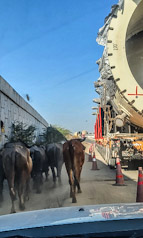
From Mandvi to Kandla Airport is 95 Km by road. We set off from Mandvi three hours before our flight to Mumbai was due to depart from Kandla. Our hosts, who use the airport frequently, told us that on average the road journey is 1 ½ hours. For the first hour of our journey, the highway was almost devoid of traffic. Along the way, we frequently switched lanes because heavy vehicles often move slowly along the outside lane without giving way to faster vehicles. We wove our way between slower vehicles, constantly overtaking and ‘undertaking’. Then after speeding along steadily, we headed towards a static queue of heavy lorries.
QuIck as a flash, our driver made a three point turn and we drove in the opposite direction tobthe rest of the traffic until we reached a gap in the central divider of the dual carriageway. We were not alone in making this manoeuvre. There were even some of the heavy goods vehicles making cumbersome manoeuvres to head away from the traffic jam. We continued our journey on the wrong side of the divider until we reached a turn off that allowed us to go under the highway and back into the correct lane.
Soon, we encountered another jam. A transporter carrying a tank as wide as one side of the motorway was inching its way onto the main road. Our driver took us off the road onto a dirt track, but this was also blocked. Another u-turn and we drove beneath the highway to a narrow, poorly tarmacced road that ran parallel to the highway. This led to a bridge beneath the main thoroughfare to reach another narrow lane that ran alongside the part of the highway running towards Kandla.
This lane offered other obstructions including large trucks and a herd of slow moving cattle. We squeezed past them and eventually rejoined the highway.
Meanwhile, the time was ticking away, and we wondered whether we would miss our flight. My spirits rose when we turned off the highway and on to a road leading to the airport. Soon, my hopes were dashed. We encountered yet another jam. However, our skilful driver managed weave his way between them. Soon, we arrived in front of the tiny airport terminal building.
Kandla Airport is primarily a military air base. Passengers use it for the one flight a day to and from Mumbai. When we disembarked there a few years ago, we walked from the aircraft to a shelter, where passengers’ check-in baggage was ready to be retrieved.
The check-in and security check is carried out in a part of a small room, the rest of which is part of the departure lounge (with a snacks stall). This hall leads to another room with seating. It is here that the departure gate is located. This simple departure lounge reminded me of Venice’s Marco Polo Airport as it was in the early 1960s.
We boarded the Spicejet two engined propellor plane after walking across the apron. The aircraft (a Q400 made by the Bombadier Company) has its own retractable staircase that we used to enter and later leave the ‘plane. After an uneventful flight lasting 1 hour and 15 minutes, we disembarked at Mumbai.
We were lucky only to have arrived a few minutes later than the scheduled time. Only three days earlier, my wife’ cousin’s flight from Mumbai to Kandla was delayed by almost 5 hours because of a technical problem discovered on the ‘plane minutes before it was due to take off. We were also fortunate because our quick-witted driver skilfully reduced the time spent stuck at significantly awful traffic jams.

Traffic on the road
Feeding green grass to a cow
India is great

Palms everywhere
Bikes and cows on the highway
Our Indian roads
THE EARLY MORNING sun was shining over the hills surrounding our holiday cottage near Wadebridge in Cornwall, and we decided to take a stroll along the narrow country lanes nearby. The air was crystal clear, and we could see far-off grassy fields dotted with grazing sheep. Wind turbines with slowly turning blades punctuated the northern horizon. After crossing a small, fast-flowing stream, we ascended a steep hill. Every now and then, gaps in the walls bordering the roadway afforded us with splendid views. We reached the entrance to a field, I was reminded of a holiday I enjoyed in 1962 when I was ten years old.

Early in 1962, I underwent surgery to have my inflamed appendix removed. A few weeks after this, we set off for Denmark in our family Fiat 1100. It was just before Easter and the weather was cold. After traversing West Germany, we crossed into Denmark and headed for our destination, a farm near Toftlund in Jutland. The farm was owned by Lis, one of our former au-pair girls, and her husband. One thing I remember about Toftlund was something pointed out to me by Lis’s father. He showed me that each house had two different numbers: one was on a red background, and the other on blue. I cannot remember which was which, but one numbering system was that of the Danish authorities, and the other was that of the Germans, who had formerly occupied this part of Denmark.
The most memorable and enjoyable aspect of our weeklong stay on the farm was being able to mingle with the farm animals. The cattle and pigs were housed in sheds because it was too cold for them to graze outside. All day my sister and I enjoyed watching and stroking the animals. I think that the time we spent on the farm was so much fun because it was far more ‘child friendly’ than most of our other family holidays, which were centred around my parents’ fascination with artworks in Italian churches and museums.
Some of the cattle had horns. There is nothing unusual about that. However, my mother, who worried about most things and saw potential danger everywhere, was extremely concerned about these horns. What made her anxious was the possibility that one of the creatures might gore me and thereby cause my appendicectomy scar to burst open. Luckily, I survived to tell this story.
Returning to our walk in Cornwall, you will recall that we had reached an entrance to a field that sparked off my memories of Denmark more than 60 years ago. The gate to the field was the entrance to a small pen, The pen contained several cows waiting to be moved somewhere, or maybe to be milked. Seeing them staring at me staring at them reminded me of my wonderful holiday near Toftlund.
THE ENGLISH COUNTRYSIDE is remarkably rich in mediaeval remains, many of them accessible to members of the public. Quite a few of these reminders of the past resulted from the mass closure of monasteries and nunneries by King Henry VIII during the 16th century. Denny Abbey between Ely and Cambridge is just one of many examples of the results of the king’s policy. We paid it a brief visit whilst driving between the two cities. We arrived there early in the morning before it was open to visitors, but without entering the compound, we were able to see most of what is on offer apart from the attached Farmland Museum, which we might visit in the future.
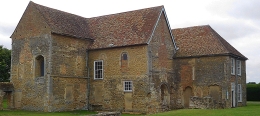
The abbey was founded by the Benedictine Order in 1159 (www.english-heritage.org.uk/visit/places/denny-abbey-and-the-farmland-museum/) and taken over by the Knights Templars in 1170. The Templars used the place to house old and infirm members of their order. Despite questioning the truth of the Pope’s suspicions about the Templars, King Edward II (reigned 1307-1327) yielded to Rome’s authority, suppressed the Templars in England in 1308-9, and confiscated their properties. In 1327, King Edward III gave the abbey to Marie de Châtillon, Countess of Pembroke (1303-1377), the founder of Pembroke College in nearby Cambridge. She converted the abbey into a Franciscan nunnery (https://en.wikipedia.org/wiki/Denny_Abbey). The nunnery became home to members of The Order of Saint Clare, often known as ‘The Poor Clares’. The abbey was closed by Henry VIII in 1536 and it, like all the other ecclesiastical establishments closed by the king, became property of the Crown.
The last abbess at Denny was Dame Elizabeth Throckmorton (1467-1547), who headed the nunnery from 1512 until its dissolution. During her term as abbess, two of the nuns in her establishment were sisters of Sir Thomas Grey (Thomas Grey, 2nd Marquess of Dorset: 1477-1530), a student of the Dutch philosopher and theologian Desiderius Erasmus (c1466-1536). When Erasmus was in Basel in 1525, Grey persuaded him to write to the community at Denny. His letter was received, and in response the nuns sent him a gift, which was stolen before it reached him. When he learned what had happened, he wrote again. In his second letter, Erasmus wrote of:
“…the troubles of the time war everywhere, and wrath of princes, famine, and plague and divisions in the Church which tore families apart but comforted the ladies with the thought of the humility and strength of St. Francis and St. Clare and asked their prayers, not only for himself but for the conversion of the thief. He sent his greeting to the ‘most religious lady’ abbess, and begged her to greet Grey’s sisters for him by name.” (https://www.british-history.ac.uk/vch/cambs/vol2/pp295-302).
According to one source, Erasmus was attracted to men. While serving as a canon in Stein (Holland), Erasmus:
“…supposedly fell in love with a fellow canon, Servatius Rogerus, and wrote a series of passionate letters in which he called Rogerus “half my soul”, writing that “I have wooed you both unhappily and relentlessly”” (www.hmoob.in/wiki/Desiderus_Erasmus)
Later, Erasmus, while teaching in Paris:
“… instructed a 21-year-old English-born student, Thomas Grey, who later became Marquis of Dorset. Erasmus was abruptly dismissed as Grey’s teacher, for making unwanted advances towards him.” (http://gayinfluence.blogspot.com/2012/04/erasmus.html)
Another source (“Erasmus” by Preserved Smith, publ. 1923) might well allude to this excessive friendship:
“…Thomas Grey, a young Englishman, of whom Erasmus was fond …”
Erasmus was in Paris between 1495 and 1499, after which he lived and worked in England (Oxford, then Cambridge) for several periods over the next few years. Clearly, his abrupt dismissal did not deter Grey from writing to him about the nunnery at Denny Abbey. The presence of Grey’s sisters at Denny might have been a consequence of a possible Grey family connection with two other families that were intimately involved with it: the Coleviles and Massinghams.
After the closure of the nunnery, its refectory became used as a barn; the abbess’s lodge, originally built for the Countess of Clare, became used as a farmhouse; and its church, built in 1159, was demolished. Over the centuries, the farm on the former nunnery’s lands was privately owned. In 1928, Pembroke College (Cambridge) bought the plot, and it remained a farm until 1947, when it was leased to The Ministry of Public Works. It was later transferred into the care of English Heritage (founded in the 1980s).
We parked in a grassy field, watched by a small herd of cows, most of whom were seated on the ground, maybe anticipating a rain shower. The farmhouse, the building originally constructed for the Countess of Pembroke, still has doorways and windows in both the Norman and mediaeval gothic styles. A Norman archway was the entrance to the Templar’s church. Some of these features, which must have once led into buildings now non-existent, have been bricked in. It has new roofing and some windows that were added long after it ceased to be part of the nunnery. Likewise with the large barn, once the refectory, it has two tall doors, which are later additions to the structure, as well as bricked in windows and archways that were used when the nunnery existed. Two lines of masonry almost flush with the ground mark the site of the nave of the now demolished church. Little else can be seen, although during the site’s opening times, visitors can see the remains of a mediaeval tiled floor.
Although little survives of the former Denny Abbey, its ruins are worth a short visit. And, while you gaze at it, you can marvel at the thought that you are looking at the remains of the only abbey in England to have been home to not one religious order but three different ones (www.dennyfarmlandmuseum.org.uk/content/things-to-see/history-of-denny-abbey). When we stopped to look at the place on a grey Friday morning in August 2021, I had no inkling that the great Erasmus had taken an interest in it, nor had I any idea that the scholar has been suspected by some of being gay. An anonymous writer denies this rather vehemently (www.erasmatazz.com/library/erasmus-the-hero/erasmus-was-not-gay/the-thomas-grey-affair.html). Whether or not Erasmus’s advances to Thomas Grey were of a homosexual nature or simply expressions of deep friendship and admiration of his intellect, it is for others to decide. Deciding whether or not to explore the remains of Denny Abbey is far less difficult than judging Erasmus.
GUILAN IS A NEW cafe on the corner of Moscow Road and St Petersburgh Place in London’s Bayswater. I have walked past the building numerous times over the past more than 25 years, but until today I missed seeing something on the building.

Above the ground floor windows there are a number of sculpted heads of cattle. I had never noticed these before.
On looking at a map produced in the 1950s, I discovered that the building was then a dairy. An older map revealed that it was ‘The Aylesbury Dairy’. A search on the Internet informed me that this building was the head office of the company, which had another branch not far away. So, the cattle heads are a souvenir of the building’s time as a dairy.
The new café in the former dairy is across the road from Aghia Sofia, a Greek Orthodox church. The cafe is elegant and serves good coffee and tasty pastries including a croissant flavoured with za’atar. I have no idea from which dairy the milk is supplied to Guilan, but you can be sure it is not the Aylesbury Dairy.
 yamey
yamey 