
An Epstein from New York (NYC): Jacob not Jeffrey

THE DUVEEN GALLERIES in London’s Tate Britain provide a wonderful space to display sculptures. The rooms are wide, long, and have high ceilings. Their walls are plain and do not distract the viewer. Until 30 March 2026, these magnificent spaces contain a selection of sculptures by Jacob Epstein (1880-1959), who was born in New York City. He joined the Art Students League in New York, before moving to Paris in 1902, where he studied sculpture at the École des Beaux Arts and Académie Julian. He settled in London in 1905. Both in Paris and London, he studied non-European sculpture, and what he learned from it often influenced his work. Some of the stone carvings in the Duveen Galleries are evidence of this. Soon after arriving in London, he began receiving important commissions to produce sculptures for significant institutions in London such as the British Medical Association (now Zimbabwe House). He became naturalised as a British citizen in 1910.
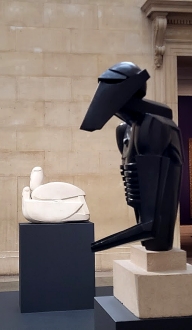
The collection of sculptures in the Duveen Galleries includes several stone carvings in different styles. The Tate’s website noted:

In the 1910s, Epstein became a key figure in the ‘direct carving’ movement in Britain. This approach emphasised a ‘truth to materials’, in which sculptors worked directly with the stone, using its natural qualities rather than making wax or clay models first. He was influenced by the techniques and imagery used in ancient Egyptian, West African and Oceanic carvings, which he collected. At the time, his portrayal of sexuality as well as the simplified forms of his monumental figure carvings drew both admiration and intense criticism, limiting his opportunities for public commissions.

Some of the sculptures on the former British Medical Association (now Zimbabwe House) building were criticised as being too explicit for Edwardian tastes, when they were completed in 1908. Sadly, these sculptures that can still be viewed from the Strand are badly damaged by being exposed to the weather and pollution.

The stone carvings in the Duveen, which vary from figurative to almost abstract, were all new to me. The bronze busts of famous and not-so-famous people include portraits of family members, artists, writers, entertainers and other public figures. These are the works that I tend to associate with Epstein. So, seeing his stone sculptures was a new and pleasant revelation for me. Each of the sculptures on display is accompanied by an informative panel. The works are well spaced so that each one can be admired in splendid isolation. This is an exhibition worth seeing.
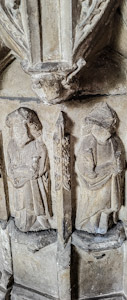
A faceless baptismal font in a small town in Hertfordshire

HITCHIN IS A SMALL, attractive town in Hertfordshire. When we first visited it in 2020, despite an easing of the covid19 lockdown rules, we were unable to enter the town’s 14th to 15th century church of St Mary’s. On the 26th of August 2023, we spent a couple of hours in Hitchin and were able to enter the church. It contains many items of interest including a large painting created in the studio of Ruben’s.

It was the 15th century carved stone font that particularly interested me. The column supporting the bowl, which contains water with which children are baptised, has twelve carved figures. These depict the 12 apostles. Looking at these closely, you will see that they are all mutilated. Their faces have been chipped away, leaving the figures faceless.

The very helpful and informative gentleman who was looking after the church was not sure whether the faces were obliterated by Thomas Cromwell during the Reformation of Henry VIII or during the time of that other iconoclast Oliver Cromwell.

Luckily the carved angels that adorn the ceiling of the Chapel of St Andrew and a finely carved 15th century wooden screen escaped the attention of the iconoclasts. In one or two Suffolk churches we have visited, angels such as these were destroyed as part of the attempts to ‘purify’ the English Church.

Apart from what I have described, there are plenty of other things that make a visit to Hitchin’s church worthwhile. And if you enjoy ‘Olde Worlde’ British buildings, the town centre is rich in them.

A church with maps in Venice

SANTA MARIA DEL GIGLIO, or ‘Santa Maria Zobenigo’ as it is commonly named in Venice, is a baroque church with a magnificent façade. It was built between 1678 and 1681. The edifice was constructed by Giuseppe Sardi for Admiral Antonio Barbaro, who died in 1679. Amongst his many achievements he was Provveditore Generale (Governor General) of Venetian Dalmatia and Venetian Albania in 1670-71.

During my many visits to Venice, most of which were made annually with my parents during the 1960s, I have passed the church and noted an interesting feature of its façade. The base of this is decorated with six carved stone bas-relief maps. These have always fascinated me, but it was only after our recent trip to Venice in September 2022 that I finally got around to investigating them.

The maps are of Spalato (Split in Croatia); Corfu; Roma (Rome); Padoa (Padua); Candia (Haraklion in Crete); and Zara (Zadar in Croatia). Except for Rome, these are all places that were once governed by Venice. The maps depict places where Antonio Barbaro served in one capacity or another.

Wnen James (later Jan) Morris wrote “Venice” (published 1960), which is I believe the best book written about Venice, he/she noted of the façade of Santa Maria Zobenigo that:

“… it is notorious because not one item of its convoluted design has any religious significance whatsoever.”

Morris also pointed out something I have never noticed on that façade. Namely, that it bears a crest with a double-headed eagle, the crest of the Barbaro family. As this symbol interests me, I checked it out. The Barbaro family might have used it because of their connection to the Vlasto family, who were prominent in Rome by the end of 2nd century AD (see; www.christopherlong.co.uk/per/vlasto.byzantium.html). By the end of the 11th century, the Vlasto family was members of important families including the Barbaro’s. The Vlasto family crest includes the double-headed eagle, which amongst other things, was a Byzantine symbol. Interestingly, the Vlasto’s had already begun using it in the early 1st century AD, while the Byzantines only began using it in the 12th – 13th centuries. Maybe I never noticed the double-headed eagle because whenever I have passed the church, my eyes have been drawn to the maps on its fine façade. They fascinated me so much that I never bothered to look upwards.

Roman and Saxon stones in Yorkshire

ROMANS TRAVELLING ON the ancient Dere Street, a road constructed by the Romans, between York and Hadrian’s Wall crossed the river Ure near the present Yorkshire village of Aldborough, which archaeological research has revealed stands on the site of a large Roman town called ‘Isurium Brigantum’. Some of the Roman remains can be seen at the beautifully laid out English Heritage site in Aldborough. The parish church in Aldborough is built on the site of the forum of the former Roman town and contains a Roman sculpture, which might well depict the god Mercury. Excavations, which we viewed, being undertaken by archaeologists from Cambridge University are discovering that the Roman town was an important way station for supplying and servicing troops travelling to and from Hadrian’s Wall. The archaeologists, who kindly showed us around their dig,  asked us not to reveal what they have discovered because they have yet to be published in the appropriate way.

A carved Saxon stone incorporated into the masonry of a church wall at Kirby Hill, Yorkshire

After crossing the Ure at Aldborough, Dere Street, so named after the Romans had departed from Britain, travelled north to Catterick (Roman: ‘Cataractonium’). A few miles from Aldborough, the old road used by the Romans passed close to the Yorkshire village of Kirby Hill, whose parish church, All Saints, perches on the summit of a hill. It is possible that the church is sited where once there was a Celtic and/or Roman shrine. The church’s informative website (www.allsaintskirbyhill.org.uk/) reveals:

“… there are some large stones in the lower walling; one of these at the South West angle is clearly Roman and has a sunk panel, which once contained a 13 line inscription. Unfortunately, it is now very badly weathered. It was a posthumous dedication to either Antonins Pius or Caracalla, the first such recorded from Roman Britain.”

Unfortunately, when we visited this lovely church recently, we missed seeing this interesting souvenir of the Roman occupation of Britain. However, during our brief look inside the church we did see evidence of some of the invaders who arrived in Britain after the Romans had left.

The church contains some well-preserved carved fragments of Saxon crosses. High up on the south side of the church, we noticed that such a fragment had been incorporated in the stonework of its wall, just as the Roman stonework had been incorporated elsewhere in the structure of the church as already described.

The nave of All Saints was built both during the Saxon and Norman eras. Its structure includes some Saxon slabs as well as those placed after the Norman invasion in 1066. A north aisle was added in about 1160 and is separated from the older part of the church by semi-circular masonry arcades supported by sturdy stone pillars topped with capitals dating back to Norman times.

The church, which we only visited because we followed a roadside direction sign with the words “Ancient Church”, contains many other interesting features, which we did not have time to examine as we were in a bit of a hurry to reach an appointment on time. When we told a lady, who was telling us about the church, that we were rather pressed for time, she said to us, smiling:

“That’s a pity. You’re speaking with the wrong person. You can’t expect someone from Yorkshire to be brief.”