HOLY TRINITY CHURCH in the Suffolk Town of Long Melford is a grand perpendicular gothic affair built in the 15th century when the town was prospering because of the then thriving wool trade. Fortunately for us today, several of the original stained glass windows have survived in reasonably good condition.
On one of these mediaeval windows, which survived the iconoclastic behaviour instigated by Henry VIII, depicts Elizabeth Talbot, the Duchess of Norfolk, who was born in about 1442. Her daughter was married as a child to Richard, one of the two princes murdered in the Tower of London in about 1483.
It has been suggested that John Tenniel, the Victorian illustrator of Lewis Carroll’s “Alice’s Adventures in Wonderland”, might possibly have visited Long Melford, seen the portrait of Elizabeth Talbot, and then modelled his illustration of the Queen of Hearts on that image on the window. Whether this was actually the case or just pure coincidence is up to the viewer to decide. I remain undecided.
THE METEOROLOGICAL OFFICE weather forecasting app predicted a very rainy Sunday (23rd of April 2023). Despite this dire prediction, we headed out west from London to Henley-on-Thames. Not far from this charming riverside town is the estate of Greys Court, which we had visited several times before. We were lucky because the spring flowers in the gardens were in gloriously full bloom.
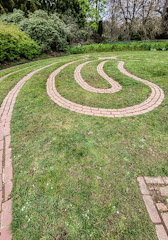
We found one part of the garden that we had not seen on earlier visits, probably because it is only open on Sundays. I believe that today was our first Sunday outing to the place. The section of the garden that is only open one day a week contains a circular maze. It consists of curving paths made of clay bricks set into the soil, and these are separated by low grassy ridges, In the centre of the maze there is a large spherical sundial, which was not working because the sky was overcast.
The maze was dedicated in 1981 by Robert Runcie (1921-2000), Archbishop of Canterbury from 1980-1991. It was created for two purposes. One was to celebrate Runcie becoming Archbishop, and the other to create what a notice described as: “… a space for reflection, exploring the idea that we should all help each other solve the mystery of the maze of life.” Well, whatever its intention, it is an attractive garden feature.
As for the weather, we were out of the house for about five hours, and it only rained for less than 15 minutes whilst we were driving to Greys Court. The maze there might in some way solve the mystery of life, but the Met Office needs to do a lot more work on solving the mystery of weather forecasting.
THE FIRST PLACE I practised dentistry was in Rainham, Kent. Every Thursday, we climbed into my then boss’s open-topped TR 7 sports car, and drove down the High Street to a pub called The Cricketers. There, we used to enjoy a hearty meat and two veg lunch. One of the waitresses, a middle-aged woman, was a patient at the practice and always made sure that we were given large portions. On other days, I used to eat either in the practice or in one of the other local eateries. Sometimes, I would go into the local branch of Tesco’s supermarket to buy myself a few items for lunch. These always included either a Mars bar or a chocolate covered honeycomb caramel called a Crunchie. All the cashiers in the supermarket knew where I worked, and often, whilst I was paying, they would raise the Mars or Crunchie in the air, and shout:
“Look what the dentist is eating!”
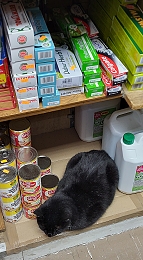
Recently, I entered a grocery shop near Portobello Road. I noticed a black cat resting on a shelf surrounded by tins, bottles, and boxes containing tubes of toothpaste. Seeing this creature reminded me of my days long ago in Rainham. There was a small ‘corner shop’ across the road from our surgery. The lady who owned it made very acceptable, generously filled sandwiches. Every now and then I used to buy one of her sandwiches for lunch. I used to accompany this with a packet of potato crisps. These packs were kept in an open topped cardboard box in no particular order. I used to rummage through its contents and select the pack that I fancied.
One day, I entered the shop to buy my lunch. When I turned to look at the box containing the packs of crisps, I saw a very plump cat comfortably curled up on top of the packets of crisps. Despite the fact that the crisps were sealed in their packets, I did not feel like choosing one. As I left the shop, I wondered where else that cat chose to rest during the day. Thinking about that put me off ever entering that little shop again.
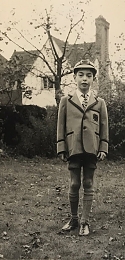
IN 1960, when I was 8 years old, I was accepted as a pupil at the Hall School in London’s Swiss Cottage area. Recently, I received some photographs of me in my newly acquired Hall School uniform. They were taken in the garden of our house in Hampstead Way in the Hampstead Garden Suburb, Maybe, it is fortunate that the photographs are in black and white because the Hall’s uniform was pink trimmed with black. The Hall’s ‘logo’ was a black Maltese cross – also a symbol used by the German army. I remember occasionally, children from other schools used to shout “Nazis” at me and my friends when we were wearing our uniforms in the street. The photographs were taken by my uncle Felix, who was born in South Africa.
When Felix came to London from South Africa in the second half of the 1950s, one of his first jobs was working in a photography shop in London’s Holborn. Like other members of my mother’s family, he was a keen photographer. His grandfather, my great grandfather, opened a photography studio in King William’s Town in the Eastern Cape in 1880. It was while Felix was working in the shop that the photographs of me in my new uniform were taken.
I remember the occasion vividly. Felix arrived at our house in the Suburb, carrying with him a great deal of equipment borrowed from the shop. Most of it was professional lighting on collapsible stands. Felix spent some time setting up a photographic studio in our living room. There were wires all over the place, and every electric socket in the room was used to power the lighting. I was positioned in a suitable pose. When he was ready, my uncle began switching on the lights. Then, it happened. The house’s electrical fuses blew, and all the lights went out. I remember that my parents were not too pleased with what had happened.
Because of the electrical problem, the much-wanted photographs, which were to be sent to relatives in South Africa, had to be taken outside in the garden. Seeing these pictures six decades later brought that occasion to the forefront of my memory.
Felix was a delightful, kindly man. He was everyone’s friend, and never harboured a grudge against anyone. Although he never had any children, I believe that he regarded the whole world as his family.
CONSTRUCTED IN 1974, it was 221 feet tall. It overshadowed the homes of many people including many of the wealthier inhabitants of West London’s Kensington. And I imagine that the wealthy inhabitants of the elegant crescents and other thoroughfares near it did not appreciate the views from their windows being spoiled by this Brutalist block of flats containing less well-off people, about whom they would rather not think. Between 2015 and 2016, the block was refurbished and made less of an eyesore by the addition of cladding – ostensibly to improve insulation – to its exterior.
On the afternoon of the 13th of June 2017, I was walking around North Kensington, taking photographs as usual. I stopped to take pictures of the recently built Kensington Leisure Centre and its near neighbour the Kensington Aldridge Academy – both are interesting examples of contemporary architecture. While I was taking these photos, I had my back to the tower block I have just described. Had I looked at it then, I would have thought that it would have been of little interest to me. How wrong I was.
Just after midnight on the following day, a fire broke out in that tall block – Grenfell Tower – that edifice which overlooked the homes of the wealthy residents of Kensington. The fire spread rapidly because of the highly inflammable nature of the cladding used to make the tower more attractive to its neighbours. Seventy-two people died in the conflagration; many were injured; and all the surviving residents were not only badly scarred psychologically, but also lost their homes and possessions.
From wherever you looked in a large area around Grenfell, including from the homes of the prosperous residents of Holland Park and Notting Hill, one could see the horrifically charred tower block – a fear-inspiring eyesore – the result of local government officialdom ignoring repeated warnings about the already known potential fire hazards that the cladding presented and inadequate planning for escape during a fire. I felt – and I am not alone in thinking this – that the local council hardly cared for a few impecunious residents in a tower block. What was more important was to save money so as not to impose high local taxes on people who could have easily afforded to pay them.
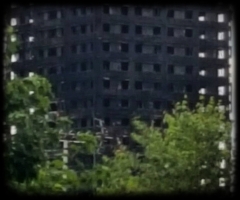
Soon after the fire, the charred tower was covered with protective wrapping to assist forensic investigations and to contain debris, which might otherwise have flown away and dropped in the neighbourhood. It also removed from sight the scarred, charred remains of the building – a 24 hour a day reminder of the avoidable, tragic loss of life, which was not altogether disconnected with civic and possibly criminal negligence. The remains of the tower are still covered up. Before the heart-rending remains of the conflagration were covered up, filmmaker Steve McQueen (born 1969 not far from Grenfell Tower) made a short film about the tower. It is currently on show at the Serpentine South Gallery in Hyde Park until the 10th of May.
The film is without words in its soundtrack and without any captions. It looks as if it might have been filmed with a drone or a camera held within a helicopter. It begins with a flight over beautiful countryside far beyond the edge of London. The camera moves above the scenes of rural serenity and slowly the city of London comes into view. We pass over London’s sprawling suburbs, and then the charred Grenfell Tower begins to be seen in the centre of the screen. The camera moves closer and closer to the blackened building, and then slowly circles around it many times. Each time the tower is slowly encircled, and the camera moves closer to it, more and more details of the destruction entered my consciousness, and my understanding of the horror of what had befallen Grenfell and its inhabitants gradually increased. As the camera moved around the wreck, you could catch glimpses of the parts of London surrounding it – the houses and flats of those who must have witnessed the fire, but were not affected by it, at least not physically. As the camera moved, one could see trains moving on nearby tracks and vehicles travelling along roads. I felt that I was witnessing life going on as usual at the same time as witnessing the horrors of a disaster. The absence of commentary added to the powerful impact that seeing these images of a lethal incineration simultaneously with scenes of normality made on me. There was a soundtrack, which consisted of recordings of everyday sounds – both natural and man-made. However, while the camera encircled the tower of death, there was no sound at all. I wondered whether this signified the fact that the victims, who had died, will no longer be able to enjoy the sounds of everyday life.
McQueen’s film is a sophisticated and solemn memorial to an event that could easily have been avoided. Without a soundtrack or explanations, the viewer is left to ponder the tragedy in his or her own way.
IN OCTOBER 1970, nine young people, including me, assembled in a room at University College in London’s Gower Street. It was the first day of our three-year course that would end with us being awarded Batchelor’s degrees in mammalian physiology. During the first year, we studied basic sciences and mathematics and had sparingly little to do with the Physiology Department. However, once a week someone from the department gave us a tutorial during which a variety of subjects were discussed. Often, these were conducted by an amiable lecturer, Jim Pascoe, a Cornishman with a strong Cornish accent.
During one of these sessions, one of us, Jenny, asked Mr Pascoe:
“What can we do with this degree?”
Pascoe thought for a minute, and said in all seriousness:
“You could become a policeman.”
What he said was not as frivolous as it sounded. With the exception of some professional training first degrees, such as medicine, dentistry, veterinary science, law, and architecture, most first degrees are essentially brain training courses. Good first degrees can lead their holders anywhere. They leave university with enhanced intellectual development and, maybe, a few other life skills. What Jim Pascoe said was a good answer.
So, what happened to the nine of us who first met each other in a room near Gower Street one morning in October 1970? One of us, a man, dropped out after one year. Four of us became academics. The last I heard of Janet was that she was working towards a PhD in goldfish behaviour. Allegra, probably the brightest person on our course, became a practitioner of acupuncture. Lopa, who is now my wife, became a banker, then a barrister. I became a practising dentist. And Jenny did not become a police officer – she qualified as a medical doctor.
IN COMMON WITH most people, I have little or no memory of the first two or three years of my life. My earliest recollections are the birth of my sibling when I was four years old, and walking with my parents to St Albans Church Hall in Golders Green to collect the free orange juice that the government provided in the 1950s. That was issued to children under the age of two, so it must have been for my sibling within the first two years of her life. At that time, I would have been less than six years old.
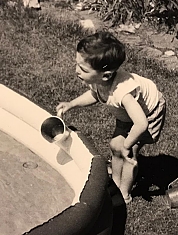
Recently, a cousin sent me scans of some family photographs. They include several of me before I was four years old. One of them taken of me in our garden in Hampstead Garden Suburb shows me standing beside a circular inflatable swimming pool filled with water. In the photograph, I am bending over the pool with a small jug in my right hand. None of this can I recall, except the crazy paving garden path behind me, which remained in existence until the 1990s, and might well still be there.
Seeing the photograph, which must have been taken before 1956, did jog my memory. I recall that after my sibling was born, my parents bought a bigger paddling pool for use in our garden. This was a rectangular affair. It consisted of a metal framework that had to be assembled and a plastic pool that was hung from its four sides before being filled with the garden hose. At each corner there was a small triangular metal seat. Well, I doubt I would have remembered this had I not seen the image of something I cannot remember at all.





 yamey
yamey 