A concert in a church at Sloane Square

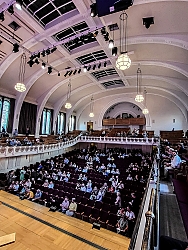
UNTIL YESTERDAY EVENING (24th of June 2023), I had never heard of the town of Davis in California. And unsurprisingly, neither did I know of the existence of Davis Senior High School and its baroque ensemble. Had I not attended their concert in Holy Trinity Church in London’s Sloane Square, I would have missed a great treat. Established in the year 2000, the ensemble consists of musicians – string players – aged between 15 and 18. It was founded by its conductor Angelo Moreno, who along with Caitlyn Oher – a student, performed some of the solo violin parts during the concert. Despite the internal air temperature of the church being about 26 degrees Celsius, the musicians played without an interval for an hour and a half. The concert included works by Purcell, Avison, Handel, Couperin, Buonamente, Vivaldi, Geminiani, and Rameau. Each piece was performed superbly. If you did not know, you would not have believed that these excellent musicians were high school pupils. The concert favourably rivalled many baroque performances I have heard by professional orchestras that specialise in baroque music.

The concert was held within a church designed by John Dando Sedding (1838-1891) in a Victorian gothic style, and completed by 1890. Apart from being a spacious church, what makes it special is that most of its decorative features were designed in the Arts and Crafts Movement’s style. Under the influence of people such as John Ruskin and William Morris, the Movement rebelled against industrialisation and encouraged craftsmen, who had been made redundant by the ever-increasing use of machines to manufacture things. The church contains much metalwork with designs characteristic of the Arts and Crafts Movement (a British version of Art Nouveau or Jugendstil). So important is this church as an example of the Movement’s style that Sir John Betjeman named it “The Cathedral of the Arts and Crafts Movement.” The east window, which we could see high above the musicians in the baroque ensemble, was created by the pre-Raphaelite artist Edward Burne-Jones and includes foliage as depicted by William Morris.

Whereas you will have to wait until the Davis High School Baroque Ensemble next visits London, Holy Trinity Church is open every day and welcomes visitors. I recommend that you pay it a visit.

A home and museum near Holborn

THE ARCHITECT SIR John Soane (1753-1837) created what is my favourite museum in London – Sir John Soane’s Museum. Son of a builder, Soane became a successful architect in the reigns of Kings George III and George IV. In 1806, he was elected Professor of Architecture at the Royal Academy. Although he was able to undertake the Grand Tour in Italy and Malta during the period 1778 to 1779, many of his students were unable to do so because of the Napoleonic Wars raging in Europe between 1803 and 1815.  This meant that they were deprived of the opportunity of viewing the great works of art and architecture, which was considered an important part of an architect’s training during the Regency Period. However, Soane got around this problem as I will explain.

Between 1792 and about 1812, Soane purchased and then demolished three neighbouring houses on the north side of Lincoln’s Inn Fields. He rebuilt them to his own designs. He continued remodelling their interiors to test out the efficacy of his novel architectural designs. One feature that stands out are his clever ways of getting natural light to reach parts of the buildings that were far from natural light sources. Often skylights are located above tall internal lightwells, which allows light to reach, for example the basement rooms. In addition, carefully placed mirrors assist the distribution of natural light. These clever methods of illumination were important innovations in the era before electricity or gas-lighting.

Soane lived in his houses, had his architectural workshops there, kept a picture gallery, and created a museum. The picture gallery is ingenious. A small square room, lit from above, has some of the pictures arranged in two layers, one covering the other. The wall carrying the outer layers of pictures is in fact a huge, hinged door, which can be opened to reveal the pictures on the layer it covers (see the photo above). By this method, Soane created much more hanging area within the room. The pictures and drawings include many by Hogarth and Piranesi, and at least one by Canaletto. There is also a pair depicting Soane and his wife. Other pictures depict buildings designed by Soane as well as projects that he planned but were never fulfilled. To squeeze so many large artworks into such a small room, where they can be viewed comfortably, is a work of genius.

Soane, who was a successful architect and married the daughter of a wealthy builder, was not short of cash. He spent some of it on purchasing a huge variety and a great number of antiques including the Sarcophagus of Seti (Egypt, c 900BC). The sarcophagus had lain in front of the British Museum for two years before he was able to purchase it from the man who owned it. It had been offered to the British Museum, which declined to purchase it for £2000. So, Soane bought it, and it is the most important exhibit in his museum. The other antiques include Ancient Greek and Roman as well as mediaeval and renaissance artefacts. Soane put much effort into arranging his collection and established it as a museum. In 1833, he managed to get a Private Act of Parliament passed. This enshrined in law that after his death, number 13 Lincoln’s Inn Fields (the museum) should be preserved in perpetuity in the state he left it. And this has been done faithfully, but with careful restoration when necessary.

One of the purposes of Soane’s Museum was to allow his architectural students to view and study the sort of things that would have been able to see had the Napoleonic Wars not prevented them from undertaking their own Grand Tour. A visit to the curiously cluttered museum is fascinating and wondrous. The staff and volunteers that keep an eye on the various rooms and chambers in the museum are well-informed and provide interesting information.

A not so peaceful garden of peace

TODAY, OUR FRIEND took us to see a part of Hampstead, which I never knew existed. Called The World Peace Garden, it is located on a sliver of sloping ground bounded to the south by Hampstead Heath Overground station and to its north by a short stretch of the western end of the road called South Hill Park. Its dimensions are approximately 95 feet in length with a maximum width of about 29 feet. It is entered by a discrete opening on South Hill Park. Some steps lead downward to a couple of paths that wind their way through the dense vegetation and past small ponds to a tiny seating area at the garden’s eastern end. The miniscule park is rich in flowers, bushes, and trees. It is a lovely place.

The World Peace Garden began to be created in about 2014 on waste land between South Hill Park and the railway station. Inspired by a local estate agent, Jonathan Bergman, the garden was designed by  Tony Panayiotou and Michael Wardle, and created by gardeners Keiko, Hugh, Laurence, Miki, and Mer. In 2016, it was awarded the ‘Time Out Love London Award for Local Culture in Hampstead’. Today, it is still delightful, although slightly overgrown. During our midday visit, we saw several people enjoying lunch in shady nooks.

Although the garden is to celebrate the idea of world peace, it is not exactly a peaceful place. Every few minutes, the peace of the garden is disturbed by noises coming from trains passing through the station beneath it. Despite speaking to many people about Hampstead, until today nobody has mentioned the Peace Garden to me.

Inspired by a novel by James Joyce

THE ARTIST ANSELM Kiefer was born in Germany a few weeks before the end of WW2 in Europe. He was brought up in a country devastated by warfare and with a shameful recent past. It is said quite reasonably that much of his artistic output has been influenced by the guilt-ridden environment in which he grew up.

Today, the 21st of June 2023, we visited the White Cube Gallery on Bermondsey High Street in south London. Until the 20th of August 2023, it is hosting a spectacular show of works created by Kiefer. To call it an exhibition is a bit of a misnomer – it is really an ‘immersive experience’. It occupies the gallery’s entire exhibition space as well as the long central corridor that links the various large display rooms.

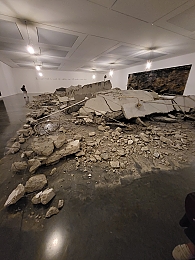
The long central corridor is lined with a large variety of ‘objets trouvés’, which some might well describe as ‘junk’. Together, they form a large-scale cabinet of curiosities like those which wealthy people used to create in the past, but few of the objects would have appealed to such collectors. Three large rooms can be entered from the corridor. The walls of each of these are lined with what at first sight look like enormous paintings. They are made of metal, often quite three-dimensional, and coloured with paint. Each one is both visually exciting and satisfying. In the middle of each room, there is an installation that suggests that it has formed after some apocalyptic event – maybe, an atomic bomb explosion or some similarly catastrophic event. In one room, the centre is filled with a pile of sand in which discarded supermarket trolleys have been abandoned. Another room is filled with what look like huge books damaged by flood waters. In the third and largest room, there are the concrete and rusted iron remains of what might once have been a modern building – it is a scene of horrendous devastation.

Throughout the ‘exhibition’, there are handwritten words, phrases, and sentences. These can be found on the walls, on the painting-like panels, and near objects stored in the corridor. A gallery attendant told us that each of them had been handwritten by Kiefer when he came to inspect the installation of his show. The words were not his but are all taken from “Finnegan’s Wake”, published in 1939 and written by James Joyce (1882-1941). Hence, the exhibition at the White Cube has been given the name of this novel.

Superb as this exhibition surely is, I found it oddly claustrophobic. Although it is a visual feast and a great feat of imagination and creativity, I found it slightly disturbing – that might have been the artist’s intention. But please do not let me put you off visiting this unusual and wonderful show.

A cafe of uncertainty

MANY READERS – ESPECIALLY those with some knowledge of physics – will have heard of the German Werner Heisenberg (1901-1976), who is well known for his famous Uncertainty Principle that relates to quantum physics. Because of my uncertainty about what exactly this principle expresses, I will let you look it up on Google or elsewhere.

One thing I was not uncertain about was seeing a café called Heisenberg in Chiswick’s Turnham Green area. As it was nearly 11 am, I was certain that I needed a cup of coffee, and what better place to have it than a place named after a person who ‘discovered’ uncertainty. The café is small but quirkily decorated and the coffee it served was very good. We drank from disposable cups, which bear the motto:

“Perfection cannot be measured as explained by the Heisenberg theory. However, this is the closest you’ll get to the perfect cup of coffee.”

Although I am uncertain whether the second part of this is true, I am certain that when I am next in the area, I will try another cup of Heisenberg’s coffee.

No, not the former Prime Minister

AT THE WESTERN END of Chiswick’s Turnham Green, there is a striking church, which was designed in the Arts and Crafts style by the architect Richard Norman Shaw (1831-1912) and consecrated in 1880. It served the community that was beginning to settle in the recently established Bedford Park, which I described as follows in my book “Beyond Marylebone and Mayfair: Exploring West London”:

“Bedford Park near Turnham Green is probably the first example of what has become known as a ‘Garden Suburb’ development, although originally it was not known as such. Pevsner noted:

‘Its reputation as the earliest garden suburb needs some qualification. Trees and green spaces … are found in many earlier suburbs; the novelty of Bedford Park is their combination with ‘artistically designed’ houses … inspired not by classical or Gothic pattern books but by the red brick and tiled idiom derived chiefly from the home counties vernacular of the c17 and c18…’

He added that the idea was to recreate the:

‘… relaxed informal mood of a market town or village…’, in ‘… a completely speculatively built suburb.’

And, in the case of Bedford Park this ideal has been almost but not quite fully achieved, because the suburb, attractive though it is, has a somewhat staid, bourgeois feel about it. Created by Jonathan Thomas Carr (1845-1915), its development began in 1875 …”

If you want to know more, you can find it in my book.

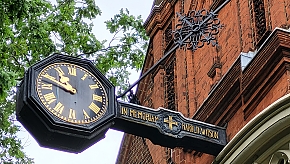
Returning to the church, which we re-visited today (20th of June 2023), I showed my wife the interesting clock on one of its exterior walls. It is held away from the building by a sturdy beam on which there are some words. On one side, you can read: “Spion Kop Africa 1900”, and on the other, you will see: “In memoriam Harold Wilson”.

In case you are wondering, the clock has nothing to do with the former Prime Minister Harold Wilson (1916-1995). Instead, it commemorates 2nd Lieutenant Harold AC Wilson, who fell at the battle of  Spion Kop in January 1900 during the 2nd Anglo-Boer War (1899-1902).

[My book is available from Amazon: https://www.amazon.co.uk/BEYOND-MARYLEBONE-MAYFAIR-EXPLORING-LONDON/dp/B0B7CR679W/ ]

Playing the music of Thomas Tallis without much feeling

JUST AS A PHOTOGRAPHER should try to capture what he or she feels about a subject, rather than attempting to copy it slavishly, I feel that good musicians should not only reproduce what is in the composer’s score but also express what they feel about it and what it means to them as they play.

Last night, the 19th of June 2023, we attended a concert of music by Thomas Tallis (c1505 – 1585) performed by the Tallis Scholars at Cadogan Hall (see photograph) in Sloane Square. As far as I could tell, the choir sung well. But I felt for most of the concert they were concentrating on accuracy more than anything else – the result seemed sterile to me. It was only during the final piece “Spem in allium” that the performer’s music sprung to life magnificently – it was an uplifting performance of this piece.

Come with me in my Ferrari

Fort Kochi (Fort Cochin) is the picturesque, historic part of Kochi – a port on the coast of Kerala in southwest India. Occupied at various different times by the Portuguese, Dutch, and British, this small urban area at the northern tip of an island contains many buildings that recall the town’s former foreign occupiers.

Essentially, the historic town centre consists of a few short streets and some open spaces. Fort Kochi is built on flat terrain, and is a paradise for walkers even in the hot, humid weather that prevails most of the year. As a consequence, the large number of autorickshaw (‘auto’) drivers often seems to outstrip customer demand.

From dawn to after dusk, auto drivers cruise around the town in their empty vehicles, looking for customers. We usually spend at least a week in Fort Kochi every year, especially when the excellent Kochi-Muziris international art biennale is in progress. So, individual auto drivers get to know us as we stroll around. They stop and ask us if we need a ride. We tell them that we are walking. So, when they next see us, optimistically they invite us to take a ride. When we turn them down, they say to us in an understanding way:

“Walking, walking! – always walking.”

Other auto drivers, who either do not recognise us or are trying to tempt other tourists into their cabs, say:

“See my Ferrari. Come and take a ride in my Ferrari.”

This always amuses me because to describe an auto as a Ferrari is rather like describing a pigeon as an eagle.

On the subject of Ferraris, there are some in India. One of them, an eye-catchingly bright yellow, belongs to, or is driven by, a young man who is the late teenaged son of a wealthy family in Bangalore. Because this is not a type of vehicle that could be safely parked in most parts of the city, he can only use it to drive to and from the exclusive Bangalore Club, where he can park it in an area well policed by security guards. At his home, he parks it in the safe compound containing his residence. Given the density of traffic and the daring driving in Bangalore, it is amazing that he feels safe enough to flaunt his precious car on the roads between his home and the Club.

Keeping watch in the Kyoto Garden

LONDON’S HOLLAND PARK contains a lovely area – the Kyoto Garden. It is a well-maintained Japanese-style garden. I visit it frequently. Each time, I see something different there.

The garden is planted around a small pond in which there are several rocks, which look like miniature islands. Today, I saw a heron perched on the summit of one of these rocks. It stood still, moving its head slowly every now and then. It showed little interest in the many fish that swim in the pond. My wife noticed that there was a nest containing eggs just below the bird’s feet. The creature stood like a sentinel, guarding its future offspring.

I could see four eggs in the nest – there might have been more. In general, so I learned from Wikipedia, the various species of heron are monogamous and lay between three and five eggs. I have no idea what species I saw in the Kyoto Garden, but it is the first time I have seen a heron’s nest with eggs anywhere in Holland Park.