
In 1949, a year after my father, Basil Yamey married my mother, one of his cousins arrived in South Africa from Europe. Hendrik (aka: ‘Henry’, ‘Hendrik’ and ‘Heinrich’) Jami set foot on South African soil after an arduous trip. Tragically, his life ended suddenly and by foul means in South Africa.
Hendrik was a son of Moses and Dora (née Peisel) Jami. The Peisel family owned a brewery in Budapest. Moses was a brother of Basil Yamey’s father Solomon Yamey. Hendrik was born in Plunge in Lithuania in 1895, soon after his uncle Solomon had migrated from Plunge to South Africa. His brother Kurt (1901-1984) migrated to Rhode Island in the USA, and another two brothers, Isidore (1903-1946) and Max (1905-1990), followed their uncle Solomon to South Africa between the two World Wars. Records in the National Archives of South Africa suggest that Hendrik was planning to go to South Africa to join his brothers there in 1939. However, it took him 10 years to reach the country.
Hendrik, who had been living in Budapest for several years, must have perceived, as did many other Jewish people, that the Nazis in Germany were beginning to make life very uncomfortable for Jews. Even after the Second World War broke out in 1939, Hungary – an ally of Germany – was not occupied by the German troops; this only happened in 1944.
From late 1938 onwards, Hungary invaded territory beyond its eastern and south-eastern borders. This increased the length of its frontier with the Soviet Union. Hungary declared war on the Soviet Union in June 1941. I assume that it must have been sometime before that date when Hendrik began his journey eastwards towards Shanghai. This city in China was just about the only place where there was no administrative difficulty for Jews to gain entry. According to Sally Ogle Davis writing in an article[i] published by the on-line Jewish Journal in 2002:
“It wasn’t that the Chinese deliberately set out to help the Jews of Europe, it was simply that among the warring colonial factions who ran Shanghai — the French, the British, the Japanese — no one wanted to control the passport department because no one wanted to take ultimate responsibility for the chaotic province. And in chaos lay an escape route for the Jews.”
Many of the Jews who fled to Shanghai travelled by boat via the Suez Canal. Others, including Hendrik, travelled by train across Stalin’s Soviet Union to China. Shanghai, their destination, had an established Jewish community. This was founded by wealthy Baghdadi Jews, including members of the Sassoon and Kadoorie families, in the 1870s.
Shanghai was occupied by the Japanese in 1937[ii]. It was then that the port allowed entry without passport or visa, making it a place that Jewish refugees could gain access freely if they could travel so far from Europe. By the time that Hendrik reached the city, there were already many Jewish refugees there, and conditions were becoming crowded. By 1943 there were at least 18,000 Jews sheltering in Shanghai. It was then that the Japanese forced them all to live in a small ghetto, a three-quarter square mile area of Shanghai’s Hongkou district. Conditions were cramped and difficult to say the least, but the Jews, most of whom might have already perished had they remained in Europe, were safe for the time being.
The Shanghai Ghetto was liberated in September 1945, and by 1949 most of its Jewish inhabitants had moved away from China. Hendrik Jami was amongst these. When he arrived in Cape Town in 1949, he was met by one of his brothers, Max Jami (who was to change his surname to that of his uncle Solomon: i.e. ‘Yamey’). Max took him to his home in Wolsely, which is just under 90 miles north-west of Cape Town and 10 miles south of Tulbagh where Solomon Yamey used to live. Hendrik lived with Max and his family for a few weeks while he acclimatised to his new surroundings and a new way of life.
Eventually, Hendrik moved to the town of Worcester, which is about 26 miles south-east of Wolsely. In time, he bought the Afrikaanse Koffiehuis in the centre of this small town in the High Street near where it is intersected by Porter Street; the establishment still exists. The Koffiehuis was both a café and a general store. Hendrik’s nephew, Max’s son Mervyn, remembers visiting his uncle once a week on Sundays. He recalls that Hendrik was a very friendly man who got along well with everyone. He was very generous, always plying his nephews with gifts of confectionery. Mervyn told me that his uncle’s generosity extended well beyond his family. Once, for example, he donated a huge sum of money, £1000, to the Dutch Reformed Church in Worcester. Mervyn also remembers that Hendrik did not believe or trust in banks, and kept much money in his living quarters which were situated behind the shop and separated from it by an almost enclosed yard. Another source of information, the Cape Argus newspaper, said that Hendrik was often seen around the town with his bulging wallet stuffed full of banknotes.
In early 1956, Hendrik sold his business to a Mr Athanassiou. He continued to work in the shop as its manager, and lived as before in his quarters behind the shop. Shortly before midnight on the warm summer night of the 10th of January 1957, Hendrik Jami, the manager of the Afrikaanse Koffiehuis, was seen taking a leisurely stroll along Porter Street in the small town of Worcester in the Western Cape Province of South Africa. Next morning, Mrs Rena Erasmus, who worked as an assistant at the Koffiehuis, arrived at half-past seven to find that her workplace was still closed. Usually, it was open by then. She knew that Mr Jami always opened the shop promptly at five thirty in the morning. He was always telling her so.
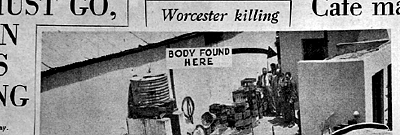
Alarmed, she telephoned the café’s owner, Mr Athanassiou, from a public ‘phone box, and told him about the unusual state of affairs. He told her to look at Mr Jami’s rooms behind the café. What she found there was very unpleasant. Mr Jami was lying fully dressed on the floor of his kitchen. His hands were tied behind his back with a handkerchief, and there were bruises on his throat. A cloud of flies hovered above him, buzzing. He was dead. His murdered body was described in gory detail in the Cape Argus. It made front page news on several consecutive days. After some days, two different rewards were publicly offered for any information that lead to the arrest and conviction of Hendrik’s murderer(s). Both Mr Athanassiou and Hendrik’s brother Max offered rewards of £100 (worth well over £1000 today).
The crime was not resolved immediately. Eventually, the murderer and his accomplice were discovered and arrested. Hendrik’s nephew Nat Yamey told me that they were both sentenced to death in the Circuit Supreme Court in Worcester. In those days the death penalty was by hanging, and he remembers that his father told him that they were both hanged in Pretoria Central Prison.
[i] http://www.jewishjournal.com/arts/article/europes_harms_to_chinas_arms_20021004, accessed March 2015.
[ii] A friend of mine, the late Sir Henry Norman Brain (1907–2002), was a British diplomat in Shanghai when it fell to the Japanese. He remembered that the seemingly unending fighting stopped suddenly. Soon after this, he asked a Japanese general what had made the Chinese surrender so suddenly. He was told the Chinese soldiers, who were all mercenaries, had accepted a bribe from the Japanese to do so.

