PANTON STREET RUNS between Leicester Square and Haymarket. The Tom Cribb pub, formerly known as the ‘Union Arms’, stands on the corner of Panton Street and Oxendon Street. The pub’s name commemorates a boxing champion Tom Cribb who lived from 1781 till 1848. A small plaque on the exterior of the pub commemorates another boxer, Bill Richmond (1763-1829).
Tom Cribb pub
Richmond was born into slavery at Richmondtown on Staten Island, New York. After witnessing Richmond’s fighting talent during a brawl at a tavern during the American War of Independence, a British commander arranged for his freedom, and took him to Yorkshire in England in 1777. There, he was educated and met his wife, Mary, while he was working as a cabinet maker. By 1795, Richmond and his family had moved to London, where he worked as an employee of Thomas Pitt, 2nd Baron Camelford (1775-1804), who happened to be a boxing enthusiast. According to Wikipedia:
“On 23 January 1804, Pitt and Richmond attended a boxing match featuring experienced boxer George Maddox. After Maddox won the bout, Richmond spontaneously challenged Maddox to a fight, which Maddox accepted. When the fight took place, Maddox defeated Richmond in nine rounds.”
Despite this, after Pitt died, Richmond took up professional boxing, and fought with many of the champions of the time, often winning these contests.
In 1805, after Richmond had defeated the Jewish champion Youssop and Jack Holmes ‘the coachman’, he challenged the great Tom Cribb, but lost. For many years Richmond and Cribb held grudges against each other. However, as the two men got older, they became friends. Often, they used to meet and converse in Cribb’s favourite pub, the Union Arms on Panton Street. It was in this pub on 28 December 1829 that Richmond spent the last evening of his life, relaxing with Tom Cribb. It is this that is recorded on the plaque outside the former Union Arms, now the Tom Cribb pub.
THERE ARE FOUR stone plinths on London’s Trafalgar Square. Three of them bear statues of noteworthy men of the past. The fourth plinth, which is at the northwest corner of the square, was destined to carry a statue of King William IV, but it was never placed there. For many years, the fourth plinth remained unused, but from 1999 onwards it became used to display works of art. Works are commissioned for the plinth, and remain displayed on it for, typically, a year or two. This year’s artwork, “Mil Veces un Instante” (‘A Thousand Times in an Instant’) is by the Mexican artist Teresa Margolles (born 1963).
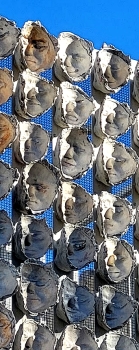
At first sight, the sculpture looks like a rectangular box-like framework covered with white ovoid shells, rather like halves of easter eggs. On closer examination, these shapes look like the internal surfaces of moulds taken from faces. Indeed, that is what they are. As an article on Wikipedia explained:
“Casts of the faces of 850 trans people from London and around the world. The ‘life masks’ are arranged around the plinth in the form of a tzompantli, a skull rack from Mesoamerican”.
And a notice by the plinth informed the viewer that:
“The casts have been created by applying plaster directly onto the faces of participants, meaning that as well as recording their features the plaster is infused with their hair and skin cells … The material is important to the work, it is fragile and will deteriorate (although not disintegrate) over time. The fragility of the material is a reflection community, both fragile and strong. The material also has a tendency to pick up other materials into the work. The material retains traces of the participants such as eyelashes, eyebrows, skin cells, makeup etc, they are present in the work.”
Well, what was the artist trying to tell the viewer? On 22 December 2016, Karla, a trans-gender woman, was found murdered in a Mexican city. According to the information panel, the work on the plinth is both a memorial to Karla and an object to raise awareness of the violence and abuse faced by so many transgender and other gender non-conforming people around the world.
Unlike some of its predecessors on the fourth plinth, Margolles’s work, is not particularly visually striking. Its strength lies in the concept that led to its creation. It expresses a message, but it is not one that is at all obvious to the casual passer-by. If one does not read the information panel, this work would make little or no impression on those who happen to notice it. I hope that the next piece to occupy the plinth will be more eye-catching, even though the present one is full of good intention.
THE PARK THEATRE in London’s Finsbury Park was opened in 2013. We have seen many productions there and they have all been good to excellent. “The Meat Kings! (Inc.) of Brooklyn Heights”, written by Hannah Doran, is showing until 29 November 2025, is no exception, as we discovered after watching it last night (1 November 2025). A word of warning is owed to vegetarians and vegans: the play is set in the meat cutting room of a family butcher’s shop somewhere in New York City. But do not let this deter you because the main points of the play are not about carving and slicing meat.
In the play, Paula Caffarelli is the owner of Cafarelli & Sons. Her great grandfather, an immigrant from Sicily, founded the firm 100 years ago. She tends to hire people released from prison to work in her cutting room. Three of her employees are ex-convicts and the fourth is an immigrant from Mexico. One of the ex-prisoners, Billy (acted brilliantly by Ash Hunter), must earn to pay his mother’s exorbitant medical fees. David, who used to make a fortune on Wall Street but has fallen on hard times, Is Paula’s senior meat cutter. JD is the Mexican. During the play, Paula takes on a new cutter, T, also recently released from prison. At the beginning of the play, Paula’s staff fool around and take life easily. However, it is not long before Paula’s business begins to suffer economically, and her staff members reveal their personal problems. Things reach a stage where Paula needs to reduce the number of her staff, and some of her cutters begin plotting against the others.
This well-acted, superb play is both entertaining and disturbing, but never uninteresting. As the theatre’s website explained, the play:
“… carves into the dark underbelly of America’s anti-immigration policies and the brutal sacrifices that drive the pursuit of prosperity.”
It adds a note of warning:
“This production contains butchery; references to prison, suicide and illness; discussions of racism & xenophobia. Also contains strong language and references of a sexual nature. Please note, this production does not use real meat.”
The play comes to a tragic end as the characters, to use an appropriate phrase, knife each other in the back. I enjoyed the play, and believe that seeing it would not disturb those who avoid eating meat. However, it might put you off crossing the Atlantic from east to west.
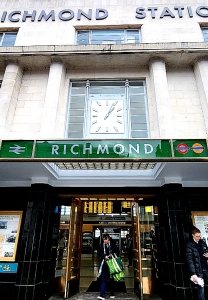
WE VISIT RICHMOND-ON-THAMES often, frequently arriving on the District Line of the London Underground. However, it was only yesterday, 31 October 2025, that, while waiting for a bus outside the station. I noticed that its façade is a fine example of the Art Deco style of Modernist architecture, which achieved popularity between the two world wars.
The first Richmond station was opened in 1846. The current station was built in 1937. It was designed by Southern Railway’s Chief Architect James Robb Scott (1882-1965), whose other works include the offices and Victory Arch at London’s Waterloo Station. Richmond station’s façade is mainly constructed with white Portland stone. The main entrance has black features constructed using polished black granite. Within the recently restored ticket hall, there is a green glass frieze that surrounds the hall and contains the original wording that indicates the various services offered within the large room. The walls of the hall are lined with travertine cladding and the light fittings hanging from the ceiling are of a Modernist design typical of the era during which the station was built.
Until 2025, many of the original Art Deco features of the station, both internal and external, were either hidden by modern panelling or were in poor condition. Between 2023 and 2025, the station was carefully restored to its original splendid state.
After catching our bus, I noticed that we passed several other Art Deco buildings near to the centre of Richmond. These were blocks of flats. Before returning to the station, we stopped outside one of these, Lichfield Court. This was designed in the Streamline Moderne style, a type of Art Deco, by George Bertram Carter (1896-1986), and completed in 1935. Incidentally, Carter had been a pupil in the office of Edwin Lutyens between 1919 and 1922. Apparently, this block of flats incorporates some innovative features, which we did not have time to see.
Until our most recent visit, I never associated Richmond with Art Deco architecture. On our next visit, I hope to wander around, examining the examples of this style in greater detail.
“… WHAT IS READING but a vice, like drink or venery or any other form of excessive self-indulgence? One reads to tickle and amuse one’s mind…”
These are the words of the verbose Mr Scogan in “Crome Yellow”, a novel by Aldous Huxley (1894-1963). With novels such as this one, reading is certain to become an incurable addiction, if not a vice. First published in 1921, only a few years after the end of WW1 this short novel is not only highly entertaining and extremely witty but almost completely un-put-downable.
Huxley was 27 years old when he published “Crome Yellow”. It begins when a young man, Denis, aspiring to be a poet arrives, at Crome, a stately home where various other guests have come to spend time during the summer. The book and the stately home contain a wealth of characters whose conversations and interactions with one another provide the reader with a wealth of entertaining situations. The author manages to convey the social atmosphere prevailing amongst the upper classes immediately after WW1, as well as presenting a range of philosophical ideas both about life and art. He managed to do this with a lightness of touch that makes even the most abstruse of ideas become easily digestible by the reader.
Every now and then, Mr Wimbush, the current head of the Crome household, reads extracts from the history of the house and its aristocratic inhabitants, which has taken him 30 years to complete. These are highly entertaining. Throughout the novel, Jenny, who is almost completely deaf, scribbles away in her notebook. What she had been entering into it is surprising, and only revealed near the end of the book. Other characters include several young ladies, Mrs Wimbush who believes in mysticism and spiritualism, Mr Scogan who cannot stop talking and has an opinion about everything, Mr Bodiham the village priest, the artist Mr Gombauld, and the spiritualist Mr Barbecue-Smith. Throughout the story, a young lady, Anne, is the object of attention by both Denis and the French artist. Between these characters and others in the book, you can be sure that Denis’s stay at Crome was anything but dull.
I picked up my copy of “Crome Yellow” at a charity shop, and am extremely glad I did. I have not enjoyed a novel as much as this one for quite a few years. I hope to read more of Huxley’s novels in the future.
THE FIFTH of November is celebrated each year to commemorate a non-event. It was on that day in 1605 that a plot to blow up the the Houses of Parliament and its inmates, which on that day included King James I. The plotters, led by Guy Fawkes (1570-1606), were Roman Catholics who were annoyed that the king would not grant greater religious tolerance of the Catholics. Had the king been killed, the conspirators would have tried to replace him with a Catholic monarch.
Guy Fawkes Day, the 5th of November, celebrates the fact that the plot failed. For several days before the 5th of November, and for a few days after it, fireworks are let off both in private and public spaces all over Britain. And because the Hindu festival of Diwali (Deepavali) is often celebrated with fireworks close to Guy Fawkes Day, between that festival and the 5th of November, the sky is filled with sounds of explosions almost every evening.
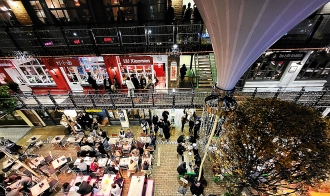
IT WAS DIFFICULT to believe that the UK is suffering a cost-of-living crisis and other economic difficulties when we entered Kingly Court on a Wednesday evening in late October 2025. Each of its over 20 restaurants and bars were almost full of diners and drinkers. And many of these establishments are not for those on a tight budget.
Kingly Court is a three-storey building surrounding a large rectangular courtyard filled with tables and chairs. The courtyard is surrounded by galleries, each of which is flanked by several eateries. There are also restaurants and bars on the ground floor. The place was literally buzzing when we arrived there at about 7.30 pm.
Kingly Court is bounded by Kingly Street, Ganton Street, and Carnaby Street. I can not determine when the place was built for its present purpose as a mecca for hungry people. In the 1890s, the block in which Kingly Court now stands was occupied by buildings of various sizes that surrounded an open space. The redevelopment of Kingly Court was carried out by Rolfe Judd Architects. The initial aim was:
“… the refurbishment and extension of four buildings, with the aim of creating unified, high-quality office spaces on the upper floors while retaining the bar and restaurant uses of the ground floor and basement.” (www.rolfe-judd.co.uk/planning/projects/kingly-street-2/)
However, since that project was undertaken, the Court’s main purpose has become a centre for restaurants and bars.
There is a wide range of food choice available at Kingly Court. There, you can feast on dishes from a multitude of different cuisines from around the world. And it seems to be very popular despite the financial problems afflicting the UK at present.
THE WRITER CHARLOTTE Bronte (1816-1855) and her sister Emily lived in Brussels from 1842 to 1844. Charlotte’s novel “Villette” (published in 1853) is based on her stay in Belgium’s capital city. In the novel, a young female character, Lucy Snowe, visited a gallery in the city, and noticed a painting that had been set aside to be viewed by connoisseurs. It was described in the story as follows:
“It represented a woman, considerably larger, I thought, than the life. I calculated that this lady, put into a scale of magnitude, suitable for the reception of a commodity of bulk, would infallibly turn from fourteen to sixteen stone. She was, indeed, extremely well fed: very much butcher’s meat—to say nothing of bread, vegetables, and liquids—must she have consumed to attain that breadth and height, that wealth of muscle, that affluence of flesh. She lay half-reclined on a couch: why, it would be difficult to say; broad daylight blazed round her; she appeared in hearty health, strong enough to do the work of two plain cooks; she could not plead a weak spine; she ought to have been standing, or at least sitting bolt upright. She, had no business to lounge away the noon on a sofa. She ought likewise to have worn decent garments; a gown covering her properly, which was not the case: out of abundance of material—seven-and-twenty yards, I should say, of drapery—she managed to make inefficient raiment. … On referring to the catalogue, I found that this notable production bore the name ‘Cleopatra.’”
Today, 29 October 2025, we looked at a small exhibition in London’s Bury Street. Presented by a Turkish gallery, Guler & Guler, the show was called “Silks & Sultanas: Courtly Fabrics and Depictions of Women in the Ottoman World”. Mr Cem Güler kindly showed us around his small, but superb exhibition. One of the larger paintings, which depicts a reclining lady, is called “The Almeh” (i.e., The Sultan’s favourite), and was painted by Eduoard de Biefve (1808-1882), a Belgian. It was painted in 1842, the year that the Bronte girls arrived in Brussels. Mr Guler explained that this was the painting that Charlotte described in “Villette”. The description in the extract reproduced above is a good description of what we saw today, but the author added a few details that are not present in the painting.
In December 2023, the painting was auctioned by Sotheby’s in Dallas (USA). The auction house’s website remarked of this painting:
“The present painting met with a tumultuous reception in 1842 largely because of its title. The Arab term Almeh designates a class of educated women who sang and recited poems from behind a screen or from another room during parties or private entertainments. However, the term’s meaning became distorted and for many at that time it was associated with exhibitionist dancers whose suggestive dances had a sexual connotation. L’Almeh by Bièfve is deliberately provocative: languorously reclining on a couch, the woman looks directly at the viewer and points a finger at the mattress. It is hardly surprising that the painting met with such reactions.”
And in “Villette”, after being caught looking at the painting, the young English lady viewing it is told off by Monsieur Paul Emanuel, who clearly thought it an unsuitable picture to be seen by a young lady. And Lucy Snowe did not approve of it, as is related in the following from artdaily.com:
“We may think of our historic and leading creative minds as endlessly progressive, but in 1842, the indelible Charlotte Brontë came face to face with a controversial new painting, a true succès de scandale that by all evidence disturbed and irritated her so badly that she wrote at length about it in her final — and some say her best — novel, Villette. Brontë’s fictional proxy, the main character Lucy Snowe, stares at the painting (and its seductive subject) and thinks: ‘…this picture, I say, seemed to consider itself the queen of the collection. She lay half-reclined on a couch: why, it would be difficult to say … She had no business to lounge away the noon on a sofa. She ought likewise to have worn decent garments; a gown covering her properly, which was not the case … Then, for the wretched untidiness surrounding her, there could be no excuse … it was on the whole an enormous piece of claptrap’.”
We had entered the small gallery to see the exhibition because I wanted to see whether there were any paintings of women dressed in traditional Albanian folk costumes (Albania was part of the Ottoman empire until 1912). There were none, but, instead, I came face to face with a painting that had caught the attention of Charlotte Bronte soon after it was painted.
ON OUR WAY to visiting friends, who live in Tonbridge (Kent), we stopped to look at the Church of St Thomas à Becket in the village of Capel. The saint lived from c1120 until his murder in 1170. An old tree in the churchyard at Capel is fenced off and alongside it, there is a label that informs the reader that the saint was:
“… supposed to have preached beneath this lovely old yew tree.”
Given that it is now the year 2025, the very latest that he could have preached beneath this tree would have been 855 years ago. As some yew trees can remain alive for several thousand years (https://fortingall-graveyard.org.uk/yew-tree), it is quite possible that the venerable yew at Capel was around when St Thomas à Becket was active.
The interior of the church offers visitors a wonderful surprise. The north wall of the church has many sizeable fragments of wall paintings that were uncovered in 1927. They had been covered with whitewash (paint) during the Reformation (sixteenth century) during which church decorations were largely removed, destroyed, or hidden. Experts believe that these paintings were executed in two periods: in about 1200 and then about 50 years later. The subject matter of these wall paintings was religious, designed to convey bible stories to those parishioners who could not read, and who did not understand Latin, then the language used during church services.
Amongst many other fascinating things in this small church, the communion rail caught my attention. Carved in the seventeenth century, it bears the date 1682 and the name “Michael Davis”. According to an informative leaflet in the church, in the 1630s Archbishop Laud (1573-1645) recommended installing such rails to prevent dogs from entering and defiling the sanctuary that contains the high altar. The simple stone altar was made in 1979 to replace a seventeenth century communion table that had been stolen. Like mediaeval stone altars, the modern one at Capel is inscribed with five crosses, which symbolise the five wounds made in the crucified Christ.
Although still consecrated, the church is not used often. It is now cared for by The Churches Conservation Trust and left open during the day for visitors to enter. For those interested in seeing mediaeval wall paintings in Kent, apart from at Capel there are fine examples at: Chiddingstone, Newington-next-Sittingbourne, Stone, and Barfreston.








 yamey
yamey 