Saved from the funeral pyre: an airport is named after this remarkable queen

AHILYABAI HOLKAR WAS born in 1725. She married Khanderao Holkar (1723-1754), the only son of Malhar Rao (1693-1766),  the founder of the kingdom of Indore.


Statue of Ahilyabai Holkar at Indore airport

When Khanderao was killed in battle, his devastated wife wanted to commit sati: to throw herself onto his funeral pyre. However, her father-in-law and the subjects of the kingdom successfully persuaded her not to commit suicide. Following that, her father-in-law trained Ahilyabai in military matters. Khanderao’s only son, Malhar’s successor, Male Rao Holkar, ruled from 1766-1767. After his brief reign, cut short by illness, Ahilyabai became ruler of the Kingdom of Indore, which was part of the Maratha Empire.


Ahilyabai was one of the world’s most remarkable queens. As Wikipedia summarised:

“She is renowned for good governance, social welfare, and humanitarian work along with religious, educational, and cultural advancements. She contributed to the growth of Indian architecture through the commission of various temples, Ghats, and Dharmshalas. Ahilyabai’s Matha, or charitable endowments, spread across India.”


As a result, she is now revered as a saint. Apart from her philanthropic activities, she was also involved with military matters (in 1765, she commanded the artillery during an attack near Gwalior), and transferring her capital from Indore to the holy town of Maheshwar.  As if this were not sufficient,  she also transformed Indore into a modern city where commerce and industry were encouraged.


In view of the above, it is very apt that Indore’s airport bears her name. It is called Devi Ahilya Bai Holkar Airport. We flew from it to Bombay. A statue of Ahilyabai greets passengers as they arrive in the hall with the airline check-in desks.

  The airport is smallish, but lovely. The departure lounges are spacious and airy, and there is a good variety of refreshment counters. Some of the walls of the airport have fine examples of art in the style practised by the tribal Gond people. Compared with many other airports I have used, that serving Indore is one of the most pleasant. Ahilyabai would have been pleased to have this place named in her honour.

The writing is on the shirt, not on the wall

RECENTLY I  SAW two eye-catching T-shirts. One that was seen in Indore, speaks for itself.

Top shirt seen in Indore, bottom one in Bombay

The other, spotted while waiting for our luggage at Terminal 2 in Bombay Airport, might look Greek to you, and indeed it is. The rear of the shirt reads when translated into Latin script ‘karimenes sardeles’, and beneath it, written in Latin script “Traditional Greek sardines, Pyrgos, Greece”. This refers to a brand of sardines from Pyrgos on the Greek Aegean island of Santorini.

I asked the man wearing this shirt whether he had got it in Greece. He said that he had bought it at a branch of H&M in India. I asked him what the Greek words on his shirt meant. He had no idea, neither had he ever heard of sardines. Well, I had no idea that this shirt was a best-selling item sold at H&M.

Bouquets of banknotes for brides and grooms in Indore

AT INDIAN WEDDINGS, money is often gifted to the happy couple, usually amounts of rupees ending in 1 (eg 51, 101, 501, 1001, etc). Today (26 December 2025), by chance, we found ourselves in a part of the city of Indore, Sarafa Bazaar, where jewellery and things for use in weddings are sold.


Amongst the numerous shops, we found several that were selling items we had not seen before.  They are decoratively made bouquets of genuine Indian banknotes. These are assembled geometrically around colourful decorative ornaments, and, in some cases, flowers.


When we asked a shopkeeper what purpose these amazing, attractive arrays of banknotes served, he said that they were for what sounded like the ‘dulhan’ (bride in Hindi). The prices of these bouquets is the sum of the banknotes contained within them and the ornamentation, as well as the labour costs.


While writing this short piece, I  found out that these banknotes bouquets or currency garlands can also be presented to bridegrooms.


I do not know how widespread is the practice of presenting banknotes arranged decoratively. So far,  I have only seen it in Indore.

EM Forster and some caves in Mandu (Central India)

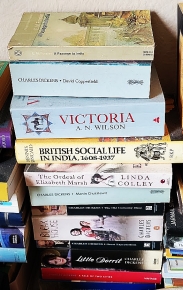
I AM OVER HALFWAY through reading “A Passage to India” by EM Forster (1879-1970). In this exciting novel, which contains the author’s acute observations about the minutiae of India as it was before Independence and to a large degree after,  Dr Aziz, an Indian, ill-advised (in my opinion) accompanies two English ladies to the Marabar Caves (a fictional name). Trouble ensues, and Dr Aziz is arrested.  I will not give away the rest of what I have read so far, but will mention some caves in Mandu (Madhya Pradesh), which we visited on Christmas Day 2025.


The caves are close to the scant remains of Mandu’s Lohani Gate. Easy to enter, they were excavated and converted into chambers or cells where Hindu priests or yogi might once have resided. Archaeological evidence suggests that the caves were excavated and modified in the eleventh or twelfth century. They predate all of the other archaeological sites in Mandu.


Fortunately,  our visit to these caves was less eventful and sinister as is described in Forster’s excellent story. In fact, the Lohani Caves are delightful, and considering how close they are to Mandu’s most visited places, they are  ignored by most tourists.


Now, I must leave you and get back to my tattered copy of “A Passage to India”.

PS: by “minutiae” I include Forster’s detailed description of the behaviour of Indian squirrels and the Echo Point at Mandu, which we saw recently, as well as the curious echo effects at the Gol Gumbaz in Bijapur, which I have experienced.

A mausoleum admired by the designers of the Taj Mahal

WHEN ARSLAN KHAN was appointed Sultan of the Malwa Sultanate (now part of Madhya Pradesh) in 1406, he became known as Hoshang Shah. He ruled until his death in 1435.


Hoshang’s body lies within a splendid, white marble mausoleum in Mandu. It has one large central dome and 4 smaller domes, one at each corner of the square edifice.  As soon as I saw this marvellous building, I  thought of the Taj Mahal,  which I have seen in many photographs.


Hoshang Shah’s mausoleum was constructed in the fifteenth century, long before the Taj Mahal.  A tablet within Hoshang’s mausoleum has an inscription that records the visit of 4 of Shah Jahan’s architects in 1659. They came to pay homage to the builders of the tomb. One of the four was Ustad Hamid, who was closely involved in the construction of the Taj Mahal in Agra (completed in 1653). This illustrates the high esteem that Hoshang’s mausoleum inspired.

I wonder whether those builders saw Hoshang’s mausoleum before designing the Taj Mahal.

The only road in Indore named after a British man

A ROAD IN INDORE NAMED AFTER A BRITISHER

A STATUE OF of Robert North Collie Hamilton (1802–1887) who was British Resident of Indore during the first war of independence in 1857, stands within the garden of the Lalbagh Palace in Indore.

According to a website about the city’s Lalbagh Palace (www.freepressjournal.in/pbd-indore/hamilton-road-only-road-of-indore-named-after-britisher) :

“In the year 1857, a group of freedom fighters gathered at Hamilton Road to protest against the Britishers. On the same day Hamilton was going on leave and his acting officer Sir Henry Marion Durand had taken charge. Sir Durand, angry at the protestors, ordered British army to attack them. When Hamilton came to know this he cancelled his sanctioned leave and ordered the army to not to attack”

The Hamilton stands close to a statue of Queen Victoria.

Because of Hamilton’s actions, he is remembered in Indore not only by the statue but also the city contains a short road named after him. It is the only road in Indore named after a British person.

The cemetery where Roman Catholics in Indore are buried

THE CITY OF Indore has a population of about 3.1 to 3.5 million. Of these, about 17750 are Roman Catholics. Indore is a diocese in the Ecclesiastical province of Bhopal. The diocese was established in 1952, having formerly been Mission Sui Iuris of Indore established in 1931. There are well over 12 Catholic churches in Indore.


It so happens that the hotel where we are staying in Indore (in December 2025) is a few hundred yards away from the Kanchanbagh Roman Catholic cemetery, which we took a look at today.


Flower garlands on graves

The older graves are raised mounds not too dissimilar from Sephardic gravestones. However, each grave is surmounted by a cross. What interested me was that on many graves there were fresh flowers. There is nothing surprising about this except that many of the flowers are ‘malas’ (garlands) such as are commonly found draped around Hindu effigies and shrines.


At the far end of the cemetery there is a large hall in which funeral masses are held. There is a bas-relief depicting the Last Supper at the altar within the hall.


On one side of the hall, there are the newer graves. These consist of flat rectangular slabs on which names are listed. These are the names and dates of the people buried beneath a slab. The idea is that several people will be interred beneath each slab, and their names recorded on it. No doubt, the new system is designed to make efficient use of the burial ground. I wondered about this because there seemed to be plenty of unused land in the graveyard.


I am pleased that we entered the cemetery because seeing it made me become aware of the surprisingly large number of Roman Catholics in Indore.

HAPPY NEW YEAR TO ALL OF MY READERS

I HOPE THAT 2026 WILL BRING YOU CONTENTMENT, GOOD HEALTH  AND PROSPERITY

In the footsteps of the founder of the religion of the Sikhs

THE SIKH RELIGION was founded by Guru Nanak (1469-1539). During his lifetime,  he made pilgrimages to Mecca. On two of these, he travelled through the port of Lakhpat in Kutch (Kachchh,  Gujarat). In his lifetime, Lakhpat was a thriving port, but now it is a ghost town.


Lakhpat contains a fully functioning gurdwara (Sikh place of worship), the Lakhpat Gurdwara Sahib. It was established by the descendants of the Sikhs who hosted Guru Nanak during his two stays in Lakhpat.  The sanctuary  of the gurdwara contains  relics that were used by Guru Nanak while he spent time in Lakhpat.


The sanctuary is housed in a large compound in which one must walk barefoot and with one’s head covered. The place is very clean.


As with all gurdwaras, pilgrims and other visitors are offered (free of charge) vegetarian food and drinks (eg tea) in the ‘langar’ (=kiitchen) hall. We drank tea from metal cups and saw others, seated on the floor, eating food from metal thalis. After finishing ones food and drinks, visitors must was the metal vessels with soap and water so that they are ready for use by others.


Although the sanctuary building is nineteenth century or older, the rest of the gurdwara is newer. We entered a huge new meeting hall to which builders were completing finishing touches. We were told that it was being got ready because there was about to be a great gathering of Sikh pilgrims at a festival.


Lakhpat and its gurdwar are close to India’s border with Sindh in Pakistan.  The whole area around the erstwhile port is full of military personnel and camps. Many Indian regiments contain Sikh members. Some of these regiments have donated things to the gurdwara at Lakhpat.  As one walks around, one can see plaques put up by, and to commemorate these regiments.


I enjoyed visiting the gurdwara, and we were happy to make a donation.  Whatever the size of the donation, the donor receives a receipt that  states the reason for making the gift. We wrote that our money was in gratitude for the refreshment offered to us in the langar hall.


By visiting the gurdwara at Lakhpat,  we can truly say that we were following in the footsteps of Guru Nanak, even though our journey was most probably more comfortable than his.

The “Native Library” in Ahmedabad (Gujarat)

AN OLD BUILDING stands near the Bhadra Fort in the heart of old Ahmedabad. This is the Himabhai Institute. Its origin dates back to 1849 when Alexander Kinloch Forbes, an administrator in the British East India Company, set up the Gujarati Vernacular Society which aimed at carrying out social reforms, enriching the Gujarati language and its literature, and to promote ‘useful knowledge’.

The Society set up a library in the building now known as the Himabhai Institute. A leading light in establishing the library was the Gujarati poet Dalpatram, a friend of Forbes and his teacher of the Gujarati language.

Dalpatram, whose full name was Dalpatram Dahyabhai Travadi, lived from 1820 to 1898. According to Wikipedia, he:
“… led social reform movements in Ahmedabad, and wrote articles against superstitions, caste restrictions and child marriage. He dealt with the problem of widow remarriage at length in his poem, Vencharitra … In 1885, Dalpatram was made a Companion of the Most Eminent Order of the Indian Empire.”

The library, named after the philanthropist Himabhai (Vakhatchand) who lived from 1785 to 1858, is one of Gujarat’s oldest. It contained a valuable collection of books and manuscripts. Today, unfortunately, the place is in a sad condition. The number of people using it has declined considerably. This is to some extent due to the Internet having become a major source of information, and as a consequence people depend less on books than they used to. The Institute has a peaceful rear garden and on the first floor there is a hall that can be used for meetings and other functions.

A preserved historical building, the now melancholic Himabhai Institute was known as the “Native Library” in the nineteenth century.

His sister was a pioneer of the labour movement in India

A LARGE WHITE MANSION stands in lovely grounds not far from the Sidi Saiyed mosque in central Ahmedabad. If you look carefully, you will see that in various places the outside of the building has cartouches consisting of an A intertwined with an S.

This edifice was a home of the textile magnate and philanthropist Ambalal Sarabhai (1890-1967).

Ambalal’s sister was Anasuya Sarabhai (1885-1972). She became a pioneer and founder of the women’s labour movement in India. Also, she helped Gandhi set up his Sabarmati Ashram in Ahmedabad.

Initially, Anasuya studied medicine, but gave it up. She was a Jain and dissecting corpses was abhorrent to her. She gave it up, and went to London where, in 1912, she studied at the London School of Economics, where many years later my father became a professor.

In 1914, she organised a textile workers strike in Ahmedabad. No doubt, her brother’s factories would have been affected. In 1917, the Ahmedabad Textile Labour Association (Majdoor Mahajan Sangh) was formed and Anasuya was made its lifelong president by Gandhi.

I do not know where Anasuya lived in Ahmedabad, but seeing her brother’s house made me think of her. [It is possible that she resided in Ambalal’s mansion.]

The villa is now the home of the Shanti Sadan institute.