The superfast express train from Ahmedabad to Bhuj

THE EXPRESS TRAIN, Indian Railways number 22903 (the Bhuj AC Superfast Express), runs between Bombay and Bhuj (in the Kutch district of Gujarat). On its way, it stops at Ahmedabad Junction Station at 630 am. To catch the train, we arrived at Ahmedabad Junction at about 530 am – I always prefer being early at the departure point of a train, aeroplane, bus,  etc.


It was dark as our autorickshaw drove speedily along the empty streets of central Ahmedabad. The sun only rises after 7 am in the west of India.


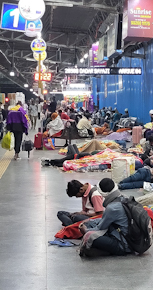
Ahmedabad Junction Station

The well-lit station platforms were covered with rows of people wrapped in blankets, sleeping on the floor. The sight of these sleepers reminded me of the images that Henry Moore made of people sleeping on the platforms in London’s deep Underground stations during WW2. Of course, the people sleeping in Ahmedabad’s Station were awaiting trains, not sheltering from bombs dropped by the German’s Luftwaffe.


These sleepers were not disturbed by the endless series of train announcements, each of them were made in three languages: Hindi, English,  and Gujarati. One of them that was repeated at regular intervals informed those who were listening that the Shalimar Superfast Express (it runs between Kolkata and Bombay) was running 12 hours and 50 minutes late. Fortunately, our train 22903, pulled into platform 3 almost exactly on time.


We had reserved places in the first class, air-conditioned carriage, and had a coupé (compartment) to ourselves. Although comfortable,  it was a rather spartan little cabin. I believe that first-class rail travel in India is aimed at those who wish to travel secluded from the ‘madding crowd’. Frankly, I prefer travelling in a carriage in which one can see and, sometimes,  interact with one’s fellow travellers and the endless stream of vendors, who move up and down the trains in India.


The six-hour journey from Ahmedabad to Bhuj is through terrain as flat as in the Netherlands,  but much dustier. All along the route we passed factories, both small and large, many with chimneys emitting smoke. For the first half of the journey,  we travelled past well-tended fields in which crops were growing. After crossing into Kutch, we passed numerous vast water features containg seawater that was being dried to produce salt. Every now and then, white, conical mounds of salt could be seen. The train runs for a long way parallel to a main highway in Kutch.  This connects Kutch and its important port Kandla with the rest of India. An endless stream of large trucks moves along this road.


At Gandidham in Kutch, the train’s engine was changed. We began moving in a different direction as we travelled along the stretch of rail track between Gandidham and Bhuj, where we disembarked.  Outside the station there was a sea of men offering to drive us in taxis, jeeps, and autorickshaws.


Eventually, our driver met us, and drove us through the hilly, almost arid hills between Bhuj and Kutch Mandvi, where we were going to stay with my wife’s cousins.


Even though train 22903 traverses terrain that few would regard as picturesque, I always enjoy long land (rather than air trips) journeys through  the countryside of India.

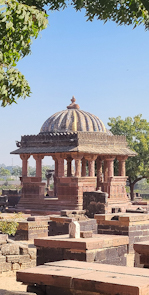
Where royalty was cremated in Kutch (Gujarat)

WHEN RAJPUT ROYALTY were cremated, their ashes were taken to be immersed in a holy river, usually the Ganges. However, at the spot where they were cremated, a memorial was erected, often in the form of a chhatri: a stone canopy supported by pillars. Often, the chhatris were quite elaborate and highly ornamented.

Next to one of the lakes in Bhuj, lies the city’s Chhatedi, a large area containing the chhatris (cenotaphs) of the Jadeja rulers of Kutch. Sadly, these cenotaphs suffered much damage during the earthquake of 2001. Thus, today the Chhatedi of Bhuj has become a picturesque set of ruins.

Although this is our fifth visit to Bhuj, it was only this time (December 2025) that we took a close look at the Chhatedi, now a site maintained by the Archaeological Survey of India. Apart from the remains of the grander chhatri, there are many smaller memorials. Often these bear a pair of carved footprints. I imagine that these smaller cenotaphs commemorate the cremation sites of lesser members of the Jadeja families: wives and children. One chhatri is particularly interesting because its roof is decorated with coloured tiling.

Surprisingly, the Chhatedi of Bhuj is one of the sights in the city that is less visited by tourists. It seems to be popular with young couples, who sit in shady spots passing the time of day. When we visited it one morning, there were few other tourists, but a party of local school children were being taken to see the place. They were in their pre-teens. What struck us was that many of these little girls were wearing lipstick, presumably to appear smart on their outing.

The Chhatedi provides great opportunities for photographers. While we were at the site, we saw a family of Indian tourists arrive at one of the larger cenotaphs. Their small daughter was dressed in her finest clothes. Her father got her to pose in front of a statue of a musician on the largest and most elaborate chhatri, and then clicked a photograph. Immediately after that, he told his family:
“Chalo” [‘let’s go’], and they exited the site. In my opinion, that was too rapid a visit. To enjoy exploring the Chhatedi, you should set aside about 30 to 45 minutes.

Although no longer recognised by the Government of India, the Jadeja royalty are held in high regard by many people in Kutch. During a conversation with a member of the family, he told us that the cremation of his grandfather, the last Maharao of Kutch, could not be carried out at the Chhatedi because the authorities would not allow it. In future, cremations of members of the former Royal family will probably no longer be performed in the traditional place: the Chhatedi of Bhuj.

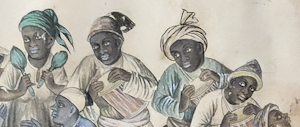
Africans in a royal procession in Kutch painted in 1876

WHAT REMAINS OF the Aina Mahal Palace in Bhuj (Kutch, Gujarat) after the powerful earthquake of 2001 is now open to the public as a fascinating museum. One of its many remarkable exhibits is a painting, which is 15 metres long and 22 cm wide. Painted in 1876 by Mr Juma Ibrahin Wadha, it depicts in minute detail a Kutch State parade during the reign of Maharao Pragmalji II, who was on the throne between 1860 and 1875.

The faces in the painting are all portraits of individuals – actual depictions, not stylised images. The degree of detailing is superb – almost photographic, yet still artistic.

Amongst the many faces that can be seen on the painting are several which have unmistakably black African features. They are all soldiers dressed in armour and guarding the Maharani, the Maharao’s queen. It is possible that they might have been eunuchs, but detailed as the picture is, this cannot be ascertained by examining it!

Black Africans travelled to India (mostly as slaves) from East Africa to Gujarat and Kutch during the 14th to 17th centuries. Mainly of Bantu descent, many of them converted to Islam. Some of them rose to high positions in society. For example, one of them became a general, who founded the Sidi Saiyedd mosque in Ahmedabad. Their descendants are known as members of the Siddi community. Known as Sheedhi in Pakistan, there is apparently a significant number of them in Lowe Sindh and Karachi. Currently, there are about 50000 Siddis in India, of which about one third live not in Gujarat but in Karnataka.

There are many other interesting details on the picture of the parade, but it was the depictions of Siddi soldiers that particularly caught my attention.

A slow journey in the west of India

OUR JOURNEY FROM Bhuj to Baroda (Vadodara), both in Gujarat, began yesterday at 650 am and ended at our hotel just after 8 pm. The distance we travelled was about 265 miles. There are direct trains between Bhuj and Baroda, but these were fully booked on the day we wanted to travel (i.e., 30th November 2023).

The first ‘leg’ of our journey was on a train that carried us from Bhuj to Sabarmati Junction – one of Ahmedabad’s several railway stations. The other passengers in our compartment were 4 young girls and a couple of young men returning to university after their Diwali break. We noted that the girls talked to each other. So, did the boys. But the girls and boys did not converse with each other and showed no interest in each other. The train rattled at high speed through the flat countryside and arrived at Sabarmati only about 8 minutes late. Unlike many Indian trains I have been on, the Bhuj to Sabarmati Superfast had no vendors wandering up and down the train.

It is a few miles between Sabarmati Junction and Ahmedabad’s centrally located main station. We hired an autorickshaw to take us between Sabarmati Jn and the Moti Mahal restaurant near the main station. Our driver tore through the heavy traffic narrowly missing numerous collisions. The eatery proved to be a scruffy but extremely popular place – noisy and lively. We enjoyed a good light lunch before walking to the station.

Although it was only about 200 yards between the restaurant and the station, it was necessary to cross an incredibly busy road with fast moving vehicles. We asked an autorickshaw driver if he would drive us there. He refused, but kindly offered to help us across the road, which resembled a disorderly road race. Using his arms like a traffic policeman he shepherded us across the thoroughfare. Even with his help it was a hair-raising experience.

We had to wait for our next train for about two hours on platform 6. The train we were about to catch was the Porbandar Shalimar Superfast. This train leaves Porbandar in Saurashtra (part of Gujarat) at 850 am on day 1 and arrives at Shalimar (a station in Calcutta) at 3.35 am on day 3 – having travelled a distance of 2544 km. Our journey on this train lasted just under two hours, arriving in Baroda about 20 minutes late.

She sells mats to passengers in the train

Unlike the train from Bhuj, the train to Shalimar was well populated by vendors. The seemingly endless procession of sales people were offering: bottled water; hot tea; snacks including biryani and bhel poori; bags of apples; and mobile phone chargers and cables. One lady in a colourful sari was selling attractive square mats at 10 Rupees each. Every now and then, a deformed invalid literally scuttled along the filthy floor of the corridor. He stopped at each compartment and banged his collecting pot ominously on the ground. Only a few passengers gave him coins.

The sun had set when our train pulled out of Ahmedabad. Through the open window, I saw many small villages, many of them with Hindu temples adorned with coloured lights – many of them flashing decorously. I could also see many brightly lit shops. Within the train, I had an excellent view of the door to one toilet. Even when it was closed it vibrated furiously as the train sped along. Many passengers peered inside the loo, but few dared to enter it.

The train seemed to travel even faster than the one from Bhuj, and it was a relief to disembark in Baroda’s lovely station. After another autorickshaw drive, we arrived at our comfortable hotel. Our reception there was a little reminiscent of an episode from “Fawlty Towers”. Once this was, over, things went smoothly and we enjoyed a good dinner in its dining room.

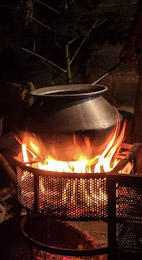
Red coloured meat dish from Rajasthan

LAL MAS IS a traditional meat dish that originated in Rajasthan. Its name means ‘red meat’ and its colour comes from the use of mild, fragrant, fresh red chillies. The best sort to use are those grown at Mathania in Rajasthan, but if these are not available, Kashmiri chillies can be used but they are less satisfactory. Originally, lal mas used to be prepared to feed hunters after a day of hunting. The meat being game.

We have been staying at the Sharad Baug Palace homestay in Bhuj (Kutch, Gujarat), which is owned and run by members of the Royal family of Kutch. Several members of the family are great cooks. The food they have been preparing for our evening meals has been superbly tasty.

Last night, one of the family gave us a very special treat. While we watched, he prepared lal mas on a pot heated on a wood fired brazier in the garden. The smoke from the burning wood enhances the flavour of the dish.

Even if I knew the exact recipe for lal mas, it would be pointless giving it to you. This is because to achieve a good result, the person cooking it must be constantly tasting the sauce and adding ingredients as required, as well as checking the degree of tenderness of the meat. This is something that cannot be described in writing.

That said, this is, roughly speaking, how he prepared the lal mas. First, good quality cold-pressed mustard oil was heated to a high temperature. Then, he added whole spices including the Mathania chillies. Next, chopped onions, followed by pureed onions and pureed Mathania chillies. Following this, the goat meat was added. Later, chopped tomatoes followed by ginger and fresh green chillies – both minced. After a while at various stages, other ingredients including ground cumin, turmeric, coriander powder, fenugreek leaves (added at the end), hot red chilli powder, salt, and water were added to the stew. Throughout the cooking process, which took almost two hours, the stew has to be stirred often, and water added as required so as to maintain the sauce’s thick consistency and to prevent the spice mixture from burning.

I can say, without exaggeration, that the resulting dish was one of, if not, the very best Indian meat dishes I have ever eaten. It was fragrant, tasty, and not too piquant. It was without fault.

We are very grateful that our host took the time and care to produce this miracle of culinary art for us.

Painting behind glass in the Palace of Mirrors

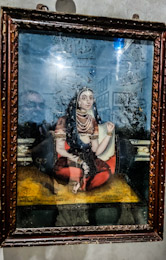
PARTLY DAMAGED BY the great earthquake that struck Kutch (Kachchh) in 2001, what remains of the Aina Mahal in Bhuj contains a fascinating museum. Constructed in about 1750 for Rao Lakhpatji, ruler of Kutch, the palace is named because of the many mirrors (‘aina’) contained within it. Miraculously many of these fragile items survived the earthquake. The same is true for a set of reverse glass paintings.

A reverse glass painting

First developed in Europe, it was introduced to China by an Italian artist Giuseppe Castiglione (1688-1766). During the 18th and 19th centuries, Kutch traders brought them back from China as gifts for the rulers of Kutch. The traders commissioned them from Chinese artists, having first explained what subject matter was to be depicted. Later, glass painting became popular in both Kutch and Saurashtra, where it began to be done.

The technique of reverse glass painting is difficult. Paint is applied to the side of the glass away from the viewer. The artist must begin by painting what will be at the front of the picture. For example, if painting a portrait, the eyebrows, eyelashes, moustache, hair, and beard must be painted first. Then, the rest of the face needs to be created, and then the background. Adding to this difficulty is that the artist is painting on glass as thin as paper.

The reverse glass paintings and the ageing mirrors are but a few of the amazing exhibits on display in the Aina Mahal. We have visited the place several times, each time noticing things we had not seen before.

LOOKING FOR A HEADMASTER IN BHUJ: FURTHER EXPLORATION OF FAMILY HISTORY

AT THE END OF January 2023, I wrote:


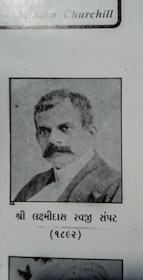
“My wife’s mother’s great grandfather was one Laxmidas Ravji Sapat (aka Sampat), who was born in the mid-19th century, or a bit earlier. Along with Gokaldas Parekh, Laxmidas was one of the first teachers in the Alfred High School in Bhuj (founded by Rao of Cutch, Pragmalji II in 1870). It is likely that he was its headmaster for a time. I have yet to see it, but his portrait hangs in the school. One of my wife’s relatives, also a descendant of Laxmidas, arranged to have it restored a few years ago.
In 1890, Laxmidas left the school. Later, along with his son-in-law, Cullyanji Murarji Thacker, he went to London (UK) to become a barrister. He studied for the Bar at Middle Temple and was called to the Bar on the 27th of June 1900, along with his son-in-law, Mr Thacker, who was my wife’s mother’s grandfather.” (https://adam-yamey-writes.com/2023/02/02/running-in-the-family/)

Laxmidas Ravji Sapat

Today, the 25th of November 2023, we visited the Alfred School in Bhuj in search of the portrait of Laxmidas Ravji Sapat. We were shown a board on which the headmasters of the school were listed. On it we discovered that Laxmidas had been headmaster between 1888 and 1892. He was the school’s eleventh headmaster. It appears that he left the school two years later than I had been told.

As for the portrait of Laxmidas, the officials at the school had no knowledge. They suggested we try the museum next door. Part of this now owns the school’s original building, which was restored after the 2001 earthquake that destroyed much of Bhuj. Despite being part of the museum, the old school building stands disused and being renovated.

At the Bhuj Museum, we asked about the portrait. We were told that it is not in the museum. So where is it? In a few days time we will return to the school to visit its current headmaster. Maybe, he might know where it is. Until then, watch this space!

An exciting Bollywood film

DURING MY TWENTIES AND THIRTIES, I enjoyed slow moving, European ‘art house’ movies, in which little or nothing happened. Good examples of these included “Claire’s Knee” and “Kings of the Road”.

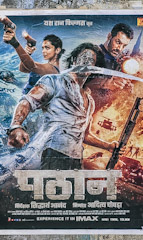
Poster for the film PATHAAN

After marrying my Indian wife in 1993, my tastes in film changed radically. She introduced me to Bollywood films. These visually dazzling productions are brilliant. Most of them incorporate moral and political messages; romance; religion; adventure; tragedy; comedy; music and song; dancing; daredevil acts; and much more. As they are designed to be seen all over India by people who speak a wide variety of differing languages, they are produced in such a way that they can be followed by audiences who cannot understand even one word of Hindustani. In fact, because of this and their visual appeal, they are popular all over the world.

Recently, we saw the new Bollywood film PATHAAN in Bhuj. It is one of the most exciting action films I have ever seen; it makes James Bond films seem static in comparison. The audience in the Surmandir cinema screamed and yelled at every possible moment, especially when the principal male star Shah Rukh Khan appeared on the screen. Both the film and the audience were fun to experience. The film was so gripping that we left the cinema feeling exhausted.

A cook from Kutch in Norway

THE SHARAD BAUG HOMESTAY is in the extensive, luxuriant, verdant grounds of the Sharad Baug Palace. Badly damaged in the 2001 earthquake, the palace is a short walk from the excellent homestay. This accommodation is owned and run by members of the royal family of the former Kingdom of Kutch.

Close to the homestay in the middle of a field, there is another ruined edifice. This was formerly used as a guesthouse by important guests of the ruler, the Maharao. For some time, the poet Dara Shiko (1615-1659) hid from his brother (the future emperor Aurangzeb) in this building.

Near the ruined palace, there is a building, which was the last Maharao of Kutch’s sitting room and dining hall. Now, the building houses a small museum filled with exhibits relating to the royal Jadeja family. Amongst these, there are several items connected with the last ruler of independent Kutch when he spent some time in Norway.

After Kutch had joined India soon after 1947, its last Maharao, Madansinhji (1909-1991), was appointed India’s ambassador to Norway. There are photographs relating to his stay in Norway in the museum. There is also a Christmas card in Norwegian and a certificate issued by the Oslo Tennis Club. He served in Norway between 1957 and 1960.

While in Norway, Madansinhji was served by his chef from Bhuj, a member of the Yadav family. For many generations, the Yadavs have been chefs, specialising in non-veg food.

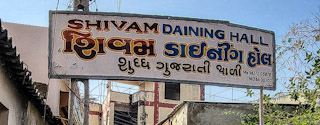
When we first visited Bhuj, in 2018, we were recommended to eat in a simple, small restaurant in the bazaar of Bhuj. Named Shivam Daining (sic), it serves very tasty pure vegetarian food. We returned to eat there several times during our recent (January 2023) stay in Bhuj. While chatting with its chef and his relatives, we learned that the man who produces the excellent food is a grandson of the Mr Yadav, who cooked for Madansinhji in Norway. Although the family have a tradition of cooking meat and fish, they do not offer it at Shivams because they rightly feel that there is little demand for non-veg food in the mainly vegetarian city of Bhuj.

Without knowing it when I booked the Sharad Baug homestay, it turned out that it and one of our favourite restaurants in Bhuj had at least one common connection, and that is Norway.

An illustrious ancestor

QUEEN VICTORIA’S SON Prince Alfred (1844-1900) visited India in December 1869. In his honour several schools in India were founded in his name. In the present State of Gujarat, there are at least 3 still in existence. One is in Rajkot, another in Bhavnagar, and one in Bhuj (formerly the capital of the Princely State of Kutch).

Alfred High School in Bhuj

In Bhuj, we have a friend, Pramod Jethi, who is a historian of Kutch. Some of what I am about to relate is based on information kindly provided by him. Much of the rest is gleaned from what my wife’s family have told me.

My wife’s mother’s great grandfather was one Laxmidas Ravji Sapat (aka Sampat), who was born in the mid-19th century, or a bit earlier. Along with Gokaldas Parekh, Laxmidas was one of the first teachers in the Alfred High School in Bhuj (founded by Rao of Cutch, Pragmalji II in 1870). It is likely that he was its headmaster for a time. I have yet to see it, but his portrait hangs in the school. One of my wife’s relatives, also a descendant of Laxmidas, arranged to have it restored a few years ago.

In 1890, Laxmidas left the school. Later, along with his son-in-law, Cullyanji Murarji Thacker, he went to London (UK) to become a barrister. He studied for the Bar at Middle Temple and was called to the Bar on the 27th of June 1900, along with his son-in-law. Mr Thacker, who was my wife’s mother’s grandfather. The two men received financial help for their studies from the Kutch Royal family.
Both men were members of the Bhatia community in Kutch. Back at the end of the 19th and the early 20th it would have been unusual for a man and his son-in-law to travel out of India together to study.

Laxmidas, after leaving the Alfred School, became appointed as police chief of Bhuj, then diwan (Prime Minister) of Jaisalmer, and after that Chief Justice of Jodhpur. Apparently, he was very successful in reducing dacoitry in the Kingdom of Kutch and also Jaisalmer.

Recognising that the dacoits robbed because they were impoverished and starving, he helped make arrangements that reduced these poor peoples’ need to steal. It was this success that attracted other rulers of Princely States to offer him employment.

Regarding Jaisalmer, I discovered this quote:
“On his retirement, one Laxmi Das Raoji Sapat, who had lately served as Police Commissioner in the Kutch State, was appointed as Dewan of Jaisalmer”
This was in 1903.

As for Mr Thacker, he was successful enough to have owned a large house with two separate kitchens (one veg, the other for meat), and to have employed an English governess for my wife’s maternal grandmother, Benabhai, who married the surgeon Haridas Bhatia FRCS (died of septicaemia whilst on duty in 1926).

Incidentally, Benabhai was sent to London to study at the former Bedford College at the same time as her husband was studying for his FRCS. This contrasts with Mahatma Gandhi, who went to study in London, leaving his wife behind in India.

In January 2023, whilst spending a short time in Bhuj, we took a look at the elegant exterior of the city’s Alfred High School, which adjoins the Bhuj Museum. Badly damaged in the earthquake of 2001, the school building has been well restored. A less attractive, newer building was built to enlarge the school. On a future and lengthier visit to Bhuj, we hope to be able to view the portrait of Laxmidas that hangs inside the school.