In the pie, or the core of the matter

RECENTLY WHEN WALKING in an an orchard in Hampshire, we found that the trees were literally groaning beneath the weight of apples growing upon them. Seeing all of these ripe fruits brought back memories of visiting family friends, who lived in Kent, during my early childhood.

Whenever we went to their home, we were given a lavish lunch. The dessert was always apple pie. The apples were covered with a topping of pastry. What fascinated me was that the centre of this topping was always raised above the rest of it. Beneath this centrally located curved mound, – and this is what used to fascinate me – there would be a ceramic cup buried amongst the cooked apples. Discovering a cup buried in an apple pie tickled my imagination, and always puzzled me. I believe that it is normal practice to insert something to support the pastry topping, but when I was less than 10 years old, I did not know this. Our friend who used to cook this apple pie for us is, sadly, no more,

Incidentally, in recent years, some of the best apple pie I have tasted is that served at The Only Place in Museum Road, Bangalore (south India). Its recipe was introduced to the restaurant by the American wife of Haroon, who founded the restaurant many years ago.

A tailor in Bangalore (India) who knew how to be tactful

DIPLOMATIC AMNESIA

Almost immediately after I first arrived in India (in late December 1993), and a few days before our Hindu wedding ceremony, my father-in-law recommended that I visit his tailor – Mr Krishnan – to get measured up for some new suits. One of these was to be a white ‘Prince Suit’, and the other two were western style formal suits in greyish materials. The Prince Suit, a traditional Indian design with a high neck collar, was to be worn at our wedding reception after the marriage ceremony. The other garments would be useful for the many formal occasions, which my father-in-law anticipated both in India and England. He loved such occasions.

When he worked in an upmarket tailoring shop in Bangalore’s Brigade Road, Mr Krishnan had made suits for my father-in-law. When I met him, he was semi-retired and worked from his home in a small, old-fashioned house on a short lane in a hollow several feet beneath the nearby busy Queen’s Road. He was a short, elderly gentleman – always very dignified and polite. He measured me up for the suits in his front room, which served as part of his workshop. After a couple of visits to try the suits whilst they were still being worked on, I picked up the finished garments. Each of the suits fitted perfectly – ‘precision-fit’ you could say quite truthfully. Despite being so accurately made, they were not in the least bit uncomfortable. Everybody admired them. I could understand why I had been sent to Mr Krishnan.

Our next trip to India was made 20 months later when our recently born daughter had had sufficient vaccinations to allow her to travel safely. During the interval between these two holidays, my dimensions had changed significantly because of my good appetite and happy marriage. Notably, my girth had increased greatly. Sadly, the suits that Mr Krishnan had so carefully crafted no longer fitted me.

We returned to see Mr Krishnan, who told us that in anticipation of my dimensions changing, he had left extra cloth within the garments for adjusting them. Without comment, he took my new measurements, and noted them down in a book. My wife, who had accompanied me, said to the tailor, mischievously:

“Just out of curiosity, Mr Krishnan, would you be able to look up Adam’s previous measurements to see how much he has changed.”

He put down his pencil, sighed, and said:

“I am very sorry, Madame, but I have unfortunately lost them.”

Mr Krishnan was not only a wonderful tailor, but also a perfect diplomat.

End of excerpt

https://www.amazon.co.uk/CORACLES-CROCODILES-101-TALES-INDIA/dp/B0DJZ6DMYB/

Sculptures hidden by the mist in Bangalore

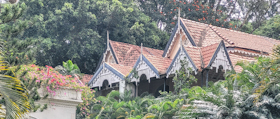
When we arrived in Bangalore in November 2025, our friend Harsh, an architect and curator who is based in Ahmedabad, sent us a message about his exhibition in Bangalore at a gallery, of whose existence we had been hitherto unaware. The privately owned gallery is called KAASH. It is housed in a beautifully restored old-style bungalow such as were built (mostly) between the 1860s and 1930s. They are a colonial ‘take’ on English country cottages. The gallery’s bungalow at number 2 Berlie Street is complete with perfect examples of ‘monkey tops’ (screens of closely spaced vertical wooden slats placed over porches and windows).  

The exhibition that Harsh had curated at KAASH was a collection of contemporarily designed devotional objects, mainly diyas (oil lamps used on Hindu ceremonies). There were also some almost abstract depictions of Devi created by Jayshree Poddar, and a few items of folk art from various countries in Africa. The artworks were tastefully displayed in rooms within the bungalow.

In the garden surrounding the building, we saw several sculptures. As the sun set, a worker moved around the garden spraying a fumigating smoke that created an eery mist. The sculptures were temporarily partially hidden, becoming rather like peaks partially concealed by low clouds. Gradually, they reappeared as the insecticidal smoke dispersed. Having seen the KAASH gallery, we decided that it would become a place we visit whenever we happen to be in Bangalore.

A coffee house in the Indian city of Bangalore (Bengaluru)

GOING THROUGH SOME old photographs today, I came across a few taken in the India Coffee House that used to be on Bangalore’s MG Road. Here is what I wrote about the place in my book “Coracles and Crocodiles: 101 Tales of India”:

When I first visited Bangalore in 1994, there was a coffee house on Mahatma Gandhi (‘MG’) Road close to the now derelict Srungar Shopping Complex. This venerable, popular ‘hole in the wall’ was a branch of the Indian Coffee House (‘ICH’) chain. In both appearance and atmosphere, it reminded me of some of the older coffee houses I had seen Belgrade and Sarajevo in Yugoslavia (when it still existed).

At the ICH, customers sat at old wooden tables on wooden benches with hard, upright backrests. Old Coffee Board (‘ICB’) posters hung on the walls. The waiters were dressed in white jackets and trousers held up by extremely wide red and gold belts – like cummerbunds – with huge metal buckles that bore the logo of the ICB. These gentlemen wore white turbans with red and gold ribbons on their heads. In addition to (in my humble opinion) rather average quality, but low-priced South Indian filter coffee, a variety of snacks and cold drinks were also on the menu.

During the British occupation of India, admission to most coffee houses was restricted to European clients. In the late 1890s, the idea of establishing an ICH chain of coffee houses for Indian customers began to be considered. In 1936, the ICB opened the first ICH in Bombay’s Churchgate area. By the 1940s, there were at least 50 branches all over what was then British India. In the mid-1950s, the ICHs were closed by the Coffee Board. The Communist leader AK Gopalan (1904-1977) and the Coffee Board workers managed to get the Board to hand over the ICH outlets to them, and they formed a series of Indian Coffee Workers’ Co-operatives. The cooperative in Bangalore was formed in August 1957. There are now several branches in the city. The MG Road branch, which opened in 1959, closed in 2009 … “

DISCOVER more about this and many other things I have experienced in India by reading my book, which is available from Amazon:

https://www.amazon.co.uk/CORACLES…/dp/B0DJZ6DMYB

Gone forever: a wonderful bookshop in Bangalore (Bengaluru)

HERE IS A BRIEF excerpt from my book “CORACLES AND CROCODILES: 101 TALES OF INDIA”. It comes from a chapter on the booksellers in Bangalore (Bengaluru), and is about a remarkable bookshop that, sadly, no longer exists. Here is the extract from my book:

Premier, one of the most fantastic bookshops that has ever existed, is also no more. It closed some years ago when its owner, Mr Shanbag, retired. I felt almost as if I had suffered a bereavement when I arrived where the shop used to be located on the short stretch of Museum Road between MG Road and Church Street, and found that it was no longer there. I still mourn its passing.

From the outside, Premier could have been mistaken for a newsagent. A rack of magazines stood by the shop’s entrance. When you stepped inside, you felt as if you had entered a book-lover’s Aladdin’s Cave.  Mr Shanbag, who was related to the founder of Strand Bookstall in Bombay, used to sit by the entrance, hidden behind the piles of books and bits of paper cluttering up his tiny desk. The rectangular shop’s walls were lined with books stacked one upon each other, from floor to ceiling. A central divider was covered in books. Two narrow corridors ran along the length of the shop allowing customers and staff to penetrate the dingy depths of the establishment. Deep inside the shop there was a narrow, book-lined passageway connecting the two main corridors. This was so narrow that most adults, and obese children, needed to progress sideways along this claustrophobic book lined chasm.

In most bookshops, customers can pick a book from a shelf, browse it, and then replace it if necessary. This was not the case at Premier.  Only the foolhardy or a newcomer to the shop would attempt to take a book from the tall, precariously stacked piles on Premier’s bookshelves. A 19th century French composer, Alkan, was killed when he was crushed by books collapsing on him in his library. A possible injury awaited any customer who attempted to withdraw a book from Premier’s hazardously stacked shelves. One could say that the books were stacked perilously. One careless move would initiate an avalanche of literature – both fiction and non-fiction. This often happened. Shanbag would raise an eyebrow, and then he or one of his assistants would restore ‘order’ in the shelves.

You may well wonder how customers ever managed to browse in Premier. It was simple. All that was necessary was to ask Shanbag or one of his helpers to retrieve the book for you. If you were unable to see the book that you desired amongst the huge number of volumes stacked in the shop, Shanbag would be able to tell you instantly whether he had it in stock, without resorting to a computer or any form of catalogue. He knew exactly what he had in his shop, and where a book was located if he stocked it. And when you had made your selection, he would prepare a bill, and then knock 20% off the final total if you paid in cash.

A remarkable thing about Shanbag was his great understanding of his regular customers’ reading habits. He could remember what each customer had bought previously …

You can find out more about Premier as well as many aspects of life in India in my book/Kindle, which is available from Amazon stores such as: https://www.amazon.co.uk/CORACLES-CROCODILES-101-TALES-INDIA/dp/B0DJZ6DMYB/

As experiences of India gradually become memories

THE BOEING JET began moving away from the oddly designed new terminal at Bangalore’s International Airport. I watched the landscape slipping past ever more quickly as we accelerated along the runway before eventually becoming detached from the soil of India. As the aeroplane rose higher and higher, random things flashed through my mind such as: eating laal maas on a rooftop in Jaisalmer; a Dutch cemetery on the coromandel Coast; hawkers wandering up and down a railway carriage in West Bengal; riding through Bangalore in a Jesus autorickshaw; being asked to bless strangers, a newly married couple, in a church in Pondicherry; tasting nolen gur in Murshidabad; attending an aarti on the Ganges; and much more. After flying over the west coast of India, all of these experiences and a whole host of others that we had enjoyed during our 88 day stay in India became, like the coastline we crossed, distant memories, which I hope will remaine etched permanently in my mind.

Painting scenes of daily life on sheets of mica in colonial India

ONE CAN PAINT ON paper, canvas, glass, textiles, ceramics, and walls. Until yesterday (9 February 2025) when we visited an exhibition at Bangalore’s Museum of Art and Photography (‘MAP’), I did not know that paintings have been made on sheets of the translucent mineral mica. Mica has been, and still is, mined in great quantities in India.


Because of its translucency,  lanterns made with mica, on which images have been painted, have been used in both Hindu and Muslim ceremonies.  Since the eighteenth century artists have been creating paintings on mica, usually using watercolours or gouache mixed with an adhesive to ensure that the colours stick to the mica. Because the colours are on a translucent material that does not absorb any of the pigments, rather than opaque paper that inevitably absorbs some pigment, they appear much more vibrant on mica than on paper.


Murshidabad,  now in West Bengal,  was an important centre of mica painting. Initially, artists concentrated on paintings and portraits commissioned by local nawabs and other members of the Indian aristocracy.  With the arrival of Europeans in Murshidabad and other parts of Bengal in the late eighteenth century, the artists began depicting subjects designed to appeal to European customers. Europeans were particularly attracted to the paintings on mica. The subjects included illustrations of daily life and customs. They are therefore an interesting record of life in Bengal (and other parts of India) during the late eighteenth century.


The exhibition at MAP consists of a collection of paintings both on mica and on paper. These images were designed to appeal to European visitors (both short- and long-term) to India and are examples of Company Paintings  (East India Company).


Many of the paintings on mica depict people who appear to have no faces. Originally, these paintings had faces painted in gouache. However, the faces were painted on a layer of mica placed above that on which the rest of the subject was painted. This was done to give the images a three dimensional quality. Sadly, many of these upper layers have been lost, resulting in literally a loss of face.


The exhibition at MAP was well displayed. An extremely informative booklet about the exhibits and mica painting was available free of charge.  I am pleased we visited the show not only because it was both beautiful and fascinating,  but also because we had visited Murshidabad a few weeks earlier.

PS mica painting was done in parts of India where mica was plentiful,  such as Andhra Pradesh,  Madhya Pradesh, Tamil Nadu, Rajasthan,  Bihar, and Jharkhand.

Traditional inlaid metalwork used to make contemporary art

BIDRI WORK IS a method for creating decorative metal items. Its name derives from Bidar in Karnataka,  where this technique was developed and is still used. Objects are made by casting a black coloured alloy containing copper and zinc in the proportion 1: 16. Then, craftsmen use fine chisels to engrave often very intricate patterns on the surface of the cast alloy. These grooves are then filled by hammering fine silver wire into them. So, the resulting item is a dark metal object inlaid with silver.


Today, 8 February 2025, we visited the Kaash gallery, which is housed in a well-preserved traditional Bangalore bungalow. One of the three small exhibitions currently being displayed is a collection of Bidri art works. The artefacts were designed by Stephen Cox, a British artist, and were made by Abdul Bari, a Bidri craftsman. The resulting artworks are both unusual and beautiful.


The two other exhibitions at Kaash were: colourful contemporary seating made by weavers from Tamil Nadu and designed by David Joe Thomas,  and some sculptures and lighting by Italian artist Andrea Anastasio.


Our visit to Kaash was very satisfying. Although small, it is a place in Bangalore that art-lovers should not miss.

A holy roller in Bangalore (Bengaluru)

ON THE SIXTH of February 2025, I  boarded an auto (autorickshaw,  tuk-tuk) in central Bangalore. It contained a selection of Christian religious leaflets and booklets, which passengers were invited to take. Some of them were in English,  the rest in Kannada (the main language spoken in Karnataka). The driver had adorned his auto with Christianity related stickers.


As we wove our way through the busy traffic, I wondered if I was travelling in a type of ‘Peace Auto’. The Peace Auto movement in Bangalore was started by Anil Shetty in October 2013 to improve the relationships between auto drivers and their passengers. To quote from Shetty:

“Peace Autos is an initiative to make peace between the City and auto drivers. There is a one-sided argument that all auto drivers are bad. But that’s not true. I want to make them feel responsible.” (https://www.deccanherald.com/india/karnataka/bengaluru/a-surprise-experience-peace-auto-2189174).


When I reached my destination, the driver said (in English):

“God bless you.”

I asked him if his vehicle was a Peace Auto. He replied:

“No, it is Jesus Auto”.

Chikkamma Tours (Pvt.) Ltd: a detective story set in Bangalore

THIS BOOK WAS RECOMMENDED to me by a bookseller in Bangalore, at Bookworm, because she said that the shop is mentioned in the book. In the novel, Chikkamma Tours is a small travel company located beneath a bookshop run by Jagat Desai. One night, he is murdered. His body is found the next morning by one of the ladies who work in the office beneath the bookshop. The police are informed, but the three women who work at Chikkamma Tours decide to make their own investigation of the murder. What they discovered about themselves and the crime are the subjects of this ‘whodunnit’ novel.

Although I enjoyed reading it, this book is not a great work of literature. However, it was fun and I liked it because it captures many aspects of life in a city I visit frequently: Bangalore. As I proceeded through it, I recognised many things I know about the city and, especially, its bookshops.

Would I recommend this book? I would to Bangaloreans and to people who know the city well. However, I am uncertain that it would appeal to those who have little or no connection with the city. That said, I am pleased that the lady at Bookworm suggested I should read it.