An Englishman’s home is his castle

IN 1604 THE COURT of the KIng’s Bench made a judgement in the case of Peter Semayne v Richard Gresham. It was a trial during which Peter Semayne was suing his tenant Richard Gresham for an outstanding debt. The Court found against Semayne on several counts, one of which was: “It is not a felony for a man to defend his house to the death.” In 1605, the lawyer and politician Edward Coke (1552-1634) summarised the case in the fifth volume of his “Reports”. Amongst his conclusions about this case, he wrote:

“… the house of every one is to him as his castle and fortress, as well for his defence against injury and violence, as for his repose …”

And by the eighteenth century, the words “An Englishman’s home is his castle” had come to encapsulate what had been decided in law during the trial mentioned above.

Visitors to the British seaside cannot miss seeing rows of single storey beach huts close to the beach. Holidaymakers and local inhabitants hire or purchase these tiny huts to store their deckchairs; bathing equipment; simple cooking equipment; and other items to make spending a day at the beach enjoyable. Each hut is its owner’s or tenant’s small dwelling by the beach. However, as we learned during a visit to Minnis Bay in Kent, nobody can spend the night in a beach hut. They have to be vacated and locked up at the end of the day. Seeing people using these small structures, I felt that they regarded their huts as extensions of their homes, but unlike their actual dwellings, these temporary homes cannot be regarded as their castles.

More than sixty years ago in Devon

IT WAS UNUSUAL for my parents to take us on holidays at the seaside during my childhood. Mostly we went to cities, such as Bruges, Florence, and Delft, where there were plenty of artistic treasures to be viewed. Yet, one year when I was less than 10 years old, we spent a holiday at a hotel in a small place, Maidencombe, which is a few miles east of Torquay in Devon. All I can recall of this trip was staying in a country house hotel that had a beautiful flower-filled garden.

Yesterday (4 June 2025), my wife and I stopped at Maidencombe. I could not recognise anything, and I believe that the hotel where we stayed over 60 years ago has disappeared.

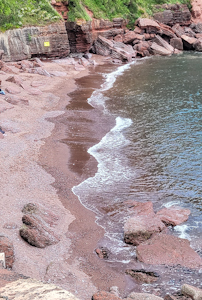
We followed signs to the Café Rio, which is reached down a winding staircase that clings to the slopes of a hillside overlooking a secluded cove surrounded by striated red rocks. The hillside is covered with luxuriant vegetation. The café is on a terrace above a small beach, where intrepid swimmers were enjoying the sea. We ate a light lunch on this terrace, and enjoyed the view.

I am pleased we visited Maidencombe but I can not stop wondering why my parents chose to go there instead of one of our usual culturally rich destinations. What or who influenced them to select Maidencombe? I will most probably never know.

A beach in the heart of London

The River Thames is tidal where it flows through the heart of London. At low tide, sandy beaches appear alongside the river’s banks. What is often beneath the water is revealed for a few hours. People, known as ‘mudlarks. wander along the sandy beaches looking for objects and fragments that have been thrown into, or lost in, the water over the many centuries that the city has been in existence. I have never attempted mudlarking, but many people enjoy searching for lost treasures.

There is something fishy about Hastings

THE HASTINGS CONTEMPORARY art gallery is housed in an elegant modern structure. Some of its large windows and the terrace outside its café look out over the fishing vessels moored on the nearby shingle beach. Other windows give the visitor a view of tall wooden sheds covered with overlapping planks of timber painted black. And yet other windows look towards a couple of long-established purveyors of sea food. The timberwork on the outside of the Hastings Contemporary is  painted black to match its towering neighbours.

The tall wooden structures are ‘net shop’ sheds used for storing fishing nets and other gear when not in use. They are called ‘shops’ not because they sell something, but because ‘shop’ is an old-fashioned word for ‘workshop’. A newspaper article (www.hastingsindependentpress.co.uk/articles/culture/features/the-net-shops-part-one/ ) explained further:

“The Hastings net shops are unique: tall, thin wooden sheds, up to three stories high, painted black, standing side-by-side in clear-cut rows on a part of beach near the sea. Sheds of various shapes and sizes have been on this shingle in front of Hastings Old Town for many centuries, but it was a town planning decision in 1835 that created both the remarkable architectural design and the layout that together make this group of buildings unique. The shops are the traditional storage buildings of the Hastings fishing fleet. They were used in the past to stow gear made from natural materials – cotton nets, hemp ropes, canvas sails, etc – which would rot if left in the open, especially when wet. If possible, the items would be dried on the beach first, and then kept dry inside these weather-proof stores. “

The sheds, the fishing vessels, and the fish shops are all spread along Rock-a-Nore Road, which runs between the cliffs and the seashore, which in this part of Hastings is known as ‘The Stade’. The word ‘stade’ is derived from a Saxon word meaning ‘landing place’.

The two fish shops caught my attention. One of them is called The Net Shop – a jellied eel bar. It is appropriately named because it is right next to a net shop. Established in 1943, this place sells a variety of traditional English seaside seafood delicacies such as: jellied eels, cockles, mussels, oysters, whelks, winkles, dressed crab, prawns, baby octopus, shrimps, crayfish tails, lobster, ocean sticks, and so on. With the exception of the jellied eels, all of the seafood on display looked delicious to me.

The Net Shop jellied eel bar is separated from the Rock-a-Nore Fisheries by the already mentioned timber net shop. The Fisheries shop was started by a member of a family, who had been fishermen since the 19th century. Albert and Lilly set up the shop over 30 years ago. Today, the shop is run by their son Sonny and other members of his family. Sonny’s grandmother:

“… Polly Gannon, used to push a fish cart seven miles from Hastings to Bexhill and back again every day before his parents Albert & Lilly set up Rock-a-Nore Fisheries some 30 years ago.” (https://hastingsflyer.com/hastings-old-town-businesses/).

Sonny’s shop sells wide variety of fish and other seafood. In part of the shop there is an oak-chip fired smokery for smoking seafood. One of their products is smoked salmon. Albert, who worked as a chef in the renowned Brown’s Hotel in Mayfair, enjoyed experimenting with food. He invented a smoked salmon cure, which has been used in the shop for many years – its recipe is a well-guarded secret. Smoked sea salt is also on sale.

Had we been staying for a few days in Hastings in accommodation with cooking facilities, I am certain that we would have been regular customers at both the Net Shop and its near neighbour, Rock-a-Nore Fisheries. However, on our most recent visit, we were only in this charming fishing town for a few hours.

A palace by the sea

IN OCTOBER 2022, we visited the Isle of Wight and went around Osborne House, which Queen Victoria and her consort Prince Albert had constructed as a holiday home near the seaside on the north coast of the island. A largely unattractive Victorian pile, its saving grace is the Durbar Hall, which is a near perfect example of the Indo-Saracenic style of architecture that can be found in many places in India. Recently (in February 2023), we visited another royal summer palace located close to the sea. It is the Vijaya Vilas Palace close to Mandvi in the former Kingdom of Kutch, now a part of the Indian State of Gujarat.

The Vijaya Vilas was completed in 1927. It was built by Kutch’s ruler Maharao Kengarji III as a summer resort for his son and heir, the Yuvraj Shri Jayarajii.

Architecturally, it resembles older Rajput palaces, and is a fine example of the Indo-Saracenic style. It and its various oriental decorative and structural features were made by craftsmen from Bengal, Jaipur and other places in Rajasthan, Saurashtra, and Kutch. The predominant material used is sandstone , of which there is no shortage in Kutch. It seems that the palace suffered little damage during the 2001 earthquake, which badly affected the Maharao’s palaces in nearby Bhuj (the capital of Kutch).

Inside the palace there are rooms with furniture that would not look out of place in many English stately homes. There are many framed photographs of the royal family, their guests, and the many wild animals that were shot. One of these was a leopard that was shot by someone inside the palace. One of the window panes has a bullet hole that is said to have been made by the bullet that killed the creature. There are also photographs that record the many times that scenes in Bollywood movies were shot in the Palace.

One photograph shows the US General Dwight Eisenhower seated in a jeep. This picture was taken in Europe during WW2. I have yet to discover what, if any, connection existed between Eisenhower and the royal family of Kutch.

Visitors can visit the rooms on the ground floor, and can ascend to the roof from which there are superb views of the sea and the flat countryside around the palace. The first floor, which is private, is the residence of members of the former royal family.

Although not as old as it looks, Vijaya Vilas, is a superb example of the kind of palace typical of those older ones that can be seen in Rajasthan. To my taste, Vijaya Vilas is a much more lovely and harmonious edifice than Victoria and Albert’s seaside home on the Isle of Wight.

Coloured cliffs and the Needles rocks

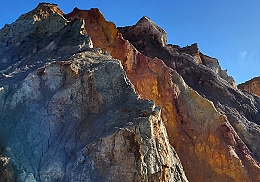
NEAR THE WESTERNMOST point on the Isle of Wight, lies Alum Bay. From its pebble beach, the Needles rock formation with their light house can easily be seen. Turn your back on the Needles and you will see that the bay and its beach have a backdrop of folded cliffs. These are not any old cliffs. They are multi-coloured.

The colouration of the cliffs is caused by the presence of oxidised iron compounds formed under different conditions.

The beach from which the coloured cliffs can be seen can be reached two ways. Either by foot, using a series of staircases, or by travelling on a spectacular set of chairs suspended from cables: a sort of funicular. I recommend descending by foot to enjoy the views at leisure and returning using the chair lift. However, descending on the latter is also said to be an exciting experience.

A ladder by the sea

GENESIS CHAPTER 28 describes a dream experienced by the biblical Jacob. In it, he dreamt that there was a ladder set on the earth that reached up to heaven. In his dream, he watched angels of God ascending and descending what is now called ‘Jacob’s Ladder’.

The small town of Sidmouth on the coast of Devon has its own Jacob’s Ladder. Unlike the one seen in the dream, it neither reaches heaven nor is it being used by angels. Often rebuilt, Sidmouth’s Jacob’s Ladder is made of wood and consists of three flights of stairs which connect Connaught Gardens with the magnificent stretch of sandy beach (at the western end of Sidmouth). This lovely, gently curving strand, known as Jacob’s Ladder Beach, is flanked by red stone cliffs and is about a mile in length. The views from the top of the Ladder and the café in the Connaught Gardens are spectacularly beautiful.

The Ladder was first constructed in 1853 on the instruction of Mr Lousada of nearby Peak House. It was rebuilt in the late 19th century, and then again following WW2. The Connaught Gardens on the clifftop overlooking the beach were first laid out in 1934 by the Gardens Department of Dartington Hall Ltd.

It is unusual features such as Sidmouth’s Jacob Ladder that give many British seaside towns great character and individuality, and makes them fun to visit.