A MAJOR ATTRACTION FOR VISITORS TO ISTANBUL

I AM ALWAYS WARY about visiting the ‘must-see’ places partly because I hate queuing and do not particularly enjoy crowds. Also, one of the few flaws in my personality is that I love visiting places that are off the beaten track taken by most visitors to a town or city. That said, I visited one of Istanbul’s most popular tourist attractions today – The Grand Bazaar – on my way to places less often seen by tourists.

The Grand Bazaar (Kapali Çarşi = ‘covered bazaar’) covers a huge area, and is like a city within a city. It has 62 covered streets and about 4000 shops. It’s construction commenced in about 1455/56 – a very few years after the Ottoman conquest of Constantinople/Istanbul. Much of its construction occurred during the second half of the 15th century, and it was largely completed by the beginning of the 17th century.
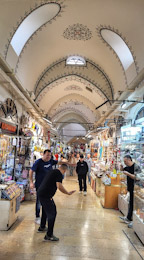
Many things impressed me about the Bazaar. It is very clean. The numerous shops are mainly tidy. Until we entered the place, I had not realised that it is built on a hillside. Many of its gently curving streets (or wide corridors) are far from level – they slope gently. The beautiful curved ceilings, supported by numerous arches, are wonderfully decorated with painted Ottoman motifs and patterns – tasteful not garish. Despite the presence of many people – tourists and locals – the bazaar did not feel crowded. Because of the great width of the streets, the bazaar did not have the bustling feeling that many large bazaars in India have.

All in all, despite my initial reservations about entering such a ‘mustn’t miss’ attraction, I greatly enjoyed visiting the Grand Bazaar, and am very pleased I did.

Made in India and sold in Istanbul

KARAKÖY IS A DISTRICT of Istanbul close to the Golden Horn (Haliç). When walking along Tersane Cadesi, a busy avenue lined with shops selling technical goods for mechanical operations (from nails to power tools), we passed an old building topped with domes. Its walls are alternating layers of stones and brick work.

A plaque on the wall of this place reads “ISBU FATIH BEDESTENI AYASOFYA VAKFI KEBIRI OLARAK INSA EDEL MIŞTIR”, which means ‘This Fatih Bazaar was built as a part of the Hagia Sophia Foundation’. So, the building was constructed as a bazaar, and is still used as such. Like the rest of the street, only machine tools and spare parts are sold in the edifice.

Made in India

The above-mentioned foundation was founded soon after the Ottoman conquest of Istanbul. Its function, along with other foundations, was to restore and restructure Istanbul, which had deteriorated badly during the last years of Byzantine rule. I have not yet been able to find out when the bazaar was constructed.

On one of the external walls of the building, a selection of rubber car tyres was on display. An elderly man, who was running the stall, greeted us, and began trying to guess where we were from. My wife told him that she is Indian. Hearing that, the old fellow rushed back to his collection of tyres, and we started to walk away. A few seconds later, he rushed towards us. He was holding a tyre in his hand, and pointing to it, and he kept saying “India”. We stopped, and then he rotated the tyre until he found the words “Made in India” embossed on it, and showed then to us.

TWO MOSQUES AND A BAZAAR IN ISTANBUL

WHILE WANDERING THROUGH the older part of Istanbul on our way to the Yeni Camii (‘New Mosque’), we came across the Mahmut Paşa Camii. This mosque stands in a remarkably peaceful, large compound, considering how close it is to a route used by crowds of tourists. Despite being in the heart of the most visited part of the city, this mosque seems to be ignored by most tourists.

The Mahmut Paşa was built in about 1463, making it one of Istanbul’s oldest mosques. It was built only 10 years after Istanbul was captured by the Ottomans. The spacious mosque was built in a style typical of some mosques found in Bursa. It has a large central hall flanked on each side by smaller rooms – rather like side chapels. It was the work of Grand Vizier, Mahmut Paşa, who was put to death by Mehmet the Conqueror in 1474. During his life, he was involved with the Siege of Belgrade, chasing Albania’s Skanderbeg, and the conquest of Bosnia. In addition to his military exploits, he was a noted writer, both in Turkish and Persian. It is worth noting that Mahmut Paşa was converted to Islam after he was captured in Serbia by the Ottomans when he was a young boy.

After seeing the mosque, we walked past the crowded Grand Bazaar, and after passing numerous shops selling lingerie and hosiery, we arrived at the Misir Çarşisi (Egyptian Market aka Spice Market). We walked through this covered, fragrantly scented spice market, which was constructed gradually from 1597 to 1664. Where two passageways lined with shops intersect, there is an open space overlooked by a wooden pavilion reached by a spiral staircase. This was used to say prayers to the merchants who gathered to listen to them at the start of each day.

The Yeni Camii is next to the Misr Çarşisi. It is an enormous structure with numerous domes. It was completed in 1603, and overlooks the Golden Horn and the Galata Bridge, which crosses it. Both the interior and the facade facing the courtyard are rich in tiles covered with blue and white motifs and calligraphy. This eye-catching tiling greatly adds to the mosque’s attractiveness. The huge, spacious interior is an oasis of tranquillity compared with the busy roadway and waterfront only a few yards away.

In between the three edifices I have described, the steeply sloping streets connecting them are lined with buildings of all ages – some of them attractive, others less so. Many of these buildings house shops.

Yet again, a stroll in Istanbul has proved to be fascinating. It is not only the historic monuments that I enjoy seeing, but also glimpses of everyday life in the city.

An interesting outdoor bazaar in Bangalore

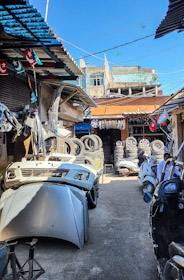
AT FIRST SIGHT, you might well think that you are looking at a crowded carpark which has been blown to pieces by a powerful bomb. There are parts of cars – bodywork, tyres, engine parts, etc., – all over the place.

After a moment or two, you begin to realise that there is a semblance of order in this ocean of car parts, many of which have been salvaged from cars at the end of their useful lives. For this area in the Shivajinagar district of Bangalore is a car parts bazaar. There are many different dealers, each specialising in particular parts of a vehicle. For example, there are merchants selling radiator grilles, others purveying axles (both front and rear), there are sellers of tyres, there are shops selling car doors and body panels … and so on.

Near both Russell Market and St Mary’s basilica, the car parts bazaar is almost hidden from sight by the buildings surrounding it. It is approached by short gullies – narrow lanes. I first stumbled across it in late December 2007. Then, on subsequent trips to Bangalore, I tried to find it again, but in vain. Today, the 26th of December 2023, I managed to locate it, and spent a few minutes wandering around it, stopping to take photographs.

It seemed that most of the dealers were Muslims. Some of them stopped me, greeted me, and asked where I came from and my name. When I replied ‘Adam’, they asked me whether I am Muslim. This reminded me of my first visit to Kosovo in 1975. As soon as I stepped of the bus that had carried me from Skopje (Macedonia) to Prizren (Kosovo), a group of youngsters surrounded me. They wanted to know my name, and when I told them, they were very happy because they thought that, like them, I was a Muslim.

Most of the dealers in the car part bazaar were happy with my taking photographs, but a few in one section of the market asked me not to use my camera.

As far as I could see, no repair work was being undertaken in the bazaar. Nearby, next to Russell Market, there were plenty of cars being repaired. Often those involved in repairing a vehicle were engaged in noisy discussions.

It is seeing places like the seemingly shambolic car parts bazaar that help to endear India and its people to me.

Catching rats in Surat, a city in Gujarat

PROFESSOR ROBERT HARKNESS was my PhD supervisor between 1973 and 1977. He and his wife remained my close friends for the rest of their lives. Robert was interested in everything. His was not a fleeting interest, but a deep, enquiring passion. He was fascinated by the contents of hardware shops, especially when making his annual overland trips between the UK and the North of Greece.

During his explorations of these shops, he noticed that the designs of traps for rodents varied from place to place. Many of them were constructed so that the rat or other pest was not killed when caught in the trap. Over the years Robert collected a wide variety of differently designed traps.

The rat trap and the man who made it

Today (the 8th of December 2023) when wandering through one of the many bazaars in Surat (Gujarat), we spotted a metal worker’s shop. On a table outside it, there were a pile of rat traps for sale. They looked like little sheds or garages. At one end of each of them, there was a sliding door. Bait is placed in the far end of the trap. When a creature touches this, the trap door drops down and imprisons it. I do not know what the owner of such a device does with the victim enclosed within it. I suspect that the animal might be killed by drowning.

The owner of the shop said that most of the traps on display were made elsewhere, but he showed us one he had made. As we examined the traps and other ironmongery on offer, I thought how much Robert would have enjoyed visiting this shop.

Still standing but for how much longer?

COMMERCIAL STREET IN Bangalore (Bengaluru) is one of the main arteries of a busy shopping district – a bazaar area – in the centre of the city. It is close to an area occupied by military establishments, descendants of a former British military base, to which Sir Winston Churchill (no friend of India) was attached briefly when he was a young man. Another main road, Kamaraj Road, in the area used to be known as Cavalry Road. And another reminder of the area’s military proximity is Infantry Road that runs into the Commercial Street area.

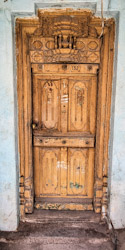
There is a network of narrow lanes that run through the bazaar district. These are lined with shops of varying sizes, tradesmen, artisans, cafés, and other businesses. Numerous motorcyclists and autorickshaws thread their way through the crowds of pedestrians thronging the streets. I suspect that only a small number of these people notice or are interested in the architecture of the buildings lining these lanes. I am one of that small minority.

Many of the buildings in the bazaar are either modern or post 1947. There are still some earlier edifices still standing. Some are gradually falling to pieces and others are in good condition.

Recently, I was taking pictures of some of the older buildings and their traditional decorative features when a man came up to me and said:
“Very old. Historic buildings. Old, very old.”
How old they are, I do not know, but it is likely that they were already standing when India became independent in 1947. I did not ask the man, who commented on the buildings’ age, exactly when they were built. One of my reasons for not doing so was a consequence of an instance in Junagadh (a city in Gujarat) some years ago. We were looking at an interesting mausoleum in the centre of Junagadh, wondering about its age, when we asked a bystander when it was built. He answered:
“I don’t know. I wasn’t born then.”

The few intact attractive, old buildings in the Commercial Street bazaar area are lovely to behold. Given how many of them have already been replaced, I wonder how much longer those remaining will survive.