Problems with identifying gender in London and Bangalore (Bengaluru)

WHEN OUR DAUGHTER was about two years old and able to walk unassisted, she often wore overalls (jump suits), rather than girlish frocks. One day we were walking in London’s Kensington Gardens when we passed a couple of elderly ladies.  One of them looked at our child, and said to us: “What a cute little boy you have”

We replied:

“Actuually, she is our daughter.”

To which one of the ladies said to her friend: “it’s so difficult to tell one from the other these days.”


The former Men’s Bar at the Bangalore Club

Some months later, we were in India at the Bangalore Club (in Bangalore). In those days, the late 1990s, the club had a Men’s Bar, to which only men were admitted. Its wood panelled walls bear hunting trophies and archaic weapons.

One day, I was having a drink in that bar with my father-in-law, when our daughter arrived in the adjoining room with my wife. Excited to see us, our daughter,  dressed in her overalls, dashed into the Men’s Bar. An elderly gentleman, seeing a child in the bar, said to our daughter:

“You are too young to come in, young man. When you are 21, you will be welcome here.”

To which, my wife standing close to the entrance, said: “She’s our daughter.”

The gentleman then responded: “In that case, you will never be able to enter our bar”.

 How wrong he was.

Sometime during the early twenty-first century, the rules changed: now both men and women can use what had been the Men’s Bar.  Now, this bar has been renamed: it is simply The Bar.

Today, almost 28 years later, nobody would have any difficulty identifying our daughter as a young lady.

A club founded for Indians in Bangalore

THE CENTURY CLUB in Bangalore is so-named because when it was founded in 1917 it was decided to limit its membership to one hundred. Today, the Club has about 6000 members. According to the Club’s website it was founded by the highly esteemed Sir M. Visvesvaraya (‘SMV’) who: “… was keen to promote what he felt was good in English society, particularly their orderly habits, punctuality, restraint in speech and social behaviour.”

The Club was founded during an era when Indians were not allowed to join or even enter the clubs (such as the Bangalore Club and the Madras Club), which were designed to be social clubs for the exclusive use of elite Britishers.

Shri Nalwadi Krishnaraja Wodeyar

SMV was inspired to establish a social club that admitted Indians after an unpleasant incident at the Bangalore Club. It occurred when SMV was the Diwan (Prime Minister) of the Kingdom of Mysore. When one day he was invited to the Bangalore Club he was wearing the royal turban of Mysore. The staff asked him to remove it and wear an ordinary cap instead. This insulting request upset him greatly, and led to him founding a club for ‘gentlemen’, which would accept Indians. Thus, the Century Club was born.

Shri Nalwadi Krishnaraja Wodeyar, the king of Mysore, allotted 7 acres of Cubbon Park for the use of the Century Club. Today, the Club is an oasis of peace and greenery in a city that is becoming increasingly less peaceful and disturbingly less green.

The Century Club began admitting Indians in 1917. Not far away, the Bangalore Club only began admitting Indians when India became independent (in 1947), or after that. And even worse, a few other Clubs (and other institutions) continued to admit only British (and other fair skinned Europeans) until the 1960s or later. This was quite remarkable in a country that had struggled for many years to free itself from foreign rule.

The Sport of Kings and a bar in Bangalore

I MUST ADMIT that I have never been much of a sportsma, and I know hardly anything about the game of polo, apart from the fact that it involves both horses and humans. Yesterday evening, as I enjoyed a postprandial brandy in the recently renamed ‘Polo Bar’ (formerly, ‘The Mixed Bar’) at the Bangalore Club, I spotted a large ‘coffee table’ book by Jaisal Singh about Polo and India.

What surprised me is the great age of the game of Polo. It seems to have been existence in some recognisable form as long ago as the 6th century BC. Then, it was played by some nomadic peoples in Central Asia. The book in the Polo Bar has a photograph of a terracotta model of a Chinese woman playing polo. This model was made between the 7th and 11th century AD. Another photograph shows the earliest known picture of a Polo player. This depicts a man on a horse, and was created in the same era as the model.

Much of the rest of the book is about polo in India. It charts the rise in popularity of the game amongst the wealthy rulers of the Princely States and the upper echelons of the British administrators and military in India.

The Polo Bar, which until recently was known by another name, has been decorated with polo memorabilia (e.g., photographs, trophies, and horseshoes). The handle on the door leading into the bar is horse-shaped. However, for me, the most interesting polo related item is in the Club’s Gardens. It is an inscribed stone block, which was the foundation stone of the Domlur Polo Pavilion laid in January 1914 by Lady Daly, wife of the British Resident.

The stone includes the information that one Major C Rankin was “Hon-Secy” and R Evans Esq was the architect. Both were military personnel, members of the “7th (Q.O.) Hussars”. The pavilion’s building contractor was BV Venkataswami Naidu.

In “Bangalore, the Story of a City”, by M Jayapal, the author wrote that initially the race course was out at Domlur. [Hence, the existence of Old Race Course Road]. In the late 19th century it moved to near Lalbagh, and then to its present position near to High Grounds. Presumably, because there had been equine facilities at Domlur, this would have been a suitable place for the Bangalore Club to locate its polo club there. I am not sure whether anything remains of the polo club pavilion whose foundation stone stands in the Bangalore Club gardens.

According to a blog article (https://wp.me/p1YuI1-1xA) about the pavilion, this is of interest:
“Information, thanks to the Bygone Bangalore group on Facebook: The Polo Club was located on Cambridge Road, in the area that is now Cambridge Layout. Opposite the Sai Baba Temple, there exists a portion of an old building which is said to be a part of the Polo Club.”
Incidentally, the centre of Cambridge Layout is less than a mile from the heart of Domlur.

As for the Bangalore Club’s association with polo, the following words quoted from the Club’s website (www.bangaloreclub.com) are of interest:
“Bangalore Club was established in 1868 as the Bangalore United Services Club for the officers of the British Empire. Originally the buildings were occupied by the Polo Club which moved out in the beginning of the 1860’s.”

I do not know how many current members of the Club play Polo these days. Even if it is not many, the Club’s former associations with the military ( the Club was formerly a club for military officers) and the land upon which it stands justify the naming of one of its bars to commemorate what was once known as “The Sport of Kings”.

Winston Churchill and a newspaper reading stand

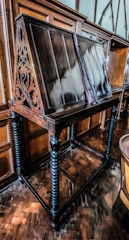
THERE IS A LOVELY old wooden newspaper reading stand is located in the formerly men only bar in the Bangalore Club. It bears the insignia “US” at one end, the S being back to front. Before about 1947, the club was the United Services Club.

Winston Churchill, who was never too fond of India, was briefly a member of the Club (in the late 1890s) , and incurred a small, but never paid debt there. I wonder whether the reading stand is old enough to have been used by Churchill.

Thrown out of a library

When she was about two years old, our daughter dressed in a unisex romper outfit, rushed into the Men’s Bar at the Bangalore Club. An elderly gentleman conducted her back to the entrance of the bar, saying: “You can’t come in here yet, young man. You’ll have to wait until you’re twenty one.”

My wife explained that our child is a girl. The gentleman replied: “In that case, my dear, you will never be able to enter the Men’s Bar.”

The Bangalore Club was founded by British officers in 1868 at the time when Mahatma Gandhi was born in faraway Gujarat. Until after about 1945, women were not allowed into the main Club House. There was a separate annexe reserved for women. And until 1947, with the exception of servants and a very few high ranking military officers, no Indians were permitted to enter any part of the Club.

The Bangalore Club and many other similar still existing colonial era clubs in India maintain many of the old-fashioned rules that applied in elite clubs in the UK. For many years, men could only enter the Club House at the Bangalore Club wearing ‘proper’ shoes, not sports shoes or sandals. Now, sandals are allowed providing they have a back strap around the ankle.

Once, I stayed at the Kodaikanal Club deep in the southern Indian state of Tamil Nadu. Dress code seemed to be non-existent there until I stepped into the club’s small library. Within a few seconds, a member of the library staff escorted me out of the library. I was wearing sandals. I was told that one could only enter the library if formal leather shoes were being worn.

Well, if you join a club, you should respect its rules however idiotic they might seem. Vide the UK and the EU.

As time moves on, rules change. A couple of years ago , for reasons best not explored here and they were nothing to do with gender equality, women were permitted to enter and use the Men’s Bar at the Bangalore Club. Since that date, the formerly masculine sanctuary has been renamed “The Bar”.

The old gentlemen who evicted our daughter from the Men’s Bar is probably no longer alive. I wonder what he would have thought when his prediction proved to be wrong. Let’s finish by raising a glass to his memory.

A Chinese gong in Bangalore

The Bangalore Club, until 1947 a British officers’ club (the Bangalore United Services Club), was founded in 1868.

gong

At the entrance to the dining hall, there stands a heavy metal Chinese gong shaped like a ship’s anchor. It is held in a wooden frame surmounted by carved wooden dragons. On each of its flat surfaces, there are Chinese pictograms (writing characters).  My friend Pamela Miu has kindly translated these Chinese pictograms. What she tells me gives some clues as to the history of the gong, which I have been seeing regularly for 25 years.

On one side, the inscription reads that the gong once  belonged to the imperial navy school of the late Qing dynasty’s Beiyang Fleet, dating the object to the late 19th century.

The other side of the gong includes a date. This refers to the Qing Dynasty period. It mentions the the gong’s date is October in the 21st year of the reign of the Guangxu Emperor, who ruled 1875-1908. This dates the gong to 1897.

How the gong reached Bangalore from the Chinese naval school is a mystery at present. Apparently, the Beiyang Fleet suffered many defeats. Also, the British, along with seven other nations, fought the Chinese and looted many treasures from China. Tjis gong might well be be part of the loot. Finally, Pamela mentioned that when the British took (leased) Hong Kong in 1898, many of its police force were brought over from India.

So, there is a bit of the history of a dinner gong, which I have never seen used.


Many thanks to Pamela Miu