
The good and simple life

A FEW DAYS AGO, we visited the Penlee House Gallery in the Cornish town of Penzance. After admiring its fine collection of art by painters who worked mainly in Cornwall during the late 19th and early 20th centuries, especially by members of the Newlyn School, I noticed a moss-covered stone in the gallery’s attractive gardens. It mentioned two twinned towns: Penzance and Concarneau.
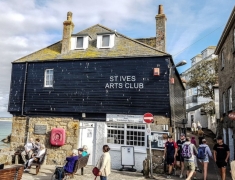
St Ives Arts Club

Concarneau is a French fishing port in Brittany. Although I was probably less than ten years old at the time, I have some recollections of the family holiday we spent there along with our general medical practitioner, Dr C, and his family. Two memories of that holiday linger in my brain. One is of the excessively lengthy luncheons we had in our hotel’s dining room. Being a poor eater in my childhood, these meals with many courses did not appeal to me. I remember whiling away the time playing with discarded crab and lobster parts from which the adults had extracted the edible flesh. The other memory is of an unfortunate accident that occurred on the beach. Dr C was showing my young sister a sea urchin. Accidentally, it slipped out of his hand and fell onto my sibling’s bare foot. For many years, she remembered this painful experience.

Concarneau is remembered on the stone at the Penlee House Gallery because some of the artists, who spent much time painting in Newlyn, a fishing port next to Penzance, also painted in Concarneau. The French port, like Newlyn, also attracted French artists. Both places were home to ‘artists colonies’ at the end of the 19th and beginning of the 20th centuries (for some details, see: http://www.stivesart.info/brittany-links/). St Ives, which is near Newlyn and Penzance, was also home to a thriving artists colony in that period. Today, one of the attractions of St Ives is the fact that serious artistic activity continues there. Stanhope Alexander Forbes (1857-1947), a highly accomplished artist based for much of his life in Newlyn, wrote that this close neighbour, almost continuation of, Penzance was his:

“…sort of English Concarneau.” (www.sothebys.com/en/auctions/ecatalogue/2003/important-british-pictures-l03123/lot.31.html)

The artists colonies that existed all over Europe and also in North America at the same time as those in Newlyn and St Ives became the subject of research for my friend, the art historian and travel writer, the late Michael Jacobs (1952-2014). For some unknown reason, Michael never learned how to drive. As a result, he depended on public transport and his friends to get him around the many places that he visited. In about 1984, two years after I had gained my driving licence, I agreed to drive him to Cornwall where he was researching its two artists colonies. We stayed both in Newlyn and St Ives in bed and breakfast accommodation. I enjoyed accompanying my friend whilst he made his enquiries.

An organisation in Newlyn let Michael the notebooks (or diaries) of Stanhope Alexander Forbes, who lived from 1884 onwards in Newlyn and died there. Trustingly, the keeper of these original handwritten notebooks gave them to Michael to peruse overnight. He hardly slept that night because he spent most of it feverishly trying to read as much as possible of this source of information about life in Newlyn’s former artists colony.

Michael was a sensitive fellow, who never wanted to upset anyone. This admirable characteristic of my friend backfired the following day. Our landlady provided us with a lavish full English breakfast. The table was covered with an ocean of food, piles of bacon, sausages, eggs, baked beans, fried bread, toast, black pudding, fried tomatoes, and much more. After we had both eaten, there was still a vast amount of food on the table. Michael said to me that we should not leave it uneaten as that would upset our kindly hostess. I said that I could not manage any more. So, Michael, not wishing to risk offending our landlady, managed to consume the huge amount of food remaining. Thoughtful as this was, it was not without consequences. For much of the rest of the day, poor Michael kept clutching his stomach that was not grateful for the load of food with which it had to deal.

We stayed in St Ives. The bed and breakfast place that we had booked was on a steeply sloping narrow street in the old part of the lovely town. Driving my car through streets like these, barely wider than my vehicle and often dangerously steep, was no joke. After that, my first trip to St Ives, I promised myself never to attempt driving in the old part of the town. I have stuck to that promise.

Our visit to St Ives was made special because Michael had to interview various artists in their studios and members of the St Ives Arts Club. The latter, which is housed in an old warehouse, was founded in 1890. Its early members included the artists Sir John Arnesby Brown, Sir Leslie Stephen, Adrian Strokes and W Titcomb. The Club’s informative website notes:

“All but one of the original Committee hung at the Royal Academy.” (www.stivesartsclub.org/copy-of-history).

I do not recall whom we met there, but we were permitted to enter parts of the Club not normally accessible to non-members.

While we were in St Ives, we did not visit the Barbara Hepworth Museum (first opened in 1976) and the Tate St Ives was not yet in existence; it opened in 1993.

By the time that Michael and I visited the two towns in western Cornwall, my friend had already done a great deal of research about artists colonies abroad. What struck him at the time was that in each of the former artists colonies that he visited in a number of different countries including France, Russia, USA, and Germany, he met experts who could tell him much about the colony in which they specialised but few of them were aware, as Michael had become, of how much the artists moved between the different colonies.

Michael’s research culminated in the writing of his book “The Good and Simple Life: Artist Colonies in Europe and America” that was published by Phaidon in 1985. Sadly, I have mislaid, I hope temporarily, my copy of this book, in which I am sure that he wrote a personal inscription. When we visited the Penlee House Gallery in September 2020, I looked at their bookstore to see if they stocked Michael’s book. It was not there and also the otherwise informative gallery staff had never heard of it, which is a great pity because it shows how the Newlyn and St Ives colonies were part of an international artistic network or community.

It was the visit to the Penlee that brought us to Penzance, a place that we had not considered visiting before. I am pleased that we went to the town because it offers many delights that exceeded our prior expectations.

Michael passed away six years ago. Although in the last few years of his life we saw him less often than previously because he was often away travelling or spending time in his home in Spain, a country which he loved, we think of him often with great affection.

Peel Street and paintings

WALKING ALONG A SHORT street in London’s Kensington recently, I observed things that I had never noticed before and was reminded of Tony ‘M’. When I was a student of dentistry at the University College Hospital Dental School, I first met Tony in the third year. In that year, we began to learn how to make crowns (‘caps’) for our patients. Instead of sending the work out to be done by technicians, we students had to learn the nitty gritty of fabricating crowns, mostly gold ones. We were assigned to one of three or four technician tutors. I was assigned to Tony’s group. Why visiting Peel Street in Kensington sparked me to think of Tony will be revealed later.

Peel Street in Notting Hill Gate lies in land that used to be known as ‘The Racks’. It was part of the extensive estate of Campden House, which was owned by the Phillimore family. In the early 19th century, the land was bought by John Punter and William Ward, who divided the land between them in 1823 after having agreed to lay out two roads: Peel Str and Campden Str. Peel Street lay in Punter’s share of the area. Although Punter retained several plots along Peel Street, the rest were sold to a variety of different people. Nearer the eastern end of the street several buildings were demolished between 1865 and 1875 during the construction of what is now the Circle Line. Though the tracks are underground, there are no buildings built above them. If you look through the gap on the north side of the road, you can see the rear of a brick building which fronts on Edge Street. Near the top of this place, some bricks have been made to project slightly and to spell the name ‘LESLIE’. The rear part of this L-shaped building is currently occupied by ‘The Spanish Education Office’. This building was flying Spanish and  EU flags. I have no idea about the significance of ‘Leslie’.

One of the houses on the south side of Peel Street used to be a pub. It still bears the lettering ‘Peel Arms’. It was probably in existence by 1889, but today it is a private dwelling. The pub’s clientele were probably mostly workers who toiled in the gravel pits that abounded in the neighbourhood. The pub is not far from the six-storey Camden Houses, brick-built blocks of flats erected in 1877-8 for labourers, some of whom might well have drunk at the Peel Arms. The blocks contain 125 separate flats. The entrances to the blocks have art nouveau features. The building were designed by the architect Edwyn Evans Cronk (1846-1919) for the National Dwellings Society Ltd. Cronk was born in Sevenoaks (Kent) and died in Redcliffe Square in South Kensington.

At the western end of Peel Street, there is another pub, The Windsor Castle. Unlike the Peel Arms, this is a working establishment, now popular with the locals, most of whom are not poorly paid labourers. It was originally built in about 1826 and then remodelled in 1933. The pub contains much of its original late Georgian building fabric and is a Grade II listed place. Although I have passed it often, I have never entered it or its reputedly fine garden. At the Eastern end of Peel Street, there is a wine bar, The Kensington Wine Rooms. When we were getting married, back in 1993, the premises were occupied by a branch of the Café Rouge restaurant chain. We held a pre-wedding dinner there. The premises now housing the wine bar once housed a pub, The Macaulay Arms.  It was listed as being in existence in the 1868 edition of “Allen’s West London Street Directory”. Thus, residents of Peel Street were only a few steps from three ‘drinking holes’.

The directory ( https://www.gutenberg.org/files/58160/58160-h/58160-h.htm) lists the residents of Peel Street in 1868 as follows:

“1 Upfold George, sweep/ 2 Arnold F., carpenter/ 3 Miles Frederick, painter/ 23 Mansell H., painter/ 26 Redman J., marine stores/ 28 Redman J., beer retailer/ 37 Taylor W., gardener/ 46 Lucas Wm. Grocer/ 53 Hobbs Mrs. general shop/ 55 Horskins Thos. Baker/ 63 Pollett —, bootmaker/ Harris W., greengrocer/ 67 Smart M., The George Brewery/ 69 Dunnett Mrs. dressmaker/ 77 Elson George, oilman/ 80 Evans H., gardener/ 82 Atwood Mrs, dressmaker/ 83 Salmon —, bootmaker”

Most of the inhabitants appear to have been tradesmen, merchants, and craftsmen, rather than labourers. This is probably because the list was compiled before the Campden Houses were built to house manual labourers and their families. Incidentally, there is still a greengrocer on Peel Street. Jack and Jessie’s excellent shop is opposite the Kensington Wine Rooms.

Peel Cottage stands almost at the corner of Peel Street and Campden Hill Road. It is next to number 118 Campden Hill Road (aka ‘West House’), a building on the corner of Peel street designed for the artist George Henry Boughton (1803-1905) in the late 1870s by Richard Norman Shaw (1831-1912). New Scotland Yard and Lowther Lodge (home of the Royal Geographical Society on Kensington Gore) were amongst the many other buildings designed by Shaw. Another artist, the landscape painter Matthew Ridley Corbet (1850-1902) lived at number 80 Peel Street, where once lived the gardener, H Evans.  

The entrance to Peel Cottage, which is dwarfed by its neighbours, is partially covered with ivy. It was seeing the blue, circular commemorative plaque on the wall next to its entrance that reminded me of my former teacher Tony M. The plaque informs the passer-by that the artist Sir William Russell Flint (1880-1969) lived in Peel Cottage from 1925 until his death. This brings me back to Tony M, about whom you must have thought I had forgotten already.

As a dental student, I spent many hours with Tony M as I struggled to make decent gold crowns that would fit my patients’ teeth in the conservation clinics of the Dental School. Each encounter with Tony involved a trip to the canteen in the school’s basement. Tony was unable to function without a fresh cup of the school’s barely mediocre coffee. Over cups of coffee, Tony used to encourage us when the clinical teachers made our lives miserable, help with our technical work, and chat. During one of our sessions together, Tony, knowing that art interested me, suggested that I visit Cottrell’s showrooms in nearby Charlotte Street (numbers 15-17) to see the fine collection of paintings that hung on its walls. Cottrell’s were an important supplier of dental equipment and materials. Today, although it has retained its original Victorian frontage, it is the premises of the Charlotte Street Hotel.

Dutifully and because I was curious, I visited Cottrell’s showroom and looked at the framed watercolours hanging on the walls of the two ground floor showrooms. The paintings were all works of the inhabitant of Peel Cottage, William Russell Flint.

Flint was born in Edinburgh. He studied at Daniel Stewart’s College and then Edinburgh Institution. Between 1900 and 1902, he worked as a medical illustrator in London. Later, he produced illustrations for books and “The Illustrated London News”. He was elected President of the Royal Society of Painters in Watercolours (now the Royal Watercolour Society, of which my wife’s cousin, Varsha Bhatia, is a member), a position he held from 1936 until 1956. He was knighted in 1947. Flint produced many well-executed, delicately tinted water-colour paintings. He often visited Spain, where he made plenty of images that often included sensuous portrayals of women in various stages of undress. It was some of these titillating paintings that Tony had sent me to see on the walls of Cottrell’s showroom.

It was in the late 1970s or early 1980s (before 1982, when I qualified) that Tony M encouraged me to pay a visit to Cottrell’s in Charlotte Street to widen my knowledge of the world of art. Many years have passed since then, but a memory of that brief glimpse of Flint’s paintings lingers in the back of my mind. Visiting Peel Street and seeing Flint’s home brought that all back to the forefront of my memory.

Art on the road

We have recently returned from Cochin (in Kerala, South India), where every two years there is a huge art exhibition, the Kochi Muziris Biennale, that is open for just over three months. The artworks on display are supposed to conform in a loose way to a theme chosen by the chief curator. The artworks are not for sale at the Biennale.

Once a year early in each January, a one day art festival called Chitra Santhe is help along Kumara Krupa Road in Bangalore. This tree lined thoroughfare runs past both the Bangalore Golf Club and also the Chitrakala Parishadh, a leading art school.

Many artists display their works along the street. Their aim is to sell to the thousands of passers by, who amble leisurely past them. The quality of the artworks varies from highly skilled to colourful kitsch. All tastes are catered for. Many visitors wander about with their wrapped purchases under their arms.

The atmosphere at Chitra Santhe is festive. The January temperatures make for pleasant outdoor art viewing. Unlike the Biennale in Cochin, there is no theme unifying the artworks on display apart from the artists’ desire to sell. The artists are happy to discuss their works and are not pushy salesmen. Prices range from very low to not unreasonably high.

If you happen to be in Bangalore on the first Sunday in January, then an hour or so at the Chitra Santhe should prove to be a rewarding and enjoyable experience.