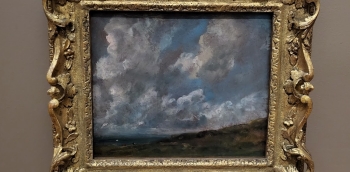
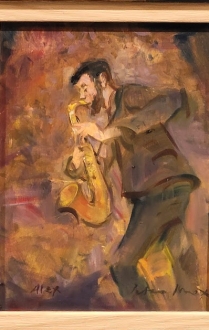
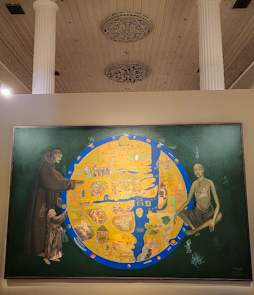
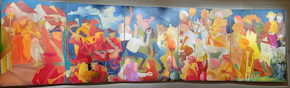
KRISHEN KHANNA CELEBRATED his one hundredth birthday in July 2025. The NGMA (National Gallery of Modern Art) in Bombay is currently holding a superb exhibition showcasing his paintings. The show is beautifully displayed and the artworks are skilfully illuminated.
Khanna was born in Lyallpur, now in Pakistan. After the Partition of India in 1947, he worked as an official in Grindlays Bank in Bombay. However, before Partition, he had already begun painting. The bank job was just to help keep him and his family going after they had left/fled what became the Pakistani part of Punjab.
Soon after arriving in India, Khanna began associating with members of Bombay’s Progressive Art Group that included notable creators such as FN Souza and MF Hussain. Thereafter, his painting career took off, and his reputation soared.
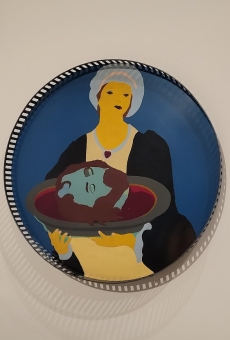
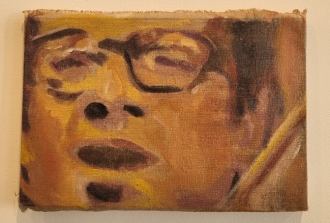
The exhibition at the NGMA surveys Khanna’s extraordinary range of paintings. Their subject matter ranges from political to historical to religious … and much more. The show, which demonstrates the artist’s amazing versatility and great artistic skill, continues until 12 December 2025, and should not be missed if you are in Bombay.
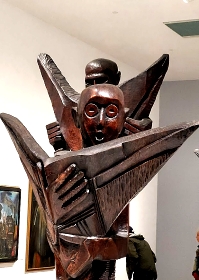
SEVEN CARVED WOODEN figures stand in a line at an exhibition in London’s Tate Modern gallery. Each of them is depicted holding something that looks like an book or a pair of wings. Their faces are all different, as are their expressions and heights. They were carved by the Nigerian artist Ben Enwonwu (1917-1994), and form part of a superb exhibition, “Nigerian Modernism”, which is showing until 10 May 2026.
Ben Enwonwu was born in Nigeria. His father was a traditional sculptor. Ben studied art first at Government College in Ibadan (Nigeria), and then at Government College Umuahia. At both places, he studied art under Kenneth Murray (1902-1972). In 1944, Ben was awarded a scholarship that allowed him to study both at The Slade School of Art in London and at The Ruskin School in Oxford. Also he undertook postgraduate studies in West African anthropology at the University of London. Thereafter, he taught art in Nigeria, where he created many of his sculptures and paintings. Since completing his education, Enwonwu has received international acclaim for his work.
In 1960, Ben proposed making a sculpture to commemorate Queen Elizabeth II’s visit to Nigeria in 1956. It was to be placed in the Nigerian House of Representatives in preparation for Nigeria’s independence in 1960. At the Tate’s exhibition, there is a photograph of Enwonwu working on this sculpture in the studio of his friend, the sculptor William Reid Dick (1878-1961), who was Sculptor in Ordinary for Scotland to Queen Elizabeth. At around this time, Ben received another commission in England.
The British newspaper, the Daily Mirror, commissioned Ben to create 7 sculptures for their headquarters. Carved in ebony, these are the works mentioned above. The diversity of their forms and expressions is supposed to represent the variety of people reading thepaper. According to a label in the exhibition, Enwonwu said:
“I tried … to represent the wings of the Daily Mirror, flying news all over the world.”
The statues were placed in the headquarters public courtyard in Holborn. Currently, they are in the Tate Modern, but after having been lost for several years, they were sold at public auction. They are now owned by Access Holdings PLC, a Nigerian company.
In addition to what I have already described, there are many more works by Enwonwu in the exhibition, both paintings and sculptures. Each one of them is wonderful. His works show the influence of European Modernism, but at the same time they reflect the artist’s African background and his involvement in the traditional art of his homeland. He was sympathetic to the Négritude movement, an anti-colonial cultural and political movement founded by African and Caribbean students in Paris in the 1930s, but was also affected by twentieth century artistic movements in Europe and the USA. It was fascinating to see how the modern art trends of the mid-twentieth century were successfully integrated with the artist’s desire to portray the life and traditions of Africa.
THE DUVEEN GALLERIES in London’s Tate Britain provide a wonderful space to display sculptures. The rooms are wide, long, and have high ceilings. Their walls are plain and do not distract the viewer. Until 30 March 2026, these magnificent spaces contain a selection of sculptures by Jacob Epstein (1880-1959), who was born in New York City. He joined the Art Students League in New York, before moving to Paris in 1902, where he studied sculpture at the École des Beaux Arts and Académie Julian. He settled in London in 1905. Both in Paris and London, he studied non-European sculpture, and what he learned from it often influenced his work. Some of the stone carvings in the Duveen Galleries are evidence of this. Soon after arriving in London, he began receiving important commissions to produce sculptures for significant institutions in London such as the British Medical Association (now Zimbabwe House). He became naturalised as a British citizen in 1910.
The collection of sculptures in the Duveen Galleries includes several stone carvings in different styles. The Tate’s website noted:
“In the 1910s, Epstein became a key figure in the ‘direct carving’ movement in Britain. This approach emphasised a ‘truth to materials’, in which sculptors worked directly with the stone, using its natural qualities rather than making wax or clay models first. He was influenced by the techniques and imagery used in ancient Egyptian, West African and Oceanic carvings, which he collected. At the time, his portrayal of sexuality as well as the simplified forms of his monumental figure carvings drew both admiration and intense criticism, limiting his opportunities for public commissions.”
Some of the sculptures on the former British Medical Association (now Zimbabwe House) building were criticised as being too explicit for Edwardian tastes, when they were completed in 1908. Sadly, these sculptures that can still be viewed from the Strand are badly damaged by being exposed to the weather and pollution.
The stone carvings in the Duveen, which vary from figurative to almost abstract, were all new to me. The bronze busts of famous and not-so-famous people include portraits of family members, artists, writers, entertainers and other public figures. These are the works that I tend to associate with Epstein. So, seeing his stone sculptures was a new and pleasant revelation for me. Each of the sculptures on display is accompanied by an informative panel. The works are well spaced so that each one can be admired in splendid isolation. This is an exhibition worth seeing.
RACHEL JONES IS an artist who was born in London in 1991. She trained at Glasgow School of Art, then at the Royal Academy Schools. There is an exhibition of her paintings, “Gated Canyons”, at Dulwich Picture Gallery until 19 October 2025. I must admit I had never heard of her before visiting the show in August 2025. So, I went to see it without knowing what to expect.
Rachel’s colourful paintings on display vary in size and shape. All of them are more abstract than figurative, but not completely abstract. The artist uses colours well, producing appealing images. Many of them interested me as a retired dentist because most of what was on display included somewhat abstract depictions of jawbones, teeth, lips, and tongues. The artist regards the mouth as being important as it is a portal through which we interact with the outside world, express our feelings, and explore psychological landscapes. If I understand it correctly, Rachel regards the mouth as a gateway to both our inner selves and the outside world. Having read the informative labels that tell viewers about her work, I began seeing, or even imagining, elements of her paintings that might be interpreted as features of oral anatomy.
The exhibition occupies three rooms, one of which I felt was too small to properly view the three large pictures within it. Otherwise, the paintings were nicely displayed and well-lit. I am glad I saw the show, but I would be reluctant to recommend it to most people I know.
THE WHITECHAPEL GALLERY in London’s Aldgate area often hosts exhibitions of adventurous art, and has been doing so for many decades. The current show “Hamad Butt: Apprehensions”, which is on until 7 September 2025, displays works by an artist Hamad Butt. He was born in Lahore (Pakistan) in 1962, and died of AIDS in London, aged only 32. His family brought him to London when he was 2 years old. He studied art at London’s Goldsmith College, Morley College, and Central Saint Martins.
Familiars 3
The ground floor of the Whitechapel Gallery contains three enormous sculptures. Together they form an art installation, which the gallery’s website described as follows:
“Familiars 1: Substance Sublimation Unit is a steel ladder made of glass rungs, each filled with an electrical element and crystals of solid iodine. The current ascends the ladder, intermittently heating the rungs, causing the iodine to sublimate into a purple vapour. In Familiars 3: Cradle, named after Newton’s cradle, 18 vacuum-sealed glass spheres are filled with lethal yellow-green chlorine gas. If smashed together, the gas – a respiratory irritant – would be released into the air. In Familiars 2: Hypostasis, three tall, curved metal poles, reminiscent of Islamic arches, contain bromine-filled tubes at the tips.”
Well, they were visually intriguing pieces of conceptual art. What they stand for is almost more important than their physical appearance.
Upstairs, the galleries are hung with paintings, drawings, and prints. There is also another installation that contains a set of lights emitting ultraviolet rays. Visitors are provided with protective goggles when viewing this exhibit called “Transmission”, which is yet another example of conceptual art that you need to read about to make any sense of it.
What saved the exhibition for me was the display of Butt’s paintings and prints. Ranging from almost figurative to abstract, they appealed to me immediately. It is a shame the artist lived for such a short time. That which he produced in a few years, I am sure, would have led to him becoming a noteworthy artist with a fascinating output.
UNTIL I ATTENDED the superb display of the paintings of Edward Burra (1905-1976) at a special exhibition at London’s Tate Britain, I associated him only with depictions of the USA. Despite his Italian sounding surname, Burra’s father came from a long-established British family. Edward trained as an artist at Chelsea School of Art, then at the Royal College of Art. In 1925, he contracted rheumatic fever, and for the rest of his life he suffered ill-health. However, this does not seem to have affected his ability to produce an impressive number of beautiful paintings.
The exhibition at Tate Britain displays Burra’s paintings and drawings chronologically. Throughout his life, he produced works of art that are not only attractive and intriguing but also sensitive portrayals of his views of the times in which he lived. Some paintings exhibit his interest in surrealism, but although many of his paintings have a dreamlike quality, they are in the main not what could be described as Surrealist. His images of France, although highly original and imaginative, capture the ‘atmosphere’ of French life between the two World Wars. Burra was keen on jazz. Many of his paintings include jazz musicians, particularly those he made while visiting the USA, and New York City in particular. The exhibition includes a collection of some of the artist’s collection of jazz music records.
Burra lived through two World Wars and the Spanish Civil War. The Tate’s exhibition includes many of his paintings depicting the horrors of these conflicts. The final room of the show displays Burra’s portrayals of Britain. The artist’s depictions of landscapes is stylistically original, slightly abstracted, but evokes their nature perfectly.
Whether Burra is painting people or objects or machinery or landscapes, the impact of his painting is in each case powerful. This wonderful exhibition will continue until 19 October 2025, and is well worth seeing. I am glad I went because now I realise that although his paintings of New York and jazz are wonderful, they are only a fraction of Burra’s amazingly artistic output.
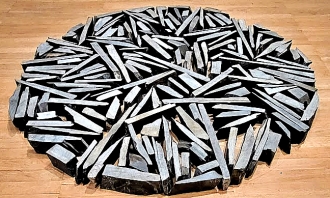
THE CAMDEN ART Centre in London’s Hampstead area rarely puts on exhibitions that can be classed as dull. The current show, which runs until 22 June 2025, is certainly anything but dull. It is a solo exhibition of works by Richard Wright, who was born in London in 1960. After his family moved to Scotland, he attended Edinburgh College of Art from 1978 to 1982 and then was at Glasgow School of Art between 1993 and 1995. He lives in Glasgow and Norfolk. In 2009, he won the prestigious Turner Prize.
From what can be seen in the variety of art works on display in the Art Centre, it is difficult to pigeonhole his art in any particular category. The works that can be viewed in the exhibition include huge wall-paintings, stained glass windows, light-diffusing structures, framed paintings, decorated sculpture, books that have had had paintings added to them, and more. A note in the exhibition handout outlines some of the influences on Wright’s art:
“The exhibition also brings together more than 40 works on paper made over the last 30 years, drawing on languages of signwriting, 1970s subculture, album covers and poster-art, as well as Baroque painting, Renaissance frescoes, Islamic mosaics and early modern artists and movements including Kandinsky, Klee, De Stijl, Mondrian, and Russian Constructivism. Some of these works are made directly into the pages of books, another kind of site, surface or architecture for him to intervene in and occupy.”
Seeing this collection of refreshingly original artworks in the brightly lit galleries of the Camden Art Centre was a delightful experience.
AMOAKO BOAFO WAS born in Accra (Ghana) in 1984, where he works and lives. After teaching himself to draw and paint in his childhood, he was engaged in various professions before he studied art at Ghanatta College of Art and Design in Accra. There, he was awarded a prize for being the best portrait painter in his year. In 2013. Boafo moved to Vienna (Austria) where he was the co-founder of a centre for artists of colour and LGBTQ+ voices.
Because of the marginalisation of Black people he noticed in Austria, Boafo began to specialise in portraying Black people. As the gallery’s website noted, he is:
“Inspired by the expressionistic portraiture of Vienna Secession artists Gustav Klimt and Egon Schiele, he counts among his contemporary influences Jordan Casteel, Maria Lassnig, Kerry James Marshall, and Kehinde Wiley.”
Looking at the faces in Boafo’s paintings on display at the Gagosian Gallery in London’s Mayfair until 24 May 2025, I could see the influences of Klimt and Schiele in them. Many of the paintings include depictions of patterned fabrics and wallpaper. What makes his paintings fascinating is that instead of using brushes, Boafo paints the faces and bodies of his subjects with his fingertips. The effect produced is curiously mosaic-like.
Part of the exhibition in Gagosian is hung conventionally in a large room. In another part, in a separate room, Boafa’s paintings have been hung in a life-size reconstruction of the courtyard of his childhood home in Ghana. In addition to the paintings, there is a display of playing cards designed by the artist. In brief, I am pleased that we visited this exhibition of works by a refreshingly original artist.
THIS SCULPTURE STANDING in the foyer of the ActOne cinema in Acton is labelled “The Urchin” and dated 1968. The sculptor is named Ute Sturch. I have searched the Internet for information about the sculptor, but found nothing. Does anyone have any information about the life and work of this creator?
THE WADDINGTON CUSTOT Gallery in Mayfair’s Cork Street puts on excellent exhibitions and the current show, which goes on until 10 April 2025, is no exception. It is an exhibition of sculptures by Yves Dana, who was born in Alexandria (Egypt) in 1959. He moved with his family to Switzerland in 1961. It is there that he lives and works. In the early 1980s, he set up a sculpture studio in Lausanne (Switzerland). In 1996, he paid a return visit to Egypt. Following that, his approach to sculpture changed dramatically. The sculptures on display at Waddington Custot were made long after that visit to the land of his birth; they date from 2004 until 2024.
Each of the works we saw, both at the gallery and outdoors in Smithson Plaza (near Bury Street), is pleasing to the eye. Many of the sculptures allude to the art of Ancient Egypt in subtle ways. Several of the artworks brought to mind the simple beauty of Cycladic sculptures and others evoke the harshness of desert climates. The gallery’s website revealed that Dana:
“… sources the best quality stone from around the world, including limestone from Egypt, France and Turkey, serpentine from Italy and diabase from Germany. He combines innovative carving techniques with traditional tools to create precise planar forms. With each work created over several weeks or months, the physicality of carving stone, with deep sensitivity to its tones and texture, is evident in the subtlest details of each work.”
This is very evident as one looks at the often sensuously shaped abstract forms of his sculptures. Where there is an interesting detail inherent in the material, he shapes the sculpture so that the viewer’s eyes are drawn to it. Although Dana imposes his artistic will on the materials he employs, he is also sympathetic to their original forms and textures and does not force them to submit totally to his compositional ideas. `Put another way, it seems that Dana’s compositions are guided by the physical properties and shape of the materials he is using.
As you can gather from what I have written, brief though it is, I enjoyed seeing this show and getting to know the work of an artist, whom I had not known about before.