A Hindu temple that incorporates a banyan tree

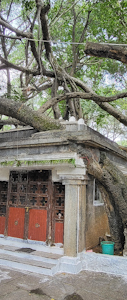
ON THE CAMPUS of Bangalore’s Chitrakala Parishath art college, there is a small Hindu mandir, the Ganapathi Temple. Dedicated in 1984 and built by Mandelia Parmarth Rosh, it contains an effigy of Ganesh and not much else.

What makes this small religious building both fascinating and charming is that its construction incorporates branches of a large, living banyan tree. The tree is growing through part of the temple.

The moving story of St Martin’s School of Art

THE MOVING STORY OF ST MARTINS SCHOOL OF ART

MY INTEREST IN the St Martins School of Art derives from the fact that my mother made sculpture there during most of the 1950s and in the first half of the 1960s.

St Martins was founded in 1854 by the Vicar of St Martins in the Fields, Henry Mackenzie. It was first housed in Shelton Street (formerly, ‘Castle Street’), near to the Seven Dials and Covent Garden. In 1859, it became independent of the Church. By the 1930s, the school had moved into a Modernist building designed for the London County Council by E. P. Wheeler and H. F. T. Cooper, about whom very little is known. It was in this building, now occupied by Foyles bookshop, that my mother worked as a sculptor.

Central St Martins today

In 1989, St Martins merged with the Central School of Art and Design. The new entity is called Central St Martins. Since 2011, it has been housed in a converted warehouse complex on Granary Square at King’s Cross. Today, the 17th of September 2024, I visited its splendid, spacious premises, which combine well-preserved elements of its industrial precursor with excellent 21st century architectural features. I was there to look at material in the archives, which proved most interesting, and about which I will write in the future.

Whenever I think of St Martins, I am moved, not because it has shifted several times, because I am moved remembering my mother’s association with it.

From Madras to Kensington

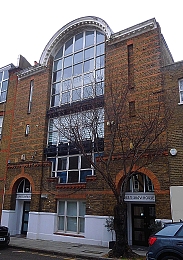
CAMPDEN STREET IN Kensington is a short thoroughfare running between Kensington Church Street and Campden Hill Road. On it, there is a distinctive building called Byam Shaw House. Until 1990, this edifice with its large centrally placed, north facing window was the Byam Shaw School of Art, which opened in 1910. Named at first as ‘Byam Shaw and Vicat Cole School of Art’, after its founders, Rex Vicat Cole (1870-1940) and John Liston Byam Shaw (1872-1919), it soon became known as the Byam Shaw school.

John Liston Byam Shaw is also known as ‘Byam Shaw’. He was born in British India, in Madras (now ‘Chennai’), where his father was registrar of the High Court at Madras. In 1878, the Shaws moved back to England, where they lived in Kensington. At an early age, he showed artistic promise and at the advice of the artist John Everett Millais (1829-1896), he entered an art school in London’s St Johns Wood. As he grew older, Byam’s works attracted less interest and he turned to teaching to earn a living. In 1910, he and Cole founded the art school in Campden Street. Sadly, Byam Shaw died during the great influenza epidemic that followed WW1.

The school in Campden Street has produced several significant artists including Winifred Nicholson (first wife of Ben Nicholson), Bernard Dunstan, Yinka Shonibare, Mona Hatoum, as well as stage designers, stained-glass makers, and actors. The inventor James Dyson also studied there. In 1990, the school moved to larger premises in Archway, and in 2003, the school was absorbed into the Central Saint Martins College of Arts and Design. Byam Shaw would have been pleased to know that his school produced such fine alumni.  Guy Burch, who studied at the school between 1981 and 1984, wrote:

“The innovative independent Art School founded in the early 1900s, Byam Shaw had an open studio policy that suited my inability to fit into categories marked ‘painter’ or ‘sculptor’. Most art schools at the time made you choose one or other with cross-media working tending to be discouraged. Their studios allowed you to move between them. I was in the ‘Image Studio’, and worked on collage, painting and mixed media installations.” (http://www.guyburch.co.uk/?p=4358)

I feel it is a shame that the building in Campden Street, which has now become a block of flats, is without any notice commemorating its former use.

RUDYARD KIPLING IN BOMBAY

KIPLING WAS BORN IN BOMBAY

IN 1857, THE YEAR OF THE FIRST INDIAN War of Independence, the British opened the first school of art in Bombay. It was named the ‘JJ SCHOOL OF ART’ after Sir Jamsethjee Jeejeebhoy, who donated much money towards its establishment.

We were very fortunate that a friend arranged a private tour of the campus for us. It began after we had eaten Yemeni food at the Hotel Stars on Chakala Street near Mohammed Ali Road.

We were shown the workshops and studios, many of which were built at the time of the School’s founding. The standard of work done by the students is high. We visited workshops for printing, textile weaving and printing, sculpture, metalwork, and ceramics. The walls of the largest part of the sculpture department are lined with models of great works by both western and Indian classical sculptors. This large room reminded me of images of how the Royal Academy in London looked long ago. Our guide explained that the JJ was modelled on the Royal College of Art in London.

We ended our tour at a building resembling a large English country house built in the Arts and Crafts Movement style of the late 19th century/early 20th century. This rustic looking edifice, which was built by 1865 long before the Movement flourished, used to be the residence for the deans of the School.

In 1865, Lockwood Kipling(1837-1911) and his new bride arrived in Bombay. Lockwood, an artist who created works in wrought iron, had been appointed Professor of Architectural Sculpture at the JJ. Soon after this, he was appointed Principal of the JJ and took up residence in the house already described. It was in this house that his son, the eminent author Rudyard Kipling(1865-1936), was born. The house is currently being restored beautifully.

The JJ also has a noted School of Architecture. This was founded by the British to train Indians to become architectural draughtsmen rather than architects. Their role was to draught the detailed plans of designs for buildings conceived by British architects. Likewise, the original colonial idea behind the JJ was to train Indians to carry out the ideas formulated by British artists. Today, the JJ no longer trains its students to be technicians to execute the plans of others, but educates them to enhance the creative life of India.

Finally, we learnt that many of the great buildings of British Imperial India were designed by architects in Great Britain, who never ever set foot in India. For example, the Deans’ house, where Rudyard Kipling was born, was built from a plan that was originally drawn up in England for a house that was never built in its intended location. Kipling’s birthplace was built from plans for a caretaker’s lodge for the Viceregal residence in Shimla, which never got built.

Now that I have seen where Rudyard Kipling was born, I feel that it is high tome that I read something he wrote!