THE TROUBLE WITH temporary exhibitions is that they come to an end. So, if you miss it, you might never see the same works of art together again. I am very pleased that we just managed to catch a superb exhibition at the White Cube gallery in Bermondsey on its final day (1st of September 2024). Called “About Space”, it is a show of paintings by an artist, of whom I had not come across before: Al Held (1928-2005).
Al Held was born in Brooklyn (NYC). His Jewish family was impoverished during the Great Depression and had to survive on welfare payments. Having served in the US forces during WW2, he was eligible (under the terms of the GI Bill) for financial assistance with his education after the war. He studied painting first in New York City, and then in Paris (France). Over the years, he explored different styles of painting, and after exhibiting at major art museums in the USA, his work began to be shown at prestigious galleries outside the USA.
The paintings on display at the White Cube date from the 1960s onwards. Many of them are huge, dwarfing the viewers. A few are smaller. All of them are visually spectacular. Although two-dimensional, they depict complex three-dimensional abstract imaginary constructions. Viewing these amazing compositions is like looking through a huge window at the kind of fantastical geometric abstracted landscapes that might now be produced by digital means. As the title of the exhibition implies, Held’s paintings are literally about space. Painted with precision, these compositions explode with energy.
I am glad that we did not miss the exciting experience of seeing these paintings created by a man, who had shown no interest in art until he left the US Navy in 1947. It was his friend the artist Nicholas Krushenick (1929 – 1999), who inspired him to take up art, and I am very pleased that he did.
THE MUSEUM OF ART and Photography (‘MAP’) on Kasturba Road is a relatively new addition to Bangalore’s cultural scene. When it opened in February 2023, we were amongst its first visitors. Privately financed by the Poddar family, it is housed in a recently constructed edifice. I prefer the appearance of its interior to that of its exterior.
MAP describes itself as a museum of art and photography. The institution is home to a large collection of photographs created over the many years since the technique was invented. Much photography is in my opinion also art. However, the present exhibition at MAP, which is on until the 24th of March 2024, combines a traditional art form – painting – with photography. The show is called “What the camera didn’t see”.
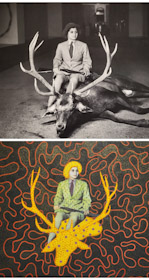
The British born artist Alexander Gorlizki (born 1967) , who holds a higher degree from the Slade School of Art (at University College London) and now works in NYC, has teamed up with Pink City Studio – a group of miniaturist painters in Jaipur – to present historic photographs in a new light.
The exhibition at MAP consists of several old photographs from the museum’s collection and new reproductions or prints of these vintage images. Gorlizki and his colleagues have taken the reproductions and painted over them in the traditional Mughal miniature style, but leaving faces in the photographs uncovered by paint.
The resulting ‘doctored’ photographs are mostly quite whimsical and witty. The highly imaginative ideas of the artists are skilfully and beautifully superimposed on the reproductions of the old photographs. Thus, the art of the original photographers has been metamorphosed by contemporary painters in Jaipur in collaboration with their curator, Alexander Gorlizki. The results, which are on display at MAP, are both amusing and most pleasing aesthetically . This is an exhibition well worth seeing.
YESTERDAY, WE ADMIRED paintings created by the Great Masters of European art, which hang on the walls of the rooms of 18th century Kenwood House in north London. Today, the 12th of April 2023, we enjoyed artworks of a completely different nature within the almost spartan spaces of the White Cube Gallery in Bermondsey Street. Currently, three artists’ works are on display. Three areas in the gallery are dedicated to one of them – Marguerite Humeau. She was born in 1986 in France, and received her MA from the Royal College of Art in London – the city in which she now lives and works.
Humeau creates works in a wide variety of materials. She also makes video art, one example of which was on show in the smallest of the three spaces. A larger room contained panels made with one or more ceramic tiles. The glazed surfaces of these tiles are not flat but contain hand-sculpted three-dimensional features including textural variations and curvy striations, which protrude from the flattish background surface.
The largest room of the show must be seen to believed. Entering is like setting foot on an alien planet inhabited by weird organic shapes that suggested to me plants, fungi, and insects, but all of them greatly magnified. These shapes are sculptures created by Humeau. Some of them were emitting musical sounds. I found the sculptures both intriguing because of their allusions to biological structures and also quite satisfying visually. As to what led to their creation, the gallery’s website (https://whitecube.com/artists/artist/Marguerite_Humeau) explained: “The artist was inspired by eusocial insects such as ants, termites and bees, whose complex cooperative societies enable them to build huge structures and to cultivate other organisms in symbiotic relationships. Reflecting on the ants shepherding their aphids and the termites tending their fungus gardens, Humeau found an equivalent in the place yeast has assumed in human societies, as the essential ingredient of bread and beer around which our human collective has gathered. Contemplating the probability of our imminent, self-inflicted extinction as a species, Humeau sees insect societies as both the inheritors of our ravaged environment, and a prompt to consider how interdependence and cooperation might offer a means to avert our fate.” Fair enough; but even if the works are portents of a gloomy future, my spirits were uplifted by seeing them. The exhibition continues until the 14th of May 2023. If you plan to visit it, save a bit of time for the interesting and attractive, abstract paintings and sculptures by Samuel Ross (born 1991 in London), which are on show in another of the gallery’s spaces.
The thing that amazes me is that even though the paintings by the Great Masters, who painted many centuries ago and which we saw 24 hours ago at Kenwood are immensely satisfying visually, seeing the artworks by Marguerite Humeau today was an equally enjoyable experience. I wonder what it is that happens in the brain to produce the same amount of enjoyment from seeing such widely differing artistic creations.
DESCRIBED AS THE FIRST living artist to have had a retrospective exhibition in the Soviet Union, the American painter Alice Neel (1900-1984), there is a superb exhibition of her art at the Barbican Centre in the City of London until the 21st of May 2023. Alice, who was born in a small town in Pennsylvania, led a colourful life – and by this, I am not referring only to her paintings. Politically, she was leftward leaning. In 1935, she joined the US Communist Party and remained a member throughout the McCarthy era and after it. She participated actively in anti-fascist activity before WW2. Some of the portraits she painted were of Marxists and members of the US Communist Party. Maybe, it was this political activity that got her, her family, and her paintings invited to Moscow in 1981. She was a Communist but objected to the bureaucracy associated with the Party. In late life, when she was asked about her political views, she replied that she was “an anarchic humanist.”
During the Great Depression that hit the USA in 1929, President Franklin Delaney Roosevelt initiated the New Deal programme to deal with the unemployment crisis. In 1933, as part of this the Public Works Art Project was set up, and Alice joined it immediately. She was paid US $26.88 per week to produce a painting every six weeks. Her works done for this organisation and its successor, the Federal Art Project of the Works Progress Association, depicted urban scenes of adversity and social injustices. These paintings were her own brand of Socialist realism. I liked what was on display.
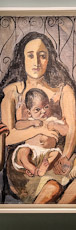
Alice remained a figurative artist throughout her life and throughout the period when most of her fellow American artists were moving away from the figurative and increasingly towards the abstract. The highlights of the exhibition are her portraits, some of them of subjects who have removed their clothing. In all of her portraits, she gets beneath her subjects’ clothing or external appearance and portrays not what a conventional portraitist depicts, but the personalities of her subjects as she understood them. The results were not always liked by her subjects, but the viewer can get much more of an idea of what the people would have been like had we been lucky enough to meet them. Like the Victorian photographer Julia Margaret Cameron (1815-1879), Alice’s portraits are not a slavish reproductions of nature but a wonderful attempt to portray what lies beneath the surface – the subject’s soul and character. She once said:
“As for people who want flattering pictures of themselves, even if I wanted to do them, I wouldn’t know what flattery is. To me, as Keats said, beauty is truth, truth beauty … I paint to reveal the struggle, tragedy, and joy of life.”
Included at the Barbican’s exhibition, there is a documentary film about Alice made by Nancy Baer. Alice was filmed in various situations, and comes across as a delightful person. Some of the scenes in the documentary show her at work on a portrait. What impressed me when watching these scenes in her studio was her ability to create straight from life unwaveringly. She looked at her subject and without faltering painted elements of the portrait that did not need adjusting. Her eye-brain-hand coordination looked to be superb.
“…a wall text incorrectly refers to Neel’s 1981 Moscow exhibition as being by the “first living artist to have a retrospective in the Soviet Union,” whereas many artists including Yuri Petrov-Vodkin, Alexander Deyneka, Pablo Picasso and Fernand Leger had exhibited there from the 1930s onwards.”
They may well be right, but whether the artists mentioned were showing a few of their works rather than a retrospective covering their whole output until the date of the exhibition, is a question I cannot answer. In any case, it was no mean achievement to have been both invited to exhibit in Moscow during the Cold War and to have been elected to the American Academy and Institute of Arts and Letters (in 1976).
Once again, I must admit my ignorance: Alice Neel was an artist who was new to me. However, I am pleased that she is now on my radar. I can strongly recommend visiting the exhibition at the Barbican for an exciting visual feast.
UNTIL I WAS SIXTEEN, my parents took me to Florence (Italy) every year, except in 1967 – the year after the city had been devastated by a flood. My parents were crazy about Italy, the Italians, and Italian art. In Florence, we used to view many frescos in churches and palaces and even those removed from their original locations and placed in museums.
Traditional fresco painting was a laborious process, which produced durable images on walls and ceilings. To create a fresco, first a couple of layers of plaster are applied to a surface (wall or ceiling) and allowed to dry. Then, the artist(s) sketch the image that will eventually be created. Next, a part of the sketch is covered with fresh plaster. The extent of this is the area which the artist can paint during one day. While the plaster is damp, the artist paints that section of the picture with water-based coloured paints. As the plaster dries, the paint becomes incorporated within it, producing a surface more durable than if the paint had been painted onto dry plaster. Day by day, section by section, the process is continued until the whole image has been finished.
I mentioned that some frescoes have been moved into museums. The Italians developed a method for doing this. The fresco to be moved is covered with a cloth sheet coated with adhesive, Then the cloth is pulled away from the wall or ceiling. As it is peeled away, it takes with it that layer of the fresco that contains the paint-absorbed layer of plaster. When this layer has been removed, the artist’s sketch becomes revealed. This is of great interest to historians of art, who can learn how the artist developed his final product from his original sketch. This whole process fascinated me when I was a child, and still amazes me.
Most of the great Italian frescos were created many centuries ago, and the process has fallen out of fashion. Well, at least that is what I believed until I visited a lovely exhibition at Tate Britain. On show until the 7th of May 2023, it is a display of works created by Hannah Quinlan (born 1991) and Rosie Hastings (born 1991). They have created six large, colourful images depicting, to quote the Tate’s website:
“…street scenes showing groups of people portraying various power dynamics, class and social relations and positions of authority.”
Attractive and fascinating as these works are, what really intrigued me is the way that they were made. The paintings, which have been created during the last few years, have been executed using traditional fresco technique such as I described above. In an interview recorded on the Tate website, they were asked why they used this archaic technique, and they replied:
“Fresco painting is often found in places of political, legal and educational importance and is executed at a monumental scale. Traditionally, frescos depict scenes loaded with ideology and symbolism while presenting themselves as neutral or universal. A fresco often represents the moral code of the time within which it is painted, intended as an instructional and educational medium that reinforces dominant perceptions.”
I can understand this, and like their reasoning. I enjoyed the exhibition, and encourage others to take a look. Enjoy the frescos, but do not omit to examine the lovely drawing the artists created using graphite.
ONE OF THE MANY JOYS of living in London is the ability to view exhibitions in the city’s commercial galleries, many of which can be found in Mayfair and the West End. These galleries display artworks, which are mainly for sale, or occasionally borrowed from places away from London. The exhibitions are of a temporary nature. Visiting them allows members of the public to view works, which might never be on public view again in London because they will be sold to private collectors, big corporations, or to galleries and museums abroad. When we are in London, my wife and I try to visit several of the commercial galleries at least once a week. At the recommendation of our daughter, whose employment is in the world of art, we paid a visit to Pace Gallery in Hanover Square to see an exhibition that will continue until the 15th of April 2023.
The artist, whose works are being displayed in the spacious modern rooms at Pace, is Gideon Appah. He was born in 1987 in Accra, Ghana. His training as an artist was at the Kwame Nkrumah University of Science and Technology in Ghana. His first major exhibition was in 2022 at the Institute of Contemporary Art at Virginia Commonwealth University in Richmond, Virginia (USA). His paintings have also been exhibited in many other places.
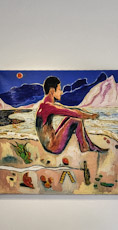
All of Appah’s works on show at Pace are oil and acrylic on canvas. They are all highly colourful and include, with one exception, figures in a variety of landscapes. The figures are positioned in landscapes that have an intensity that makes them look slightly unreal, yet completely compelling. One of the pictures we particularly liked is “Night Vision” which depicts a brightly lit town on a hill at night reflected on a sea of still water. The leaflet issued by the gallery describes Appah’s work as “dreamlike”, and this was also my opinion. On the whole, the dreamy nature of the works is quite distinct from that seen in the works of the great Surrealists of yesteryear. Appah portrays his scenes with the clarity and strangeness that I associate with the dreams I experience. His works are intriguingly eery, but not scary. If you can get to Pace, do so to enjoy the well-executed and fascinating works by this artist from Accra.
ASPINWALL HOUSE IN Fort Kochi is the epicentre and largest exhibition space of the Kochi Muziris Art Biennale. We have attended this event four times to date – 2014, 2016, 2018, and 2022. Outside the main entrance to Aspinwall House, there is a list of those companies, organisations, and individuals, who have donated money to the Biennale. The current (2022/23) list has the following heading “Principle supporters”. Is this wording an undetected typographical error, or is it intentional, or is it a Freudian slip? I ask this question because the sentiments expressed in many of the exhibits question the consequences of the activities of some of the donors.
Far too many of the exhibits in Aspinwall House are more like well-made documentaries than what has until recently been regarded as art. The documentary exhibits are mostly well put together with superb still photography and cinematography, and quite a few of them are highly informative – akin to, for example, National Geographic productions.
The majority of the documentary-like exhibits have elements of political protest, often leftward leaning. Now, I have no objection to political protest in art, but I wonder whether some of these exhibits have strayed too far from what used to be considered art, and have become more documentary than artistic. In the past, to mention but a few, artists such as Picasso, George Grosz, Otto Dix, Joan Miró, Subhi Tagore, Diego Riviera, and currently William Kentridge, have made artworks with political content. These artists and some of their contemporaries produced artworks which are not purely political or polemic, but can also be enjoyed as purely visual experiences; knowing the message is not important to the impact the works make on the viewer, but can add to that. Much of what is on display at Aspinwall House during the current Biennale simply thrusts political messages at the viewer. There is little else to appreciate but often depressing messages and images.
As for the abundance of photography it is mostly superb. Since the invention of photography, it has been used highly creatively by some photographers. Examples of these include Julia Margaret Cameron, Charles Dodgson, László Moholy-Nagy, Ansel Adams, and Alfred Stieglitz. Artists like these were competent photographers who exploited the camera to create original images that would have been difficult if not impossible to produce with other artistic materials. In contrast, many of the beautiful photographic works in the current Biennale seem to be aiming at documentary or archival accuracy rather than creative images – works of ‘pure’ art.
Having blasted at what I did not like about the Biennale, I must point out that there are many artworks that satisfied me purely visually. Some of them are in Aspinwall House, but many of them are elsewhere, notably in the Durbar Hall in Ernakulam. The works that impacted me positively because of their purely aesthetic 7characteristics might also be conveying political sentiments, but the nature of these did not impede my immediate, visceral rather than cerebral enjoyment of them.
Returning to the predominantly documentary exhibits, those that made most impact on me were housed in the TKM warehouse complex in Mattancherry. Some of the works there are not only political or polemical, but also highly creative and artistic (in the old sense of the word).
As for the odd use of “principle” on the list of donors mentioned above, I found this not only careless but ironic. Many of the artworks in the current Biennale question the principles of some of the donors, who funded the show.
Having read this, you can call me ‘old-fashioned’ or ‘politically incorrect ‘ if that makes you feel better. I might well be both, but I was brought up by my artistic parents to appreciate the works of both old masters and contemporary artists equally, be they works by Piero della Francesca or JMW Turner or Brancusi or Barbara Hepworth or Rachel Whitehead or Anish Kapoor.
Visit the Kochi Muziris Art Biennale if you can before it ends in early March 2023, and judge it for yourself. Almost all of the exhibits are housed in heritage buildings, which are alone worth seeing. I look forward to the next show in 2024/25.






 yamey
yamey 