THE ROYAL BOMBAY Yacht Club faces the famous Gateway of India. One side of the club’s compound runs along Adom Street. ‘Adom’ is a transliteration of a transliteration of ‘Adam’.
Adam at Adom Street
According to Samuel T Sheppard’s book “Bombay Place-Names and Street-Names”, the Street is named after the British architect John Adams. He taught architectural drawing at Bombay’s esteemed Sir JJ School of Art.
Adams designed the Royal Yacht Club’s present building that faces the Gateway of India. Although the club was founded in 1846, Adams’s edifice was opened in 1898.
It is appropriate that a Street running next to his building now bears his name, even though on the street ame sign, it is now spelled Adom instead of Adam.
THE ARCHITECT MIMAR SINAN (c1489-1588) was the greatest of Turkish architects. There are many wonderful buildings of all sizes and for a wide variety of purposes designed by him all over Istanbul.
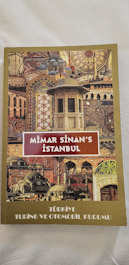
When visiting a tourist information office on the Asian side of Istanbul, I noticed several copies of a book called “Mimar Sinan’s Istanbul”. Beautifully illustrated with a detailed text, I quickly decided that I would love to own a copy. I asked if I could buy a copy. The official said that he could not sell me one because they were for reference only. I asked where they were sold, and was told that I could buy one at the publisher’s bookshop. The book is published by Turing. The discovery of the book occurred on a Friday.
On the following Sunday, we found the Turing shop. It was shut. We went again on Monday, and found a notice stating that it was always closed on Mondays. Tuesday was a public holiday. So, we did not bother going to the shop. On each of our abortive visits, I could see the book on a shelf in the shop, but could not quite see its title.
On Wednesday, the shop was open. We entered it, and discovered that they only stocked the Turkish edition. As it is beautifully illustrated and remarkably cheap given its fine quality, we purchased a copy.
Later that day, my wife Lopa had an ingenious idea. We were not sure whether it would work, but it was worth a try, especially as the tourist office was close to where we wanted to go the next day.
On the following day, we took the ferry to the Asian side, carrying with us the brand new copy of the Turkish edition of the book about Sinan, and returned to the tourist office. Lopa asked the official, who remembered us, whether we could exchange our Turkish book for one of the office’s books in English. Without hesitating, the official said: “Why not. We don’t have a copy in Turkish.”
He handed us a copy of the book in English, and we gave him our Turkish copy. I was very pleased and full of admiration for Lopa’s resourcefulness – especially as it was her birthday.
ALTHOUGH IT IS NEAR where we live, I had never heard of the Cosmic House at 19 Lansdowne Walk near Holland Park. Recently, our daughter went to a special event there and was so impressed by the place that she very kindly gave me admission tickets for my Father’s Day gift.
Cosmic House, initially called ‘Thematic House’, was designed by the American born writer, theorist, and architect Charles Jencks (1939-2019). It is a heavily modified building first erected in the early 1840s. Jencks purchased it in 1978 and had completed most of its many dramatic alterations by 1983. It is a song of praise to Post Modernism. Because Jencks was fascinated by cosmology, the house’s various rooms and other spaces have been designed with cosmological ideas in mind. For me, the most exciting element of this house is the spiral staircase from which all the rooms on various levels can be accessed. Each room contains a riot of decorative motifs. Jencks let his imagination run wild. Some of the rooms, such as the library and the jacuzzi area (inspired by a dome designed by Borromini), are extremely effective. Some of the other rooms, are, as Jencks can be heard admitting in a film we were shown, a bit ‘over the top’.
The shapes of the rooms and the various spaces in Cosmic House show that Jencks was a great architect. However, I felt that they were somewhat disguised by the flamboyant interior décor, which was designed mainly by Jencks. With natural light accessing the building in many ingenious ways and the profusion of objets d’art in many of the rooms, we were reminded a bit of the ‘atmosphere’ of the Sir John Soane Museum in London’s Lincolns Inn Fields.
As a Father’s Day gift, a visit to Cosmic House was certainly original. It is a place worth visiting, possibly on the same day as a visit to another highly original edifice nearby – Leighton House.
THE ARCHITECT SIR John Soane (1753-1837) created what is my favourite museum in London – Sir John Soane’s Museum. Son of a builder, Soane became a successful architect in the reigns of Kings George III and George IV. In 1806, he was elected Professor of Architecture at the Royal Academy. Although he was able to undertake the Grand Tour in Italy and Malta during the period 1778 to 1779, many of his students were unable to do so because of the Napoleonic Wars raging in Europe between 1803 and 1815. This meant that they were deprived of the opportunity of viewing the great works of art and architecture, which was considered an important part of an architect’s training during the Regency Period. However, Soane got around this problem as I will explain.
Between 1792 and about 1812, Soane purchased and then demolished three neighbouring houses on the north side of Lincoln’s Inn Fields. He rebuilt them to his own designs. He continued remodelling their interiors to test out the efficacy of his novel architectural designs. One feature that stands out are his clever ways of getting natural light to reach parts of the buildings that were far from natural light sources. Often skylights are located above tall internal lightwells, which allows light to reach, for example the basement rooms. In addition, carefully placed mirrors assist the distribution of natural light. These clever methods of illumination were important innovations in the era before electricity or gas-lighting.
Soane lived in his houses, had his architectural workshops there, kept a picture gallery, and created a museum. The picture gallery is ingenious. A small square room, lit from above, has some of the pictures arranged in two layers, one covering the other. The wall carrying the outer layers of pictures is in fact a huge, hinged door, which can be opened to reveal the pictures on the layer it covers (see the photo above). By this method, Soane created much more hanging area within the room. The pictures and drawings include many by Hogarth and Piranesi, and at least one by Canaletto. There is also a pair depicting Soane and his wife. Other pictures depict buildings designed by Soane as well as projects that he planned but were never fulfilled. To squeeze so many large artworks into such a small room, where they can be viewed comfortably, is a work of genius.
Soane, who was a successful architect and married the daughter of a wealthy builder, was not short of cash. He spent some of it on purchasing a huge variety and a great number of antiques including the Sarcophagus of Seti (Egypt, c 900BC). The sarcophagus had lain in front of the British Museum for two years before he was able to purchase it from the man who owned it. It had been offered to the British Museum, which declined to purchase it for £2000. So, Soane bought it, and it is the most important exhibit in his museum. The other antiques include Ancient Greek and Roman as well as mediaeval and renaissance artefacts. Soane put much effort into arranging his collection and established it as a museum. In 1833, he managed to get a Private Act of Parliament passed. This enshrined in law that after his death, number 13 Lincoln’s Inn Fields (the museum) should be preserved in perpetuity in the state he left it. And this has been done faithfully, but with careful restoration when necessary.
One of the purposes of Soane’s Museum was to allow his architectural students to view and study the sort of things that would have been able to see had the Napoleonic Wars not prevented them from undertaking their own Grand Tour. A visit to the curiously cluttered museum is fascinating and wondrous. The staff and volunteers that keep an eye on the various rooms and chambers in the museum are well-informed and provide interesting information.
MY FRIEND MICHAEL Jacobs (1952-2014) studied history of art at A Level (university entrance examinations) and then later at university. Later, he became a prolific author. When we were in our late teens, we used to visit Hampstead’s second-hand bookshops together. A few days ago (early September 2022), I was walking along Marylebone’s New Cavendish Street when I spotted something that reminded me of one of our bookshop visits in the late 1960s.
There is a building on the northeast corner of New Cavendish Street and Wimpole Street, which caught my eye. As I passed it, I spotted a small plaque giving the architect’s details. It reads: “BANISTER FLETCHER & SONS ARCHITECTS AD 1912” Sir Banister Flight Fletcher (1866-1953) trained at London’s Kings College, University College, the Royal College of Art, the Architectural Association, and Paris’s École des Beaux-Arts. In 1889, he became a partner in the architectural firm founded by his father: Banister Fletcher & Sons. In addition to designing buildings, Banister Fletcher (and his father) wrote a book of great importance.
The book, “A History of Architecture on the Comparative Method”, which was first published in 1896, was republished several times during the 20th century. It was the standard reference work in English on the history of architecture.
Seeing the name Banister Fletcher on the building in Marylebone reminded me of an afternoon in Hampstead during the late 1960s. We were rummaging around the somewhat disorderly collection of books in Francis Norman’s bookshop in Perrins Lane when Michael discovered a copy of Banister Fletcher’s history of architecture, a book that was well-suited for the bookshelf of a student of the history of art. Michael bought it at an extremely reasonable price.
Until I spotted the building on New Cavendish, I had always associated the name Banister Fletcher with that afternoon with Michael in Hampstead. The building I saw is the first example of a structure that I have been able to associate with the author of the history purchased by my late friend.
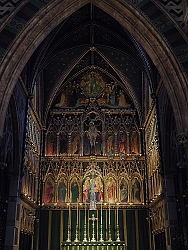
FROM THE OUTSIDE, the church of St Barnabas in Pitshanger Lane (Ealing) is not particularly attractive. Even though we visited it on a Sunday, it was locked up. However, we were fortunate to meet a lady, who had been in the church hall and happened to have the key to the church with her. Kindly, she unlocked the edifice, and we were able to enter. The church’s interior, unlike its exterior, is wonderful.
The church stands close to Brentham Garden Suburb, which was built largely between 1901 and 1915. I will write about the Suburb at a later date, but now I will concentrate on the church. Although the Suburb was built with a magnificent club house, there had been no plans to include a church. In 1907, a temporary church made from corrugated iron sheets, and dedicated to St Barnabas was constructed at the junction of Pitshanger Lane and Castlebar Park. Eventually, it was too small to accommodate its congregation in an area where plenty of housing was being constructed. For legal reasons, it was not possible to build a larger church on the site. So, in 1911 a larger plot was acquired at the corner of Pitshanger Lane and Denison Road (one of the streets within the Garden Suburb).
Ernest Shearman (1859-1939) was the architect chosen to build the larger St Barnabas Church, which can be seen today. After working in Buenos Aires and later at Sandringham, he moved to Winchester in 1907. From that year onwards, his work was mainly concerned with designing churches. According to a book by Hugh Mather about the centenary of the church of St Barnabas, all of Shearman’s churches:
“…are tall imposing buildings without spires, and their austere, simple architecture was designed so that elaborate furnishings and other adornments could be added subsequently …”
His churches represent “… almost the final flowering of the last phase of the Gothic Revival.”
All except one of his churches demonstrate Shearman’s fascination with rose windows and elaborate tracery. St Barnabas is a fine example of this.
The construction of the church began just before the start of WW1, in June 1914. It was completed in the middle of the war by June 1916, when it was consecrated.
The church has a spacious nave, which has a lovely timber ceiling. Although it was designed to reflect the heritage of the gothic era, the inside of the church feels almost contemporary. There is an enormous organ at the west end of the church. Made in 1851, it was made by the company of William Hill and originally housed in St Jude’s Church in Southsea. It was moved to St Barnabas in 2011. Some of the pipes on the south side of the central tall organ pipes do not make sounds. They were added to the organ for purely aesthetic reasons. The current organ replaced an older, less reliable instrument, which was removed in 2010.
The apse is adorned by a large painting by James Clark (1857-1943), who was living in Bedford Park not far from the church when he created it. He was one of many artists residing in Bedford Park, which was an ancestor of the Garden Suburb movement. His painting in the apse depicts the three hierarchies of angels praising and adoring the Holy Trinity. It is a magnificent addition to the church.
As we did not want to delay the lady who opened the church for us, we did not have sufficient time to examine its interior in great detail, but it did demonstrate how wrong it was to, to rephrase a well-known saying, to judge a church by its cover.
WHEN THE BANKER Sir Francis Child (1642-1713) acquired Osterley Park in the 18th century, its Elizabethan manor house was in a poor state of repair. His grandsons, Francis and Robert, employed the famous architect, Robert Adam (1728-1792) to give the house a major ‘makeover’ including adding a grandiose neo-classical front portico. And that is what he did on a grand scale. Adam was no ordinary architect. Not only did he plan buildings (and modifications to them), but he also designed their interiors: everything from ceilings and wall decorations to furniture and doorhandles. Osterley Park offers a magnificent display of his wide-ranging skills.
Long gallery at Osterley Park
The visitor to Osterley Park, now managed by the National Trust, usually gets to see a series of wonderful rooms on the ground floor of the house. All the rooms except one have beautifully decorated ceilings, all designed by Adam. Some of them have paintings created by Adam’s favourite painter, the Venetian Antonio Zucchi (1726-1795). Amongst my favourite ceilings are those in the Etruscan Dressing Room and the Drawing Room. The latter has a fantastic ceiling that was inspired by drawings in “The Ruins of Palmyra otherwise Tedmor in the Desert” by James Dawkin and Robert Wood (published in 1753).The ruins were those that were recently badly vandalised by the IS group. In each of the rooms, except the long gallery, the visitor’s attention is dominated by the eye-catching ceilings.
The ceiling of the long gallery is devoid of decoration. It was in this room that the Child family’s collection of fine paintings used to be displayed. The gallery’s ceiling was left plain, without decoration, deliberately, so that the viewer’s attention would be concentrated on the paintings. Sadly, the paintings are no more. After WW2, the house’s owner, George Francis Child-Villiers, 9th Earl of Jersey (1910 -1998) gave the house and its grounds to the National Trust. He moved to Jersey, taking with him most of the paintings that had hung at Osterley. Unfortunately, many of these works were destroyed in a warehouse fire soon after he donated the house. The artworks in the gallery have since been replaced with other paintings and because the ceiling is naked, you can give them your full attention.
SADLY, THE CHARTERHOUSE was closed to the public when I walked through London’s Charterhouse Square on a Monday in July. As I walked clockwise around the grassy space in the middle of the (not so square) square, I spotted a building with a curvy brick façade with windows, many of which have both curved steel frames and glass panes.
The building, a block of flats which has Art Deco features, is called Florin Court. Although it looks recently built, it was constructed in 1936. It was designed by Guy Morgan (1903-1987) and Partners. Morgan had worked with the better-known architect Edwin Lutyens until 1927. Two years earlier, Morgan and Partners designed another block of Art Deco style flats in Highgate Village: Cholmeley Lodge. Although I was unable to enter Florin Court, I have read (on Wikipedia) that it contains 120 flats; it has a communal library, roof garden as well as a basement swimming pool. The reason that the structure looks so new is that it underwent extensive restoration work in 2013.
“Best known as ‘Whitehaven Mansions’, its exterior used as the residence of Hercule Poirot in the television adaptations of Agatha Christie’s novels.”
I have never watched this television show, but I am pleased that I stumbled upon this lovely example of Art Deco architecture in the heart of one of the older areas of the City of London.
MANY YEARS AGO, I read “The Gothic Revival” by the art historian Kenneth Clark (1903-1983). If I recall correctly, he wrote that it was likely that in Britain, the gothic style never truly died out before it came back into fashion in the 18th century. What we call ‘revival’ was merely the flaring up of the embers of the use of gothic designs, which had persisted despite the flowering of newer forms of architecture, such as neo-classicism. By the 19th century, the use of gothic motifs and structural features had fully revived, especially in the construction of churches and many other buildings, such as London’s St Pancras Station and the Prudential Building (near Chancery Lane).
Today, the 22nd of February 2022, I revisited a slightly concealed church, All Saints, in Margaret Street, which runs north of Oxford Street and parallel to it. You can see its tall, tiled spire from afar, but the church itself is set back from the street in a courtyard. Externally, with its multi-coloured patterned brickwork it is eye-catching but inside it is fantastic.
The church was established by the Ecclesiological Society, which was founded in 1839 as ‘The Cambridge Camden Society”. The group’s aim was:
“… announced a plan to build a ‘Model Church on a large and splendid scale’ which would embody important tenets of the Society: It must be in the Gothic style of the late 13th and early 14th centuries; It must be honestly built of solid materials; Its ornament should decorate its construction; Its artist should be ‘a single, pious and laborious artist alone, pondering deeply over his duty to do his best for the service of God’s Holy Religion’ Above all the church must be built so that the ‘Rubricks and Canons of the Church of England may be consistently observed, and the Sacraments rubrically and decently administered’.”
The architect chosen was William Butterfield (1814-1900), who specialised in the ‘gothic revival’ style. The church was built on the site of a former chapel, and within the confined space available, it was accompanied by a choir school and a clergy house. The church’s spire, 227 feet high, is taller than the towers of Westminster Abbey.
The Victorian writer and art critic John Ruskin (1819-1900) was full of praise for Butterfield’s edifice in Margaret Street. He wrote about it in his “The Stones of Venice, Volume III” (published 1853), observing that it:
“…assuredly decides one question conclusively, that of our present capability of Gothic design. It is the first piece of architecture I have seen, built in modern days, which is free from all signs of timidity or incapacity. In general proportion of parts, in refinement and piquancy of mouldings, above all, in force, vitality, and grace of floral ornament, worked in a broad and masculine manner, it challenges fearless comparison with the noblest work of any time. Having done this, we may do anything; there need be no limits to our hope or our confidence; and I believe it to be possible for us, not only to equal, but far to surpass, in some respects, any Gothic yet seen in Northern countries.”
That was praise indeed.
The interior of All Saints is a riot of colour. This results from the use of stones of differing hues – some inlaid to create bold patterns and others to form images of biblical scenes, glorious stained glass, gilt work, and elaborate ironwork. This feast for the eyes must be seen to be believed. And this gem of Victorian architecture, a peaceful have and a joy to see, is merely a stone’s throw from the hustle and bustle of Oxford Circus.





 yamey
yamey 