Time pass and embroidery in a Tudor setting

THE ILL-FATED MARY Queen of Scots was kept prisoner by her relative Queen Elizabeth the First. Mary spent many years of her captivity under the supervision of the Earl of Shrewsbury, who was the fourth husband of Bess of Hardwick.


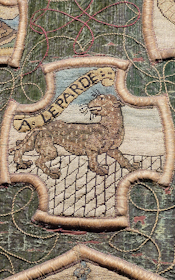
Between 1569 and 1584, Mary and Bess passed the time by working on embroideries, creating embroidered panels. Many of these bear depictions of animals copied from illustrations in a book by the Swiss naturalist Conrad Gessner and another by the Italian doctor and naturalist Pietro Andrea Mattioli. These books had been published a few year before 1569.


A woman who married a former owner of Oxburgh in Norfolk brought the embroidered panels to Oxburgh Hall, a moated Tudor edifice,  in 1761 at the time of her marriage. It is not known how they had come into her possession. Now they are now on display to the public in Oxburgh Hall . These well-preserved beautiful embroideries are mounted on panels. They provide some evidence of how Mary spent some of her time in her years of captivity.

PS Mary was never held at Oxburgh.

Tassels attached to trucks on the highway

 THE ROAD FROM Jodhpur to Jaisalmer is called a highway and tolls are levied along the way. In fact, most of the way it is a two-lane road without a central divider. The country through which we travelled from Jodhpur to Jaisalmer is for the most part as flat as a pancake The sandy landscape contains many trees and succulent plant bushes.  As one gets further and further away from Jodhpur,  villages and settlements become few and far between. Apart from agriculture,  there is no other industry.  However, as you get closer to Jaisalmer,  the countryside becomes filled with wind turbines and electricity pylons.


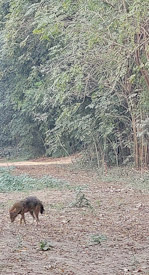
Although we did not encounter much traffic, we did meet a variety of animals using the roads: cattle, goats, sheep, horses, peacocks, and camels. Drivers are careful to avoid hitting them, often crossing over to the wrong side of the road to bypass them.


We stopped for a light lunch (vegetarian) at an isolated, small, unpretentious wayside eatery (a ‘dhaba’). The menu was in Hindi script only, and the waiter asked my wife to write down (in Hindi) the items we wanted. In addition to us, there was a family from Assam eating in the dhaba. The stuffed parathas we ate were well made and the buttermilk was refreshing.


Most of the trucks we saw on our way had tassels attached. Often, they are black, as we have seen all over India during past travels. However  some of the trucks we saw in Rajasthan sported coloured tassels, hanging from the rear. Those readers unfamiliar with India might be curious about the purpose of these usually unattractive tassels. In my book “CORACLES AND CROCODILES: 101 TALES OF INDIA”, I have written about these tassels, which flutter in the wind as the truck speeds along the highway.


Even if the scenery is not spectacular,  I  enjoy travelling by road in India. All along the way, there are scenes of rural life to be seen. For example, today we passed through a village in which piles of red chillies were out drying alongside the roadway. And often the country folk can be seen going about their daily routines dressed in traditional garb, whose design is centuries old. These fleeting glimpses of rural life enhance my enjoyment of India.

[The book mentioned above is available from Amazon: https://www.amazon.com/CORACLES-CROCODILES-101-TALES-INDIA/dp/B0DJZ6DMYB ]

They had no choice

ARMISTICE DAY IS celebrated annually on the 11th of November, the day that fighting came to an end in WW1. The day is to celebrate and:

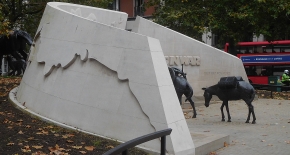
“…remember all those who gave their lives in service to their country since 1914.” (https://www.britishlegion.org.uk/get-involved/remembrance/about-remembrance/armistice-day). It was not only humans who sacrificed their lives, either willingly or less willingly, but also animals, who had been employed in warfare. A monument on a wide traffic island in London’s Park Lane was constructed to remember these four-legged creatures who lost their lives prematurely during battles from which they were unlikely to gain any benefit.

Erected by The Animals in War Memorial Fund (www.animalsinwar.org.uk/) and unveiled in 2004, this dramatic monument consists of a semi-circular Portland stone wall with a gap near its centre. Two bronze horses laden with military equipment are depicted walking towards the gap. and beyond the gap, a bronze sculpture of a running dog can be seen. The western part of the concave side of the wall has bas-reliefs depicting, horses, elephants, and camels. The eastern side of the concavity bears several inscriptions including one with the words “They had no choice”. The convex surface of the wall bears stylised silhouettes of horses. The monument was designed by David Backhouse and was inspired by the book “Animals in War” by Jilly Cooper.

“They had no choice” is a poignantly appropriate sentence on a memorial to creatures who were taken into fields of battle innocent of their likely fate. Seeing this moving monument made me think that these same four words could easily be applied to the numerous Indian participants in WW1 and WW2 who were sent to Europe as ‘volunteers’ innocent of their horrendous destination by their rulers in the Princely States of India, who wished to please the British, whom they served. Had these unfortunate servicemen known what they were about to face, some of them might have objected. That option was not one that would ever been open to the slaughtered animals commemorated on Park Lane.

Three hares sharing only three ears

There is a lovely parish church in Long Melford, Suffolk. Called Holy Trinity Church, it is a fine example of the perpendicular gothic style, completed in about 1484. Some of its windows contain old pre-Reformation stained-glass. A tiny circular piece of stained-glass above the north door of the nave depicts something unusual. It is hard to see with the unaided eye, but if you can manage to see it properly, you will notice something interesting. Known as the Hare Window, it depicts the heads of three hares and three hare’s ears. Each hare appears to have the usual two ears, but each of the three ears on the glass are shared by a pair of hares.

Although unusual, the three hare motif is not unique to Long Melford. Another example, a ceiling boss with three hares sharing three ears can be found in the Chapter House of the Church of St Peter and St Paul in Wissembourg, France, and another on a bell at Kloster Haina near Kassel in Germany (http://www.chrischapmanphotography.co.uk/hares/page3.htm)

A small zoo in north London

EVERY VISIT TO GOLDERS Hill Park in northwest London gives me great pleasure. Now officially part of Hampstead Heath, it contains a lovely feature, its small zoo. This consists of a large paddock containing deer and sometimes a rhea. Close to this, is a series of cages, an aviary, containing exotic birdlife including a laughing kookaburra. These are located next to an enclosure that contains a small group of ring-tailed lemurs. The lemurs’ neighbours are several wallabies and a couple of donkeys, named Sienna and Calypso. The wallabies and the donkeys have a long rectangular sloping field in which to wander.

I have written about the park and the zoo before, and published it elsewhere (https://adam-yamey-writes.com/2020/11/19/walking-past-wallabies/). When I wrote that piece, I did not explore the small zoo’s history. It was certainly present well over 60 years ago, when I was less than ten years old. As a small boy, I remember seeing wallabies and flamingos. More recently, the flamingos have disappeared and have been replaced by ibis and various other exotic fowl. Before my time, the flamingos used to reside in the duck pond next to the park’s walled garden (https://londongardenstrust.org/conservation/inventory/site-record/?ID=BAR027).

The zoo’s history is difficult to ascertain. After searching the Google entries relating to the park and its history, I found only one reference that alludes to the presence of the zoo prior to WW2. This consists of a recording of an interview (https://sounds.bl.uk/Oral-history/Science/021M-C1379X0029XX-0001V0) with the scientist Sir Anthony Seymour Laughton (1927-2019), an oceanographer. Laughton was born in Golders Green, began his education in Hampstead at Heysham School, a ‘dame school’ (private elementary school) in Branch Hill, and moved to Gerrards Cross during WW2 (https://royalsocietypublishing.org/doi/10.1098/rsbm.2020.0021). As a young child, Laughton lived in one of the small roads that lead of North End Road and back on to Golders Hill Park. He and his brother were often taken to Golders Hill Park where he remembered that there was a small zoo with wallabies. This would have been before 1939, when he and his family moved out of London. So, we can conclude that the zoo was in existence before WW2.

According to Pam Fox, author of “The Jewish Community of Golders Green”, Golders Hill Park was popular with local Jewish families, who went:

“Golders Hill Park on Sundays to watch the peacocks strutting around the grounds of Golders Hill House.”

The House was destroyed in 1941. Laughton did not mention these in his interview and, sadly, there are none to be seen today.

To discover whether the little zoo existed before Laughton’s childhood, that is prior to 1927, I looked at a detailed map, surveyed in 1912. This was after the park was opened to the public by the London County Council in 1899, making it the first public park to have been opened in what was then the Borough of Hendon (now incorporated into the Borough of Barnet). I compared what was on that map with what is on modern maps and found that the park’s layout has not changed much since 1912. The bandstand that you can see today is where there was one back in 1912. Where there is the deer enclosure today, there was a similarly shaped and located fenced field in 1912. The same is the case for the long narrow field where you can see the wallabies and donkeys today. The 1912 map does not show any buildings where the aviary is located today, but apart from that the pattern of land enclosures in the part of the park where animals and birds are kept enclosed today is remarkably similar. The question is, and I cannot answer it, was what is now a deer enclosure, then a deer or other animal enclosure? Here is another as yet unanswerable question: did the long rectangular field where the wallabies live today enclose animals for viewing by the public as long ag as in 1912?

Prior to becoming a public park, Golders Hill Park was the gardens of the now long-since demolished Golders Hill House, built in the 1760s for the merchant Charles Dingley (1711-1769), who traded with Russia (www.leeandstort.co.uk/Stort%20History/Charles%20DINGLEY%20Biography.pdf). I have not found any references to any collections of birds and animals in Golders Hill Park prior to the childhood of Laughton, the oceanographer. It is possible that the merchant Charles Dingley or later owners of the property might have kept deer and even exotic creatures, but there is no evidence to confirm or deny this.

What is important, is that the little zoo, which I remember from the 1950s, is still thriving today and providing enjoyment for children of all ages. Whether the various creatures ‘enjoy’ being caged-up and gawped at is a question I cannot begin to answer.

Walking past wallabies

FILTHY SLIPPERY MUD deterred us from exploring a section of the path running beside a stretch of Dollis Brook in north London. After abandoning our attempts to negotiate this slippery, squelchy, wet path, we decided to visit Golders Hill Park, one of our favourite open spaces in north west London. I have been visiting this park since I was a small child, for over six decades. Formerly, the park was the grounds of a mansion, built for Charles Dingley (1711-1769), long since demolished (see: https://adamyamey.co.uk/waugh-and-pitt-hampstead-north-end/).

We sat on a bench near to the North End Road entrance to the park, which is close to where the demolished mansion once stood. From our bench, we had a fine view of the gardens, lawns, and mature trees, sloping away from us. It is a view that reminded us of the landscaped gardens that sweep away from fine mansions such as can be seen at Compton Verney (in Warwickshire), Osterley Park, and Kenwood House. I mention Kenwood House in particular because the man who had a hand in landscaping its grounds, Humphrey Repton (1752-1815), was also involved in the design of the gardens, now park, of the former mansion at Golders Hill.

We walked around the park, first passing a deserted bandstand. Soon, we arrived in the part of the park, which I loved as a child and still enjoy as I approach my ‘second childhood’. It is a small zoo. Although many would question whether animals are happy to be confined to cages, these creatures provide much pleasure to city dwellers. There is a vast field that contains various types of deer and occasionally a rhea, which looks like a kind of ostrich. Most of the other enclosures in this small zoo are smaller than the deer enclosure.

An enclosure, which used to house flamingos when I was a child, contains a variety of exotic waterfowl including some with long, slender curling beaks. Close to this, there is a larger enclosure in which three or four ring-tailed lemurs pass the time of day.

Another large enclosure, slightly smaller than that where the deer spend their time, contains what for me is the highlight of the zoo. These creatures, which intrigue me, are wallabies. They are Bennett’s (red necked) wallabies (Macropus rufogriseus). If you wish to see these in their natural habitat, you will need to fly to western Australia or Tasmania. I have not yet discovered when these cute looking creatures from ‘down-under’ first began to be displayed in the park, but they have been present in Golders Hill Park ever since I can remember, and that includes the late 1950s. A sign attached to the fence around the area in which the wallabies live describes the antipodean creatures as ‘The Golders Hill Mob’.

During our latest visit today, the 10th of October 2020, we saw a creature we had never noticed before. It was a bird of prey, a Laughing Kookaburra (Dacelo novaguinea), which like the wallabies, is a native of Australasia. According to the notice attached to its cage, this handsome bird uses its beak to kill its prey by hitting it against a hard surface. Well, you learn something new every day.

As mentioned already, Golders Hill Park is amongst our favourite open spaces in London. In my early childhood, I remember being taken to the park and passing the public tennis courts where my parents played occasionally. Seeing the park, its lovely trees, its tiny zoo, and the tennis courts, was as usual an enjoyable experience. It was a good place to remember my parents with great fondness. One of them died forty years ago, and the other quite recently at the ripe old age of one hundred and one years.

Pig on the roof

THE FRENCH COMPOSER Darius Milhaud (1892-1974) composed the music for a surrealist ballet, “Le Boeuf sur la Toit” (i.e. ‘The Ox on the Roof’) which had its premiere in February 1920 in Paris. Today, the 4th of September 2020, I saw a pig on a roof and on other roofs I saw birds and dogs. None of them moved a muscle. They just sat or stood where they were without moving. No, I have not been taking hallucinatory drugs or daydreaming. These creatures are made of straw and sit on the ridges of thatched roofs in country villages north of London including Abbington Piggot in Cambridgeshire. On previous occasions I spotted these straw animals on the ridges of roofs in Suffolk villages including Stoke by Clare.

In many parts of England, thatchers, proud of their skills, sometimes add decorative straw creatures as finishing touches to their fine handiwork. These ornaments are variously known as ‘dollies’ (not to be confused with ‘straw dollies’) and ‘straw finials’. Many contemporary thatchers are still willing to add a straw finial to a thatched roof.

There are records of sightings of straw ornaments such as I have described dating back to 1689. The use of thatching probably goes back many thousands of years. However, because of its organic composition, thatch does not usually survive long enough to be detected by archaeologists. The remains of some buildings found on archaeological sites have structural features that are strongly suggestive of their suitability to support thatched roofing. Thatching is not confined to the British Isles. It can be found almost all over the globe.

Thatch, being made of straw and other related material does not last forever. It has to be replaced periodically. The same is true of the straw finials. They look great when they are relatively new, but like the thatch, they decay gradually and become deformed. In one village that we visited today, we saw what looked like a squirrel perching on the ridge of a thatched roof. On closer examination, what we were looking at turned out to be the tattered remnants of what might once have been a fine straw animal.

We saw the straw pig on a roof in Abbington Piggott. Having seen this and having had a drink in the village’s pub, the Pig and Abbott, I wondered if the place’s name had anything to do with pigs. The Domesday Book of 1086 list the village as ‘Abintone’, which means ‘estate associated with a man called Abba’. The village became known by its present name by the 17th century, the name being taken from the Pykot or Pigott family who owned the manor between the 15th and 19th centuries. And, just in case you are wondering whether the surname Pigott has anything to do with swine, it does not. It is derived from the Old English word ‘pic’ meaning a hill topped with a sharp point.

We would never have discovered the village of Abbington Piggott had we not been advised by our cousins in Baldock (Hertfordshire) to visit nearby Ashwell, a very attractive village. It was in Ashwell, where there was only one pub open (and it did not serve food), that we were advised that we should continue to Abbington Piggott where we found the welcoming Pig and Abbott as well as the pig on the roof.

You can listen to “Le Boeuf sur la toit”  by Darius Milhaud on: https://youtu.be/Bv9ii_uc2Rc

Diana and the deer

LIKE AN ORIENTAL PASHA with his harem, a large stag with huge branching antlers sat in the shade of a big tree on a warm September afternoon in Bushy Park. Five female deer sat close by, all of them looking at him attentively.

Bushy Park abuts the grounds of Hampton Court Palace, which was built in 1515 for Henry VIII’s former favourite, Cardinal Wolsely, who died in disgrace in 1530 after losing the king’s favour. The area where the Park stands has known human usage since the Bronze Age, maybe as long ago as 4000 years. In mediaeval times, the area was used for agricultural activities.

In 1529, when Henry VIII took over Hampton Court from Cardinal Wolsely, Bushy Park became used for deer hunting. Later, in the 17th century, King Charles I (reigned 1625-1649) ordered the building of a canal, the Longford River, which carries water for 12 miles from the River Colne (a tributary of the Thames) to the grounds of Hampton Court Palace. The man-made waterway, designed by Nicholas Lane (1585-1644) and dug by hand in only 9 months in 1638-39, flows through Bushy Park, supplying water to its numerous water features. The water was drawn from the river Colne at a point (Longford near Slough) whose altitude (72 feet above sea level) was great enough to ensure a fast flow to Hampton Court Palace, which is only about 13 feet above sea level. Today, the water still flows rapidly through the Park’s numerous streams.  Later, the architect of the current St Pauls Cathedral, Sir Christopher Wren (1632-1723), designed the mile-long avenue (Chestnut Avenue), which runs through the Park, and its water feature as a grand approach to Hampton Court Palace.

During the two World Wars, large parts of Bushy Park were used temporarily to grow much-needed food for the British public. Before it became a royal hunting ground, much of the park was common land, accessible to all and sundry. The general public had to wait to have access to this lovely area until the reign of William IV (reigned 1830-1837), who requested that there should be free admission of the public to ‘his’ park. In 1838, when Queen Victoria opened the grounds of Hampton Court to the people, visits to Bushy Park increased. The park’s popularity grew significantly when the railway reached Hampton Court from London in 1849. Today, judging by how difficult it was to find a space in the car park, Bushy Park’s popularity continues to be great.

We entered the park, driving along the Chestnut Avenue. With its tidily arranged rows of trees, it reminded me of an entrance driveway to a French chateau or one of the opening scenes in the film “Last Year in Marienbad”.  Each tree is protected from the park’s deer by its own fence. We drove off the avenue into the car park near the Pheasantry, café with pleasant outdoor tables and chairs, housed in a pleasing contemporarily designed building (built 2014, designed by Mizzi architects, who have been responsible for many attractive kiosks in Kensington Gardens and Hyde Park and other Royal Parks).

After drinking coffee, we took a walk in the park. There are patches of woodland fenced off from the rest of the park, doubtless to prevent deer from entering. The Woodland Gardens have many trees and bushes. The shady area is dotted with ponds, some of them almost covered with waterlilies, and fast flowing, shallow streams. Small bridges cross the streams in this delightful part of the park and many ducks swim in the water.

We left the woodland area to enter the rest of the park. This consists of wide expanses of grassy terrain with isolated, and, also, clumps of trees. These areas allow the visitor to enjoy wide vistas and huge expanses of sky. It does not take long before you spot deer grazing, some of them quite close to visitors enjoying the park. What at first sight looks like a distant leafless tree branch will suddenly begin moving, proving that what you had spotted was not a piece from a tree but the antlers of a stag. Seeing the deer running wild is a joy that adds to the loveliness of the park. We also saw horseriders and cyclists, but these are not as visually interesting as the deer.

After taking a somewhat circuitous but very picturesque route through the park, we arrived at a circular pond, which is near the Hampton Court end of Wren’s Chestnut Avenue. Part of the original design, the avenue skirts the circumference of the pond. As we approached the pond, a solitary heron sitting on its edge, noticed us and then flew elegantly across the pond, less than 3 feet above the water’s surface.  The middle of the pond is occupied by a fountain surmounted by a gold-coloured statue. The stone plinth on which the statue stands has several more metal statues, which are not gilded. These are most probably, but not definitely, works of the Italian Francesco Fanelli (c1590-1653). The tall stone plinth was designed by, amongst others, Nicholas Stone (c1586-1647).

The gilded figure on the top of the fountain depicts Diana, the Roman goddess associated with hunting. This seems like an appropriate statue to stand in what were royal hunting grounds until the 19th century. However, when the French sculptor Hubert Le Sueur (1580-1658) was commissioned by King Charles I to make this statue to adorn the garden of his wife, Queen Henrietta Maria, it stood at London’s Somerset House. There, it stood on a lower pedestal than it does today. Incidentally, Le Sueur’s bronze equestrian statue of King Charles I stands in Trafalgar Square close to the point from which all distances from London are measured. Both Hubert Le Sueur and Francesco Fanelli had had experience working in the Florentine studios established by the Flemish born sculptor Giambologna (1529-1608), who was famous for his bronze statuary.

The Diana statue and the rest of its associated artworks were moved to Hampton Court Palace by Oliver Cromwell during the English Commonwealth (1649-1660). The fountain topped by Diana was moved to its present position during the works carried out to the designs of Sir Christopher Wren. The current plinth was completed in 1713 during the reign of Queen Anne. So, it was not until the 18th century that the goddess of hunting stood amongst the hunters’ prey. Although it is commonly held that the gilded statue represents Diana, some believe that it might depict Arethusa, Proserpina, or Venus. The one person that she does not depict is the late Diana, Princess of Wales.

After the heron had taken flight, we noticed about four black-coloured birds perching on the sculptures on the fountain’s plinth. One of them was on top of Diana’s head. The birds had largeish bodies and long necks that were often in sinuous poses. They resembled cormorants, but none of them had their wings unfolded, which is what these creatures do to dry them.

It was my first visit to Bushy Park, and I hope that many more will follow. I have learnt much about the park whilst researching this essay. Future visits will be enhanced by the knowledge I have acquired. I am grateful that our friends in Richmond have introduced us to yet another part of London that was until recently quite new to me.

Finally, it is useful not to confuse Bushy near Hampton Court with Bushey in Hertfordshire.