A memorial to a lost artist at the Tate Britain art gallery

GRENFELL TOWER IN west London went up in flames on the evening of the 14th of June 2017. At least 72 people died in the conflagration. Amongst those unfortunates was the Gambian-British artistic photographer Khadija Mohammadou Saye (born 1992).

About a month before she died, she met the painter Chris Ofili (born 1968) in Venice (Italy), where they were both exhibiting their works.

In 2023, the Tate commissioned Ofili to create an artwork to decorate the grand north staircase of the Tate Britain. According to the Tate’s website, Ofili:

“…  considered the significance of painting directly onto the walls of a public building and wanted to choose a subject that affected us as a nation. ‘Requiem’ is a dream-like mural, resulting from his poetic reflections.”

Ofili said:

“I wanted to make a work in tribute to Khadija Saye. Remembering the Grenfell Tower fire, I hope that the mural will continue to speak across time to our collective sadness.”

“Requiem” covers three of the staircase’s large walls. On the middle wall, there is a portrait of the artist Khadija Saye. The website explained:

“Artist Khadija Saye is at the centre of an energy force, high up on the middle wall. She represents one of the souls. She holds an andichurai (a Gambian incense pot) to her ear, in a pose taken from her own artwork. This object was precious to Saye, as it belonged to her mother. It symbolises the possibility of transformation through faith, honouring Saye’s dual faith heritage of Christianity and Islam.”

At the top of the stairs, there are panels explaining the wall paintings. There is also one of Ms Saye’s photographs. Called “Andichrai”, it is from a series of photographs she created in the last year of her life. The photograph, which is a visually intriguing artwork, shows a woman holding an andichirai to her ear, It looks as if Ofili used this photograph to create his image of Khadija in his “Requiem” mural.

When I first looked at Ofili’s “Requiem”, I was reminded of the dramatic images of William Blake (1757-1827).  It is a wonderful memorial to an artist, who was cut-off in her prime. I do not know how long “Requiem” will remain on the staircase at the Tate. So, I recommend that you go and see it as soon as possible.

The artists John Mallord Turner and Mark Rothko and abolition of slavery

AFTER BEING DISAPPOINTED by the large temporary exhibition of playful but repetitive works by the artist Sarah Lucas (born 1962) at Tate Britain, we had a coffee and then revisited the rooms containing paintings and sketches by John Mallord Turner (1775-1851). It has been many years since we last viewed these paintings, and seeing them revived our spirits after having had them somewhat lowered by the Lucas exhibition.

One of the Turner galleries contains a particularly fine painting by the American artist Mark Rothko (1903-1970). It hangs amongst a series of Turner’s often unfinished late experiments on canvas. They were mostly items found in Turner’s studio after his death. Without outlines, these almost ethereal paintings are examples of the artist’s experimentation in ways of depicting light and colour. If one did not know when these works were created, one might easily guess that they are the works of an artist working during the age of Impressionism. As an aside, many of Turner’s finished works are extremely impressionistic, and I consider him to be the pioneer of what later became Impressionism, and one of the best creators in this style. These experimental works were displayed at an exhibition in New York City at its Museum of Modern Art in 1966. That year, Rothko remarked:

“This man Turner, he learnt a lot from me”.

The Rothko painting hanging amongst the Turner experiments was created in 1950-52. Later, in 1969, Rothko donated a set of his paintings to the Tate, hoping that they would be hung close to those of Turner. They are not; they are hanging at the Tate Modern.

Moving away from the room in which the Rothko painting is hanging, I came across another Turner painting that interested me, “The Deluge”, which was first exhibited in about 1805. In the bottom right corner, Turner has painted a black-skinned man rescuing a naked white woman. On close examination, the man can be seen to have a chain around his waist. The Tate’s caption to this picture includes the following:

“Painted at a time when the cause for Britain to abolish its enslavement of people of African descent was gaining ground, this detail is significant.”

Some years after it was painted, Turner gave a print of this work to a pro-abolition Member of Parliament.

“The Deluge” is not the only painting by Turner relating to his sympathy for the abolition of slavery. His “The Slave Ship”, first exhibited in 1840, is another powerful example. This painting, now in Boston (Massachusetts), is based on the dreadful incident when, in an attempt to cheat the insurers, the captain of a slave ship, the Zong’, caused 132 slaves to be thrown overboard (in 1781).  Turner had learned about this crime from the anti-slavery activists with whom he associated. Although Turner, a liberal, was sympathetic to the abolition of slavery, he was not totally divorced from the benefits that transatlantic slavery brought to Britain, as was pointed out by Chris Hastings in the “Mail Online” on the 28th of August 2021:

“One of Britain’s greatest painters has fallen victim to woke culture, as art-lovers are being warned not to ‘idolise’ J. M. W. Turner because he once held a single share in a Jamaican business that used slave labour.”

The website of London’s Royal Academy gives more detail:

“It would be fair to assume that Turner’s views were strongly pro-abolition at the time he painted this work. However, scholars have pointed out that earlier in his career he apparently had no qualms about investing in a company that ran a plantation … In 1805 Turner invested £100 to buy a share in a business called Dry Sugar Work. Despite the name, this enterprise was a cattle farm on a Jamaican plantation run on the labour of enslaved people. The business was owned by Stephen Drew, a barrister who bought the estate from William Beckford in 1802. The firm went bust in 1808.”

Some many months ago, we saw a play at the National Theatre, “Rockets and Blue Lights” (written by Winston Pinnock). It concerns an ageing Turner seeking inspiration from a remembered incident like the awful event that took place on the “Zong”. During the play, it was alleged that because of his disgust with the slave trade, Turner gave up using sugar. Whether or not this was the case, I cannot say.

Fascinating as are abolitionist and the Rothko ‘connections’ with JMW Turner, the well-displayed paintings in the Turner galleries are all superb and well worth visiting.

An old Mughal painting in an altered format

THE PADSHAHNAMA WAS created by Abdul Hamid Lahori (and others) and completed in between 1630 and 1637. It is an illustrated history of the reign of the Mughal Emperor Shah Jahan I (1592-1666). In 1799, a copy of this valuable manuscript was sent by Saadat Ali Khan II, the Nawab of Awadh as a gift to the British King George III. This edition has been preserved in the Royal Library at Windsor. It contains 44 intricately painted Mughal miniatures. In 1997, reproductions of the paintings in this version of the Padshahnama were published in a catalogue produced to accompany the precious book as it travelled the world in an international touring exhibition. As with many publications, the illustrations in it are subject to copyright.

One of the paintings in the Windsor Padshahnama depicts the arrival of the gifts for Nadira Banu, the bride of Shah Jehan’s son, the ill-fated Dara Shikoh. They married in 1632, a year after Shah Jehan’s wife – Mumtaz Mahal – died.  The Taj Mahal was built in her honour. This painting has been lent by the Royal Collection to be displayed in a brilliant exhibition, “Beyond the Page – South Asian Miniatures and Britain, 1600 to Now”, which is being held at the M K Gallery in Milton Keynes until the 28th of January 2024. This lovely painting hangs in the first of the gallery’s five rooms.

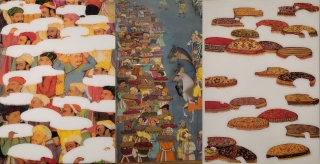
In another room, the viewer will encounter a work by Hamra Abbas (born 1976 in Kuwait). Her artwork consists of four panels. The two central panels are enlarged copies of two pages of the catalogue of the above-mentioned exhibition. One of them is the title page of the catalogue, and to its left is the “all rights reserved” page, which warns the reader that no part of the publication may be reproduced in any way at all.  These two pages are flanked by two images (illegally) reproduced from the images of the original miniature in the catalogue, and then modified.

Ms Abbas has reproduced the part of the page in the Padshanahma which depicts the crowd of men bearing the bridegroom’s gifts to his bride. To the left of the two middle panels, we see the image of these bearers, but the gifts they were carrying have been removed from the image, leaving white spaces with the outlines of the shapes of the gifts, On the right side of the middle panels, we see the depictions of the removed gifts arranged against a white background. The artist has named this work “All Rights Reserved”. She devised it in 2004. By removing the gifts from the bearers, the artist has made her own interpretation of the removal of the Padshahnama from India in 1799.

The Padshahnama was not the only gift that Saadat Ali Khan II gave the British. He was crowned in 1798 by the British Governor General of Bengal, Sir John Shore. In gratitude, he ceded half of the Awadh (Oudh) kingdom to the British. Now that colonialism is being examined critically (at last), Ms Abbas’s intriguing artwork makes a subtle but powerful statement.

A concrete environment: a brave new world

ONE SUNDAY MORNING in October 2023, we arrived in central Milton Keynes (‘MK’). The reason for our visit was to see an exhibition at the MK Gallery. I will describe the exhibition in a future posting. Although it was just after 10 am, there were few people around in the city centre. The little that we saw of central MK reminded me of trips to modern parts of cities in Eastern Europe before the collapse of the so-called ‘Iron Curtain’. However, in comparison with those places, central MK seemed much less lively.

Like New Belgrade and the new parts of Bratislava and Budapest, MK was built after WW2. In the 1960s, the UK government decided that to relieve the housing congestion that had developed in Greater London, new towns should be developed. MK was one of these. It was founded in 1967, and named after one of the villages in the area which the new city covers, rather than, as I had believed, in honour of two economists (John Maynard Keynes & Milton Friedman). Laid out in a grid pattern, it is modernist in conception. Having learned the mistakes made when planning earlier new towns in the UK, MK was designed to have commercial buildings that did not exceed six storeys, and residential that did not exceed three. However, a few taller buildings were added in the 21st century to provide the city with a central landmark. The city was designed by Melvyn Webber (1920-2006), who, according to an article in Wikipedia, believed:

“… telecommunications meant that the old idea of a city as a concentric cluster was out of date and that cities which enabled people to travel around them readily would be the thing of the future, achieving ‘community without propinquity’ for residents.”

Thus, MK has an amazing grid of roads that mostly intersect each other at roundabouts. It also has a high proportion of its area covered with open spaces (greenery and water features). MK was granted formal city status in August 2022. The part of MK we saw – and it was only a small part, but centrally located – has roads separated by wide tree-lined walkways. As already mentioned, the place reminded me of post-war urban developments in the formerly Communist countries of Central and Eastern Europe. I wondered whether the city has been a success. I have read that it makes an important contribution to the economy of the UK, but what I would like to know is how its inhabitants feel about living in what resembles a totalitarian utopia.

A steep climb to the memorial to a poet

ALFRED LORD TENNYSON (1809-1892), the famous Victorian poet, had his home, Farringford House, at Freshwater Bay on the Isle of Wight. First, he rented the house in 1853, and then bought it in 1856. Because he was pestered by so many tourists, he moved to Aldworth in West Sussex in 1869. However, he kept Farringford, and spent most winters there. In 1860, his friend, the creative photographer Julia Margaret Cameron (1815-1879), bought a house, Dimbola, which was very close to Farringford.

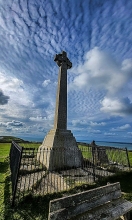
In 1897, a memorial to the poet was erected on Tennyson Down, a clifftop high above Farringford and Dimbola. Designed by JL Pearson, it is a tall stone Celtic cross mounted on a stepped base. A gently sloped footpath leads from Dimbola to the memorial, but we did not use this. Instead, my friend Martin and I laboriously climbed a steeper path closer to it.  The cross is impressive and dramatic against the wide-open sky – almost Wagnerian. The views from the clifftop were magnificent on the clear day we visited it.

Our descent from the clifftop was somewhat adventurous. This was not intentional. Because we could not remember the place the path (and staircase), which we ascended, began, we had to create our own route down the steep, almost vertiginous, wooded slopes. We had to be careful not to trip over the numerous tree roots and fallen branches that were hidden under fallen leaves that lay all over the place. I was quite relieved when we reached the car park without having fallen or strained our ankles. Next time I visit the poet’s memorial, I will use the lengthier but safer footpath.

You can read more about Tennyson and Julia Margaret Cameron, “Between Two Islands. Julia Margaret Cameron and her Circle”, available from Amazon sites such as:

On planning an itinerary, palindromes, and the Panama Canal

EVERY YEAR EXCEPT for a couple when travel was restricted by regulations connected with the covid19 pandemic, we plan a trip to India. Whilst trying to complete this year’s itinerary, I was reminded of a palindrome, which I first heard from my wife. It goes like this:

“A Man, A Plan, A Canal, Panama!”

This particular palindrome relates to the Panama Canal (constructed between 1904 and 1914), rather than to the Panama hat. The author of this set of words is unknown.

I have long enjoyed palindromes. The one about Panama is one of my favourites. Another, which incorporates my first name, is:

“Madam I’m Adam.”

Again, I do not know who originated it, but I have discovered that there is a Merlot rosè wine from France, which bears that palindrome as its name.

A novel about Cornwall by Daphne du Maurier

I HAVE BEEN TO CORNWALL many times, and always enjoy visiting this unique part of the UK. For many years, it was the home of the author Daphne du Maurier (1907-1989). She died in the Cornish town of Fowey, where she had a house, which is still owned by her family. Despite having visited Cornwall so many times, it was only recently (October 2023) that I first read one of her novels. The one I chose is called “The House on the Strand”. It is an exciting book, which is difficult to set aside once you begin reading it.

Richard Young is spending a holiday in Cornwall in a house owned by his old friend, a scientist Magnus, who is a professor at the University in London. Magnus has developed a set of related drugs, which he and Richard decide to test on themselves. Both men experience the same effects of these hallucinogenic substances. Within minutes of drinking a dose, they are transported back to 14th century Cornwall and become witnesses to events that they later discover had been recorded in historical records. Both men become witnesses to things that were happening during that far off period in the area where Magnus’s house is located. The desire to know more and more leads both men to keep taking the drug.

Things begin to get complicated when sooner than expected Richard’s wife and his stepchildren join him in Cornwall. The drug has odd side-effects that make Richard’s wife both worried and suspicious. As the days pass, things become more and more complicated, and eventually there is a series of tragic events.

The plot is ingenious and intriguing. By transporting Magnus and Richard back to mediaeval times, the author was able to describe Cornwall today and as it might have been in those days. The novel is also about addiction and how it develops. Further, Du Maurier describes the conflict between truth, half-truth, and deception. Not only is this novel a delightful story about Cornwall but also it is a brilliant depiction of certain types of human behaviour and how it has changed over the centuries.

Creating art with wood and a chainsaw

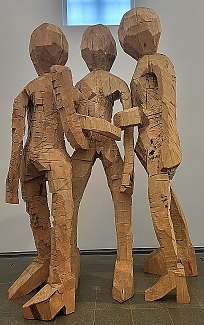
BORN IN WHAT BECAME EAST GERMANY in the town of Deutschbsaselitz, the artist christened as Hans-Georg Kern (b. 1938), is better known by the name of Georg Baselitz. His first education in art was at Hochschule für Bildende und Angewandte Kunst in East Berlin, commencing in 1955. After two semesters, he was expelled from this academy because of his lack of compliance with the socialist diktats of the German Democratic Republic. By 1957. he was a student at the Hochschule der Künste in West Berlin. In 1961, he changed his name to Georg Baselitz in honour of the town where he was born. In 1979, he began creating sculptural works, some of which are on display at London’s Serpentine South Gallery until the 7th of January 2024.

The works being shown at the Serpentine are all made of wood. They were created between 2011 and 2015 as models (maquettes) for finished works, and as such were not originally intended for public display. The wood has a rough finish and is pitted with many saw marks. After making preliminary drawings, some of which are displayed at the exhibition, Baselitz used axes, chisels, and chainsaws to fashion huge bits of timber into intriguing sculptural forms. These works are beautifully displayed in the various spaces of the gallery.

Although Baselitz’s timber sculptures are more figurative and much more complicated than those produced by my mother, seeing them reminded me of her. After leaving the sculpture workshops of St Martins School of Art, my mother hired a garage near Golders Hill Park, and used it as her studio. There, she worked on huge pieces of wood, creating abstract sculptures. Unlike Baselitz, she had no power saws, but only chisels and a power drill. I recall that when she wanted to create a ring-shaped piece of timber, she would first trace circles on the wood and then using a power drill she would drill holes around the circumference until the circle was complete. After that, she had to smooth the edges to produce a perfect circle. It was laborious, and lifting the heavy timber (without lifting gear) damaged her back.

The works on display in the Serpentine  (and one outside it) appear to be crudely finished when looked at closely, but as semi-abstract sculptures they seem to mock the grandeur of classical Greek or Roman sculptures. Born a rebel, the artist has produced attractive works that comfortably go against the grain of traditional sculpture.

An unusual Victorian funicular still working by the sea

STEEP CLIFFS OVERLOOK Hastings Old Town and the beach immediately east of it. Although there are roads that lead from these parts of Hastings to the rest of the town on top of the cliffs, a more interesting way of travelling between the bottom and the top of the cliffs is by using either the East Hill Lift or the older West Hill Lift. Both are funiculars. We travelled up and down on the West Hill Lift, which travels between the west end of the Old Town and the ruins of Hastings Castle high above on the top of the cliff.

The West Hill Lift (‘WHL’) is 500 feet long and ascends a height of 170 feet, a gradient of 33% (1 in 3). It comprises two tracks, each 6 feet in gauge. It is powered by electricity. The two carriages, which can each hold up to 16 people are raided and lowered along the tracks by steel cables attached to them. They are equipped with a mechanism that automatically applies brakes to the wheels should the cable break. I did not know this when we made a trip up and down the cliff in the creaky old carriages, which are those that were supplied when the system was originally installed.

The construction of the WHL began in 1899 (the year that the Eiffel Tower was built). But it was only completed in 1891, when the cable winders were operated by a gas-powered engine. The funicular system was built by Messrs A H Holme & C W King of Liverpool, who later built the Snowdon Mountain Railway. In 1894, after the Hastings Lift Company went ‘bust’, the WHL was taken over by the Hastings Passenger Lift Company. This company ran it until 1947, when the Lift was bought by Hastings Borough Council. In 1924, the gas engine was replaced by a diesel engine, which was later replaced by an electric motor (in 1971).

Despite having been refurbished in 1991, the WLF still operates with its original 1890s carriages. Admission to these is via an old-fashioned metal turnstile operated by the ticket seller. Apart from looking archaic, a special feature of the WHL is that most of it travels in a brick-lined tunnel burrowed through the cliff. Its neighbour, the East Hill Lift, runs through an uncovered cleft cut in the cliffs. Apparently, few other funiculars in Britain were built, like the WHL, to run through tunnels, and those that were, are no longer in use.

Although Hastings is not nearly as elegant as other British seaside towns such as Eastbourne and Brighton, it is an intriguing place rich in places of historical and visual interest. The existence of the superb Hastings Contemporary art gallery and the two working funiculars adds to the fascination of the place. It is not a place to be ‘sniffed at’.