ONCE A VILLAGE ON THE MARMARA SEA, NOW A SUBURB OF ISTANBUL

THE FIRST TIME I visited Turkey was in about 1960. My father was participating in a conference organised by the Eczacibaşi Foundation. It was held in the then luxurious Çinar Hotel on the European shore of the Marmara Sea at a place called Yesilköy, which is about 9 miles west of old Istanbul. This April (2024), we visited Yesilköy both for old times sake and because we had read that the place has several interesting sights to be seen. Incidentally, it was in Yesilköy that I had my first piece of chewing gum.

After disembarking from the Marmaray train, which connects settlements on the coast of the Sea of Marmara, we enjoyed the best cheese börek we have eaten since arriving in Turkey. Then, despite constant rain, we walked along Istasyon Caddesi, admiring the many houses with decorative timber cladding that line the avenue.

We made a small detour to look at a Syriac Christian Church, which looked recently built. We could not enter because a service was in progress. Thence, we walked to the rainswept seafront, where we looked around a museum dedicated to the life of Ataturk. It was housed in a mansion once owned by Greeks. The ground floor is dedicated to the first decade of the Turkish Republic, which was founded in October 1923. The first floor has a display of ethnographic exhibits from Turkey. The second floor is a collection of photographs, items, and books relating to the life of Ataturk.
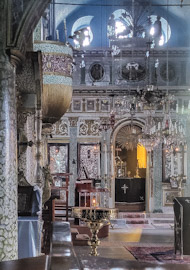
Greek Orthodox church in Yesilköy

Next, we came across a Greek Orthodox church. We could enter its covered porch in which candles were flickering. Through the windows of the porch we could see enough of the church’s interior to realise it is quite beautiful. Unfortunately, the church was locked.

Nearby, we found the huge Latin Catholic Church, which was open. Its interior was nothing special, apart from one religious painting which contained words in the Ottoman Turkish script. The size of the church suggests that there might once have been a large Roman Catholic community in Yesilköy.

Yet another church is a few yards away from the Latin church. It is an Armenian church, enclosed in a compound surrounded by high walls. The entrance was open, and after looking at the church, we joined the congregation (at least 40 people), who invited us to have tea and cakes. A couple of gentlemen began speaking with us in English. They told us that the Çinar Hotel was no longer in business, but it was still standing. They also told us that they are in the textile business. They are waiting for Indian visas because they are planning to visit Bangalore and Tiripur soon because they are looking to buy textile machinery there.

Several people told us that the Çinar Hotel is about a mile from the centre of Yesilköy. As it was cold and raining we decided against looking for it. Despite not revisiting the place I first stayed in Turkey more than 60 years ago, we saw Yesilköy and some of its fascinating sights. It is close to the railway tracks and not on most tourists’ beaten tracks.
An artist in Turkey with a famous Albanian ancestor

ALI PASHA OF TEPELENE (1740-1822) was born an Albanian in what is now Albania. He ruled the Ottoman pashalik of Yanina (Ioannina in Greek) with a large degree of autonomy. One of his descendants was Naciye Hanim. She married Lieutenant Colonel Abdurrahman Ziya Bey,

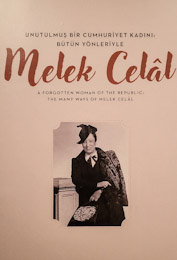
Naciye and her husband had only one child, a daughter called Melek, who was born in 1896 (in Istanbul) and died in 1976 ( in Munich, Germany). She became a renowned painter, sculptor, and writer (books and articles). I would not have heard of her had we not visited the magnificent Sakip Sabanci museum of art at the village of Emirgan on the European shore of the Bosphorus. At this place there was an excellent exhibition of Melek’s life and works. With information both in Turkish and English, it was an enlightening experience.

From an early age, Melek showed signs of artistic ability. She was brought up in an intellectual atmosphere. The Turkish poet Niğar Hanim encouraged her to take up painting. Her first lessons were with her uncle the soldier and painter Kâzim Bey. Later, she attended the Académie Julian in Paris. She also attended the School of Fine Arts for Women in Istanbul. While in Paris, Melek worked with various well-known French artists in their studios. Soon, she was recognised as an accomplished artist. This is evident from the many portraits and still-life’s on display in the exhibition.

In addition to painting and sculpting, Melek was a prolific writer of articles and books. She was also involved ed with Turkish politics during the period when the Ottoman Empire was dying and Ataturk’s modern Turkey was in its infancy. Her first book was published in 1938. In 1959, she published a book in French to introduce western readers to the delights of the Topkapi Palace complex in Istanbul. Many of her publications are on display alongside her paintings and one sculpture.

Melek married twice. First with Mr Celal in 1917. They had a son, and Celal died soon after that. In 1956, she married Dr Lampé, a physician. He died before she did. Melek died whilst being treated in a hospital in Munich.

Melek was one noteworthy descendant of Ali Paşa of Tepelene. There were others, who became famous Turkish intellectuals, including the writer Ebüzziya Tevfik(1849-1913), another writer Abdülhak Şinasi Hisar (1887-1963) and the author and poet Nâmik Kemal (1840-1888). These people of Albanian descent were not alone in shaping Turkey – both Ottoman and modern – in various ways, both peaceful and otherwise. I had heard about some of them, but Melek and her art are a wonderful discovery.

A MAJOR ATTRACTION FOR VISITORS TO ISTANBUL

I AM ALWAYS WARY about visiting the ‘must-see’ places partly because I hate queuing and do not particularly enjoy crowds. Also, one of the few flaws in my personality is that I love visiting places that are off the beaten track taken by most visitors to a town or city. That said, I visited one of Istanbul’s most popular tourist attractions today – The Grand Bazaar – on my way to places less often seen by tourists.

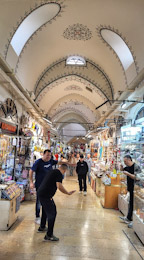
The Grand Bazaar (Kapali Çarşi = ‘covered bazaar’) covers a huge area, and is like a city within a city. It has 62 covered streets and about 4000 shops. It’s construction commenced in about 1455/56 – a very few years after the Ottoman conquest of Constantinople/Istanbul. Much of its construction occurred during the second half of the 15th century, and it was largely completed by the beginning of the 17th century.

Many things impressed me about the Bazaar. It is very clean. The numerous shops are mainly tidy. Until we entered the place, I had not realised that it is built on a hillside. Many of its gently curving streets (or wide corridors) are far from level – they slope gently. The beautiful curved ceilings, supported by numerous arches, are wonderfully decorated with painted Ottoman motifs and patterns – tasteful not garish. Despite the presence of many people – tourists and locals – the bazaar did not feel crowded. Because of the great width of the streets, the bazaar did not have the bustling feeling that many large bazaars in India have.

All in all, despite my initial reservations about entering such a ‘mustn’t miss’ attraction, I greatly enjoyed visiting the Grand Bazaar, and am very pleased I did.

Made in India and sold in Istanbul

KARAKÖY IS A DISTRICT of Istanbul close to the Golden Horn (Haliç). When walking along Tersane Cadesi, a busy avenue lined with shops selling technical goods for mechanical operations (from nails to power tools), we passed an old building topped with domes. Its walls are alternating layers of stones and brick work.

A plaque on the wall of this place reads “ISBU FATIH BEDESTENI AYASOFYA VAKFI KEBIRI OLARAK INSA EDEL MIŞTIR”, which means ‘This Fatih Bazaar was built as a part of the Hagia Sophia Foundation’. So, the building was constructed as a bazaar, and is still used as such. Like the rest of the street, only machine tools and spare parts are sold in the edifice.

Made in India

The above-mentioned foundation was founded soon after the Ottoman conquest of Istanbul. Its function, along with other foundations, was to restore and restructure Istanbul, which had deteriorated badly during the last years of Byzantine rule. I have not yet been able to find out when the bazaar was constructed.

On one of the external walls of the building, a selection of rubber car tyres was on display. An elderly man, who was running the stall, greeted us, and began trying to guess where we were from. My wife told him that she is Indian. Hearing that, the old fellow rushed back to his collection of tyres, and we started to walk away. A few seconds later, he rushed towards us. He was holding a tyre in his hand, and pointing to it, and he kept saying “India”. We stopped, and then he rotated the tyre until he found the words “Made in India” embossed on it, and showed then to us.

A resourceful lady and a book about a famous Turkish architect in Istanbul

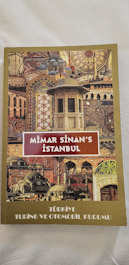
THE ARCHITECT MIMAR SINAN (c1489-1588) was the greatest of Turkish architects. There are many wonderful buildings of all sizes and for a wide variety of purposes designed by him all over Istanbul.

When visiting a tourist information office on the Asian side of Istanbul, I noticed several copies of a book called “Mimar Sinan’s Istanbul”. Beautifully illustrated with a detailed text, I quickly decided that I would love to own a copy. I asked if I could buy a copy. The official said that he could not sell me one because they were for reference only. I asked where they were sold, and was told that I could buy one at the publisher’s bookshop. The book is published by Turing. The discovery of the book occurred on a Friday.

On the following Sunday, we found the Turing shop. It was shut. We went again on Monday, and found a notice stating that it was always closed on Mondays. Tuesday was a public holiday. So, we did not bother going to the shop. On each of our abortive visits, I could see the book on a shelf in the shop, but could not quite see its title.

On Wednesday, the shop was open. We entered it, and discovered that they only stocked the Turkish edition. As it is beautifully illustrated and remarkably cheap given its fine quality, we purchased a copy.

Later that day, my wife Lopa had an ingenious idea. We were not sure whether it would work, but it was worth a try, especially as the tourist office was close to where we wanted to go the next day.

On the following day, we took the ferry to the Asian side, carrying with us the brand new copy of the Turkish edition of the book about Sinan, and returned to the tourist office. Lopa asked the official, who remembered us, whether we could exchange our Turkish book for one of the office’s books in English. Without hesitating, the official said:
“Why not. We don’t have a copy in Turkish.”

He handed us a copy of the book in English, and we gave him our Turkish copy. I was very pleased and full of admiration for Lopa’s resourcefulness – especially as it was her birthday.

The warmth of a teamaker I’m a mosque garden in Istambul

THE KUCUK AYASOFIYA mosque in the European side of Istanbul was once a Byzantine church (construction commenced in 527 AD). It was converted to a mosque after the Ottomans took over Istanbul. In front of the mosque, there is a square garden with a pavilion in its centre. The garden is enclosed on three sides by cloister-like arcades, which contain small shops, a religious institution, craftsmen’s workshops, and a small café.

From the first day we arrived in Istanbul – a Monday, we visited the peaceful garden every evening to relax and enjoy glasses of Turkish tea. The tea was made by a man in his sixties, called Yavuz.

We kept returning to the garden every evening not only because of the tea, but to greet Yavuz. He was the sort of person you have to like. Despite not being able to speak Turkish, we felt the warmth of his personality. After a couple of days, he began greeting us as if we had known him forever. When he walked past our table, he would pat our shoulders in a friendly manner. He was a person, whom you could not help liking. He was warm and genuine.

On the Sunday following our arrival, Yavuz was not at the café. Someone else made our tea. We imagined that it was Yavuz’s day off. On the next day, he was not there. Someone else, whom we had met earlier at the café and spoke good English, was at the café that Monday. We asked him where Yavuz was. He told us quietly:
“He is no more. He died of a heart attack at the café late on Saturday night.”

We must have seen him only a few hours before he died. Although we had known him for less than a week, we were heartbroken. We felt as if we had lost a close friend or a much-loved relative.

Sadly, I never took a photograph of dear Yavuz. As we expected to see him during the rest of our trip, I had planned to ask him for his permission to take his picture later on. Even without a photograph, Yavuz will occupy an honoured place in our memories.

AN OBELISK IN THE HEART OF OLD ISTANBUL

COVERED WITH HIEROGLYPHS, and standing close to Istanbul’s Sultanahmet Mosque, there is a tall obelisk mounted on 4 metal brackets, which rest on a stone block covered with bas-relief carvings. It is called Dikilitas in Turkish, and The Obelisk of Theodosius in English.

Over 65 feet tall, it is only a small part of an obelisk that was commissioned by the Egyptian Pharaoh Thutmose III (1549-1503 BC), and it stood opposite Thebes. The fragment that stands in the former hippodrome of Istanbul was brought to what was then Constantinople in the 4th century AD. It was erected in its present position by Emperor Theodosius the Great in 390 AD.

The carvings on the plinth that support the obelisk depict Theodosius and his officials involved with the races that were held in the hippodrome. The obelisk and two other vertical structures marked the cental line or long axis of the race course.

During our current visit to Istanbul, we often walk past the obelisk on our way to our nearest tram station. We usually do this in daylight. However the best time to see the obelisk is after dark when it is beautifully illustrated with spotlights that enhance the appearance of both the hieroglyphs and the sculptures below it.

TWO MOSQUES AND A BAZAAR IN ISTANBUL

WHILE WANDERING THROUGH the older part of Istanbul on our way to the Yeni Camii (‘New Mosque’), we came across the Mahmut Paşa Camii. This mosque stands in a remarkably peaceful, large compound, considering how close it is to a route used by crowds of tourists. Despite being in the heart of the most visited part of the city, this mosque seems to be ignored by most tourists.

The Mahmut Paşa was built in about 1463, making it one of Istanbul’s oldest mosques. It was built only 10 years after Istanbul was captured by the Ottomans. The spacious mosque was built in a style typical of some mosques found in Bursa. It has a large central hall flanked on each side by smaller rooms – rather like side chapels. It was the work of Grand Vizier, Mahmut Paşa, who was put to death by Mehmet the Conqueror in 1474. During his life, he was involved with the Siege of Belgrade, chasing Albania’s Skanderbeg, and the conquest of Bosnia. In addition to his military exploits, he was a noted writer, both in Turkish and Persian. It is worth noting that Mahmut Paşa was converted to Islam after he was captured in Serbia by the Ottomans when he was a young boy.

After seeing the mosque, we walked past the crowded Grand Bazaar, and after passing numerous shops selling lingerie and hosiery, we arrived at the Misir Çarşisi (Egyptian Market aka Spice Market). We walked through this covered, fragrantly scented spice market, which was constructed gradually from 1597 to 1664. Where two passageways lined with shops intersect, there is an open space overlooked by a wooden pavilion reached by a spiral staircase. This was used to say prayers to the merchants who gathered to listen to them at the start of each day.

The Yeni Camii is next to the Misr Çarşisi. It is an enormous structure with numerous domes. It was completed in 1603, and overlooks the Golden Horn and the Galata Bridge, which crosses it. Both the interior and the facade facing the courtyard are rich in tiles covered with blue and white motifs and calligraphy. This eye-catching tiling greatly adds to the mosque’s attractiveness. The huge, spacious interior is an oasis of tranquillity compared with the busy roadway and waterfront only a few yards away.

In between the three edifices I have described, the steeply sloping streets connecting them are lined with buildings of all ages – some of them attractive, others less so. Many of these buildings house shops.

Yet again, a stroll in Istanbul has proved to be fascinating. It is not only the historic monuments that I enjoy seeing, but also glimpses of everyday life in the city.

A VILLAGE ON THE BOSPHORUS WAS ONCE HOME TO A JEWISH COMMUNITY

LONDON HAS ITS Hampstead. Budapest has its Szentendre. Paris has its Montmartre, and Athens has its Plaka. Like these cities, Istanbul also has an area where the city’s citizens meet to relax – Kuzuncuk. This is a village-like settlement on the Asian shore of the Bosphorus in the northeast corner of Üskudar.

We visited Kuzguncuk on a sunny Sunday morning, having walked along the coastal road that leads away from the centre of Üsküdar. As we walked, we watched competitors in a running event, struggling up and down the undulating road from which traffic had been temporarily excluded.

Kuzguncuk

The streets of Kuzguncuk run up hill away from the shore. They are lined with small houses, many of which are picturesque with their timber cladding, small balconies, and other ornamentation. Tables and chairs of cafés, snack bars, and other eateries occupy the pavements. Many of them had customers, who were eating tasty looking breakfast platters, cakes, and other snacks.

As far as we could tell, most of the visitors to Kuzguncuk are Turks. This has not always been the case. Jewish people, who had been expelled from Spain and Portugal, began settling on the village in the 16th century. The earliest tombstone in Kuzuncuk’s Jewish cemetery is dated 1562. The Jewish inhabitants of Kuzguncuk have mostly left – many in 1948. There are two synagogues – one heavily guarded by the police, and the other one more lightly guarded – in the village. Both were locked up.

Armenians began settling in Kuzguncuk in the 18th century. We spotted one of their churches, but it was locked up the service having finished. Following disturbances in 1955, most of the Armenians and Greeks, who lived in Kuzuncuk, left. We passed a couple of Greek Orthodox churches, both locked up. One of them located next door to the heavily guarded synagogue is still in use on Sundays, but we were too late to enter it.

The centre of Kuzguncuk did not have a mosque until 1952. Then, one was built in the courtyard of the Armenian Church of Surp Krikor Lusavoriç. The Armenian community contributed funds towards the construction of this mosque.

When the Greeks, Jews, and Armenians left Kuzguncuk, many of their homes were acquired by migrants from Anatolia.

After spending an extremely pleasant couple of hours in Kuzguncuk, we climbed up the vertiginously steep lanes behind the village, and eventually reached a long main road that led gently downwards to the centre of Üsküdar. As we struggled up a lane, a lady in her garden said to us “Yavaş yavaş” (loosely translated as ‘take it slowly’).

If you wish to escape the crowds of tourists in Sultanahmet and other well-known historic parts of Fatih (the older part of Istanbul in Europe), then head for Kuzguncuk for something delightfully different.

TWO ARCHITECTS IN ISTANBUL SEPARATED BY A SHORT DISTANCE AND SEVERAL CENTURIES

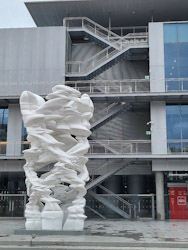
A MOSQUE DESIGNED by Mimar Sinan (c1489-1588), probably the best of Ottoman architects, stands a few yards away from Istanbul Modern (modern Art museum) designed by one of Europe’s best contemporary architects – Renzo Piano (born 1937).

The mosque is the Kiliç Ali Paşa, designed by Sinan and completed 1580. Like other mosques designed by this architect, the spaces contained within feel most satisfying. Sinan was masterful in his creation of contained spaces. The mosque with buttresses also has some attractive tiled panels both inside and outside.

One minute’s walk away from the 16th century mosque stand Piano’s Istanbul Modern, which was completed in 2004. Quite different from the mosque, it shares one thing in common – brilliant spatial design. Located next to the waterfront of the Bosphorus, brilliant views of Istanbul can be obtained from the waterfront, from the rooftop terrace, and through the gallery windows.

Piano’s building is so utterly engaging visually that it competes with the exhibits for one’s attention. Although many of the mostly Turkish artworks are both beautiful and engaging – we spent three hours looking at them, it is Piano’s building that steals the show.

I found it fascinating that two magnificent buildings, their constructions separated by 424 years, should be standing so close one another. Had I been in Renzo Piano’s shoes, I would have felt honoured to have one of my buildings so close to that of an architect who has easily passed the test of time.