This coffee stall
In Bangalore’s busy airport
Remains free of meat
‘Outside food‘ is food not sold by the stall. You must not bring food you have obtained elsewhere. This coffee stall only sells vegetarian products.

This coffee stall
In Bangalore’s busy airport
Remains free of meat
‘Outside food‘ is food not sold by the stall. You must not bring food you have obtained elsewhere. This coffee stall only sells vegetarian products.
THE SAINSBURY WING of London’s National Gallery is stark, almost clinical, compared with the older nineteenth century rooms in the rest of the place. Although the pictures in the new wing can be seen without the eye being distracted by the rooms’ decorative features, I found that the paintings felt more ‘at home’ in the older, highly decorated galleries. One of these rooms, Room 36 has a central octagon topped by circular, glazed dome. In contrast to the Sainsbury Wing, this octagonal and the rooms leading of it, the Barry Rooms, are gloriously decorative in a Victorian baroque style. This and the rooms adjoining it were designed by the architect Edward Middleton Barry (1830-1880). His creations in London include The Royal Opera House and the Charing Cross Hotel.
There are several paintings by great artists such as Claude and Turner in the octagon. If you avert your eyes from these masterpieces, you might notice a small commemorative plaque that reads:
“Dame Myra Hess. On 10 th October 1939 in this room the pianist Myra Hess performed the first of many music concerts for the enjoyment of Londoners during wartime”.
Myra Hess, who was born in South Hampstead in 1890, died in London in 1965. She studied music at the Guildhall School of Music and at the Royal Academy of Music. Her concert debut was in 1907. During WW2 when most concert halls were out of action, she organised almost 2000 lunchtime concerts in the National Gallery: Monday to Friday for six years. She played in 150 of them, and never took a fee for her playing. In recognition of her work in keeping up the morale of those who heard her, King George VI made her a Dame Commander of the Order of the British Empire in 1941.
At the time of her death in 1965, Myra Hess was residing at 48 Wildwood Road in Hampstead Garden Suburb. Although I lived not far from her in the Suburb during my childhood, then I was unaware of both her existence and the fact that she was almost a neighbour. It was only during the twenty-first century that I spotted her creeper covered commemorative plaque on the house in Wildwood Road. Although I am glad that I did not have to live through WW2, I would have enjoyed listening to a concert in the gloriously decorative octagonal room at the National Gallery.
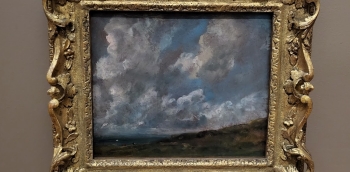
DURING A VISIT to London’s National Gallery, I entered a room in which paintings by JMW Turner (1775-1851) and J Constable (1776-1837) were being displayed.
Seeing these artists’ works together reminded me of a visit to the Lady Lever Gallery in Port Sunlight (Cheshire). I wrote about this place in my book “An Alphabetical Tour of England”, and compared the two artists. Here is what I wrote in my book:
“In one small gallery, … two paintings hang close to each other but are separated by a neo-classical fireplace (an exhibit). One of them is by JMW Turner (1775-1851) and the other by his contemporary and rival J Constable (1776-1837). It is interesting to see them almost side-by-side because it allows the viewer to compare their styles and what they tried to convey in their paintings. The Turner painting depicts “The Falls of the Clyde”, and the Constable depicts “Cottage at Bergholt”. Neither of the paintings, both created in the age before photography, achieves the accuracy of, say, a photograph. Both seem impressionistic, but the effects that the artists were attempting to have on the viewer are entirely different. Turner’s paintings are often far more impressionistic than Constable’s. Although his subject matter is always at least almost discernible, I feel that Turner’s works were created to evoke both the artist’s and the viewer’s psychological and/or emotional reaction(s) to what was being depicted. In contrast, Constable’s painting techniques seem to have been designed to emphasise aspects of the scene he was painting to give the viewer the impression that he or she is looking at the very same view as that which attracted the artist. Constable regarded painting as being a branch of science. In a lecture he gave in 1836, he said:
‘Painting is a science and should be pursued as an inquiry into the laws of nature. Why, may not landscape painting be considered a branch of natural philosophy, of which pictures are but the experiments?’
Turner, in his almost abstract paintings such as the one at the Lady Lever, appeared to be wanting to stimulate the viewer’s deepest emotions. In contrast, Constable tried to convey to the viewer what he saw or felt was important in his subject matter. Without resorting to the almost photographic accuracy of, for example, both Canaletto and Vermeer, the two artists, whose paintings hang almost next to each other in the Lady Lever, successfully achieve their aims. For me, the avoidance of detailed accuracy of representation in both Turner’s and Constable’s paintings, enhances the impression of reality in my mind, something that photography cannot do to the same extent.
Even if you do not wish to compare Turner and Constable, I can strongly recommend a visit to the soap maker’s gallery in Port Sunlight …”
Seeing the paintings at the National Gallery reinforced my feelings as expressed above in the excerpt from my book.
If you wish to read my book, it is available from Amazon’s websites, e.g.:https://www.amazon.co.uk/ALPHABETICAL-TOUR-ENGLAND-Adam-Yamey/dp/B0FVV6JLZ7/
PANTON STREET RUNS between Leicester Square and Haymarket. The Tom Cribb pub, formerly known as the ‘Union Arms’, stands on the corner of Panton Street and Oxendon Street. The pub’s name commemorates a boxing champion Tom Cribb who lived from 1781 till 1848. A small plaque on the exterior of the pub commemorates another boxer, Bill Richmond (1763-1829).
Richmond was born into slavery at Richmondtown on Staten Island, New York. After witnessing Richmond’s fighting talent during a brawl at a tavern during the American War of Independence, a British commander arranged for his freedom, and took him to Yorkshire in England in 1777. There, he was educated and met his wife, Mary, while he was working as a cabinet maker. By 1795, Richmond and his family had moved to London, where he worked as an employee of Thomas Pitt, 2nd Baron Camelford (1775-1804), who happened to be a boxing enthusiast. According to Wikipedia:
“On 23 January 1804, Pitt and Richmond attended a boxing match featuring experienced boxer George Maddox. After Maddox won the bout, Richmond spontaneously challenged Maddox to a fight, which Maddox accepted. When the fight took place, Maddox defeated Richmond in nine rounds.”
Despite this, after Pitt died, Richmond took up professional boxing, and fought with many of the champions of the time, often winning these contests.
In 1805, after Richmond had defeated the Jewish champion Youssop and Jack Holmes ‘the coachman’, he challenged the great Tom Cribb, but lost. For many years Richmond and Cribb held grudges against each other. However, as the two men got older, they became friends. Often, they used to meet and converse in Cribb’s favourite pub, the Union Arms on Panton Street. It was in this pub on 28 December 1829 that Richmond spent the last evening of his life, relaxing with Tom Cribb. It is this that is recorded on the plaque outside the former Union Arms, now the Tom Cribb pub.
THERE ARE FOUR stone plinths on London’s Trafalgar Square. Three of them bear statues of noteworthy men of the past. The fourth plinth, which is at the northwest corner of the square, was destined to carry a statue of King William IV, but it was never placed there. For many years, the fourth plinth remained unused, but from 1999 onwards it became used to display works of art. Works are commissioned for the plinth, and remain displayed on it for, typically, a year or two. This year’s artwork, “Mil Veces un Instante” (‘A Thousand Times in an Instant’) is by the Mexican artist Teresa Margolles (born 1963).
At first sight, the sculpture looks like a rectangular box-like framework covered with white ovoid shells, rather like halves of easter eggs. On closer examination, these shapes look like the internal surfaces of moulds taken from faces. Indeed, that is what they are. As an article on Wikipedia explained:
“Casts of the faces of 850 trans people from London and around the world. The ‘life masks’ are arranged around the plinth in the form of a tzompantli, a skull rack from Mesoamerican”.
And a notice by the plinth informed the viewer that:
“The casts have been created by applying plaster directly onto the faces of participants, meaning that as well as recording their features the plaster is infused with their hair and skin cells … The material is important to the work, it is fragile and will deteriorate (although not disintegrate) over time. The fragility of the material is a reflection community, both fragile and strong. The material also has a tendency to pick up other materials into the work. The material retains traces of the participants such as eyelashes, eyebrows, skin cells, makeup etc, they are present in the work.”
Well, what was the artist trying to tell the viewer? On 22 December 2016, Karla, a trans-gender woman, was found murdered in a Mexican city. According to the information panel, the work on the plinth is both a memorial to Karla and an object to raise awareness of the violence and abuse faced by so many transgender and other gender non-conforming people around the world.
Unlike some of its predecessors on the fourth plinth, Margolles’s work, is not particularly visually striking. Its strength lies in the concept that led to its creation. It expresses a message, but it is not one that is at all obvious to the casual passer-by. If one does not read the information panel, this work would make little or no impression on those who happen to notice it. I hope that the next piece to occupy the plinth will be more eye-catching, even though the present one is full of good intention.
THE PARK THEATRE in London’s Finsbury Park was opened in 2013. We have seen many productions there and they have all been good to excellent. “The Meat Kings! (Inc.) of Brooklyn Heights”, written by Hannah Doran, is showing until 29 November 2025, is no exception, as we discovered after watching it last night (1 November 2025). A word of warning is owed to vegetarians and vegans: the play is set in the meat cutting room of a family butcher’s shop somewhere in New York City. But do not let this deter you because the main points of the play are not about carving and slicing meat.
In the play, Paula Caffarelli is the owner of Cafarelli & Sons. Her great grandfather, an immigrant from Sicily, founded the firm 100 years ago. She tends to hire people released from prison to work in her cutting room. Three of her employees are ex-convicts and the fourth is an immigrant from Mexico. One of the ex-prisoners, Billy (acted brilliantly by Ash Hunter), must earn to pay his mother’s exorbitant medical fees. David, who used to make a fortune on Wall Street but has fallen on hard times, Is Paula’s senior meat cutter. JD is the Mexican. During the play, Paula takes on a new cutter, T, also recently released from prison. At the beginning of the play, Paula’s staff fool around and take life easily. However, it is not long before Paula’s business begins to suffer economically, and her staff members reveal their personal problems. Things reach a stage where Paula needs to reduce the number of her staff, and some of her cutters begin plotting against the others.
This well-acted, superb play is both entertaining and disturbing, but never uninteresting. As the theatre’s website explained, the play:
“… carves into the dark underbelly of America’s anti-immigration policies and the brutal sacrifices that drive the pursuit of prosperity.”
It adds a note of warning:
“This production contains butchery; references to prison, suicide and illness; discussions of racism & xenophobia. Also contains strong language and references of a sexual nature. Please note, this production does not use real meat.”
The play comes to a tragic end as the characters, to use an appropriate phrase, knife each other in the back. I enjoyed the play, and believe that seeing it would not disturb those who avoid eating meat. However, it might put you off crossing the Atlantic from east to west.
WE VISIT RICHMOND-ON-THAMES often, frequently arriving on the District Line of the London Underground. However, it was only yesterday, 31 October 2025, that, while waiting for a bus outside the station. I noticed that its façade is a fine example of the Art Deco style of Modernist architecture, which achieved popularity between the two world wars.
The first Richmond station was opened in 1846. The current station was built in 1937. It was designed by Southern Railway’s Chief Architect James Robb Scott (1882-1965), whose other works include the offices and Victory Arch at London’s Waterloo Station. Richmond station’s façade is mainly constructed with white Portland stone. The main entrance has black features constructed using polished black granite. Within the recently restored ticket hall, there is a green glass frieze that surrounds the hall and contains the original wording that indicates the various services offered within the large room. The walls of the hall are lined with travertine cladding and the light fittings hanging from the ceiling are of a Modernist design typical of the era during which the station was built.
Until 2025, many of the original Art Deco features of the station, both internal and external, were either hidden by modern panelling or were in poor condition. Between 2023 and 2025, the station was carefully restored to its original splendid state.
After catching our bus, I noticed that we passed several other Art Deco buildings near to the centre of Richmond. These were blocks of flats. Before returning to the station, we stopped outside one of these, Lichfield Court. This was designed in the Streamline Moderne style, a type of Art Deco, by George Bertram Carter (1896-1986), and completed in 1935. Incidentally, Carter had been a pupil in the office of Edwin Lutyens between 1919 and 1922. Apparently, this block of flats incorporates some innovative features, which we did not have time to see.
Until our most recent visit, I never associated Richmond with Art Deco architecture. On our next visit, I hope to wander around, examining the examples of this style in greater detail.
“… WHAT IS READING but a vice, like drink or venery or any other form of excessive self-indulgence? One reads to tickle and amuse one’s mind…”
These are the words of the verbose Mr Scogan in “Crome Yellow”, a novel by Aldous Huxley (1894-1963). With novels such as this one, reading is certain to become an incurable addiction, if not a vice. First published in 1921, only a few years after the end of WW1 this short novel is not only highly entertaining and extremely witty but almost completely un-put-downable.
Huxley was 27 years old when he published “Crome Yellow”. It begins when a young man, Denis, aspiring to be a poet arrives, at Crome, a stately home where various other guests have come to spend time during the summer. The book and the stately home contain a wealth of characters whose conversations and interactions with one another provide the reader with a wealth of entertaining situations. The author manages to convey the social atmosphere prevailing amongst the upper classes immediately after WW1, as well as presenting a range of philosophical ideas both about life and art. He managed to do this with a lightness of touch that makes even the most abstruse of ideas become easily digestible by the reader.
Every now and then, Mr Wimbush, the current head of the Crome household, reads extracts from the history of the house and its aristocratic inhabitants, which has taken him 30 years to complete. These are highly entertaining. Throughout the novel, Jenny, who is almost completely deaf, scribbles away in her notebook. What she had been entering into it is surprising, and only revealed near the end of the book. Other characters include several young ladies, Mrs Wimbush who believes in mysticism and spiritualism, Mr Scogan who cannot stop talking and has an opinion about everything, Mr Bodiham the village priest, the artist Mr Gombauld, and the spiritualist Mr Barbecue-Smith. Throughout the story, a young lady, Anne, is the object of attention by both Denis and the French artist. Between these characters and others in the book, you can be sure that Denis’s stay at Crome was anything but dull.
I picked up my copy of “Crome Yellow” at a charity shop, and am extremely glad I did. I have not enjoyed a novel as much as this one for quite a few years. I hope to read more of Huxley’s novels in the future.
THE FIFTH of November is celebrated each year to commemorate a non-event. It was on that day in 1605 that a plot to blow up the the Houses of Parliament and its inmates, which on that day included King James I. The plotters, led by Guy Fawkes (1570-1606), were Roman Catholics who were annoyed that the king would not grant greater religious tolerance of the Catholics. Had the king been killed, the conspirators would have tried to replace him with a Catholic monarch.
Guy Fawkes Day, the 5th of November, celebrates the fact that the plot failed. For several days before the 5th of November, and for a few days after it, fireworks are let off both in private and public spaces all over Britain. And because the Hindu festival of Diwali (Deepavali) is often celebrated with fireworks close to Guy Fawkes Day, between that festival and the 5th of November, the sky is filled with sounds of explosions almost every evening.