He moves with the sun on Jewellers Street in Bangalore

JEWELLERS STREET RUNS in a north/south direction. In the morning, the sun shines on the west side of the street and in the afternoon, on the east side. As its name suggests, the street is lined with many shops selling jewellery.

Jewellery breaks sometimes, but it can often be repaired. K is a jewellery repairer. In the morning he sits working in the shade on the pavement on the east side of the street, outside a particular shop. In the afternoon, you will find him outside a shop close to a silver and hold plating shop on the west side of the street.

K squats bare-footed alongside his trays of tools and materials, and mends a wide variety of jewellery. When re-threading necklaces and bracelets, he uses his toes to hold one end of the thread. We visit this friendly, highly skilled man whenever we are in Bangalore, usually with items if jewellery that have broken since our last visit to the city.
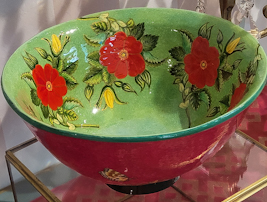
Made of paper in the north  of India

A naqashi bowl

NAQASHI is a traditional handicraft practised in Jammu & Kashmir.  It is papier-maché hand painted with Mughal inspired motifs. The objects created with this technique are lacquered  to produce a shiny finished surface.

[The word ‘naqashi’ means ‘painting’]

An alarming purchase at a supermarket in London

A TRUE STORY

I entered one supermarket and purchased a bottle of gin. I paid for it, and as I left the store, the alarm rang. I ignored it. Nobody stopped me.

I took a bus to another area, where I  entered a different supermarket.  Once again, as I  left the store, nobody, not even the store’s security guard, stopped me.

When I got home, I  discovered that the anti-theft device had been left on my bottle. It should have been removed when I paid for the gin.

I tried removing the tag, which was tied to the neck of the bottle with tough metal cable. I realised that without breaking the glass bottle,  I would not be able to reach the gin.

In the end, I  retraced my steps and returned to the shop, which was a 10 minute bus ride away. I explained what had happened, showed the shop assistant the receipt, and demanded a fresh bottle, but with the security tag removed.

This episode made me wonder why so much effort is put into protecting goods when the security officials at the supermarkets take so little heed of their alarms when they are set off.

Ageing bungalows in Bangalore (Bengaluru)

BANGALORE IS A CITY which changes rapidly. Sadly, much of the change involves the demolition of buildings of historical interest – so-called ‘heritage’ structures.

So, it is wonderful to come across residences (bungalows) that have been standing for many years. Some of these bungalows appear neglected and will most likely be demolished soon to make way for architecturally indistinguishable office blocks and blocks of flats. Others are still being used as homes and can be seen in varying conditions of repair. And, fortunately, some have been beautifully restored and are either being used as dwellings or for a new purpose.

2 Berlie Street

One of the restored bungalows is number 2 Berlie Street in Langford Town. It is now being used as an art space (for exhibitions) by an organisation called Kaash. We visited it today (22nd November 2024) to view a temporary exhibition about contemporary designs of devotional objects, mainly diyas (oil lamps used on Hindu ceremonies) and also some almost abstract depictions of Devi created by Jayshree Poddar. The artworks were tastefully displayed in some of the rooms in the Bungalow. The other rooms contained folk art from various countries in Africa.

It would be great if most of the remaining heritage bungalows could be preserved, but this is unlikely because the land on which they stand can be sold for enormous sums of money.

All of the photos are of Kaash in Berlie Street unless otherwise labelled.

A magnet for bookworms in the heart of Bangalore (Bengaluru)

I HAVE VISITED BANGALORE regularly over the past 31 years. Each time, I have been impressed by the city’s numerous well-stocked bookshops. Many of them are now located along the short Church Street, which runs parallel to a stretch of the much longer MG Road. At the last count, I found 9 bookshops along Church Street, which is less than half a mile in length.

Bookworm

One of these shops that impresses me most is called Bookworm. Its location has changed several times since I first found it in 1994. Now, it is housed in a former mansion set back from Church Street and reached by a tree shaded pathway. It contains many rooms, each of which has walls lined with bookshelves filled with books from floor to ceiling. Much of the floorspace in these rooms is covered by piles of books. The books range from the latest releases to out of print and secondhand volumes. Recently, a small room has been added to display rare antiquarian editions. Despite this, there are many old and interesting books within the other rooms.

Bookworm is an ideal place for browsing if you have plenty of time on your hands. If you are pressed for time or know what you are looking for, the helpful staff will either know where to find what you are seeking, or will search for you.

When you have selected what you wish to purchase, some of the newer titles are subject to a discount at the cash desk. The older books and secondhand editions are priced very reasonably.

Although there are other superbly stocked bookstores in Church Street, notably Blossom Book House, Bookworm is my favourite. It is truly a magnet for bookworms.

An iconic roadside shoe repairer in Bangalore

AN ICON IS a person or symbol worthy of veneration. These days ‘iconic’ has come to mean “widely known and acknowledged especially for distinctive excellence”. Thus, for example, the Taj Mahal and the Gateway of India are now described as being iconic.

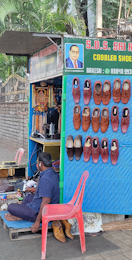
Today, we visited a pavement shoe-repairer (‘cobbler’ or ‘mochi’) in Bangalore. All over India, one can find these useful street side artisans. Often, they work from small open fronted huts, which contain their tools and materials as well as footwear that is either waiting to be repaired or already fixed. One could say that the mochis are iconic features of the streets of India.

Apart from being iconic, many mochis adorn their huts with icons. These icons always include at least one picture of BR Ambedkar (1891-1956). He not only drafted the Constitution of India but also fought for the political rights and social freedom of the Dalits (once known as the ‘untouchables’).

Traditionally and still today, mochis are almost always from Dalit communities. This is why mochis have images (icons) of Ambedkar on their huts. The mochi we visited today on St Marks Road had not only some images of Ambedkar but also one of a Mr Haris, the local member of the Karnataka legislative assembly. And this is not all. Within his hut, the mochi had an image of Shrinatji, who is the God Krishna represented as a young child. This was garlanded with flowers as was one of the pictures of Ambedkar hanging beside it.

The iconic mochi polished my well-worn leather sandals while I sat beside his hut covered in icons

Money can’t buy you love, but it can buy you comfort

THE DIRECT FLIGHT FROM London to Bangalore (Bengaluru), operated by British Airways (‘BA’) lasts about 9 hours and 20 minutes. In the past, we have travelled World Traveller Class (the cheapest seats) and were not satisfied with both the level of comfort and the attitude of the cabin staff.

This year (2024), we splashed out and paid for World Taveller Plus seats. The extra cost gets one bigger seats that recline more than adequately, more leg room, better treatment and attention from the cabin crew, and priority boarding. At the end of the flight, we felt that spending more on the tickets was easily justified.