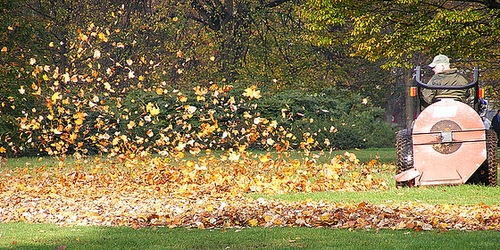
Leaves are falling
sun rises late, air cooling
I’m thinking autumnal

Leaves are falling
sun rises late, air cooling
I’m thinking autumnal
Artwork by Man Ray (1890-1976)
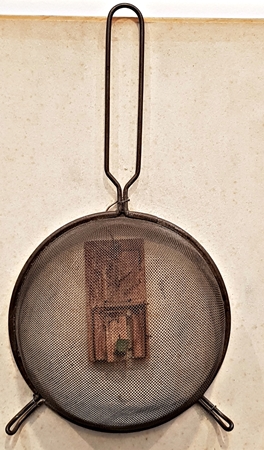
It’s so simple yet so alluring
a sieve, a mouse trap:
it’s pure Dada
At Hackney Downs station

Linear parallels
converging finally
on a high walkway
On Saturday the 29th September 2018, we had a wonderful evening at London’s recently opened Bridge Theatre. It is located on the south bank of the River Thames, a stone’s throw from the world famous ‘icon’ of London, Tower Bridge. From the glass front of the theatre’s foyer, there are superb views of: the new high-rise buildings in the City (including the ‘Gherkin’); the White Tower and the walls of the Tower of London; and Tower Bridge, which is beautifully illuminated at night.

The Bridge Theatre opened for its first show in October 2017. The theatre is the brainchild of Nick Starr, of the former National Theatre, and the renowned theatre director Nicholas Hytner. Both of these two Nicks have been long involved with London’s National Theatre. Their creation, the Bridge, is an improved version of the facilities offered by the now ageing National Theatre on the Southbank. Excellent as the National Theatre is, the Bridge seems to have been designed to avoid some of the defects of the former. The newer theatre, which can seat 900 audience members, was designed by S Tompkins and R Watts of Haworth Tompkins Architects.
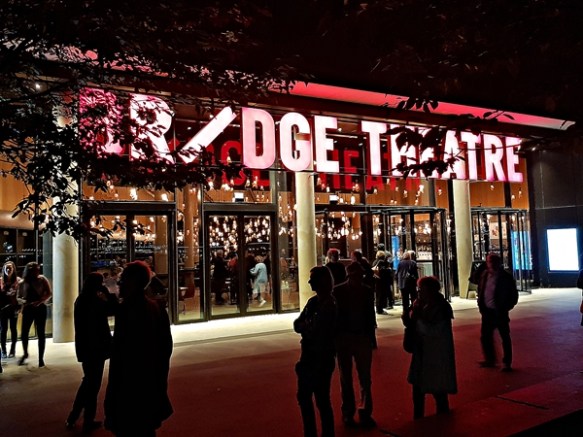
Doorways in the wide glass façade give access to a vast foyer, well-illuminated by a myriad of lamps with curious shades that look like large translucent handkerchiefs. Ample tables and chairs are available for people to sit in the foyer, enjoying excellent food and drinks from the counters lining one side of the space.

When you order food, you are handed a small flat, square receiver that looks like a drinks mat. When your food is ready, lights on the receiver flash alarmingly. The flashing object must be taken to a counter where your freshly prepared food is waiting for you. Despite the size of the foyer and its large capacity, it never felt crowded or noisy. It is a well-designed space.

The cloakroom and toilet facilities are easily accessible, not hidden in odd places as they are in the National Theatre.
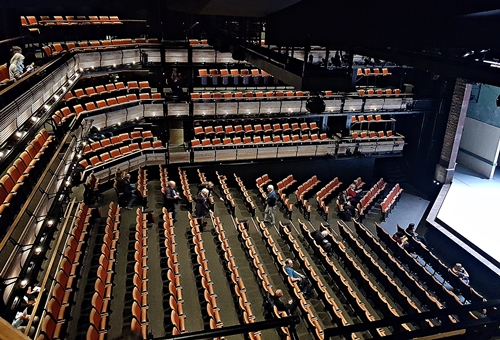
The auditorium is large, but not too large to be without intimacy. No seat is excessively far from the very wide stage. Sightlines are either excellent or more than satisfactory. We had ‘restricted view’ seats, which we bought at the last moment. They were as good as many ‘full view’ seats in older theatres. The acoustics are excellent. We were seated quite far from the stage, but had no difficulty hearing every word. The play we saw, “Allelujah” by Alan Bennett, was well-staged, well-acted, and well-written. In short, it was highly enjoyable. Set in an ageing National Health Service (‘NHS’) hospital facing imminent closure, most of the actors play either the roles of geriatric patients or those of hospital staff and management. The plot is about the plight of the aged and the plight of the ageing NHS system in today’s profit-oriented, economically declining Britain.

Our visit to the Bridge Theatre was enjoyable and uplifting. I cannot wait to see another performance there.

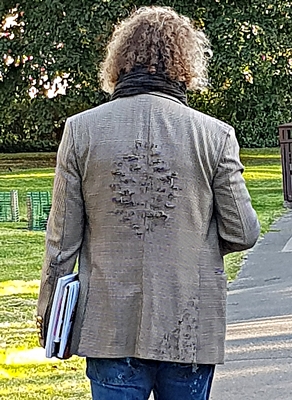
Is it à la mode?
A tailor’s design?
Or is it a torn jacket?
Contemplation of an artwork by Doris Salcedo

walking across the names
of refugees drown’d:
such is artwork today
Not long ago, I wrote about Warren Street, which played a significant role during part of my life. Now, let’s move a little further south to a street, which is overshadowed by the Post Office Tower and contains many memories for me.

London’s Charlotte Street runs between Rathbone Place in the south and Maple Street in the north. It is just over half a kilometre in length. Laid out in 1763, it was named after Queen Charlotte, who married King George III. I began to get to know the street just under 200 years later.
My earliest recollections of Charlotte Street were regular visits in the early 1960s to the Hellenic Stores on the west side of the street south of Goodge Street. My mother bought olives and other Mediterranean products at this store and another Greek shop in nearby Goodge Street. The latter was smaller than the Hellenic Stores, and a little less honest. When something needed weighing in the Goodge Street shop, the shopkeeper would throw it on the scales. The weighing machine’s needle would flash across the dial, and before one had time to think, a price was given. Neither of these purveyors of Greek produce exist anymore.

Site of Schmidt’s, now rebuilt
During the twelve years (1970-82) that I studied at University College London (‘UCL’), I used to visit Charlotte Street often. As a student, I was always keen to find somewhere to eat cheaply. Schmidt’s on Charlotte Street was one such place. This was a German restaurant. Its dining area was on the first floor. Most of the waiters were pasty-faced gentlemen, who added to the gloomy atmosphere of the place. The ground floor served as a delicatessen. It contained a counter where boiled Frankfurter sausages were served with mustard and slices of delicious greyish German bread. They were very cheap and extremely delicious. A female cashier sat in a booth in the middle of the room. Whenever I saw her, she had a blackish facial hair where men grow moustaches. My father, who was in London during the 2nd World War, told me that during the conflict, the owners of Schmidt’s posted labels on their windows, which read: We are British, NOT German.”
There have always been plenty of eateries on Charlotte Street. L’Etoile, which I never entered because it was beyond my budget, was a long-established restaurant on Charlotte Street. It had a Parisian look about it, but like Schmidt’s, it has disappeared. Near to the posh L’Etoile, there was a Greek ‘taverna’ called Anemos. I never visited it, but plenty of my fellow students did. One did not visit Anemos for its food, but for its riotous atmosphere, which included music, dancing and the trational Greek practice of plate breaking. Venus was another Greek place that has long since disappeared. I was taken there several times by an uncle, who worked nearby and regarded it as his favourite Greek restaurant.
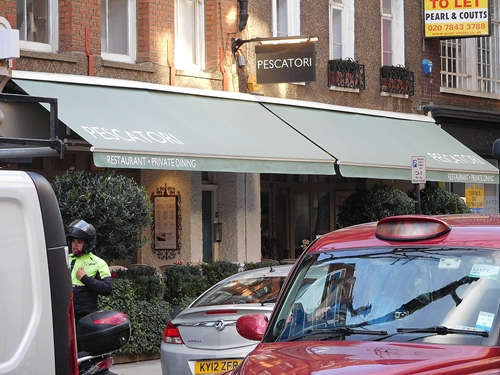
Just north of Goodge Street, there is another long-standing, and still existing, restaurant. This is the Pescatori, an Italian place specialising in fish dishes. It was one of my parents’ favourite restaurants in London. Back in the 1960s, there used to be a life-size boat suspended from the ceilings above the tables. I believe that my father was being serious when he said that he preferred not to sit beneath the boat, in case it fell.

There was another fish restaurant in Tottenham Street that leads east of Charlotte Street. Pescatori was at the high end of the scale of elegance, and Gigs was at the lower end. Gigs was very popular with students from UCL and workers in the neighbourhood. It was divided into two sections: take-away and sit-down. At lunchtimes, there was always a long queue at the take-away counter. Two gentlemen, oozing with sweat, took the orders for fish and chips and also for the delicious lamb shish kebabs they prepared while you waited. In between taking the cash and wrapping the fish and chips, they threaded lumps of lamb onto skewers, and grilled them. The kebabs were served with salad in a warm pita bread. As the saying goes, they were ‘to die for’. Despite the rather haphazard-looking hygiene, I know no one, who died from these mouth-watering bundles of meat and salad.
Gigs closed many years ago. Then a few years ago, the premises were modernised, and Gigs was brought back to life by some relatives of the original owners. What used to be the take-away section is now an attractive restaurant, and what used to be the sit-down area is now the take-away area. The updated Gigs is both hygienic in appearance and looks as if it is designed to attract a more sophisticated clientele than its ancestor.
My father was a professor at the London School of Economics (‘LSE’) for most of his working life. The LSE has a hall of residence for students, Carr-Saunders Hall, a non-descript 1960s building on Charlotte Street. When it opened in 1964, my father’s colleague Kurt Klappholz was its first warden. Kurt, whom I knew well as a family friend, was a Polish Jewish Holocaust survivor. Later, another of my father’s colleagues was a warden there many years ago. Once, he invited me to his flat. This academic possessed the most wonderful sounding HiFi equipment that I had ever heard. The warden, who owned it, was rather over-built. He told me that he preferred listening to music sitting in a comfortable armchair in front of his HiFi, than trying to squeeze into uncomfortably narrow chairs in concert halls.
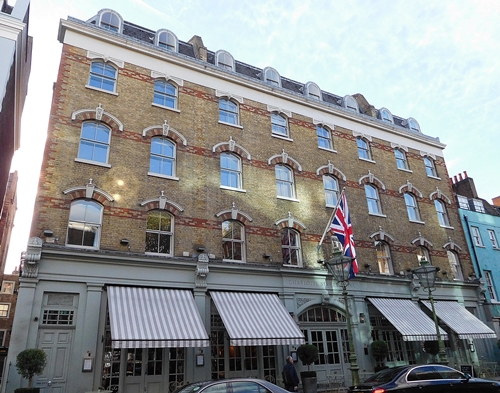
The building that used to house Cottrells
When I became a dental student, I became aware of Cottrells in Charlotte Street. This was near the Rathbone Place end of the street. It was the showroom for a major supplier of dental equipment. Housed in an elegant Victorian building, which still exists (it now contains a restaurant), the firm supplied everything from dental examination mirrors to entire dental operating units (chair plus attachments fordrills etc.) The technician responsible for teaching me how to cast gold crowns (caps) told me to visit Cottrells, not to look at the equipment, but, instead, the pictures hanging on the walls of the showroom. The walls were hung with a large collection of paintings by William Russell Flint (1880-1969). He specialised in depicting women. Well-painted, and quite artistic, the paintings on the walls of the dental showroom and of its main staircase fell very definitely into the category of extremely light porn.
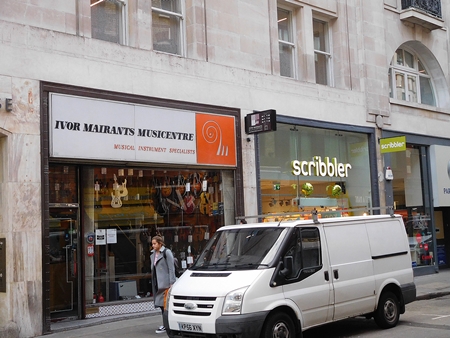
One of the longer established shops in Rathbone Place: Mairants
Rathbone Place, a short street which connects the southern end of Charlotte Street contained a large postal sorting office. Quite late on in life, one of my uncles, a bachelor now sadly no longer living, got a job there as a postman. He often used to tell me about his experiences as a medical orderly in the South African Army in the North African desert during the 2nd World War. He spoke of them fondly, regarding the great camaraderie he experienced amongst his fellow serving men. I often felt that this was one the more enjoyable times in his long and varied life. When he joined the postal team at Rathbone Place in his fifties, he spoke of this in the same appreciative terms. He liked being part of a working team. Now, not only has my uncle gone, but also the sorting office no longer exists.
Charlotte street and its surroundings lie in the shadow of the Post Office Tower, which was ready for use in 1964. Until 1980, it was the tallest building in London. When it opened it had a revolving restaurant high above the ground. I never ate there, but did manage to visit the viewing platform just beneath it. When I looked up from this platform, I could watch the concrete base of the restaurant rotating slowly. A terrorist attack in 1971 put an end to the public being allowed to visit the viewing platform or any other part of the tower.
I still wander along Charlotte Street occasionally. Although it is still extremely vibrant, it evokes many memories of times long past.

In a gauzy gown,
wandering through the dark,
ignoring Tower Bridge
My parents loved coffee. In particular, they enjoyed drinking well-prepared Italian espresso coffee. Every Saturday morning when I was a child in the late 1950s and early 1960s, we used to drive to the car park by Jack Straws Castle, a pub near Whitestone Pond in Hampstead. Now, the pub no longer exists; it has been adapted to become a block of flats. The car park behind it, where we used to leave our car, still exists.
We used to walk down Heath Street, passing the open-air art exhibition if it was summer-time. Our first stop was a café housed within a building with a triangular floor plan, which still stands on the corner of Heath Street and Elm Row. The Pimpernel café/restaurant, which was run by Italians, no longer exists, but this is where my parents used to take their espresso coffee on Saturday mornings.
In those far-off days, espresso machines were not equipped with pre-set electronic controls as they are today. The person making the coffee had to pull down a leaver, which forced the hot water through the powdered coffee and into the cup waiting below it. The speed at which the leaver is pulled determines the rate at which the hot water flows through the coffee and the length of time that the water remains in contact with the coffee grains. These factors help affect the taste and quality of the final cup of espresso and are dependent on who operates the lever. Thus, using the manual espresso machines requires skill and experience. In my parents’ view those who worked at the Pimpernel had these skills. Whenever we visited this café, the kindly staff would give my sister and me a small matchbox sized piece of Italian nougat (‘torrone’). I remember that the piece of torrone was coated on two sides with thin edible rice paper. That there was paper which was edible really impressed my young mind.
There was another place, whose coffee gained my parents’ approval during the 1950s. This was the Bamboo Bar on Finchley Road in Golders Green. It was located under the Northern Line bridge which straddles Finchley Road close to Golders Green station and opposite a now disused covered walkway which was once an entrance to the station.

Although the walkway and the Bamboo Bar have been closed for many decades, there is still an eatery in the same place, the popular Artista Italian restaurant. The latter is much larger than its predecessor.

The walls of the Bamboo Bar were lined with bamboo. It was run by two Italian men, Lorenzo Fraquelli and Simone Lavarini. My parents, who both loved Italy and her people, enjoyed chatting with these fellows. In 1955, they opened the first branch of what was to become the now widespread, extensive chain of Spaghetti Houses.
As mentioned, the Bamboo Bar closed years ago. Sometime in the 1960s, another café, Bar Linda, opened next to the bus station at Golders Green. This souvenir of my childhood still survives and is thriving.

One branch of the Spaghetti House chain made headline news in 1975. It was the branch, now closed, in Knightsbridge. This was the branch where managers of the various outlets of the chain would meet occasionally to deposit their takings before they were deposited in a nearby bank’s night-safe. On the days of the meetings, this restaurant was closed to the public. On Sunday 28th September, three armed men burst into the restaurant and demanded the takings that had been collected from the branch managers, who were meeting there. They bundled the managers in the basement. Luckily, one of the managers escaped and alerted the police, who arrived promptly. The bandits held the managers hostage for three days before giving themselves up to the police. This event became known as the ‘Spaghetti House siege’. I am pleased to report that nothing remotely exciting as that has ever occurred during my years of visiting this restaurant chain.
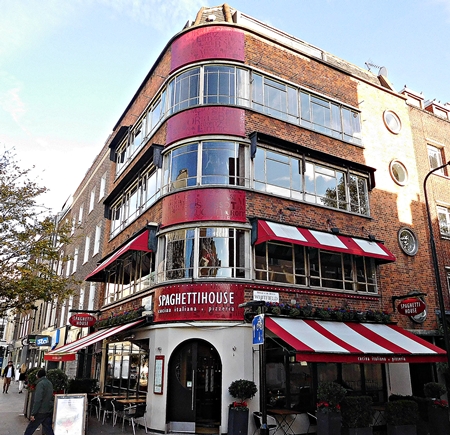
The first branch, which still exists, stands on the corner of Goodge Street and Whitefield Street (see picture above). When I was a young boy, my mother often treated me to a meal at this restaurant. We became quite familiar with the staff.
Many years later in 1970-71 during my first year as a BSc student at University College London (‘UCL’), I used to treat myself to lunch at the Goodge Street Spaghetti House. It was more expensive than the numerous canteens that were available on the UCL campus, but the food was far better. The ground floor of this multi-storey restaurant, like the Bamboo Bar, had walls covered with bamboo. This has long since been replaced by newer wall coverings. Some of the waiters who were working at the Goodge Street Spaghetti House were getting on in age by the time I began my undergraduate studies. At least one of them used to greet me as she remembered me as a child. Not only had she worked at the Spaghetti House since its opening, but she told me that she had also been a waitress at the Bamboo Bar.
We still eat the occasional meals at various branches of the Spaghetti House chain. The food is usually of a good standard. A few years ago, I met a chap with whom I had been to school before 1960. I had not seen him since about 1971, and then only extremely briefly. We agreed to meet up at a Spaghetti House restaurant. He told me that he preferred meeting people on ‘neutral territory’ in places like restaurants, rather than in homes. Although he had aged quite a bit since we were both 8 years old, he was recognizable. Almost as soon as he met me, he said to me:
“Oh, I thought I was meeting someone else, not you.”
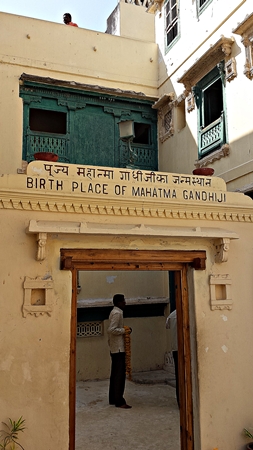
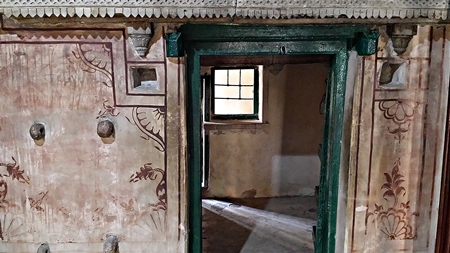
2nd of October was Mahatma Gandhi’s birthday. Here are pictures of his birthplace in Porbandar
Mohandas K Gandhi, the Mahatma, was born in Porbandar (Gujarat) on the 2nd of October 1869. The house in which he was born still stands, and is now part of the Kirti Mandir memorial complex in the centre of Porbandar. Here are some photos of Gandhi’s birthplace that Adam Yamey took in March 2018:
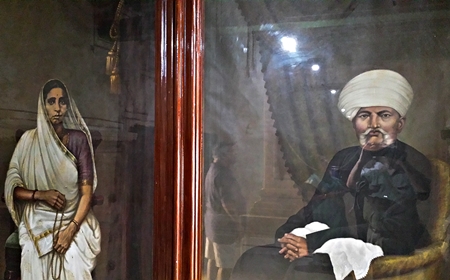 Gandhi’s parents
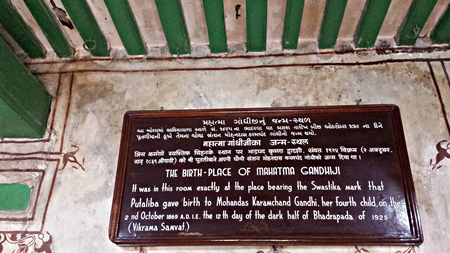
 The swastika marks the spot where Gandhi was born


 yamey
yamey 