
Feeling festive?
Why not go over the top
And decorate wildly?

Feeling festive?
Why not go over the top
And decorate wildly?
IT IS NOT OFTEN that I feel the need to write about answering the call of nature but after a recent visit to Hampstead’s South End Green, I must satisfy the urge.

There is a yard at South End Green, where buses serving the route number 24 wait before setting off to Victoria station. Long ago, this yard used to have tram tracks as it was the terminus of a tram line. A lovely small café, Matchbox by name, stands beside the yard. Its owner, Mirko, a friendly Slovenian, serves excellent hot beverages and a range of mouth-watering snacks, both sweet and savoury. The nearest public toilets are across the yard, almost opposite to Matchbox.
The toilets are below ground level and accessed by staircases with cast-iron structures above them. It was only on our most recent visit to South End Green, in December 2021, that I had reason to descend into the ‘gents’, and I am pleased that I did, not only for reasons related to my physiology but also to satisfy my curiosity.
The ‘gents’ is magnificent, with its white glazed brick walls decorated with bands of light green bricks, its long narrow, black and white chequered floor, its polished dark wood cubicles, and its row of white urinals all topped with grey (marbled with white streaks) granite separators. Although there is electric lighting, a skylight admits some natural light.
The underground toilet facilities, both the men’s and the ladies’, were constructed in 1897 for the benefit of passengers using the tramway. Stephen Emms, writing in the “Kentish Towner” in October 2013, noted that the gent’s underground facility at South End Green was a pick-up place used by homosexuals. He noted:
“But most memorably South End Green is the only public toilet still in use known to have been visited by iconic 1960s playwright Joe Orton. Apparently it was his “favourite pick-up point” too””
You might be relieved to learn that my recent brief visit was completely uneventful.

Plants in many pots
A garden filled with pleasure
The sweet joys of life
A REMARKABLE ENGINEER and furniture entrepreneur Jack Pritchard (1899-1992) and his family lived at 37 Belsize Park Gardens, in London’s Hampstead district. before WW2. Pritchard, who studied engineering and economics at the University of Cambridge, joined Venesta, a company that specialised in plywood goods. It was after this that he began to promote Modernist design. In 1929, he and the Canadian architect Wells Coates (1895-1958) formed the company, Isokon, whose aim was to build Modernist style residential accommodation.

Pritchard and his wife, a psychiatrist, Molly (1900-1985), commissioned Coates to build a block of flats in Lawn Road on a site that they owned. Its design was to be based on the then new ideas for communal housing that had been realised in Germany including the influential Bauhaus in Dessau. The flats are close to Fleet Road and the Mall Studios in Parkhill Road. Completed in 1934, they were, noted the architectural historian Nikolaus Pevsner, “… a milestone in the introduction of the modern idiom to London.” He continued, writing in 1952, clearly critical of the edifice, which:
“…put on a forbidding face towards the street, with large unmitigated concrete surfaces … It is all in the spirit of revolution, unaccommodating and direct to the verge of brutality.”
Well, I quite like the building’s elegant simplicity. In the basement space of the block, there was a refreshment area known as the Isobar. This and its furniture were designed by Marcel Breuer (1902-1981). Regularly, exhibitions were held in the Isobar and, according to an on-line article in The Modern House Journal these were attended by artists including Adrian Stokes, Henry Moore, Barbara Hepworth, Ben Nicholson and Naum Gabo. The article also noted that this refreshment area was frequented by modernist architects such as Erich Mendelsohn, Serge Chermayeff and, Wells Coates, as well as by left-wing politicians. Pritchard occupied the penthouse flat. In 1969, he sold the block, and now it contains accommodation for 25 keyworkers on a shared ownership basis and 11 flats are in private ownership. The block, first known as the Lawn Road Flats, is now called ‘Isokon. Lawn Road Flats’.
T F T Baker, Diane K Bolton and Patricia E C Croot, writing in A History of the County of Middlesex: Volume 9, Hampstead, Paddington, noted that the Lawn Road Flats were built partly to house artistic refugees, who had fled from parts of Europe then oppressed by dictators, notably by Adolf Hitler. Some of them had been associated with the Bauhaus. These included the architect and furniture designer Marcel Breuer, the architect Walter Gropius (1883-1969), and the artist and photographer Laszlo Moholy-Nagy (1895-1946). All three of them are regarded as being masters of 20th century visual arts.
Despite both having come from bourgeois backgrounds, the Pritchards aimed to free themselves from middle-class conventions. The concept and realisation of the Lawn Road Flats, were important landmarks in their quest to achieve a new, alternative way of living. It is accurate to say that the atmosphere that prevailed in the community that either lived in, or frequented, the Lawn Road Flats was predominantly left-wing and extremely welcoming to cultural refugees from Nazi Germany. Probably, it had not been anticipated that the place should become a convenient place for Stalin’s Soviet spies to use as a base. According to a small booklet about the flats Isokon The Story of a New Vision of Urban Living, published in 2016, the flats were home to the following espionage agents, who had been recruited by the NKVD in Central Europe: Arnold Deutsch, Simon Kremer, Jürgen Kuczinski, and Brigitte Kucynski Lewis. Jill Pearlman, one of the book’s several authors, noted that they found the Lawn Road Flats convenient for several reasons:
“Above all, they blended inconspicuously into the sociable community of tenants there. Many tenants too were refugees from Central Europe … Even the Lawn Road Flats building worked well for the spies. One could enter and exit any unit without being seen … no one could see in. At the same time, the cantilevered decks on each floor provided the tenants a perfect vantage point from which to survey the street below.”
Today, there is a small exhibition area in the garage of the flats. This is open on some weekends, but I have yet to visit it.
I DO NOT KNOW why there is a huge Albanian flag hanging outside The Cow pub in Notting Hill’s Westbourne Park Road. The large red flag decorated with a double-headed eagle has been fluttering outside the pub for several weeks, if not longer.

I walked into the colourfully decorated pub, for many years a local favourite both for drinkers and diners, and asked two members of staff if they knew anything about the flag. They did not have any real idea, but suggested that it might be because at least one long-serving member of the pub’s current staff is Albanian. A quick search of the internet revealed nothing.
The flag was put up long before the 28th of November, Albania’s Flag Day commemorating the founding of independent Albania in 1912, and is still flying. Maybe, one of you out there can tell me more about the reason that The Cow has an Albanian flag.
THE ARCHITECT JOHN Soane (1753-1837) was skilled in designing buildings with features to permit natural light to reach parts of them that were far away from their exteriors. Good examples of this were the two homes he designed for himself, one in Lincolns Inn Fields, now the Soane Museum, and the other in Ealing, the recently restored Pitzhanger Manor. Another superb example, which we visited recently (December 2021) is the Dulwich Picture Gallery in south London. Completed and opened in 1817, it became the first picture gallery in England that was open to the public.

Light enters Soane’s galleries at Dulwich from above via overhead sky lights. These were placed in such a way that they illuminate the hanging spaces without allowing direct sunlight to hit the paintings on the walls. This system has since been adopted in many other art galleries. Newer rooms, lit entirely by artificial lighting, are used for temporary exhibitions including that of the woodcuts of the American artist Helen Frankenthaler (1928-2011), which we saw on our latest visit. Compared with Soane’s galleries, these newer ones are far less impressive, and despite the modern lighting they feel claustrophobic and rather gloomy.
The permanent collection of old masters, which is hung in Soane’s original galleries, is fabulous. Some of the paintings were parts of collections made before the 19th century. Others were supplied by the artist Sir Francis Bourgeois (1753–1811) and his business partner, the art dealer and collector, Noël Desenfans (1744–1807). Together they ran an art dealership in London and were commissioned in 1790 to purchase a collection of paintings for the then King of the Commonwealth of Poland and Lithuania, Stanisław August Poniatowski (1732-1798). It took them five years to do this but by 1795, the Commonwealth had been dissolved. The collection remained in England. After Desenfans died, Bourgeois inherited the collection and then commissioned Soane to design a gallery to house it. The superb gallery at Dulwich came into existence. Soane included within it a small circular mausoleum in which the remains of both Desenfans and Bourgeois have been placed. Rather irreverently, I felt, it was being used to screen a video about the artist Helen Frankenthaler.
In 1944, during WW2, the western façade of Soane’s gallery was badly damaged by bombing (a German V1 flying bomb) but it has been well-restored. Later, in 1999, a new café and other facilities in a modern style were built to the designs of the architect Rick Mather (1937-2013).
As for the exhibition of works by Frankenthaler, this was a delightful surprise. It is a collection of colourful abstract woodcuts that are the result of years of the artist’s complex and imaginative experimentation. Many of the works reminded me of, but were not identical to, the subtleties of Japanese ceramic glazes. Despite being displayed in galleries far less satisfactory than those designed by Soane, this as an art show well worth visiting before it ends on the 18th of April 2022.
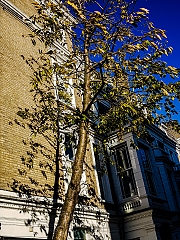
Sun shining brightly
On a leaning leafy tree
Casts a fine shadow
IT MIGHT BE OBVIOUS to many that the village pub is, along with the local parish church, often the social hub of small settlements all over England. Since the outbreak of the covid19 pandemic, we have not made our usual annual long trip to India. Instead, when public health regulations have permitted, we have been taking the opportunity better our knowledge of the country where we live, England, by making frequent trips to different parts of the land. On all these excursions, we have stopped for food and drink at pubs in many small places. Some of these pubs have become more like restaurants than traditional village social centres, but many still act as communal living rooms where local people gather to drink and chat together.
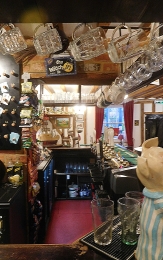
In Cavendish, a small village in Suffolk, there are two pubs. One is more of a restaurant than a traditional pub. By the way, it serves very excellent food. The other pub serves no food except packets of potato crisps. When we visited it, we were told that it only offers drinks. This pub was full of locals talking to each other quite animatedly. One, whom we overheard, claimed to be having a fantastic sexual relationship with a French lesbian, in whose house he had done some plumbing work.
One pub, which we have visited more than half a dozen times since early 2020, is in south Cambridgeshire. The Pig and Abbot at Abingdon Piggots, a village with about 60 households not far from Royston, successfully combines being a meeting place for locals with being a place where very well prepared, tasty food may be enjoyed, either in a small restaurant area or at tables near the centrally located bar.
The current owners, Mick and Pat, have owned the pub for almost 20 years. Pat is a superb cook and warm hostess, and Mick is a knowledgeable and charming host. He told us that the early 18th century building in which his pub is located used to be the local dower house, in which the wife of the lord of the manor lived after she was widowed. Back in those days, women usually outlived their husbands. The dower house was far from being a peaceful retirement home for widows of lords of the manor. It was a hive of activity. It was in the dower house at Abingdon Piggots that bread was baked, and other food prepared, not only for the manor house, but also for all the local families that worked for the lord of the manor. The manor, which had been in the Piggott family, many of whom have memorials in the local church, ended up in the hands of the De Courcy-Ireland family. In the early 20th century, a descendant of the Piggott family, who had inherited the manor married the Reverend Magens De Courcy-Ireland (died 1955). Mick told us that the dower house became a pub during the second half of the 19th century.
While we were enjoying a superb lunch during a recent visit to the Pig and Abbot, we asked Nick how many of the local villagers used the pub regularly. He told us that of the 60 households, 10 were regulars. We wondered whether we were amongst his customers who lived furthest away from the village. He said that we are, but his furthest customer, a former resident in the village, a biologist, now lives in Fairbanks, Alaska. However, whenever he is in England, he makes a point of visiting the Pig and Abbot. Despite this outlier and us, most of the regulars do not come from afar, and I noticed that Nick seems to know most of his customers by their first names.
Of the many pubs that we have visited during our extensive roaming around the English countryside, the Pig and Abbot has become our favourite. From its warm welcoming staff, to its great food and drink, to its range of well-chosen decorations, and to its lovely wood burning fireplaces, it ticks all the boxes, making it a perfect pub. Visiting the Pig and Abbot gives one a wonderful idea of what has made the English country pub such a successful institution over many centuries.
GROVE PLACE IS a short street running southwest from Hampstead’s steeply inclined Christchurch Hill. We often walk along it on our way to the lovely café at nearby Burgh House. A building containing numbers 29-31 Grove Place has often attracted my attention because its roof is topped with a couple of cupolas, each supported by four carved wooden pillars. These stand on either side of a grand central façade. The edifice bears a plaque, which is in an excellent state of preservation, that reads:
“This stone was laid by Mrs Sarah A Gotto on the 13th of July 1886 being the 50th Yr of the reign of her majesty Queen Victoria”
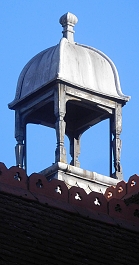
Elsewhere on the wall facing Grove Place there is a metal shield, painted black, which bears the following:
“1871. SPPM”
I was a bit puzzled by this because 1871 was some years before the stone was laid by Mrs Gotto.
I was pleased to discover that this building has been described in a book I possess, “The Streets of Hampstead” by Christopher Wade. He revealed that it was converted in 1970 from Bickersteth Hall, a hall built for the nearby Christ Church in 1895, and named after a former vicar, who later became the Bishop of Exeter. This gentleman was Edward Bickersteth (1825-1906), who had been vicar of Christ Church in Hampstead from 1855 to 1885 (www.praise.org.uk/hymnauthor/bickersteth-edward-henry/). Wade adds that it is confusing that the 1871 St Pancras shield and the 1886 Mrs Gotto plaque have been placed on the building. So, it seems that Mrs Gotto might have had little to do with laying the first brick of the building, but I wondered who she was.
Wade describes Sarah Gotto as Mrs Edward Gotto. Edward was most probably Edward Gotto (1822-1897), a civil engineer and architect who entered a partnership with Frederick Beesley in 1860 to create the engineering firm of Gotto and Beesley, which flourished for 30 years and carried out drainage works in towns all over the world including Rio de Janeiro, Seaford, Trowbridge, Evesham, Huyton and Roby, Redditch, Brentford and Cheshunt; and the drainage and water-supply of Campos (Brazil), Oswestry, Leominster and Cinderford (www.gracesguide.co.uk/Edward_Gotto). According to his obituary, Mr Gotto lived in Hampstead in a house called The Logs on East Heath Road. Built in 1868, The Logs, was as I have described elsewhere (see https://adam-yamey-writes.com/2021/02/01/finding-boy-george-and-bliss-in-north-london/), much later home to the comedian Marty Feldman and the singer Boy George. Edward’s wife Sarah was born Sarah Ann Porter (1829-1901; https://ancestors.familysearch.org/en/L1Q6-7NL/major-harold-ralph-gotto-1868-1957), She and Edward had eight children, one of whom was Harold Ralph Gotto. He was born in 1868 in Hampstead and later became a major in the British Army.
All of this is interesting enough, but none of it explains (to me) why Sarah is commemorated by the plaque on the house in Grove Place. If anyone knows the reason, I would be pleased to hear from them.
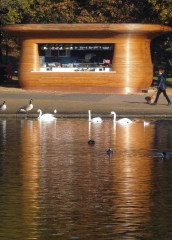
Swans sail serenely
Passing the lakeside kiosk
Very silently
 yamey
yamey 