Weaving life’s tapestry,
Warp and weft:
A world of experienc-es


Weaving life’s tapestry,
Warp and weft:
A world of experienc-es
I have always enjoyed browsing the shelves and piles of books in second-hand bookshops. During my adolescence in the 1960s, I bought many old travel guidebooks, such as were published before WW2 by the likes of Baedeker, Michelin, Murrays, and so on. These items were not highly valued by collectors in the ’60s and were very reasonably priced. This was just as well because my spending power at that time was not great. My self-imposed rule was that I would not buy anything priced over £1 (Sterling). One of my prized purchases in that time was a pre-WW1 Baedeker’s guide to Egypt. I paid six shillings (30 pence) for this already rare edition in the second-hand department off Dillons university bookshop, which faces the Engineering Department of University College London. This shop is now a branch of the Waterstones chain of booksellers.
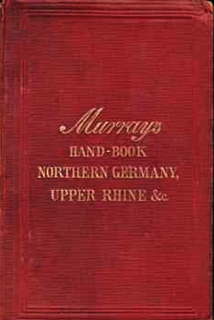
Most of the bookshops that I visited regularly were in or near Hampstead, which in the 1960s had at least eight second-hand booksellers. There was one shop that I visited occasionally on the corner of Fleet and Agincourt Roads, Once I entered it and found a copy of Murray’s Handbook to Northern Germany, which was published in the late 1880s. I was fascinated by this book which described Germany long before it was divided into East and West Germany, which is how it was in the 1960s. I looked inside its cover to discover its price. My heart sank. It was priced at one pound and ten shillings (£1.10). It was well over my price limit. I could not decide whether or not I should break my £1 rule … only this once. I did not. Reluctantly, I left the book behind in the shop. I had never seen a copy of this book before, and as I walked away I wondered whether I would ever see another.
In the 1980s, I was still collecting old books including travel guide books. By 1983, I had a car and drove to see friends all over the UK and elsewhere. Often, I visited friends in Cornwall. My route took me through many small towns, all of which I explored with a view to discovering second-hand bookshops. Honiton in Devon used to contain several well stocked booksellers. On one trip I entered one of them at the western end of the town and made an exciting discovery. Yes, you have probably guessed it already. In that shop, I found another copy of the guide to Northern Germany. Nervously, I looked for its price. By now, I had abandoned the idea of limiting my spend to £1, which in the 1980s would have been insufficient to buy any of the old guidebooks that attracted my interest. The volume I found was £7, which was good value in the 1980s. I snapped it up and paid for it with pleasure.
Nowadays, if I see a rare book that interests, I seize the opportunity to buy it, provided that it is not outrageously costly.

When I was doing experimental work in a physiology laboratory in London during the early 1970s, a new technician joined us. She was a lovely young girl from Liverpool. The job suited her perfectly and she was a great worker, full of cheer.
After two weeks, she announced that she was leaving us and returning to Liverpool. When asked why, she said: “I love working with you all, but nobody talks to each other on the bus. Back home in Liverpool everyone chats on the bus.”
Several decades later, I visited the lovely city of Liverpool. As soon as I was able, I took several rides on the city’s buses. On not one of these journeys did any of my fellow passengers chat to me nor to anyone else. I was so disappointed: I had been looking forward to speaking with the loquacious Liverpudlians, whom our technician had missed when she spent two weeks working with us in London.
An Albanian who attacked the Portuguese in India during the 16th century
While visiting the former Portuguese colony of Diu, an enclave on the south coast of the Saurashtrian peninsula of Gujarat, I came across an open space that provides great views of the fortresses.
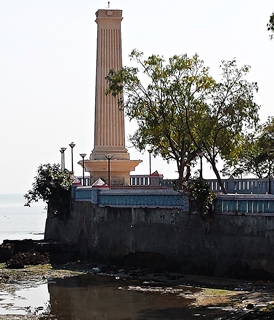
It contains a tall, bulky, four-sided column with longitudinal striations. Wire hoops serving as simple steps provide a means of reaching the column’s flat square summit. This is a monument built by the Portuguese to honour of the Gujarati General Khadjar Safar (known by the Portuguese as ‘Coge Cofar’). The Gujaratis and the Portuguese were enemies and a siege occurred in 1546. This siege of Diu was won by the Portuguese, but Safar was remembered for his bravery. I have seen a picture of this column taken in the 1950s, when it bore a plaque in Portuguese that read in translation: “The tomb of Coge Cofar, instigator of the second siege of Diu. Commander-in-chief of the Turkish…
View original post 235 more words

Someone, maybe it was a great composer such as Beethoven, once said:
“Forget the past, don’t be satisfied with the present, and have hope for the future.”
I don’t agree with all of this, but then I am not Beethoven. The past teaches us valuable lessons. Enjoy every moment of the present. And, look forward to the future.
By the way, does anyone know for sure whether Beethoven or another composer came up with the words I quoted?

Sometimes it pays to keep your mouth shut at the dental surgery.
In the 1950s and early ’60s, our family dentist was a kindly German Jewish refugee called Dr Samuels. In those days, I learned later while I was studying dentistry, sugar used to be an ingredient of toothpaste made for use by children. I doubt that my mother provided us with children’s toothpaste, which she would have regarded as being gimmicky.
Dr Samuels had a very upmarket practice in London’s St John’s Wood. His waiting room floor was covered with thick pile oriental carpets and the reading matter was glossy journals such as Country Life.
The surgery, where Dr Samuels performed his dentistry, was old-fashioned. Instruments were kept on display in glass fronted metal cabinets. His x-ray machine looked antiquated even to my young, inexperienced eyes. So, did most of his other equipment, much of it made by the German Siemens company. One of my uncles, also a patient of Dr Samuels, once asked him if a museum might be interested in displaying this historic looking dental equipment. Samuels answer was that it was not quite old enough for a museum.
Dr Samuels drilled teeth with a cord driven dental handpiece. He told us that he had an air driven high speed dental drill, but he did not like it because it cut too fast in his opinion. So, having fillings in his surgery was quite a noisy and bumpy experience.
Dr Samuels was a gentle, kindly man, like a benevolent grandfather. He never frightened me.
At the end of an appointment, he used to reward me with a boiled sweet. I looked forward to receiving these. However, one day when I was about 8 or 9 years old and he offered me the sweet, I said to Dr Samuels: “No thank you. Sweets are filled with sugar and bad for my teeth.”
The price I paid for my precociousness was that he never again offered me a sweet at the end of my appointments with him. I should have kept my mouth shut and graciously accepted his kind but unhealthy gift.
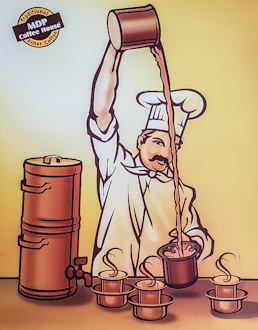
Traditionally, South Indian filter coffee is served piping hot in small conical metal breakers. The beakers, which are almost too hot to hold, stand in deep cylindrical metal saucers, as shown in the picture.
To cool the coffee so that it reaches a drinkable temperature, one lifts the hot beaker out of the saucer, and then pours the coffee from the beaker into the saucer from as greater height as you dare. Then, you pour the slightly cooler coffee back into the saucer. The procedure is repeated until the beverage reaches the desired temperature.
The person making the coffee repeatedly scoops the bubbling boiling milk, which is added to the coffee, from its pot on the heat, and then pours it back from a great height. The stream of boiling milk is often quite long.
My late father-in-law, a witty man, referring to the pouring from a height involved in filter coffee making and drinking, used to ask us when we visited a coffee house in Bangalore : “How many yards of coffee do you want?”
Note: 1 yard is a measure of length a little less than 1 metre
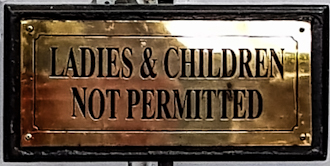
When she was about two years old, our daughter dressed in a unisex romper outfit, rushed into the Men’s Bar at the Bangalore Club. An elderly gentleman conducted her back to the entrance of the bar, saying: “You can’t come in here yet, young man. You’ll have to wait until you’re twenty one.”
My wife explained that our child is a girl. The gentleman replied: “In that case, my dear, you will never be able to enter the Men’s Bar.”
The Bangalore Club was founded by British officers in 1868 at the time when Mahatma Gandhi was born in faraway Gujarat. Until after about 1945, women were not allowed into the main Club House. There was a separate annexe reserved for women. And until 1947, with the exception of servants and a very few high ranking military officers, no Indians were permitted to enter any part of the Club.
The Bangalore Club and many other similar still existing colonial era clubs in India maintain many of the old-fashioned rules that applied in elite clubs in the UK. For many years, men could only enter the Club House at the Bangalore Club wearing ‘proper’ shoes, not sports shoes or sandals. Now, sandals are allowed providing they have a back strap around the ankle.
Once, I stayed at the Kodaikanal Club deep in the southern Indian state of Tamil Nadu. Dress code seemed to be non-existent there until I stepped into the club’s small library. Within a few seconds, a member of the library staff escorted me out of the library. I was wearing sandals. I was told that one could only enter the library if formal leather shoes were being worn.
Well, if you join a club, you should respect its rules however idiotic they might seem. Vide the UK and the EU.
As time moves on, rules change. A couple of years ago , for reasons best not explored here and they were nothing to do with gender equality, women were permitted to enter and use the Men’s Bar at the Bangalore Club. Since that date, the formerly masculine sanctuary has been renamed “The Bar”.
The old gentlemen who evicted our daughter from the Men’s Bar is probably no longer alive. I wonder what he would have thought when his prediction proved to be wrong. Let’s finish by raising a glass to his memory.

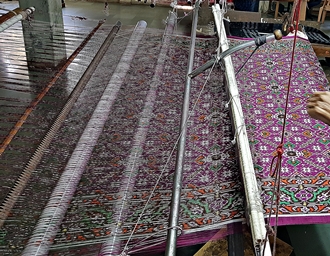
Worth its weight in gold:
The craftsmanship –
Often sadly under valued
Mahatma Gandhi might well have crossed this bridge…
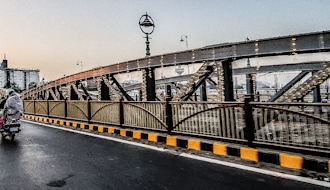
Ahmedabad was founded on the east bank of the River Sabarmati in the 15th century. Until 1871, there was no bridge across the river from the city to the west bank. In that year, a wooden bridge was constructed.
A few years later, the wooden bridge was destroyed by floods. In 1892, a steel bridge was constructed. This was designed by an Indian engineer HD Bhachech and named in honour of a British colonial official named Ellis.
The Ellis Bridge remained in use until 1997, when it was closed. By 1999, two concrete bridges were constructed, one on each side of the old bridge. These new, wider bridges form what is now known as the Swamivivekananda Bridge. The old Ellis Bridge flanked by the two concrete bridges, heavily laden with traffic, has been preserved as a heritage monument.
The old Ellis Bridge, which existed when Gandhi returned to India from…
View original post 22 more words

 yamey
yamey 