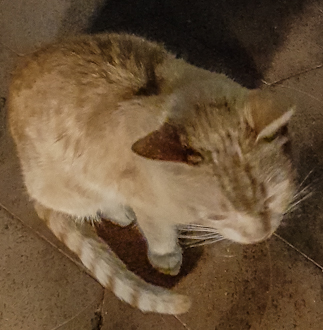
Mice sing prais-es,
Their coast is clear:
Our belov-ed pussy is no more


Mice sing prais-es,
Their coast is clear:
Our belov-ed pussy is no more
Salt is more than just a condiment on your dining room table. It is one of life’s essentials…

Salt is an essential part of the human diet. In Africa, salt produced by the Moors was transported across the Sahara Desert to salt-free Central Africa, where it was exchanged for gold. This shows how much salt is valued as a commodity.
On a recent bus trip between the two Gujarati cities of Baroda and Bhavnagar, we passed through a flat low-lying district not far from the sea (the Gulf of Khambat). Along the way, we passed numerous white piles of salt recently extracted from the sea. These piles stand amongst pools of salty water that is evaporating in the hot sun. Although flat, the landscape is varied and fascinating.
Gujarat is the largest salt producer in India and the third largest in the world. Sadly, the salt workers, whose life is tough and dangerous, are poorly treated by their employers. According to the Indian Express dated April 26, 2016…
View original post 21 more words
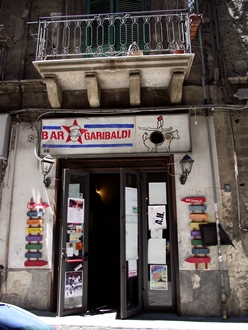
In 1860, Giuseppe Garibaldi commenced his famous invasion of Sicily. This led to the downfall of the House of Bourbon’s rule in Sicily and Naples and, ultimately, to the Unification of Italy.
Many people who live in the UK will be familiar with Garibaldi biscuits (‘cookies’ in US English). They consist of a paste made with currants sandwiched between two layers of thinnish baked biscuit dough. Because of their appearance, they are sometimes called ‘squashed flies’. Garibaldi biscuits were first made in 1861 by the Peek Frean Company in London and have been popular ever since. Garibaldi, who visited England in 1854, became very popular amongst the British at that time.
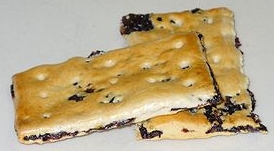
Garibaldi biscuits (from Wikipedia)
In 1910, the Peek Frean Company designed a biscuit that consists of a chocalate flavoured paste placed between two rectangular chocolate flavoured biscuits. This now very popular biscuit was named the ‘Bourbon Biscuit’.
I wonder how many of the millions of Garibaldis and Bourbons are eaten by people, who know the historical significance of their names.

Man’s ingenuity:
To cross a river,
Construct a simple stone bridge
Picture taken in Dartmoor, England

Before I began studying at Highgate School (in North London) in 1965, joining the Combined Cadet Force (‘CCF’) was compulsory. The CCF was military training for teenagers, who were dressed in full military uniforms. The school was well-equipped for CCF training, having an assault course, a shooting range, a fully-equipped armory, and several members of staff who had been, or still were, high ranking military officials.
Fortunately for me, joining the CCF became voluntary just after I joined the school. The CCF trained on Tuesday afternoons. Those, incuding me, who had opted out of the CCF, had to do something worthy instead of military training.
For a while I was enrolled in ‘Digweed’, a squad of pupils who helped with gardening in the school’s numerous properties. I was assigned to the garden of one of the boarding houses. I could not tell a wanted plant from a weed, and was therefore quite useless. We used to be given cups of tea halfway through the afternoon. It was tea with milk, which I detested in those days. So, my only useful contribution to Digweed was watering plants with the contents of my tea cup.
After a spell of Digweed, I was asked to visit a home for elderly people every Tuesday afternoon. My task was to chat with them. People who know me now will not believe how shy I was when I became a visitor to the home, but I was. The elderly folk living at the home used to sit in high backed chairs arranged around the walls of a large room. I was supposed to talk with them. I tried, but almost all of them were too far gone to respond. These Tuesday afternoon visits were dreary and depressing, as well as being pointless.
There was one old lady, who was very chatty and friendly. However, she was not present every time that I visited. She told me that whenever she could, she would run away from the home, but would always be found and brought back.
One Tuesday, I rang the doorbell of the home. One of the staff opened the front door, but prevented me from entering. Behind her, I saw a coffin resting on a trolley in the hallway. “Best you don’t come in today,” the staff member whispered to me. I know it sounds wrong, but I was really pleased that the coffin had spared me yet another afternoon of misery with those poor distressed gentlefolk.
Beasts of burden fit for the climate of Gujarat…
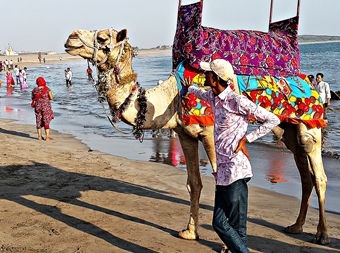
Somnath beach
When we visited the beaches at Daman, Kutch Mandvi, and the temple town of Somnath, we saw camels on the beach. Their owners offer rides to holidaymakers, who have come to enjoy the sun, sea, and sand.
However, camels are not only kept for pleasure. All over Gujarat, we spotted camels drawing carts and wagons in towns, villages, and in the open countryside. Apart from being picturesque to my western eyes, they are much valued beasts of burden.
Gujarat and Kutch are areas with a semi-desert terrain and almost desert weather conditions. The camel is ideaaly suited to this environment. Most of the camels used in Gujarat State are bred in Kutch and are highly priced.
Read much more about this fascinating part of western India in “TRAVELS THROUGH GUJARAT, DAMAN, AND DIU” by Adam Yamey. The paperback is available from lulu.com, bookdepository.com, and Amazon, which…
View original post 5 more words

Japanese food was a relatively new addition to the Londoner’s diet in the early 1970s. It was then that I first tasted sashimi (i.e. raw fish).
Some friends including my future wife persuaded me, an impecunious PhD student, to join them at one of London’s few Japanese restaurants. This one was in St Christophers Passage that leads off Oxford Street. I ordered a serving of tuna sahimi. Four neatly cut cubes of tuna arrived in front of me. It was delicious. Fish had never tasted as good as this before. Cooking, however carefully done, removes something essential from the fresh taste of fish. The four exquisite cubes of fish soon disappeared. I did not order anymore because this tiny portion of sashimi cost £7 Sterling, a huge amount in the early 1970s. The purchasing power of £7 in 1974 is roughly equivalent to the purchasing power of £66 today. Despite its enormous price, I became ‘hooked’ on sashimi.
I must tell you that I left the Japanese restaurant with my hunger unassuaged. Without telling my friends, I sneaked off to a nearby … now, don’t frown disapprovingly … McDonalds outlet and filled up on junk food.
Fortunately, although not cheap, Japanese food, including sashimi, is relatively cheaper in London now than it was back in the 1970s,

Highgate Wood in late February
Trees with bare branches will soon bear leaves.
The sun shines through the cool, clear morning air.
Shadows of tree trunks fall across the gravelly path, along which a man walks his dog.
A mother wheels her baby in a pushchair.
And a jogger lopes past me, panting wheezily.
An occasional bus passes by a signboard on the barely used pavement. It invites customers to take refreshment in a sylvan café.
It is Monday morning, and most people are at work.
A suburban idyll.

Until a couple of years ago, I considered that the very best coffee served in London could only be found in a few coffee bars, all of which were Italian (e.g. Bar Italia, Lina Stores, and The Algerian Coffee House in Soho; the Portobello Garden Café in Portobello Road), Portuguese (e.g. Lisboa Café in Golborne Road and Madeira Star in Lambeth), or Spanish (e.g. Brindisa near Borough Market). I still consider all of these as good choices for excellent coffee, but need to add another to my list.
A Polish born receptionist working at the dental practice where I used to practise dentistry, suggested that a restaurant in Ealing called ‘Sowa’ (means ‘owl’ in Polish) served good Polish food. We visited this place, but were not impressed by the food. Much better Polish food can be obtained at Café Maja in POSK, the Polish Centre in King Street, Hammersmith.
The well-appointed restaurant at Sowa adjoins a café, which is part of the same establishment. Unlike the restaurant that fails to shine, the café is magnificent. The coffee served here in all forms (espresso, cappuccino, latte, etc.) is at least as good as that we have drunk in the best of the Italian, Portuguese, and Spanish coffee houses in London. Having visited Sowa too many times to remember, I can safely say that the high quality of its coffee never wavers.
Sowa’s café also offers a mouth-watering range of highly tempting pastries and cakes. It seems in general that the Polish have a magical touch when it comes to making these delightful accompaniments to coffee.
So, if you are in Ealing, ignore every other café, and head for Sowa.
PS: Next door to Sowa, there is a lovely Polish delicatessen that offers a wide range of salamis, hams, and other cooked meats, as well as other Polish food items.
Sowa: 33 High St, London W5 5DB
NB: I have no interest financial or otherwise in Sowa. I am simply a content customer!
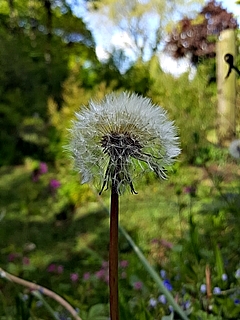
In time, it will become bald.
Won’t we all?
Is life a dandelion?

 yamey
yamey 