
Why do some birds
Stand on only one leg instead of two?
Please tell me


Why do some birds
Stand on only one leg instead of two?
Please tell me
THE FATEH SAGAR is one of the 4 lakes within the city of Udaipur in Rajasthan. It is man-made, having g first been established by Maharana Fateh Singh of Mewar in the 1680s. Two centuries later, the dam holding the lake was washed away. In 1889, a new dam was built, the lake enlarged,and given its present name. The lake is a little way outside the centre of the city and is surrounded by hills. It is a peaceful place.

Electrically powered boats ferry visitors to and from an island in the lake. This island contains the well-maintained Nehru Park, which was established in 1967 and named after Pandit Jawaharlal Nehru.
The small park is beautifully planted with trees and other plants. Various paths criss – cross the island and one runs around its perimeter. The perimeter path is punctuated by circular domed pavilions that provide shade. There is also an elaborate fountain system that was out of action when we visited the park one morning.
Refreshments can be obtaine at a small cafe behind which there is a very clean set of WCs. We spent a very pleasant hour on this small island, and while we were there we spotted some interesting birds which neither of us could identify.
Nehru Park is a lovely refuge: a place to escape from the hustle and bustle of the historic entre of Udaipur.
THE ENTRY TICKETS to the City Palace in Udaipur (Rajasthan, India) were reduced in price today (25 November 2025) because parts of it were closed because a major wedding had just been held within them.
The palace, which is perched on a hill high above Pichola Lake, began to be constructed in 1553. Over the next 400 years, its construction continued. Overall, it is an example of typical Rajput architecture, sharing features that can be seen in other royal palaces in Rajasthan.
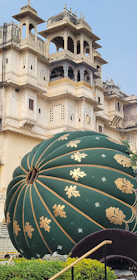
On entering the palace today, we confronted with a sea of debris, the remains of temporary structures used during the wedding. It looked as if a bomb had exploded. The crowds of tourists had to avoid bumping into the numerous workmen carrying boards and planks that were the remains of the demolished temporary structures. It was not a pleasant way to enter a historic building.
Visitors to the palace are obliged to follow a route through its various rooms and courtyards. The passageways co necting these are narrow, featureless, airless, and crowded. Moving through the palace was an unpleasant experience.
Was it worth the effort? I think it was not. Evenif there had been no debris and workmen, the palace would not have impressed me. The City Palace in Udaipu is no way as elegant and beautiful as the royal palaces I have seen elsewhere in Rajasthan, notably those in Amer (Amber near Jaipur), Jodhpur, and Bikaner.
Well, after having seen the City Palace, one of the main ‘attractions’ of Udaipur, I would certainly give it a miss should we ever visit the city again.
A MAJOR ATTRACTION in Udaipur (Rajasthan, India) is its Lake Pichola. There are plenty of hotels and eateries close to the water. One of these is Jheels Ginger café. This small establishment is next to the waterside and has great views of the lake. Also it has a small bookshelf. On it, my wife found a book that aroused my interest.

The book, which was falling to pieces, was “Compact Dictionary of Canadian English” edited by Thomas Paikeday, and published 1976 in Toronto. It was the first Dictionary of English as used and spoken in Canada.
Thomas Paikeday was born in Thiruvananthapuram, India in 1926. He completed his studies at Madras Christian College (1958) and the University of Madras (1960). Then, he became a lecturer of English at the University of Delhi. In 1964, after studying in the USA at Boston College and the University of Michigan, he became a lexicographer.
Paikeday was a pioneer in the use of computers for collecting and analysing data for compiling dictionaries. He became highly respected amongst lexicographers, linguists, and other scholars. He died in 2019 at Oakville, Ontario, Canada.
It was strange discovering a dictionary of Canadian English lying discarded in a café in Udaipur. But given that it was in India that its editor was born, it seemed quite both appropriate and really amazing.
WE OFTEN VISIT Wadebridge in Cornwall. It contains an establishment called Churchill Bars. Actually, it is also the headquarters of the local Conservative Club. Until 2025, this place had a restaurant that served well-prepared meals, which included very tasty roast pork belly. Sadly, since early 2025, the Churchill Bars have ceased serving meals.

Fortunately, far away from Cornwall in South Bombay, Churchill Cafe is still in business. Located in Colaba and owned by Parsis, this tiny restaurant serves superb European-style dishes, as well as a few Parsi gastronomic offerings. Decorated with photographs of London landmarks and a portrait of Winston Churchill, this bustling restaurant is well worth visiting.
KRISHEN KHANNA CELEBRATED his one hundredth birthday in July 2025. The NGMA (National Gallery of Modern Art) in Bombay is currently holding a superb exhibition showcasing his paintings. The show is beautifully displayed and the artworks are skilfully illuminated.
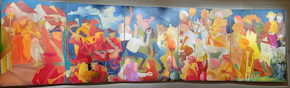
Khanna was born in Lyallpur, now in Pakistan. After the Partition of India in 1947, he worked as an official in Grindlays Bank in Bombay. However, before Partition, he had already begun painting. The bank job was just to help keep him and his family going after they had left/fled what became the Pakistani part of Punjab.
Soon after arriving in India, Khanna began associating with members of Bombay’s Progressive Art Group that included notable creators such as FN Souza and MF Hussain. Thereafter, his painting career took off, and his reputation soared.
The exhibition at the NGMA surveys Khanna’s extraordinary range of paintings. Their subject matter ranges from political to historical to religious … and much more. The show, which demonstrates the artist’s amazing versatility and great artistic skill, continues until 12 December 2025, and should not be missed if you are in Bombay.
THE DR BHAU Daji Lad Museum in Bombay’s Byculla district is housed in a building with a neo-classical (Palladian) facade. However, within it there architecture is gloriously Victorian. Recently restored its interior competes with the exhibits for the viewer’s attention.

The museum was opened in 1872 as ‘The Victoria and Albert Museum’. Like its namesake in London, its exhibits are form a display of applied arts, technology, and design. Some of them are replicas of objects that were sent from India to London as exhibits in the Great Exhibition of 1851.
In 1975, the museum was given its present name, which honours Dr Bhau Daji Lad (1822-1874). He was an eminent physician and surgeon, who researched cures for leprosy. With a keen interest in archaeology, he did much to raise funds to pay for the establishment of the museum.
One of the men who donated money towards the founding of the museum was the Jewish businessman David Sasoon. The museum contains a tall statue of Victoria’s Consort Prince Albert. The base of this includes the words “dedicated by David Sassoon”, and beneath them, there are some words in Hebrew. The base of the statue also has words in Hindi, Gujarati, and Urdu scripts. In front of the statue, there is a bust of Sassoon.
Like the much larger Victoria and Albert Museum in London, the Dr Bhau Daji Lad Museum contains a wide variety of beautifully crafted objects: too many to describe here. Some rooms of the museum are dedicated to housing temporary exhibitions. Behind the museum, there is a courtyard, lined by another exhibition space, a café, a small Hindu shrine, and a museum shop.
Of the many wonderful places that can be seen in Bombay, the Bhau Daji Lad Museum is one of my favourites.
WE ATTENDED AN exhibition of paintings on cloth textiles by Anju Dodiya, who was born in Bombay in 1964. She studied at the Sir JJ School of Art. We were fortunate to have met her at Chemould Galleryin Bombay’s Prescott Street, where her paintings are being exhibited.

The exhibition is called “The Geometry of Ash”. The fabrics on which she has painted beautiful, slightly mysterious images come from all over the world. Some from West Africa, and one from London (it is a slightly stained British Museum tea towel).
According to the gallery’s handout:
“Anju speaks of stillness not as passivity, but as resistance. In an age of urgency, of constant outrage and digital noise, her paintings compel us to pause. They demand attention, not compulsion …”
Whetether or not you feel this when you view the exhibition is irrelevant because the paintings are beautifully executed and visually compelling. I am pleased that we were braved Bombay’s high air temperature one afternoon to walk to the show.
THE ROYAL BOMBAY Yacht Club faces the famous Gateway of India. One side of the club’s compound runs along Adom Street. ‘Adom’ is a transliteration of a transliteration of ‘Adam’.

According to Samuel T Sheppard’s book “Bombay Place-Names and Street-Names”, the Street is named after the British architect John Adams. He taught architectural drawing at Bombay’s esteemed Sir JJ School of Art.
Adams designed the Royal Yacht Club’s present building that faces the Gateway of India. Although the club was founded in 1846, Adams’s edifice was opened in 1898.
It is appropriate that a Street running next to his building now bears his name, even though on the street ame sign, it is now spelled Adom instead of Adam.
ALMOST EXACTLY TWO years ago (in December 2023), we spent a few nights in the Moti International hotel in a street leading off Bombay’s bustling Colaba Causeway. Despite its impressive sounding name, this hotel was curiously interesting.
It is housed in Moti Mansion, a large house built by a Parsi family in about 1900.

We had not booked the hotel in advance, but walked in to enquire whether we could stay fir a few nights. The young man at the small reception desk asked us:
“Are you married?”
We told him that we were and then he said:
“I have to ask you because, you see, my grandfather who lives with us on the top floors, is an old fashioned orthodox Hindu.”
Our ground floor room was adequate, air-conditioned,and had a decent attached bathroom. Sadly, the windows had been painted over. So there was no daylight. When we asked for a kettle, the young man explained:
“Yes, but I must charge you an extra 100 rupees for three days of electricity.”
We were happy with that.
On our last morning, we met the boy’s mother. She showed us the buildings impressive main wooden staircase. She explained that many of the rooms in the building were occupied by long-stay guests.
Today, 19 November 2025, we walked past Moti Mansion. Its street facing facade wast partly hidden by scaffolding and almost all the windows were covered over with wooden boarding.
I wonder what the future holds for this charming edifice.
 yamey
yamey 