Unknown's avatar

About yamey

Active author and retired dentist. You can discover my books by visiting my website www.adamyamey.co.uk .

Building boats by hand at a port in Kutch, (Gujarat, India)

THE SEAPORT MANDVI in the Kutch district of the Indian state of Gujarat was founded by Maharao Khengarji I, the ruler of the kingdom of Kutch, in 1580. It became an important, thriving centre of trade for several centuries. And for over 400 years it has been a place where dhows have been built. Today, these huge wooden ships can be seen in various stages of construction along the banks if the Rukmavati River on whose shore lies the town of Mandvi.


The dhows are constructed largely by hand as they have been done for over 400 years. They are built with timber, sal wood, imported from Malaysia. Today, the timber is landed at the port of Kandla in Kutch  a d brought by road to Mandvi.


According to an article in the The Hindu  newspaper dated April 2017:

“As maritime trade grew, traders—belonging to the seafaring Kharva community of both Hindus and Muslims—developed a new expertise: boat-making and repairing to add to their traditional navigational skills.”


Furthermore ,  the arti le related, the dhows:

“… built by hand by craftsmen who are barely literate and have no training in engineering, the ships come up expertly without so much as a sketch being referred to.”

I found this to be quite amazing.


The dhows take several year to be built. When they are completed,  they are usually  towed to the Persian Gulf where they are fitted with engines. Occasionally,  engines are fitted in Mandvi.


Having been fitted with engines in the Gulf, they return to Mandvi with a small crew. Back in Mandvi,  the dhows are loaded with cargo and a larger crew before sailing back to the Middle East.  About a year after they have been completed,  the dhows are sold in the Gulf or East Africa.


Whereas in the past, the dhows had a capacity of about 40 Tonnes, some of those being built today can carry up to 2000 Tonne.


Whenever we visit my wife’s cousins, who lives close to Mandvi, we take a walk along the road next to stretch of shore where the dhows are being made. The huge timber structures, upon which men are assembling the ship using hand held tools. The workmen appear to cling to the beams of timber as they worked on the ship. They do not wear safety harnesses.


The ‘embryonic’ dhows are surrounded by piles of uncut timber as well as the planks that have been cut prior to being attached to the ships being constructed.  Apart from the building  materials, the area contains numerous stray dogs and the occasional foraging cow.


Mandvi is about 250 miles northwest of Alang (in Saurashtra,  Gujarat),  which we have visited. It is in Alang that ships that have reached the end of their lives are broken up. I was interested to read in The Hindu article that in Mandvi:

“The boat-makers use old generators discarded from dismantled ships lying in Gujarat’s Alang ship-breaking yard. These are then modified by installing gear boxes in them and converted into boat engines.”


I have no idea for how much longer  the handmade dhows will continue to be built in Mandvi. So, if you are able, a visit to Mandvi to see this traditional boat building  is well worthwhile. It is handicraft on a huge scale.

The superfast express train from Ahmedabad to Bhuj

THE EXPRESS TRAIN, Indian Railways number 22903 (the Bhuj AC Superfast Express), runs between Bombay and Bhuj (in the Kutch district of Gujarat). On its way, it stops at Ahmedabad Junction Station at 630 am. To catch the train, we arrived at Ahmedabad Junction at about 530 am – I always prefer being early at the departure point of a train, aeroplane, bus,  etc.


It was dark as our autorickshaw drove speedily along the empty streets of central Ahmedabad. The sun only rises after 7 am in the west of India.


Ahmedabad Junction Station

The well-lit station platforms were covered with rows of people wrapped in blankets, sleeping on the floor. The sight of these sleepers reminded me of the images that Henry Moore made of people sleeping on the platforms in London’s deep Underground stations during WW2. Of course, the people sleeping in Ahmedabad’s Station were awaiting trains, not sheltering from bombs dropped by the German’s Luftwaffe.


These sleepers were not disturbed by the endless series of train announcements, each of them were made in three languages: Hindi, English,  and Gujarati. One of them that was repeated at regular intervals informed those who were listening that the Shalimar Superfast Express (it runs between Kolkata and Bombay) was running 12 hours and 50 minutes late. Fortunately, our train 22903, pulled into platform 3 almost exactly on time.


We had reserved places in the first class, air-conditioned carriage, and had a coupé (compartment) to ourselves. Although comfortable,  it was a rather spartan little cabin. I believe that first-class rail travel in India is aimed at those who wish to travel secluded from the ‘madding crowd’. Frankly, I prefer travelling in a carriage in which one can see and, sometimes,  interact with one’s fellow travellers and the endless stream of vendors, who move up and down the trains in India.


The six-hour journey from Ahmedabad to Bhuj is through terrain as flat as in the Netherlands,  but much dustier. All along the route we passed factories, both small and large, many with chimneys emitting smoke. For the first half of the journey,  we travelled past well-tended fields in which crops were growing. After crossing into Kutch, we passed numerous vast water features containg seawater that was being dried to produce salt. Every now and then, white, conical mounds of salt could be seen. The train runs for a long way parallel to a main highway in Kutch.  This connects Kutch and its important port Kandla with the rest of India. An endless stream of large trucks moves along this road.


At Gandidham in Kutch, the train’s engine was changed. We began moving in a different direction as we travelled along the stretch of rail track between Gandidham and Bhuj, where we disembarked.  Outside the station there was a sea of men offering to drive us in taxis, jeeps, and autorickshaws.


Eventually, our driver met us, and drove us through the hilly, almost arid hills between Bhuj and Kutch Mandvi, where we were going to stay with my wife’s cousins.


Even though train 22903 traverses terrain that few would regard as picturesque, I always enjoy long land (rather than air trips) journeys through  the countryside of India.

Woven by nature long before humans discovered weaving

HUMANS HAVE BEEN weaving textiles for many centuries, for at least 12000 years, if not longer.

Today, while walking in the extensive grounds of a country house in Kachchh (Kutch) in Gujarat, we noticed something interesting about the decaying fronds that had fallen from palm trees. The fronds have long tapering stems that support the photosynthesising leaves of the tree. The stems are widest where they attach to the tree and taper as the distance from the trunk increases. The tree discards mature fronds to make way for new ones.

Woven by nature: detail of a drying, fallen palm frond

What interested us was that the drying fronds that have fallen from the trees shed or lose part of their external cuticle to reveal lattices of fibres that resemble woven textile. These lattices of drying palm fibres look just like sheets of sacking cloth. Nature achieves this natural weaving without requiring looms.

Palm trees have been around since long before Homo sapiens. Therefore, this natural form of weaving antedates human weaving activities. I wonder whether when our ancestors saw what we noticed today that they conceived the idea of weaving.

A statue iņ Ahmedabad and a friend in Bangalore

I FIRST CAME ACROSS the name Indulal Yagnik when I was researching my book (“Indian Freedom Fighters in London:1905-1910”) about the less well-known Indian Freedom Fighter, Shyamji Krishnavarma (1857-1930). Indulal Yagnik (1892-1972), who was a writer and political activist, published a biography of Krishnavarma in 1950. Yagnik wrote many other things, amongst which were the first 30 chapters of Gandhi’s autobiography that were dictated to him by the Mahatma whilst they were both imprisoned in Yeravada jail.


Between 1915 and 1947,  Yagnik was active in the Indian struggle for freedom. Amongst his many activities,  he carried the first tricolour Indian flag from Germany to India. This flag had been designed by Madam Cama, a leading proponent of Indian independence, and had been displayed to the world (for the first time) at a meeting of socialists in Stuttgart (Germany). Yagnik was imprisoned by the British at least twice on account of his anti-British activities and publications.


After Independence, in 1956, Yagnik led the Mahagujarat Movement for a separate Gujarat state, which led to the separation of Gujarat from Maharahtra that occurred in 1960.


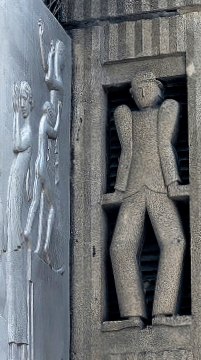
Close to the east end of the Nehru Bridge in Ahmedabad, the city in which Yagnik died, there is a small, well-maintained  park in  which there is a fine statue of Indulal Yagnik. It was created by the late Kantibai B Patel, who also made many other statues of well-known Gujarati people, including many of Mahatma Gandhi.  The statue of Yagnik depicts the man striding forward, his shirt pocket filled with a spectacles case and a pen.


I was keen to view the statue not only because I had read Yagnik’s biography of Krishnavarma  but also for another reason. His nephew,  who lives in Bangalore,  is a good friend, whom we got to know because his wife is related to members of my wife’s wider family.


Even if you do not have the sort of ‘connection’ we have with Indulal Yagnik’s nephew, the statue is worth seeing because it is a good piece of sculpture.

Shifting Identities: movement of crafts across national boundaries in the Indian subcontinent

THERE HAVE BEEN events that have caused people to flee from one part of the Indian subcontinent to another, traversing national boundaries.  The best known of these events was the Partition of India in 1947. Another event was the Bangladesh War of 1971, which resulted in Bangladesh (formerly East Pakistan) becoming independent, no longer united with West Pakistan.


Until I visited an exhibition,  “Shifting Identities”, at Arthshila, an art institution in Ahmedabad, I was unaware of India’s temporary occupation of a part of West Pakistan in 1971. In order to deflect some of West Pakistan’s army from their activities in East Pakistan, India staged an attack on Sindh, a province in West Pakistan.  As a result of this, India temporarily annexed a part of Sindh close to Kacchch (Kutch). This annexation was reversed by treaty in 1972. However, this resulted in a flow of refugees from Pakistan  into border areas of Gujarat and Rajasthan.  Likewise, during the liberation struggle in what was East Pakistan, refugees flowed from what was to become Bangladesh into Indian West Bengal.


Amongst the migrants who sought refuge in India, there were many who were skilled in traditional crafts,  notably textile manufacturing. 


The splendid exhibition at Arthshila contains beautiful examples of textiles made by refugees both from Sindh and the former East Pakistan.  The exhibition also includes documents and photograph albums that belonged to these people who felt it necessary to flee their former homes. The photographs in the albums were those sent to the migrants by family and friends they had left behind.


The show at Arthshila is both attractive and very moving. The exhibits are well labelled with much information. It showcases the skills that were the only riches that the refugees were able to carry with them when forces beyond their control made them feel it was necessary to leave the land that had been their home for innumerable generations.

A fort and a temple in the heart of Ahmedabad

THE TEEN DARWAZA (a magnificent three arched gateway built in 1415) was an entrance to the Bhadra Fort in Ahmedabad.  The Gateway faces the main part of the fort, but is separated from it by a large rectangular piazza lined with shops, eateries, an auditorium designed by BV Doshi, and market stalls.


The Bhadra Fort itself was constructed by the founder of Ahmedabad,  Ahmed Shah, in 1411. Thus, it is one of the oldest surviving edifices in the city. Only a few parts of this imposing structure are accessible to members of the public.

One substantial part  of the fort is occupied by a busy Hindu Temple,   Nagardevi Shri Bhadrakali Temple. This has been in existence for many years. However, since our last visit to Ahmedabad two years ago, the temple has spread into the piazza, occupying an area that used to be filled with traders’ stalls. The expansion consists of an area covered by a colourfully decorated canopy.


In addition, many of the street vendors who used crowded and enliven the piazza between the fort and the Teen Darwaza have been cleared out. According to one shopkeeper, with whom we spoke, it was the Temple authorities who ordered their removal.


The Bhadra Fort was built by followers of Islam. It has now been used to accommodate a Hindu temple.  Seeing this reminded me of the Charminar in Hyderabad.  This place, which is of great significance in the Islamic world, like the Bhadra Fort,  has been encroached by a Hindu temple. Although less solid in appearances than that in the Bhadra Fort, that attached to the Charminar is here to stay.

Where royalty was cremated in Kutch (Gujarat)

WHEN RAJPUT ROYALTY were cremated, their ashes were taken to be immersed in a holy river, usually the Ganges. However, at the spot where they were cremated, a memorial was erected, often in the form of a chhatri: a stone canopy supported by pillars. Often, the chhatris were quite elaborate and highly ornamented.

Next to one of the lakes in Bhuj, lies the city’s Chhatedi, a large area containing the chhatris (cenotaphs) of the Jadeja rulers of Kutch. Sadly, these cenotaphs suffered much damage during the earthquake of 2001. Thus, today the Chhatedi of Bhuj has become a picturesque set of ruins.

Although this is our fifth visit to Bhuj, it was only this time (December 2025) that we took a close look at the Chhatedi, now a site maintained by the Archaeological Survey of India. Apart from the remains of the grander chhatri, there are many smaller memorials. Often these bear a pair of carved footprints. I imagine that these smaller cenotaphs commemorate the cremation sites of lesser members of the Jadeja families: wives and children. One chhatri is particularly interesting because its roof is decorated with coloured tiling.

Surprisingly, the Chhatedi of Bhuj is one of the sights in the city that is less visited by tourists. It seems to be popular with young couples, who sit in shady spots passing the time of day. When we visited it one morning, there were few other tourists, but a party of local school children were being taken to see the place. They were in their pre-teens. What struck us was that many of these little girls were wearing lipstick, presumably to appear smart on their outing.

The Chhatedi provides great opportunities for photographers. While we were at the site, we saw a family of Indian tourists arrive at one of the larger cenotaphs. Their small daughter was dressed in her finest clothes. Her father got her to pose in front of a statue of a musician on the largest and most elaborate chhatri, and then clicked a photograph. Immediately after that, he told his family:
“Chalo” [‘let’s go’], and they exited the site. In my opinion, that was too rapid a visit. To enjoy exploring the Chhatedi, you should set aside about 30 to 45 minutes.

Although no longer recognised by the Government of India, the Jadeja royalty are held in high regard by many people in Kutch. During a conversation with a member of the family, he told us that the cremation of his grandfather, the last Maharao of Kutch, could not be carried out at the Chhatedi because the authorities would not allow it. In future, cremations of members of the former Royal family will probably no longer be performed in the traditional place: the Chhatedi of Bhuj.

A  store house for official documents in Ahmedabad

THE GOVERNMENT BOOK Depot on Ahmedabad (Gujarat) is located in the seventeenth century Azam Khan Sarai, which is next to or part of the Bhadra Fort, whose construction began in the early fifteenth century. Built in 1637 as a caravanserai, it was later used as an arsenal by the Mughals, and later as a prison by the British. Now, one of its cavernous halls with Persianate decoration houses the Government Book Depot.

The dark, cool Depot is filled with government publications. Most of those which we saw are in Gujrati and are printed versions of laws, regulations, proclamations, and other official business. Lofty alcoves leading off the main octagonal space are filled with books and booklets from floor to ceiling. I suppose/hope that someone knows what has been stored there and can lay their hands on what might be required.

The Depot is next to the often busy Khwaja Marketand a vibrant Hindu temple. Yet within its cool chamber it is a peaceful, shady haven. Various officials occupy the place, and there are seats for visitors to sit and read. Open for a few hours every day this Depot will appeal to lovers of libraries as well as to fans of Persian architecture.

In addition to housing the Depot, the Azam Khan Sarai contains various other government departments including one concerned with Scheduled Caste welfare.

SALT AND A UNIVERSITY FOUNDED BY MAHATMA GANDHI IN AHMEDABAD

THE GUJARAT VIDYAPITH is an educational establishment, now recognised as a university, founded by Mahatma Gandhi in 1920. Until he created the university, most higher education in India was, according to plans laid down by Lord Macaulay, dedicated to training Indians to be useful in the service of the British Empire.

The Vidyapith was, according to its website, part of:
“… a great response to Gandhiji’s command to vacate the English teaching schools and colleges. Now, in order to see that the students who left their education half-way are not deprived of the education, it was decided to estalish National Vidyapith. Out of those five Vidyapiths established during that period, Gujarat Vidyapith was one, estalished by Gandhiji himself on October 18, 1920. Gandhi wanted his Vidyapith to prepare the youths for the task of national reconstruction and usher in ‘Hind Swaraj’, the India of his dream”

The establishment, based in a very peaceful leafy campus, still functions today. Many of its students are members of underprivileged families.

Gandhi on the Salt March in 1930

As we were wandering around the campus, we came across a photograph of Gandhi taken while he was on the Salt March (1930) to Dandi during which the Mahatma and his followers were protesting against the government monopoly on salt production. Underneath the photograph, there was a caption that read as follows:
“Pranjivan Vidyarthi Bhavan was first stop of Historic Dandi March 12/03/1930”

This Bhavan was one of the first buildings on the Vidyapith campus. When the Vidyapith was started, it was located close to Gandhiji’s first ashram, the Kochrab Ashram. However, as an article in the Indian Express explained:
“With space constraints in the bungalow along with looming threat of plague, Vidyapith was shifted to Aga Khan Estate near Nehru bridge, where a building stands now. It ran from there briefly till the foundation stone of Pranjivan Vidyarthi Bhawan was laid by eminent scientist Prafulla Chandra Ray on March 9, 1923 which after completion was inaugurated by Gandhi in 1925.”

Our friend, Arthur Duff, showed us around the campus. Apart from seeing the memorial to the Salt March, we saw the models of villages outside the university’s folklore museum, which was sadly closed when we arrived. As the sun began to set we walked around the campus, a peaceful oasis in a busy part of Ahmedabad across the river from the old city.