
Exhibits in an exhibition at a famous landmark in Kolkata

FROM AFAR, THE VICTORIA Memorial in Kolkata looks almost magical. However, inside it is pompous and overbearing (and not particularly beautiful), just as the British must have seemed to many Indians before their country was freed from the British Empire.


Visitors to the Memorial can explore the ground floor and the one above it. Much of the upper floor is dedicated to an exhibition of photographs and facsimiles of documents relating to the exploits of those who fought to make India independent.  Naturally, better known individuals such as Gandhi, the Nehrus, and Subhas Chandra Bose figure in this show. But they are outnumbered by lesser known freedom fighters. One of these is Shyamji Krishnavarma (1857-1930).  Many of you reading this might well be wondering why this man deserved to be includefacsimilesexhibition.


Like several other freedom fighters,  Krishnavarma went to London to become a barrister.  He returned to India and made a fortune working for the rulers of some of the Princely States.  Then, he returned to London. In 1905, when Bengal was partitioned  he conducted his own campaign against British rule in India.
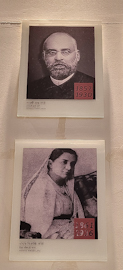
 

Above: Krishnavarma,  below: Madame Cams

Amongst the many things he did in addition to starting an anti-British newspaper, Krishnavarma purchased a house in Highgate (northwest London), which he converted into a hostel and meeting place for Indians studying  in London. It was named India House. Soon, it became a meeting place for Indians who wanted to rid India of the British. I have read that amongst the revolutionary activities carried out in India House was experimentation in bomb making. Amongst those associated with India House was VD Savarkar (1883-1966). In 1910, he was arrested by the British and spent several terrible years in the Cellular Prison in Port Blair (Andaman Islands). Amongst Savarkar’s many achievements was the development of Hindutva.


In 1907, Krishnavarma migrated to Paris. Later, until his death  he resided in Geneva. Unlike Gandhi and his followers, Krishnavarma and his colleagues (including Madame Cama) did not believe that India could become free by relying only on non-violent protest.


I first became interested in Krishnavarma when visiting Mandvi in Kutch (part of Gujarat). Shyamji was born in Mandvi, and his ashes are kept at a memorial centre a few miles outside the town. The centre includes a full size replica of Highate’s former India House. Seeing this building standing on its own in a flat sandy semi-desert landscape intrigued me, and got me interested in Krishnavarma.  I became so fascinated that I wrote a book about Krishnavarma and what happened in and around his India House. The book is called “Indian Freedom Fighters in London (1905-1910)”, and is available from Amazon (e.g., https://www.amazon.co.uk/INDIAN-FREEDOM-FIGHTERS-LONDON-1905-1910/dp/0244270716/ ).


The exhibition at the Victoria Memorial includes several photographs and documents relating to Krishnavarma and his India House. I had seen some of these elsewhere, but a few were new to me.


Although the Victoria Memorial is not one if my favourite things in Kolkata,  I  am pleased we visited if only because there were exhibits related to Krishnavarma.  In addition,  I was pleased to see several paintings by Thomas Daniell (1749-1840) and one by an artist I like very much : John Zoffany (1733-1810). Both of these men spent several years living and working in India.

A surprise in Suffolk

I FEEL SURE THAT I visited Ickworth House in Suffolk at least 25 years ago. Apart from remembering the external appearance of its wonderful central rotunda, I could not recall anything else about it when we revisited it yesterday (13th of May 2023).

Ickworth House was built between 1795 and 1829 by the Hervey family, who became the marquesses of Bristol in 1467. Now maintained by the National Trust, it contains a remarkable collection of paintings. Unlike the often-indifferent paintings that can be found hanging in many English stately homes, Ickworth possesses many works by top-rated Western European artists of yesteryear. These were collected by the 4th Earl of Bristol and Bishop of Derry, Frederick Hervey (1730-1803), who inherited the fortune that allowed him to finance the construction of Ickworth. A frequent visitor to mainland Europe, he amassed a fine collection of art – both paintings and sculptures.

By Elisabeth Vigée Le Brun

Visitors to Ickworth can view a painted sketch by Velasquez, a portrait by Titian, five paintings by Johann Zoffany, a picture by Angelica Kauffmann, a sculpture by John Flaxman, and many other works by artists including Reynolds, Romney, and Gainsborough. And this is not all. There are also plenty of paintings by artists whose names are less familiar to me.

In one room there are two paintings by Élisabeth Louise Vigée Le Brun (1755–1842), who was court artist to Marie-Antoinette. One of them is an interesting self-portrait, in which the artist depicted herself painting a portrait of her daughter. She and her daughter fled from France after the arrest of the French royal family in 1789. She met Frederick Hervey, the Earl-Bishop, in Italy twice in 1790. Both in Rome and in Naples, she painted his portrait. The one painted in Naples hangs at Ickworth, facing her self-portrait.

We visited Ickworth yesterday as apart of a drive around Suffolk. As we had done no advance planning or research on the place, what we found inside – the amazing collection of artworks – was a delightful surprise.

Adeline and James in Calcutta

THE CHURCH OF ST JOHN in central Kolkata was built by the British East India Company in the 18th century. Its foundation Stone was laid by Warren Hastings in 1784. We had visited it today, the 13th of January 2023, mainly to see the magnificent painting of the Last Supper by Johann Zoffany (1733-1810). We also spent time looking at the memorials that line the walls of the church. Suddenly, my wife pointed at one of them, which is of great interest to me at the moment. It commemorates James Pattle, who died in 1845 aged 68, an his wife Adeline, who died the same year aged 52. Whereas James is buried in London, Adeline was lost at sea.

My interest in this couple is related to a book I am writing about one of their daughters, who became one of the most famous British photographers during the 19th century. You will learn more about her after I publish my book.

James was born in Calcutta, as the city was named in his time. He was educated in England, and returned to Calcutta, where he became a High Court Judge. Adeline was born in French Pondicherry. Her maiden name was De l’Etang. Her father was a French nobleman who has fled from France to French India after the Revolution. He had been in charge of the French Royal stables and became important in the welfare of the East India Company ‘s horses in Calcutta . Her mother Therese had some Indian ancestry. James and Adeline married in 1811 at Bhagulpur in India. They had 10 surviving children.

⁸After James died in his home on Chowringee, he was placed in a barrel of preservative spirits so that, according to his wishes, he coukd be buried in London beside his mother in Marylebone Parish Church. Adeline travelled from Calcutta to London on the same ship as her husband’s corpse. Adeline died at sea according to the memorial in St John’s, but this might be incorrect. In any case, Adeline died a few months after James.

James’s remains did reach England, but they are interred at St Giles Church in London’s Camberwell. It is in this church, not the one in Marylebone, where his mother was buried.

The memorial in St John’s Church must have been placed because his fellow British citizens held him in high regard. The memorial was also a token of love given by their sorrowful childrenAs for his famous daughter, I will leave you in suspense!