An artist from China who is creating works of art using gunpowder

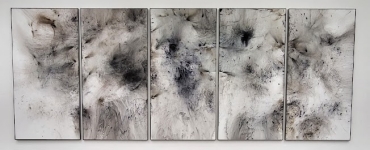
CAI GUO-QIANG IS an artist who was born in Quanzhou, Fujian Province, China, in 1957. Many of his artworks involve the extravagant and clever use of explosive materials, as can be seen in a documentary film being screened at the White Cube Gallery in Bermondsey (south London) until 9 September 2025. The film is accompanied by a collection of the artist’s images created on canvas, glass, and mirrors. Pleasing to the eye, these images have been created by an unusual method.

Guo-Qiang uses gunpowder, and ignites it, to assist him produce his pictures. The gallery’s website outlined his technique:

“… each composition is first mapped by sprinkling the powder, then covered and weighted before ignition, so that the blast disperses, recomposes and fuses matter into image.”

The unpredictability of the explosive material adds an interesting chance element to the finished product, but despite this, the composition was initially planned by the artist. In some of the works on display, not only was gunpowder placed on the base (i.e., paper, glass, etc) but also pigment powders. The explosions caused by igniting the gunpowder cause interesting spreading and scattering of the pigment.

The artist began experimenting with using explosives in his works on materials such as canvas and paper in the early 1980s in Quanzhou. Occasionally, the work in progress would ignite, and the fire had to be smothered to save the artwork. The works on display at White Cube were created after 2015, mainly in the 2020s. By now, he has refined his technique so that wholescale conflagration does not happen. However, as a gallery assistant told us, if you look carefully at some of the works, small burn marks can be found here and there.

Apart from being created in an intriguing way, I found the pictures being displayed in the gallery to be both attractive and beautiful.

Alien Shores in south London’s Bermondsey

THE ARTIST ANSELM Kiefer is said to have remarked:

“I think there is no innocent landscape, that doesn’t exist.”

By Nomoru Minata

For what we see when we regard a landscape is the result of millions of years of geological and meteorological evolution as well many millennia of interventions by biological phenomena including human activities: both constructive and destructive. As the writer and academic Robert Macfarlane wrote:

“We live on a restless crust of earth. Behind the façade of stability, everything is shifting, imperceptibly, but continuously.”

 Artists have been creating images of landscape for many centuries. The earliest known depictions of landscape include Minoan frescoes created in about 1500 BC. The genre of European art called ‘landscape painting’ began in Holland in the seventeenth century. The website of the White Cube Gallery in Bermondsey noted in connection with this:

“17th-century Dutch artists of the Golden Age, during which the genre ‘landschap’ was first named, turned away from religious subjects as an expression of Protestant values …”

Until 7 September 2025, the White Cube at Bermondsey is hosting an exhibition called “Alien Shores”. Curated by Susanna Greeves, this show:

“… explores landscape as a place of memory, imagination, yearning and belonging. Through painting, video, photography and sculpture, the artists included offer speculative, symbolic or surreal depictions of emotional terrain and voyages of the imagination, visions of the distant past or possible futures.”

The exhibition includes works by 37 artists, all of whom worked in the twentieth and/or twenty-first centuries. It is a display of modern and contemporary works of art that either depict landscapes or try to evoke thoughts of landscapes. The works are distributed amongst three rooms. In the first two rooms there are videos and kinetic sculptures as well as paintings. A video by Noémie Goudal is particularly fascinating and dramatic. The third and largest room contains a mixed bag of paintings and a sculpture by Noguchi. My enjoyment of the paintings in this room was not 100%. Some of the paintings looked like wall space fillers rather than great works of art. However, it his is not a room to be missed because it contains three outstanding landscapes by Anselm Kiefer. Seeing these in the company of many of the others served to emphasize (to me) what a great contemporary artist he is. Other ‘stars’ in this room were paintings by Minoru Nomata, Georgia O’Keeffe and Marina Rheingantz.  A three-dimensional screen depicting a leafless forest by Eva Jospin in the long corridor of the White Cube also impressed me.

Although I wondered why a few of the artworks were included in the show, the Alien Shores exhibition has much to recommend it. It was fascinating to see how in a time frame of well under 100 years, artists have been tackling their various portrayals of landscape, and the interesting varieties of ways they have done it.

Sunflowers on the walls in London’s Mayfair

SINCE TIME IMMEMORIAL artists have been influenced and inspired by creators who preceded them. In the case of the German artist Anselm Kiefer (born 1945), he has been both influenced and inspired by Vincent Van Gogh (1853-1890), who was born almost a century before him. Both artists have broken boundaries, and explored new ways of expressing themselves in painting. At two Mayfair galleries, White Cube (Mason Yard; until 16 August 2025) and Thaddeus Ropac (in Dover Street), you can see some of Kiefer’s paintings that illustrate his response to Van Gogh, and in particular the Dutch artist’s depictions of sunflowers and wheat fields.

By Anselm Kiefer

At the age of 18, Anselm Kiefer made a journey following in the footsteps of Van Gogh. The White Cube’s website revealed the route he took:

“… from the Netherlands to Belgium, Paris, and finally to Arles, where, in the final years of his life, Van Gogh created many of his most iconic works.”

It is those works painted in Arles that are reflected in Kiefer’s creations that are on display in both galleries as well as in a temporary exhibition in London’s Royal Academy in Piccadilly. Almost all of Kiefer’s images at White Cube and Thaddeus Ropac contain sunflowers and/or depictions of fields of agricultural crops. Unlike Van Gogh’s paintings, there are no human figures depicted in Kiefer’s artworks. In one of them, there is a flock of menacing looking black birds with wings outstretched. Kiefer’s crops made by sticking materials onto his canvases look much more sinister than the often-vivid depictions of agricultural landscapes created by Van Gogh. In their own ways, both Van Gogh and Kiefer portray the world as a disturbed place. In the case of the Dutch artist, this might have been due to his psychologically disturbed state of mind when he was in Arles. In Kiefer’s case, one must remember that he was born at the end of WW2 in a country devastated by conflict and the horrendous dictatorship that preceded it.

Although I am often less than convinced by pairing and comparing two artists in exhibitions such as that at the Royal Academy, but putting Vincent and Anselm side-by-side is both intriguing and appropriate. Having viewed the Kiefer works at the two Mayfair galleries, I now look forward to seeing how the Royal Academy’s curators have dealt with the relationship between the two artists.

About Space at an exhibition in a gallery in south London’s Bermondsey

THE TROUBLE WITH temporary exhibitions is that they come to an end. So, if you miss it, you might never see the same works of art together again. I am very pleased that we just managed to catch a superb exhibition at the White Cube gallery in Bermondsey on its final day (1st of September 2024). Called “About Space”, it is a show of paintings by an artist, of whom I had not come across before: Al Held (1928-2005).

Al Held was born in Brooklyn (NYC). His Jewish family was impoverished during the Great Depression and had to survive on welfare payments.  Having served in the US forces during WW2, he was eligible (under the terms of the GI Bill) for financial assistance with his education after the war. He studied painting first in New York City, and then in Paris (France). Over the years, he explored different styles of painting, and after exhibiting at major art museums in the USA, his work began to be shown at prestigious galleries outside the USA.

The paintings on display at the White Cube date from the 1960s onwards. Many of them are huge, dwarfing the viewers. A few are smaller. All of them are visually spectacular. Although two-dimensional, they depict complex three-dimensional abstract imaginary constructions. Viewing these amazing compositions is like looking through a huge window at the kind of fantastical geometric abstracted landscapes that might now be produced by digital means. As the title of the exhibition implies, Held’s paintings are literally about space. Painted with precision, these compositions explode with energy.

I am glad that we did not miss the exciting experience of seeing these paintings created by a man, who had shown no interest in art until he left the US Navy in 1947. It was his friend the artist Nicholas Krushenick (1929 – 1999), who inspired him to take up art, and I am very pleased that he did.

Dreamlike but almost realistic from Japan

IT IS OFTEN a pleasure to see an exhibition of works by an artist, whose existence was hitherto unknown to me. In this case, the artist is the Japanese born Minoru Nomata, who was born in 1955 and lives as well as works in Japan. The exhibition of his works, currently at White Cube in Masons Yard (near Piccadilly) until the 24th of August 2024, consists mainly of paintings (acrylic on canvas).

At first sight, his paintings look almost like photographs. However, after a few moments’ contemplation, they can be seen to depict subjects – often structures and aspects of nature – that are at the same time unreal and almost but not quite real.  His subject matter is not quite surreal, but is an unusually dreamy interpretation of the real world. None of the paintings on display contained any signs of human presence. The gallery’s website (www.whitecube.com/gallery-exhibitions/minoru-nomata-masons-yard-2024)  includes the following:

“According to the artist, ‘construction, repair and demolition’ occur simultaneously in his paintings; they confer, too, upon the simultaneity of past, present and future distinct to Nomata’s work. As he states, he sets out to create worlds that ‘are not “somewhere”, but “nowhere”, in a position that helps [him] find a place to head for’. Devoid of identifiable temporal or geographical markers as they may be, Nomata’s ambivalent landscapes speak directly to humankind’s long-standing existential concerns about what place, if any, it has in the world.”

As I viewed the pictures, which I found aesthetically pleasing, I felt they had the ‘realness’ of images that appear in dreams, yet at the same time they seemed as if they could almost be depictions of reality. In brief, I found them both attractive and intriguing, and can recommend this show to everyone.

Inverted images by an artist born in Germany at a gallery in London

CERTAIN IMAGES IMMEDIATELY come to mind when the names of some artists are mentioned. For Vincent Van Gogh it is sunflowers; for Claude Monet it is waterlilies; for Salvador Dali it is melting clocks; and for Edvard Munch it is “The Scream”. In the case of the German artist Georg Baselitz (born as ‘Hans-Georg Kern’ in Deutschbaselitz, Saxony, Germany in1938), mentioning his name conjures up inverted images: paintings in which the images appear to be upside down. He signs them with his signature, but it is not upside down.

Recently, we viewed an exhibition of this octogenarian’s latest paintings at the White Cube Gallery in London’s Bermondsey Street. The show is on until the 16th of June 2024. If you miss it, you will not have missed much worth seeing. As you can tell, I was not over-impressed by what I saw, but it did get me thinking about why the artist often chooses to paint his subjects – human and others – upside down.

Does he choose to do this because his childhood in Germany was spent in a country that had been turned upside down by the Nazi regime, the 2nd World War, and its immediate aftermath in the early years of the German Democratic Republic? The White Cube website quotes the artist as having said:

“I’ve got my early childhood drawings of eagles, stags, deer, dogs and so on in folders,’ Baselitz remarks. ‘Every now and then I look at them, and I think was it a good time, was it a bad time?”

Or does he paint his images upside down to attract the viewer – to make his artwork ‘stand out from the crowd’? Alternatively, does he invert his images so that the viewer is forced to consider not only the subject matter, but also his painting techniques (brush strokes, colour choices, and so on)?

I do not know the answers to these questions. However, I am glad I have seen the exhibition, which did not particularly thrill me, because it did stimulate me to consider his art a little more that I had expected.

A Brazilian artist and the River Ganges at Varanasi

MARINA RHEINGANTZ IS an artist whose works I had never seen until today, the 31st of October 2023. Her exhibition, “Maré”, which means ‘tide’ in Portuguese, is on at the White Cube Gallery in London’s Masons Yard until the 11th of November 2023. Most of the exhibits are painting, but there are also an embroidery and a tapestry.

Marina was born in 1983 at Araraquara in Brazil. She lives and works in São Paulo, Brazil. The works on display at White Cube tend towards being abstract, but they are not completely devoid of naturalistic content. As the gallery’s handout explained:

“Guided by observations of tidal rhythms, ocean beds and meteorological conditions, Rheingantz infuses landscapes of water with a quasi-sentient vitality … Expansive in scale and richly textured, Rheingantz’s landscapes deconstruct topography into its loosest arrangements.”

Although separated from him by many years, Marina’s paintings are almost as atmospheric as the great JMW Turner’s most impressionistic works. However, she has gone further than Turner in her almost abstract depiction of natural phenomena.

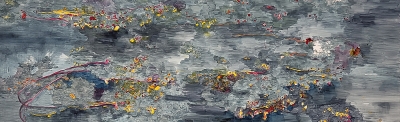
For example, this is evident in two paintings (detail from one of them above) she created following a recent visit to Varanasi (‘Benares’) on the Ganges River in India. These depict in an impressionistic way the orange embers that bodies being cremated on the burning ghats spit out onto the surface of the river. Other pictures on display express her perceptions of places as far afield as Brazil, Mexico, and Morrocco.

Not far from Piccadilly and the Royal Academy, White Cube Masons Yard is well worth a visit, It would be a shame to miss viewing the artworks created by Ms Rheingantz.

Anselm Kiefer at the White Cube in Bermondsey

TODAY, I MADE MY second visit to the Anselm Kiefer exhibition, which is on at the Bermondsey White Cube gallery until the 20th of August 2023. I was pleased to visit it again because after my first visit, I left it feeling oppressed and somewhat depressed. This might be what the artist (born at the end of WW2 in Germany) intended when he created the extraordinary series of scenes of dereliction and decay on show in Bermondsey. My second visit (on the 15th of August 2023) left me with a slightly more favourable impression, but my opinion that the artist has depicted an image of a world of confusion, conflict, and decay, remains unchanged.

The works, which are distributed in several rooms and the central corridor of the gallery, are, so I read in an information sheet, Kiefer’s reactions to, and representation of, a novel by James Joyce – “Finnegan’s Wake”. The artist has written short quotations from the book on many of the items that together make up the amazing art installations. As I have not read the book, I cannot comment on the appropriateness of what he has created.

In one room of the gallery, there are mainly huge paintings, which I found attractive. On close examination, one can see that the paint has been applied to that it is far from flat. The three-dimensional surfaces create interesting illusions, which change according to from where you view the pictures.

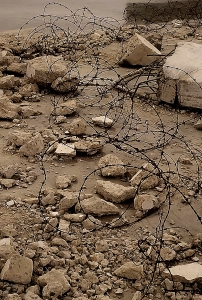
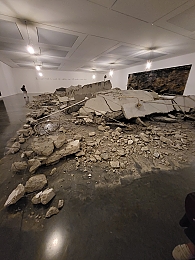
Another room has a huge pile of sand littered with discarded, corroded supermarket trolleys – an impressive but sad sight. In yet another room, most of the floor is covered with barbed wire and huge pieces of concrete – the ruins of a large building. As a friend of ours said, it looked as if it had been imported straight from a bombsite in Ukraine.

Would I recommend visiting this exhibition? It is certainly inappropriate for people who suffer from claustrophobia or depression. However, if you are of an adventurous frame of mind, do head for this show before it ends.

Inspired by a novel by James Joyce

THE ARTIST ANSELM Kiefer was born in Germany a few weeks before the end of WW2 in Europe. He was brought up in a country devastated by warfare and with a shameful recent past. It is said quite reasonably that much of his artistic output has been influenced by the guilt-ridden environment in which he grew up.

Today, the 21st of June 2023, we visited the White Cube Gallery on Bermondsey High Street in south London. Until the 20th of August 2023, it is hosting a spectacular show of works created by Kiefer. To call it an exhibition is a bit of a misnomer – it is really an ‘immersive experience’. It occupies the gallery’s entire exhibition space as well as the long central corridor that links the various large display rooms.

The long central corridor is lined with a large variety of ‘objets trouvés’, which some might well describe as ‘junk’. Together, they form a large-scale cabinet of curiosities like those which wealthy people used to create in the past, but few of the objects would have appealed to such collectors. Three large rooms can be entered from the corridor. The walls of each of these are lined with what at first sight look like enormous paintings. They are made of metal, often quite three-dimensional, and coloured with paint. Each one is both visually exciting and satisfying. In the middle of each room, there is an installation that suggests that it has formed after some apocalyptic event – maybe, an atomic bomb explosion or some similarly catastrophic event. In one room, the centre is filled with a pile of sand in which discarded supermarket trolleys have been abandoned. Another room is filled with what look like huge books damaged by flood waters. In the third and largest room, there are the concrete and rusted iron remains of what might once have been a modern building – it is a scene of horrendous devastation.

Throughout the ‘exhibition’, there are handwritten words, phrases, and sentences. These can be found on the walls, on the painting-like panels, and near objects stored in the corridor. A gallery attendant told us that each of them had been handwritten by Kiefer when he came to inspect the installation of his show. The words were not his but are all taken from “Finnegan’s Wake”, published in 1939 and written by James Joyce (1882-1941). Hence, the exhibition at the White Cube has been given the name of this novel.

Superb as this exhibition surely is, I found it oddly claustrophobic. Although it is a visual feast and a great feat of imagination and creativity, I found it slightly disturbing – that might have been the artist’s intention. But please do not let me put you off visiting this unusual and wonderful show.

A versatile contemporary artist

YESTERDAY, WE ADMIRED paintings created by the Great Masters of European art, which hang on the walls of the rooms of 18th century Kenwood House in north London. Today, the 12th of April 2023, we enjoyed artworks of a completely different nature within the almost spartan spaces of the White Cube Gallery in Bermondsey Street. Currently, three artists’ works are on display. Three areas in the gallery are dedicated to one of them – Marguerite Humeau. She was born in 1986 in France, and received her MA from the Royal College of Art in London – the city in which she now lives and works.

Humeau creates works in a wide variety of materials. She also makes video art, one example of which was on show in the smallest of the three spaces. A larger room contained panels made with one or more ceramic tiles. The glazed surfaces of these tiles are not flat but contain hand-sculpted three-dimensional features including textural variations and curvy striations, which protrude from the flattish background surface.

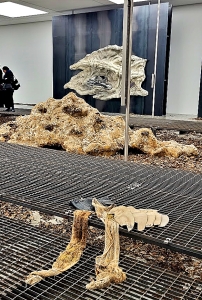
The largest room of the show must be seen to believed. Entering is like setting foot on an alien planet inhabited by weird organic shapes that suggested to me plants, fungi, and insects, but all of them greatly magnified. These shapes are sculptures created by Humeau. Some of them were emitting musical sounds. I found the sculptures both intriguing because of their allusions to biological structures and also quite satisfying visually. As to what led to their creation, the gallery’s website (https://whitecube.com/artists/artist/Marguerite_Humeau) explained:
“The artist was inspired by eusocial insects such as ants, termites and bees, whose complex cooperative societies enable them to build huge structures and to cultivate other organisms in symbiotic relationships. Reflecting on the ants shepherding their aphids and the termites tending their fungus gardens, Humeau found an equivalent in the place yeast has assumed in human societies, as the essential ingredient of bread and beer around which our human collective has gathered. Contemplating the probability of our imminent, self-inflicted extinction as a species, Humeau sees insect societies as both the inheritors of our ravaged environment, and a prompt to consider how interdependence and cooperation might offer a means to avert our fate.”
Fair enough; but even if the works are portents of a gloomy future, my spirits were uplifted by seeing them. The exhibition continues until the 14th of May 2023. If you plan to visit it, save a bit of time for the interesting and attractive, abstract paintings and sculptures by Samuel Ross (born 1991 in London), which are on show in another of the gallery’s spaces.

The thing that amazes me is that even though the paintings by the Great Masters, who painted many centuries ago and which we saw 24 hours ago at Kenwood are immensely satisfying visually, seeing the artworks by Marguerite Humeau today was an equally enjoyable experience. I wonder what it is that happens in the brain to produce the same amount of enjoyment from seeing such widely differing artistic creations.