AFTER WATCHING A superb play, “Moffie” (a one man show about homosexuality in apartheid South Africa), at the Riverside Studios in London’s Hammersmith, we visited the nearby William Morris Museum, and then retired to its close neighbour, The Dove pub. This quaint little hostelry has a riverside terrace and the shortest bar counter in England. There has been a pub on its site since the 17th century. At one time, it was also a coffee house. The present building, whose interior is rich in timber beams, dates from the 18th century.
Being a sunny Sunday afternoon, the riverside terrace was full when we arrived at the pub. So, we found seats in the room with the short bar at the front of the pub. It was while we were enjoying our refreshments that I noticed a lovely white carving on the chimney breast above the fireplace – its style reminded me a little of the work of Eric Gill. Near to the carving there was a framed notice that provided the following information:
“As a result of old age and Hitler, this fireplace had to be re-built in 1948. It was re-built by Mr Ward of Barnes, in Elizabethan bricks, from a design by Mr Reece A.R.I.B.A.
The plaque was sculpted in white Portland stone by Ian Coleman, from a design prepared by John Worsley, after a woodcut in the possession of the landlord”
I have no idea about the woodcut that the landlord possessed, but I can tell you that John Worsley lived from 1919-2000. He painted at least one view of Hammersmith Bridge from a viewpoint close to The Dove – in 1948 (www.orleanshousegallery.org/collection/boat-race-hammersmith-bridge/). As for Ian Coleman, I cannot find any references to an artist with this name, who would have been alive in the late 1940s.
The fireplace alone is of interest, but there are also many other artworks – paintings and old photographs – that can be viewed in this delightful pub.
MACBETH STREET IS a short thoroughfare in Hammersmith. It runs from Kings Street to the A4 dual carriageway. We often walk along it to reach the pedestrian subway beneath the busy A4. There is an architecturally unexciting building on Macbeth Street, which I would not have stopped to look at had I not noticed two memorial plaques affixed to it.
One of the plaques bears the words:
“This stone was laid To the Glory of God on June 28th 1930 on behalf of the South Street Mission by Mrs Alfred Goodman. Mission superintendent Sister Lizzie”
The other plaque reads:
“To the Glory of God on June 28th 1930 on behalf of the Shaftesbury Society by Sir Charles JO Sanders KBE. Treasurer L(?) Goodman Esq”
“South Street Mission Hall. This was run by Sister Lizzie as a women’s refuge. South Street Mission Brass Band was active from around 1910s through to the 1950s. The building now appears to be operated as a church centre probably through St.Paul’s church. It also appears to have links with the Shaftesbury Society and the St.Barnabas movement operating as a centre for the homeless and a night shelter for street sleepers.”
As for the Shaftesbury Society, according to Wikipedia:
“In 1872 the social reformer Lord Shaftesbury established the Emily Loan Fund to enable young women flower sellers to support themselves. Later, in 1914, the Ragged School Union merged into the Shaftesbury Society, becoming fully subsumed under the title of the Shaftesbury Society in 1944.”
“Whos Who 1938” has an entry for Sir Charles JO Sanders. He was an important civil servant involved in shipbuilding matters. The reference to him includes his philanthropic work:
“… a well known worker amongst the poor in all kinds of religious, social, and philanthropic work, Chairman of Council of Shaftesbury Society and Ragged School Union, 1918, 1919,1929, 1930, 1936 and 1937, Treasurer since 1933.”
As for Sister Lizzie, I have not been able to discover more about her.
Today, the building is used by various religious groups including the ‘House of Worship’ and the ‘Sword of the Spirit – Int. Prophetic Ministries’.
I guess that the memorial plaques, which caught my eye, were placed when the present building was built to replace an earlier version.
IN MY BOOK about west London, “Beyond Marylebone and Mayfair: Exploring West London”, I described a stream that used to flow through Hammersmith. It was located where part of Furnivall Gardens now stands today. I wrote:
“… Furnivall Gardens, a pleasant open space created in 1951, and named after a distinguished scholar of English literature and an important pioneer in the sport of rowing, Dr Frederick James Furnivall (1825-1910) … Before WW2, the area of the park was covered with industrial buildings including the Phoenix Lead Mills, which stood east of The Creek, an inlet of the Thames that was filled-in in 1936.
In earlier times, The Creek, which extended as far inland as today’s King Street, was centre of Hammersmith’s flourishing fishing industry. Writing in 1876, James Thorne described The Creek as follows: ‘… a dirty little inlet of the Thames, which is crossed by a wooden footbridge, built originally by Bishop Sherlock in 1751 … the region of squalid tenements bordering the Creek having acquired the cognomen of Little Wapping, probably from its confined and dirty character.’
The Creek, an outlet of the now largely hidden Stamford Brook, is long gone, but there is a storm outlet in the bank of the Thames close to where The Creek emptied into the river. This can be seen from Dove Pier at the western end of the Gardens.”
Today, the 25th of February 2024, we were walking past Furnivall Gardens along the riverside path. It was low tide. A wide, not too clean, beach lined the river. At one point, the beach was interrupted by what looked like the mouth of a small stream. This was lined on both sides with wooden fencing. The stream, which issued from below the riverside walkway ended abruptly in an archway that was filled by a sturdy door or dam. The position of this sluice gate in relation to the nearby Dove pub, Dove Pier, and Furnivall Gardens is correct for what must have once been the mouth of Hammersmith’s erstwhile Creek. I had noticed the archway with the heavy-looking door many times before, but today, because of the low tide, it was the first time that I could clearly the remnants of the mouth of the Creek. I suppose that there is some leakage from the now covered-up Creek that causes the appearance of the mouth of a small stream when the tide is out.
My illustrated book about West London is available as a paperback and a Kindle from:
FURNIVALL GARDENS IS a pleasant grassy open space that lies between the busy Great West Road (part of the A4) and Hammersmith’s riverside at Lower Mall. The park was created as part of the Festival of Britain (1951). Prior to WW2, the area upon which the garden now stands was mostly occupied by industrial premises and slums. Part of this area was occupied by the Quakers (of Hammersmith) Friends’ Meeting House and its adjoining Friends’ burial ground. A little bit of the land owned by the Quakers is now covered by the carriageways of the A4. The Quakers gave up their land to Hammersmith Borough Council when they were planning Furnivall Gardens.
There have been Quakers living and worshipping in Hammersmith since 1658 (see: https://hammersmithquakers.org.uk/history/). In 1677, they built their first Meeting House at number 28 Lower Mall near Hammersmith Creek (now covered up), which used to run along the western edge of what is now Furnivall Gardens. This tributary of the Thames ran through a very poor area of Hammersmith. In 1765, the meeting House was rebuilt and remained in use until a few years after the Creek was covered over in 1936. On the 24th of July 1944, this venerable Meeting House was destroyed by a flying bomb.
I have walked through Furnivall Gardens many times, but it was only today (the 18th of February 2024) that we took time to look at a noticeboard with its history. My wife noticed that the former Quaker Meeting House and burial ground are mentioned on this informative board. It indicated an area of the Gardens, where a memorial stone can be found. The simple monument in an area walled off from the rest of the park is surmounted by a circular metal plate on which the following words are inscribed:
“This garden is on the site of the Friends’ Meeting House and burial ground 1765-1944”.
It is an unassuming little memorial, which you might not notice if you did not know it existed. It has taken me several decades to become aware of it. I have driven along the stretch of the A4 that runs alongside Furnivall Gardens many times. And until today, I had no idea that my car’s tyres were racing over land where once Quakers were buried.
Here is a brief excerpt from my illustrated book “BEYOND MARYLEBONE AND MAYFAIR: EXPLORING WEST LONDON”. It concerns a curiously shaped building constructed in the early 1960s in Kensington:
“Returning to High Street Kensington, the eastern wall of the Melbury Court block of flats bears a plaque commemorating the cartoonist Anthony Low (1891-1963), who lived in flat number 33. Set back from the main road, and partly hidden by two hideous cuboid buildings, stands an unusual glass-clad building with an amazing, distorted tent-shaped roof made of copper. This used to be the Commonwealth Institute. Built in 1962 (architects: Robert Matthew Johnson-Marshall & Partners), I remember, as a schoolboy, visiting the rather gloomy collection of ethnographic exhibits that it contained shortly after it opened.
The Institute closed in late 2002, and the fascinating building stood empty until 2012, when it was restored and re-modelled internally. In 2016, it became the home of the Design Museum. Like the architecturally spectacular Guggenheim Museum in Manhattan, the building competes with the exhibits for the viewer’s attention but wins over them easily. The displays in the Design Museum are a poor advert for the great skills of British designers, whereas the building’s restored interior is a triumph. This is a place to enjoy the building rather than the exhibits. One notable exception to this comment is the sculpture by Eduardo Paolozzi (1924-2005), which stands outside the front of the museum.”
You can discover much more about Kensington and many places west of it by reading my book, which is available (as a paperback and a Kindle) from Amazon:
WE FIRST VISITED the grounds of Boston Manor in the London Borough of Hounslow in April 2021.
Plenty of covid19 restrictions were then in force and the old Jacobean manor house was inaccessible both because of the pandemic and also because the building was undergoing extensive restoration works. We were able to enjoy the lovely grounds that surround the manor house. In July 2022, long before the manor house’s restoration was completed, I published my book about west London, “BEYOND MARYLEBONE AND MAYFAIR: EXPLORING WEST LONDON”, and included a chapter about Boston Manor. Here is a part of this chapter:
“… the name Boston is derived from an older name ‘Bordeston’, which comes from the word ‘borde’, meaning ‘boundary’. Another etymology of the name, which is unrelated to that of the Boston in Lincolnshire, is that it derives from the name of a Saxon farmer named ‘Bord’. Whatever the origin of the name, Boston Manor, the house, and its lovely gardens (now known as Boston Manor Park), which reach the bank of the River Brent, stands on the border between Hanwell and Brentford.
Until the Priory of St Helens in Bishopsgate (in the City of London) was suppressed in 1538, the Manor of Bordeston was owned by it. King Edward VI granted it to Edward, Duke of Somerset (1500-1552), Lord Protector of England during the earlier part of his reign, and later, it reverted to the Crown. In 1552, Queen Elizabeth I gave the manor to the Earl of Leicester, who immediately sold it to the merchant and financier Sir Thomas Gresham (c1519-1579). After several changes of ownership, the property was sold in 1670 to the City merchant James Clitherow (1618-1682). The new owner demolished much of the existing manor house. He modified and enlarged Boston House, which was originally built in the Jacobean style by Lady Mary Reade in 1622, widow of Gresham’s stepson, Sir William Reade. This house with three gables still stands (but was closed when I visited it during April 2021 because it was undergoing extensive repairs). It looks out onto grounds planted with fine trees, many of them Cedars of Lebanon. The grounds, which include a small lake, slope down gently towards the River Brent.”
Today, the 26th of October 2023, I revisited Boston Manor. Fortunately, the Jacobean manor house’s restoration had been completed. After enjoying coffee in its fine café and walking around the grounds ( part of which is beneath an elevated section of the M4 motorway), we were able to enter the manor house. Visitors are allowed to wander freely through rooms on the ground and first floors. Each room is identified by informative labels. In one of the rooms, there are portraits of several members of the Clitherow family. One was painted by Godfrey Kneller (1646-1723), and another by George Romney (died 1802), who lived in Hampstead for a few years at the end of the 18th century. Several of the rooms have beautiful three-dimensional plastered ceilings. These have been restored well to look like they must have done when they were first installed. Reproductions of the original wallpapers line many of the walls and the grand staircase. The reproductions were based on the few fragments of the original wall papering that were discovered. A couple of wall panels have large expanses of original wallpaper that have survived the passage of time. Although the manor house was stripped of the Clitherow’s furniture long ago, Hounslow Borough Council have restored the rooms magnificently.
Boston Manor house is not nearly as architecturally exciting as its neighbours Osterley House and Chiswick House, but it is older than them, and in good condition. I feel it ought to become as well known as the more frequently visited stately homes nearby.
My book about west London is available as a paperback and a Kindle from Amazon websites such as follows:
THERE IS A SHORT crescent lined with elegant residential houses near to the Kensington Temple church close to the centre of London’s Notting Hill Gate. A few yards west of this there is a short cul-de-sac called Horbury Mews. The crescent also bears the name Horbury. Although I have passed them often, it was only today that I wondered about ‘Horbury’.
Both the Crescent and the Mews were built on land that was leased to William Chadwick in 1848 by Felix Ladbroke, heir of the property developer and landowner James Weller Ladbroke (died 1847). William, a developer, built many houses on the Ladbroke Estate in Kensington. His heir WW Chadwick constructed the houses on Horbury Crescent between 1855 and 1857. The mews nearby bear the date 1878, which is prominently displayed on one of its buildings. The mews was constructed on a former nurseryman’s grounds. They served to house horses and servants of the nearby houses. Today, they are homes for the well-off.
The name Horbury derives from the nearby Kensington Temple, which was built in 1848-49, and was then called ‘The Horbury Chapel’. The name was chosen because the hometown one of its first deacons was Horbury in Yorkshire.
So, two street names in a little part of Kensington commemorate a small town in Yorkshire. I did not expect to discover that.
I FIRST CAME ACROSS the critic, writer, and poet Leigh Hunt (1784-1859) when I was collecting information for my book about Hampstead. For some years, Hunt lived in a house in Hampstead’s Vale of Health. Amongst the many noteworthy people who visited him there regularly were the poets Shelley and Keats. Later, when I was writing my book about west London, I found out that Hunt had resided in Edward’s Square, Kensington. He had also lived in Chelsea. Until today (the 7th of August 2023), I had never seen a memorial to Hunt. Today, I spotted one, a carved stone plaque, high up on the wall of the Bush Theatre that faces Pennard Road (in Shepherds Bush).
The theatre is housed in what was formerly one of several libraries established by the newspaper entrepreneur and philanthropist John Passmore-Edwards (1823-1911). The library building was built in 1895 and its external features are well-preserved. The theatre moved into it in 2011.
Hunt is not the only person commemorated on the plaque. Below his name is that of the artist Charles Keene (1823-1891). In his book “A Few Footprints”, Passmore-Edwards wrote (in 1906) that he placed memorials of illustrious people in places near where they died:
“I have placed medallions of Charles Lamb and John Keats in the Public Library, Edmonton; of Sir Henry Austin Layard and Sir William Molesworth in the Public Library, Borough Road ; and of Leigh Hunt in the Public Library, Shepherd’s Bush…
… Mr. A. E. Fletcher, who unveiled the memorial medallion of Leigh Hunt at the Shepherd’s Bush Public Library, said: ” Let us remember Shelley’s fine description of Leigh Hunt as one of the happy souls who are the salt of the earth.’ We have learnt enough to admire him for his genius and his marvellous industry, to honour him for his fearless outspokenness and courageous sacrifice for principle, and to love him for his splendid faith in humanity and his buoyant optimism””
However, Passmore-Edwards makes no mention of Keene.
The plaque was probably affixed to the library when it was built. But why the two names are on the same plaque is a bit of a mystery to me. The only possible connection, which makes sense in the light of what Passmore-Edwards wrote, is that both men died reasonably close to Shepherds Bush.
JOHN LINNELL (1792-1882) painted the Kensington gravel pits in about 1811. The picture hangs in London’s Tate Britain These pits lay alongside Bayswater Road and Notting Hill Gate. They provided gravel for building projects in England and as far away as Imperial Russia.
Today, the pits no longer exist. They have been built over, but street names such as St Petersburg Place and Moscow Road commemorate the fortunes made by selling gravel from these pits to Russia.
You can discover more about this and much more about Paddington and Kensington and points further west in my book “BEYOND MARYLEBONE AND MAYFAIR: EXPLORING WEST LONDON” (see https://www.amazon.co.uk/gp/aw/d/B0B7CR679W/
I AM READING A most fascinating book at present (June 2023). Published in 1984, it is “Staying Power: The History of Black People in Britain” by Peter Fryer (1927-2006). In it, the author described how during the 18th century, it was fashionable for wealthy British people living in England to have at least one ‘black’ servant (or slave, in some cases) amongst their teams of domestic staff. Including a black servant in a portrait painting was believed to add to the perceived status of the subject being portrayed. Putting it crudely, just as sporting a Prada handbag or driving a Maserati is supposed to enhance the status of their owners today, exhibiting the ‘black’ servant did the same for the vanity of the wealthy in the 18th century. Sadly, many wealthy British people in the 18th century did not see the ‘black’ servants as human beings but as valued possessions or accessories.
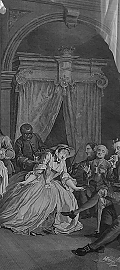
Today (3rd of June 2023), we paid a visit to Hogarth’s House in Chiswick. Located next to the busy A4 dual carriageway and the often-congested Hogarth Roundabout, it is now hard to believe that in 1749, the artist William Hogarth (1697-1764) bought this place to use as his country home. For, in those days this 17th century house was surrounded by countryside. The house and its garden are open to the public free of charge. The visitor gets to see a series of wood-panelled rooms, very much like those I have seen a friend’s 18th century house in the oldest street in Kensington. Unlike our friend’s house, the walls of the rooms of Hogarth’s former country place are lined with a large number the artist’s wonderful, printed works. Most of these depict scenes portrayed with many fine details. They express Hogarth’s satirical views of the life and behaviour of his contemporaries.
Some of the prints portray the lives of the poor and less well-off. A few depict life in ‘high society’. In several of the latter, there are a few black faces amongst the people in the pictures. All of them are obviously servants. In one of these prints, a black woman with her back facing the viewer can be seen attending to something at her white mistress’s foot. The lady is reclining, and she is looking up from a book propped in front of her. In another print, a black man is shown carrying a cup and saucer into the room filled with white people and there is also a black child playing with a small statue or toy. I examined all the prints on display and noticed that it was only those with scenes of the lives of rich people that included black people. The people in all the other prints were white only.
The depiction of black people with rich people in Hogarth’s satirical depictions of life in 18th century England helps to back up what I have read so far in Fryer’s book. That said, and I might not have noticed what I have described had I not been reading the book, Hogarth’s House is a delightful place to visit. It does not offer refreshments but the lovely café at Chiswick House is only a few minutes’ walk away.



 yamey
yamey 