A birth at Bethlehem seen through the eyes of a Ugandan

TO THOSE ACCUSTOMED to seeing European depictions of the birth of Jesus at Bethlehem, a picture currently (May 2025) on display at the SOAS Gallery in London’s Bloomsbury might come as a surprise.

In 1958, the Ugandan artist Francis Musango (1932-2005) painted his “Birth of Christ”. Set in a luxuriant tropical landscape, everyone in the manger where Jesus is lying has a black African face. When I saw this painting yesterday, 8 May 2025, it was the first time I had seen a Nativity scene in which all the people are Africans. Jesus was born in what is now the Middle East, yet in many European depictions of this historic birth, the faces of the people in them have European rather than Semitic physiognomies. So, it is perhaps not so surprising that an African artist should have chosen to populate his Nativity scene with people who look African rather than Semitic.

Musango is not an artist whom I have come across before. So here is something about him on the SOAS website:

“Francis Musango trained as a teacher and also joined the religious order of ‘The Brothers of Christian Instruction’. In 1954 he gained a scholarship to the school of art at Makerere University, where he studied under Trowell’s tutelage. Subsequently he worked as an art educator in Kitovu and later as Inspector of Schools, Arts and Crafts (1970-77), promoting art in the Ugandan curriculum. He became a lecturer at the Makerere School of Art in 1977 and head of department from 1986 to 1988.”

An international annual fair of art in a London park and an artist from Uganda

WE WERE FORTUNATE to have been given a couple of entry tickets to the Frieze art fair held every year in London’s Regents Park. The fair consists of the elaborate stalls (or booths) set up by commercial art galleries and dealers from London and all over the world. It is divided into two sections, each housed in enormous temporary structures. Frieze Masters displays artworks and other artefacts (many of them antiques) created before the year 2000 AD. Although many of the pieces on display are fabulously beautiful and for sale, walking around Frieze Masters is rather like exploring a large museum. The stall by Jonckheere was especially wonderful with its display of paintings by Hieronymus Bosch and others of his era.

South of the Frieze masters pavilion is the Frieze London pavilion which showcases mainly works created after 2000. I found this to be far more exciting than the Frieze Masters. Many of the exhibitors’ displays had a vibrancy that I found lacking at Frieze Masters. Many of the booths had works by the brilliant, versatile Nigerian British artist Yinka Shonibare, whose works I have seen recently in several other galleries around London. Many other well-known artists such as Grayson Perry had works on display. Three booths, operated by galleries based in India, exhibited works by artists from not only India but also Pakistan and Bangladesh. Amongst the many eye-catching exhibits, there was a collection of works by the artist Patrick Goddard (born 1984). What made this display most interesting was that both the walls of the booth and the artworks were covered by life-like models of snails (see photograph above).

Having seen several exhibitions of contemporary art by African artists during the three days before we visited Frieze, I was attracted to the booth set up by the Stephen Friedman Gallery (London). It contained paintings and sculptures by an artist, Leila Babirye, born in Kampala, Uganda in 1985. She studied art at Makerere University in Kampala, and then participated in the Fire Island Residency (New York State) in 2015. The Residency is a meeting place for visual artists who are (to quote the Residency’s website): “… lesbian, gay, bisexual, transgender, non-binary, intersex and queer …” Ms Babyre is a member of the LGBTQ+ community, which is frowned upon in her native land. Because of this, she received asylum in the USA in 2018, and now both lives and works in Brooklyn, New York City. On display at Frieze, is her collection of colourful portraits, which sre described as “queer identity cards”. A director of the gallery explained that these are a reaction to the formal format of official identity card photographs in which the subject has to remove spectacles, headwear, and tie back their hair. In addition to these, and more interesting visually, there were several sculptures by Ms Babirye. Beautifully crafted, most of them incorporate a variety of different materials – often discarded objects. The point of embellishing her sculptures with what is basically ‘trash’ is to illustrate the word used in the Luganda language to describe homosexuals – ‘ebisiyaga’ meaning ‘sugar cane husk’, in other words ‘it’s rubbish’.

There was plenty more that I found exciting at Frieze London, but the stalls exhibiting artists from the Indian Subcontinent and that showing Leila Babirye wer for me the most interesting. A visit to the Frieze art fair is both exhilarating and exhausting. Luckily, the prices of the artworks were way beyond our budget. Had they not been so costly, I am sure that we would have brought home quite a few of them.

Uganda and me

UGANDA IS ONE OF many countries that I have not yet visited. Yet, I can relate some personal anecdotes related to it.

When we had our Hindu wedding ceremony in Bangalore (India), several of my wife’s aunts, whose families originated in Kutch (now part of Gujarat State in western India) were present and quite concerned that there were elements of Kutchi marriage traditions incorporated into our three-hour long ceremony. I cannot remember what these were. One of the aunts had lived with her family in Uganda until they saw the ‘writing on the wall’ and left for India before Idi Amin forcibly expelled all of the other Asians from his country. Her son, who lives in the UK, introduced me to Uganda’s national alcoholic drink ‘waragi’, brewed from bananas, which did not appeal to me as much as other drinks with 40% alcohol content.

Soon after I went to India for our wedding, I began working in a dental practice near Portobello Road in west London. It was there that I worked with ‘A’, who was the best dental surgery assistant I have ever worked with. She was resourceful, bright, friendly, polite, efficient, and never lost her cool. When equipment went wrong, I used to want to ring Andy, our repairman, but A would say:

“Let me fix it, Mr Yamey, I saw what Andy did last time.”

And usually, she fixed whatever had broken down.

Occasionally, A worked at the reception desk. Patients used to come up to the desk, often impatient and desperate to obtain dental treatment immediately. Instead of getting flustered, as other receptionists might easily have done, she used to say calmly something like:

“Good afternoon, Mr Brown, how are you today? And how is your family?”

When the patient had been calmed down by her questions, she would get down to the business of making arrangements for the patient’s treatment. She had a civilising influence on others.

A was born in Uganda after Idi Amin had given up ruling the country, but she lived through the troubling times that followed his downfall. She told me that she had witnessed a member of her close family being shot while she hid in a bush nearby. On another occasion, she told me:

“I heard some soldiers coming to my home, and, Mr Yamey, I jumped out of a window at the back and ran into the fields. I ran and ran and ran.”

Despite these and other horrific experiences, one would not imagine that A had had such a traumatic childhood.

A was an evangelical Christian. She kept a small edition of the New Testament in one of the drawers in my surgery alongside tubes and bottles of dental materials. It was printed mainly in black but with some words in red. These were, A explained to me, the words that had been uttered by Jesus. Every day, she used to say to me in her gentle voice:

“Mr Yamey, all you need to do to be saved is to accept Jesus into your life.”

This did not bother me, nor did the evangelical Christian radio station that she liked to hear while we were working. However, one day a particularly nervous dental patient, a frequent attender who had been born in the USA, was lying in my treatment chair, when he lifted his hand and said politely:

“There are two things that upset me. One is having dental treatment and the other is having religion thrust down my throat. So, A, will you please turn off the radio now.”

A did as asked, and we never listened to that station again. Often, A encouraged me to try ‘matoke’, a Ugandan dish made from a type of banana. She thought it was delicious, but I have not yet sampled it. I have not seen A for a long time now and hope that she and her husband are thriving and enjoying a life far better than she experienced in Uganda.

Long before I became a dentist, in my teens (in the second half of the 1960s), I loved collecting travel brochures: leaflets, maps, and booklets issued free of charge by travel companies and national tourist offices. My friend ‘F’ shared this passion. One day during the summer holidays, F suggested that we, that is F and his brother, me, and ‘H’, another close friend, should have a brochure collecting competition.  F and H formed one team, and F’s brother and I the other. The plan was that we start together at Oxford Circus and then work our way down to Trafalgar Square, collecting as much free travel literature as we could gather. The winning team would be the one which had collected most material, but taking duplicates was not allowed. Speed was also important, so we tried to waste as little time as possible in each place.

My team entered one travel agent or national tourist office after another, taking whatever was on display and asking the people working in them for any material that was available but not on display. We piled our ‘loot’ into the rucksacks we were carrying and moved from one location to the next. Our loads were quite heavy when F’s brother and I arrived at the locked door of Uganda’s tourist office on the south side of Trafalgar Square. We rang the door and were admitted by a man who led us upstairs to his office. There, we were asked to sit in front of his desk. He chatted to us politely, passing the time of day, whilst we sat there anxiously as the minutes, which we could be using more profitably, slipped past. Eventually, we got around to asking him for travel literature. He handed us three thin coloured brochures, which we considered to be a poor haul given how long we had spent with him.

Passing the Ugandan tourist office, which is still where it was during the 1960s, today in January 2021, soon after a recent election in that country, brought back memories of our brochure collecting dash and made me wonder whether at that time I should have been chasing after girls in my spare time, as many of my schoolmates were doing, rather than picking up leaflets about exotic destinations. By the way, F and H won our competition by a narrow margin.

So, finally, this is almost all I have relate about my somewhat tenuous connections with Uganda. All I wish to add relates to my father’s regular purchases of the satirical magazine “Private Eye”, which gave the term ‘Ugandan discussions’ a new meaning in March 1973. If you do not know what I mean, then I will leave you to search for the term on Google.

The antelope and the well

IT WAS HUNGER that drew us to Lighthorne, a tiny rural village just over six miles south-east of the city of Warwick. Our aim was to eat lunch at the highly recommended Antelope Inn before visiting the magnificent Compton Verney House with its gardens that were designed by Lancelot (‘Capability’) Brown in the 18th century.

Lighthorne is an attractive village nestling in a steep sided basin. Some newer buildings have been built on the slopes above what was the heart of the old village. The etymology of the village’s name is uncertain. Close to the Fosse way (a road built by the Romans; it linked Exeter with Lincoln in an almost straight line), it was in existence in 1086 when the Domesday Book was compiled. Throughout the centuries, the village has been ‘in the hands’ of various noblemen and religious institutions. Time constraints did not permit us to visit the village’s Church of St Lawrence, whose construction began in the late 14th century, but we hope to see it on a subsequent visit.

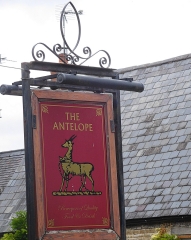
The Antelope Inn is housed in a building whose construction began in the early 18th century. The earliest record of the pub’s existence is a document dated 1838. This was signed by the then publican Joseph   Lattimer.  I was curious about the pub’s name because I thought that antelopes were not common in Warwickshire. The friendly staff in the inn suggested that there were two possible explanations for the name. One was that some previous owners of the pub had been a South African couple. Far more likely than this is the fact that the antelope is taken from the badge of the Warwickshire Regiment. A useful website, www.lighthornehistory.org.uk, explains the pub’s sign:

“The Antelope is standing on a strip of six pieces. This is said to be the six feet of turf representing the old name of the 6th Regiment of Foot.”

Always on the lookout for Indian connections, I found the following (www.forces-war-records.co.uk/units/316/royal-warwickshire-regiment):

“The Regiment took part in two campaigns in South Africa known as the Kaffir Wars (7th Kaffir War 1846-47 and 8th Kaffir War 1850-53), protecting Dutch and English settlers from the aggressive native tribes north of Cape Town.  The Regiment also took part in the suppressing the India Rebellion of 1857.”

So, the regiment had taken part in campaigns both in South Africa, where my parents were born, and in India, where my wife was born. Regardless of the activities of the local regiment, we ate an excellent meal at The Antelope Inn.

More recently, in 1972, Ugandan Asians who had fled from Idi Amin’s Uganda were housed temporarily at Gaydon Airfield (now ‘Lighthorne Heath’) that is near Lighthorne (see: http://www.lighthornehistory.org.uk/wp-content/uploads/Shorthistory.pdf).  Some of the inhabitants of Lighthorne assisted the distressed Asians during their first couple of months in England.

Almost opposite the inn, there is a well or spring that issues from an elaborate stone structure with a badly weathered coat-of-arms. It is a ‘broadwell’, a word derived from the Old English ‘breac-well’, a well that is supplied with water from a brook (rather than a spring). The well is likely to be as old as the village. However, the stone structure probably dates from 1746, as the Lighthorne history website notes:

“… the quoins and coving, were probably built in 1746, the remainder of the fascia, pool and paving are from the 19th and 20th centuries. The old ironstone escutcheon inserted in the fascia is older and is believed to be the arms of the Pope family, Lords of the Manor in the 16th and 17th centuries.”

There was green mildewed water in the two receptacles of the broadwell. It has been suggested that this well might have been used for washing in the past.

Close to the well, we spotted red grapes ripening on a vine growing on the side of a cottage facing the Antelope. They are located in what must be a fine sun trap. Our Sunday lunch in the inn, one of the best Sunday roast meals that I have eaten for many a year, ended soon before we were due to take up our timed entry at Compton Verney. Next time we visit the latter, spending more time in Lighthorne and The Antelope will be given top priority.