Down in Hampshire at The Vyne with the Sandys and the Chutes

THREE MILES NORTH of Basingstoke, there is a magnificent stately home, The Vyne, which is now owned by the National Trust. Set in fine grounds alongside a long, thin lake, this edifice is a wonderful mixture of architectural styles and features.

The present house began its life as a Tudor mansion built between 1500 and 1510 for William Sandys, 1st Baron Sandys, Lord Chamberlain to King Henry VIII. It remained a possession of the Sandys family for most of the time from when it was constructed until 1653, when it was sold to Chaloner Chute (died 1659), who was a lawyer and the Speaker of the House of Commons during the Commonwealth. Because he felt that the Vyne was too big for his requirements, he had much, but not all, of the Tudor mansion demolished. Fortunately, several of the beautiful rooms with elaborate wood panelling were saved, along with the Tudor chapel.

The rest of what remained of the original building was converted to a version of the Palladian Style. This included adding a neo-classical portico to the north side of the hose, facing the lake. In the eighteenth century, one of Chaloner’s descendants, John Chute, influenced by his friend Horace Walpole, redesigned the interior of the chapel, adding trompe l’oeil features and also installed a very spectacular staircase in the house. The staircase is in the neo-classical style. It must have impressed those who visited the Chutes, and it still dazzles the visitor today. Although there are many fine artefacts to be seen in the house, this staircase was, for me, the ‘star of the show’.

When John Chute died childless, The Vyne was inherited by his cousin Thomas Lobb, who then changed his surname to Chute. After that, few changes were made to the house. The house remained in the Chute family until 1958 when Charles Chute bequeathed the estate to the National Trust.  

The Virgin Queen visited here to watch the hunt in Epping Forest

IT HAS BEEN STANDING for many centuries, but until we saw something about the place in a recent (March 2024) issue of the free Metro newspaper, we did not know it existed. The place is located in Epping Forest on Rangers Road, which runs eastwards from Chingford (on the edge of northeast London). I am referring to a well-preserved, whitewashed, half-timbered Tudor building, which was constructed in 1543 for King Henry VIII, and renovated by his daughter Queen Elizabeth I in 1589.

This edifice, which is 481 years old, is aptly known as ‘Queen Elizabeth’s Hunting Lodge’, and is open to the public to explore. It is a timber-framed three-storey ‘standing’. That is to say that it was constructed to be used as a place from which the hunt could be observed. And Epping Forest, where it stands, was, from the 12th century until the 19th century a Royal Forest, where only the monarch had the right to hunt deer. Although now fully glazed, originally the window apertures on the two upper floors were without glass. Visitors to the lodge would have been able to watch the hunt and, maybe also, shoot animals from these raised vantage points.

Throughout the building, one can see unpainted oak beams – supporting the floors, the walls, the ceilings, and the roof. The ground floor consists of an entrance hall and a larger room (with a fireplace), which served as a kitchen. A wooden staircase leads to the upper floors. It is wrapped around a square hollow newel, which supports the stair treads. There is a glass pyramid (not Tudor) above this space, which allows visitors to see the original lath and plaster work that makes up the newel.

Much of the first floor is occupied by a large hall with windows overlooking the forest. The second floor is similar, but it has a fine hammer-beam ceiling. Another such ceiling is high above the top of the staircase.

During the reign of Queen Victoria, the first floor of the lodge was divided into small bedrooms by partitions, which have long since been removed. It was then used as accommodation by the bailiff of the local lord of the manor. The Watkins family were residents for a period. It was Mrs Harriet Watkins, who used the Lodge and its garden for providing refreshments until 1897, when she took over the adjacent barn – now known as Butler’s Retreat – for the provision of teas. Writing about the lodge in 1876, James Thorne noted:

“The open space in front of the lodge has always been a favourite resort of the East-end holiday folk, for whom ‘tea and refreshments’ are provided at the lodge. On a fine summer’s day, on Monday especially, numerous picnic and ‘van’ parties may be seen, with swings improvised between the oaks, and gipsies with their donkeys in attendance.”

Regarding the suitability of the position of the lodge, he wrote:

“The ground, sloping gently from the lodge on all sides, used to be everywhere unenclosed, the tract beyond being open forest, with some famous unlopped trees, but chiefly, as in other parts of Epping Forest, of pollard oak.”

Today, standing on the second floor, or even on the first, one gets a good panoramic view of the surrounding land.

Queen Elizabeth’s Hunting Lodge is not as grand as some other surviving Tudor buildings (e.g., Hatfield House), but it has been well looked after and it is a remarkable survivor, which is well worth a visit. But before you go, please check the current opening tomes if you wish to explore its interesting interior.

House of Claret

WE HAD INTENDED to drive along the A1 directly from London to Stamford in Lincolnshire. The A1 follows the route of the old Great North Road, but tends to bypass the small towns through which the older road ran. After driving northwards for about 1 hour and 40 minutes, I spotted a brown and white direction sign pointing towards a tourist attraction, the historic town of Buckden. We left the A1 and soon found ourselves in the village of Buckden. With its three old coaching inns, it was once a stopping place for travellers on the old Great North Road. As soon as we entered the place, we spotted some impressive, mainly brick, Tudor buildings behind crenelated boundary walls. A sign by an entrance to the grounds bore the words “Claret Centre”. We entered to discover that a sale of garden plants was being set up. We were invited to wanderin around the remains of a Tudor Palace and the knot garden next to it.

The Claret Centre is housed in the extensive remains of Buckden Palace – once a property owned by the Bishops of Lincoln. In the Domesday Book of 1086, the manor of Buckden belonged to the Bishop of Lincoln. By the time that St Hugh was Bishop of Lincoln (he had that position from 1186 to 1200), there was already a Bishop’s house in Buckden. St Hugh was by all accounts a remarkable man. Amongst his many virtues, he protected some of the Jewish people of the city of Lincoln from massacre in the 1190s. Albert Hyamson wrote in his “A History of the Jews in England”:
“At Lincoln, the Jews saved themselves by taking refuge in the castle. They were befriended by the Bishop Saint Hugh, whose death ten years later was very sincerely mourned by the local community.”

The bishop’s residence at Buckden was rebuilt several times before that which can seen today was constructed in the late 15th century. With two brief interludes, the bishop’s home and grounds remained as church property until 1870, when the property was bought by James Marshall of the firm Marshall and Snelgrove. In 1919, Dr Robert Holmes Edleston bought the by then dilapidated Buckden Palace. Keenly interested in history, Edleston extensively restored the Tudor buildings. He was an admirer of Napoleon III, and wrote two books about him. He planned to open a museum of the Frenchman’s relics at Buckden Palace and in anticipation of this project, which was never realised, inserted a commemorative plaque to Napoleon III in a wall facing the palace’s courtyard. Thanks to Edleston, there are substantial remains of the Tudor structures including an impressive square tower. This overlooks a beautifully restored knot garden, now named Queen Katherine’s Garden.

After the marriage of Katherine of Aragon (1485-1536) and King Henry VIII was annulled in May 1533, Katherine was housed in various places around England. One of these was Buckden Palace, where she was held/housed between July 1533 until 1534, when she was transferred to nearby Kimbolton Castle, where she spent the rest of her life. In December 1533, when Henry VIII sent the Duke of Suffolk to move Katherine to a more secure place, the men of Buckden resisted this and the duke had to abandon the attempt. Katherine was not the only noteworthy person to have stayed at Buckden. After her death, Henry VIII stayed there with his fifth wife, Catherine Howard in 1541. Other celebrities who visited included Thomas Wolsely, James I, Samuel Pepys, and the Prince Regent (later King George IV).

During WW2, Buckden Palace was home to refugees from the London Blitz. In 1956, Bishop Leo Parker (1887-1975), Roman Catholic Bishop of Northampton, arranged for Buckden Palace to come into possession of the Claretian Missionaries. Hence, its current name – The Claret Centre. The Claretians were founded by St Anthony Mary Claret (1807-1870) in Vich (Spain) in 1849. His followers grew widely in the Spanish-speaking world, and the movement came to Britain in 1912. After founding the first Claretian community in Hayes (Middlesex), others were established at Gorseinon (Wales), Langley Park (Durham), and Buckden.

Had it not been for the sign on the A1, I am not sure that we would have ever visited, or even known about, Buckden Palace. We were lucky to find the grounds accessible because of the flower market that was being arranged when we turned up. I am not sure that it is always possible to wander about the place as freely as we did on other days. Buckden has an attractive parish church as well as the three inns already mentioned. There is a high-end boutique hotel in the George Inn. Nearby, there is also an excellent hairdresser.  Even if the palace is not open, Buckden is a charming place to rest a while on a journey along the frequently busy A1.

A surprise in Stamford

WHEN I WAS A YOUNG child, I remember going with my parents to south London to visit a Spanish sculptor, who had escaped to Britain as a refugee during the Spanish Civil War. Although we only visited him once, I recall that his name was something like ‘Alberti’. That is all I can remember, and I do not believe that my parents ever spoke about him much since that visit made maybe more than 60 years ago.

Today, the 20th of May 2023, we spent a couple of hours in the Lincolnshire Town of Stamford. This attractive place has several lovely old churches, one of which is St Martins. This edifice contains a chapel filled with glorious funerary monuments of members of the Cecil family, which was of great importance during the reign of Queen Elizabeth I and other Tudors.

When we were about to leave the church, I spotted a modern wood carving of the head of a man with a beard and moustache. Although it was not nearly as attractive as the Cecil monuments, I decided to examine it. I do not know why I did, but I am glad that I did.

I was surprised to discover that the carved head was created by Jose Manuel de Alberdi Elorza (1922-2008). Beneath the head there is a notice with the following words written by Alberdi:
“A kind of anti-war protest… The face at the moment just when Christ died on the cross … The deed is done. We have killed.”

The sculptor was two years younger than my mother, also a sculptor. All that I can discover about Alberdi on the Internet is that he was Basque and a refugee from the Spanish Civil War. Also, he taught sculpture at the St Martins School of Art in London from 1948 to 1958 , which is where my mother made sculptures during that time.

Although I cannot be certain, I am pretty sure that this head in Stamford was made by the Spanish sculptor we visited in South London so many years ago.

A numerical oddity in Cornwall

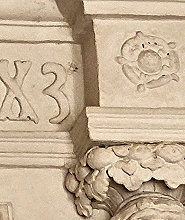
TRERICE HOUSE IN Cornwall was built mainly between 1570 and 1573. It is one of the loveliest National Trust (‘NT’) properties in the county and one of my top ten. In one of the upper rooms there is an ornate bas-relief above the fireplace. The top of this bears the following:

“ANNO: DOMINI: M : CCCCC : LXX3”

It is clearly a date in mostly Roman numerals, (i.e., 1573). However, this date has several odd features.

‘CCCCC’ is 500, but usually abbreviated to ‘D’ in Roman numerals. There is a surplus of colons (‘:’) and instead of ending in a Roman numeral, there is the Arabic numeral ‘3’.  Or is it the symbol for a serpent, rather than a ‘3’? It is a curiously shaped 3: it is widest at the top and tapers towards its lower end.

The NT volunteer offering information in the room with this curious date suggested three possible explanations for this peculiar form of the date above the fireplace. One is that the creator of this date miscalculated the amount of space, and instead of ending the date in ‘: III’, used the Arabic ‘3’ to fit in the last part of the date. Had he used ‘D’ instead of the unusual ‘CCCCC’, there would have been plenty of space to fit in the entire date using only Roman numerals. Another explanation offered is that the ‘3’ is really a stylised serpent, a symbol of wisdom often associated with Queen Elizabeth I, during whose reign the house was built.

3 or a serpent?

The last explanation was provided by a builder, who had visited Trerice some weeks before us. He suggested that the ‘3’ was added to indicate that the building works were supposed to have been completed in 1570, but had finished 3 years later than expected; the builders were running behind schedule.

Whatever the explanation of the curiously written date, and you might have another theory, Trerice is well worth a visit.

Perspective in a Tudor house in Barking

NOT FAR FROM the busy A13 road that links London with Tilbury and places further east, and surrounded by a sea of unremarkable dwelling houses in the London Borough of Barking & Dagenham, stands an unexpected historical Tudor architectural treasure: Eastbury Manor.

Part of a wall painting in Eastbury Manor

This beautiful Tudor mansion, built between 1560 and 1573 for Clement Sisley (or Sysley) and his family, stands on land that had been owned by Barking Abbey until its dissolution in 1539.  He was a wealthy businessman connected with high-status families. Married thrice, each of his wives’ dowries added to his prosperity. The manor house remained connected with his extended family until it was sold in 1628. After that, the house and its associated extensive land had a series of owners and tenants until sometime in the 19th century when the building began to deteriorate. The various inhabitants made use of the place’s formerly large grounds for agricultural purposes: principally, grazing. The National Trust (‘NT’) bought the house in 1918, and this purchase is responsible for its survival. Owned by the NT, it was Barking’s local museum between 1935 and 1941. Now, still the property of the NT, it is maintained by the London Borough of Barking and Dagenham.

According to an article written by Hazel Stainer (https://hazelstainer.wordpress.com/2019/05/17/eastbury-manor-house/), Eastbury Manor was noted by the author Daniel Defoe during his travels in 1724:

“A little beyond the town, on the road to Dagenham, stood a great house, ancient, and now almost fallen down, where tradition says the Gunpowder Treason Plot was first contriv’d …”

I checked my copy of Defoe’s book and discovered that the editor of my edition (Pat Rogers) had doubts about this connection with Guy Fawkes et al. Rogers noted that the conspiracy was largely planned in Northamptonshire.

The house, which stands on land rich in clay, is built of bricks made locally, on-site. It is built to an H-shaped plan: two parallel wings are linked by a central portion perpendicular to near their northern ends. The central part and the two wings enclose a charmingly intimate courtyard, whose fourth (southern) side is bounded by a wall connecting the two wings. Although a modern staircase and lift have been added, the house’s original timber spiral staircases were housed in octagonal towers that encroach onto the northwest and northeast corners of the courtyard: they are classed as ‘external staircases’.

The house and its garden have many fascinating features typical of Tudor architecture. For example, in the Great Hall on the ground floor, there is a huge fireplace. It is large enough for several adults to stand within it. Our informative guide directed us to look up into the large chimney. There, we could see platforms that were built to allow workmen to climb into the chimney to clean it in the era long before there were chimneysweeps with special equipment. The Tudor brick wall surrounding one of the gardens has 17 small niches. These were designed as bee boles, in which skeps, baskets where bees lived, were placed.  Interesting as these and many other things are, the most amazing feature is to be seen in the so-called Painted Chamber on the first floor, which we reached using the original timber staircase.

Discovered beneath layers of paint after a fire during the 19th century, are the sizeable fragments of two exceptional wall paintings. It is believed that these were commissioned by the London Alderman Sir John Moore who died in 1603. His coat of arms is depicted on one of the pictures. Moore, who took an interest in international trade and the then proposed East India Company, used the house as his country home.

The paintings depict trompe-l’oeil walls with columns, classical figures, and archways. The latter frame depictions of countryside and nautical scenes. Apart from their great age and skilful execution, these frescos are remarkable for their use of perspective.  The lady who was showing us around the Manor mentioned that these wall paintings are some of the earliest surviving examples of  pictures in England displaying the kind of perspective that is now commonly used in Western European art. So-called ‘true geometric perspective’ was developed by Italian painters during the 14th and 15th centuries. Its use spread to other parts of Europe and would have been known in England by the time of Moore’s occupancy of Eastbury Manor. The surviving wall paintings were executed before his death in 1603, but by whom we might never know. It is quite possible that the artist had either been abroad or had come from overseas. Whoever painted these lovely images had a good grasp of what was then regarded as the latest way of portraying the illusion of depth and distance. Whether there are earlier examples of surviving paintings created in England (using tru perspective) than those at Eastbury Manor, I do not know. So, until I am wiser on the subject, I will accept what we were told. I have seen older surviving wall paintings in English churches, but none of them display even the slightest hint of true geometric perspective.

All in all, it is well worth venturing into the rather dull suburbs of Dagenham and Barking to visit Eastbury Manor. It might not be as glorious as other surviving Tudor edifices, such as Hatfield House, but it is no less a wonderful reminder of an era long-since passed.

A back to front church

JUST TWO AND a half miles north of Heathrow Airport and one mile north of Harmondsworth lies the former village of West Drayton, formerly known simply as ‘Drayton’, now part of the London Borough of Hillingdon.

Both the mainline railway and the Grand Union Canal run through West Drayton. During the second half of the 19th century, this settlement in middle of flat agricultural land was also home to grain mills, brickworks, ropemaking, and docks connected with activities on the canal. There is still some industry in the area, but now it is mainly residential.

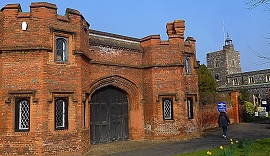
Tudor gateway and St Martins Church at West Drayton

West Drayton’s parish church of St Martin was first mentioned in writing in 1181. The present building, with a flint covered exterior and a bell tower topped with a small cupola, mainly dates from the 15th century. Whereas most of the building is 15th century, at least one part of it, a two-arched piscina in the southeast corner, is 13th century. Currently, the church is entered through a modern doorway at the east end of the south wall instead of the older south entrance near the west end of the southern wall. On entering the church, I felt immediately disoriented. This is because, as I realised quickly, the church is arranged back to front. The high altar is at the west end of the church almost at the base of the bell tower and the pews face in that direction. Some years ago, the altar was moved from the chancel, where it had been for many centuries, to the western end of the nave. The reason for this, the vicar and her husband told me, was that it was done so that nobody in the congregation would have a restricted view of the altar during services. However, the attractively carved 15th century stone font stands where it was before the position of the altar was reversed: in the southwest corner of the nave. Another curiosity in the church is the hanging pyx suspended above the high altar. This gothic revival style container (based on the appearance of a mediaeval pyx in a church in Suffolk), which holds the sacrament and can be lowered during services, was designed by Andrew Low, manufactured at Pinewood (film) Studios, and placed in St Martins in 1975.

This oddly arranged church contains several carved stone memorials on its interior walls. Many of them commemorate members of the De Burgh family. Their bodies and those of the Paget family are sealed in a vault below what was originally the chancel.

With only a brief interruption during the 17th century, the manor and estate of West Drayton was owned by the Paget family between 1546 and 1786. In 1786, Henry Paget (1744–1812), 1st Earl of Uxbridge, sold the manor to a London merchant Fysh Coppinger (died 1800), who changed his surname to De Burgh, that of his wife. His memorial is in the church. Henry Paget’s eldest son, Henry William Paget, 1st Marquess of Anglesey (1768-1854), lost his right leg during the Battle of Waterloo (1815). It was replaced by a wooden prosthesis. His amputated leg was buried in Belgium, whereas the rest of his body was interred in Lichfield Cathedral.

The church and its small cemetery are enclosed within an old wall with Tudor brickwork. This is part of a large wall, which once enclosed private grounds. Following the passing of an Act of Parliament, Sir William Paget (1506-1563), at one time secretary to Jane Seymour (c1508-1537), one of the wives of King Henry VIII, enclosed his grounds with a brick wall in the 1550s. The Act stipulated free public access to the church.  Parts of this wall can be seen around the churchyard and alongside Church Road. The Paget family built a mansion on the land that had been enclosed. This building, West Drayton Manor House, was demolished in 1750 by the then Earl of Uxbridge. Although the spacious brick mansion, where the Paget family once lived, is no longer, the red brick gatehouse to the grounds still stands. According to Bob Speel (www.speel.me.uk), this Tudor grand entrance with two octagonal turrets was built in the 16th century. Close to the old gatehouse, there is a newish housing estate, a small enclave called Beaudesert Mews, which was built on land on which at least a part of the long-since demolished manor house might have stood.  The name ‘Beaudesert’ relates to the above-mentioned Sir William Paget, who had the title ‘1st Baron Paget de Beaudesert’.  

By the 19th century, the De Burgh family were living in Drayton Hall, an early 19th century building, which now serves as Council Offices and is surrounded by Drayton Park, near the church. A new building attached to it contains offices of at least one commercial enterprise. West Drayton retains a rectangular grassy space, The Green, once the village green. Several of the buildings around it look as if they were present well before the area was engulfed by London’s western spread. Unlike nearby Harmondsworth and Longford, West Drayton is not under threat of suffering demolition if or when Heathrow Airport is expanded.

At Liberty in London

BEFORE WE MARRIED in 1993, many of our kind friends wanted to give us wedding presents. A large proportion of them wanted to choose gifts from a ‘wedding list’. For those who are unfamiliar with this kind of list, let me explain. A ‘wedding list’ is a list of items, usually available from a shop chosen by the bride and groom, from which those wishing to give wedding presents can choose. As the items are bought, the shop removes them from the list so that the likelihood of duplicate purchases is reduced.

We were a little reluctant at first, but people insisted that it would be helpful if we compiled a wedding list. We chose to have our list at a shop that we both enjoy visiting: Liberty on Great Marlborough Street, very close to Regent Street.

Above an entrance to Liberty shop

From the outside, Liberty looks like an extremely well-preserved example of Tudor architecture, too good to be true. It is not because it was completed in 1924.

Liberty was founded by Arthur Lasenby Liberty (1843-1917), son of a draper. In 1875, he opened his own shop on Regent Street. According to the Liberty website (www.libertylondon.com), he wanted:

“… a London emporium laden with luxuries and fabrics from distant lands, his dream was to metaphorically dock a ship in the city streets. To this day, a voyage of discovery awaits on the good ship Liberty, with history hidden amongst six floors of cutting-edge design, unexpected edits and beautiful wares from the world’s greatest craftspeople. In 1875, Arthur borrowed £2,000 from his future father-in-law and took a building on Regent Street, London with just three dedicated staff and plenty of ambition.”

By the time that Liberty opened his shop, the British public was fascinated by Japan and other parts of Asia. In 1885, he brought 42 villagers from India and set up a temporary ‘living village’ of artisans in the shop.

The website added:

“Liberty’s collection of ornaments, fabric and objets d’art from around the world proved irresistible to a society intoxicated at the time by Japan and the East and Liberty effected social change in interior design and dress, so much so that the Art Nouveau period in Italy is called ‘Liberty Style’.”

Liberty died before his new shop was completed. Designed by Edwin T Hall and his son Edwin S Hall, it was built in the Tudor Revival style that achieved great popularity in the 1920s.  Not only is the shop’s exterior in the Tudor Revival style, but also its interior. A great dela of wood was used in the construction as the shop’s website revealed:

“… the builders Messrs Higgs & Hill were given a lump sum of £198,000 to construct it, which they did from the timbers of two ancient ‘three-decker’ battle ships. Records show more than 24,000 cubic feet of ships timbers were used including their decks now being the shop flooring: The HMS Impregnable – built from 3040 100-year-old oaks from the New Forest – and the HMS Hindustan, which measured the length and height of our Liberty building.”

Even if you do not wish to purchase anything from our long out-of-date wedding list, a visit to Liberty is rewarding not only to see the wonderful range of beautiful products on sale but also to narvel at the building and its many finely crafted decorative features.

Royal remains

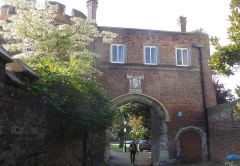
WE VISIT RICHMOND regularly to see a couple of friends, with whom we almost always take a stroll, usually somewhere reasonably near their home. They know that I love seeing places that I have never visited before and almost always they take us to see something that they feel might interest us. On our most recent walk with them, taken in October 2021, we began by walking across Richmond Green, taking a path that was new to us. At the western edge of the green, we crossed a road and immediately reached a Tudor gateway that leads into an open space surrounded by buildings. The open space is on the site of a now mostly demolished royal residence that was particularly liked by Queen Elizabeth I.

The royal residence was Richmond Palace. It was built by King Henry VII, when the 14th century Shene Palace, which used to stand on the site, was destroyed by fire in December 1497.  Henry VII built a new palace on the same ground plan of Shene Palace. Richmond Palace, as the new building was named, was used continuously a royal residence until the execution of King Charles I in January 1649.

On a wall facing a pathway leading from the old gatehouse to the River Thames, there is a commemorative plaque with the following carved on it:

“On this site extending eastwards to cloisters of the ancient friary of Shene formerly stood the river frontage of the Royal Palace first occupied by Henry I in 1125…”

It adds that Edward III, Henry VII, and Elizabeth I all died in the palaces that stood on this riverside site in Richmond.

After Charles I lost his head, the palace, like many other parts of the royal estate, was sold by the Commonwealth Parliament led by Oliver Cromwell. Much of its masonry was sold. According to an informative source (www.richmond.gov.uk/media/6334/local_history_richmond_palace.pdf):

“While the brick buildings of the outer ranges survived, the stone buildings of the Chapel, Hall and Privy Lodgings were demolished and the stones sold off. By the restoration of Charles II in 1660, only the brick buildings and the Middle Gate were left.”

The same source relates that after being owned by the Duke of York, who became King James II, and after he was deposed:

“The remains of the palace were leased out to various people and, in the early years of the 18th century new houses replaced many of the crumbling brick buildings. ‘Tudor Place’ had been built in the open tennis court as early as the 1650s, but now ‘Trumpeters’ House’ was built in 1702-3 to replace the Middle Gate, followed by ‘Old Court House’ and ‘Wentworth House’ (originally a matching pair) in 1705-7. The Wardrobe building had been joined up to the Gate House in 1688-9 and its garden front was rebuilt about 1710. The front facing the court still shows Tudor brickwork as does the Gate House. ‘Maids of Honour Row’ replaced most of the range of buildings facing the Green in 1724-5 and most of the house now called ‘Old Palace’ was rebuilt about 1740.”

During our recent perambulation with our friends, we saw most of the buildings listed in the quote above but not the Maids of Honour Row. They also pointed out that Richmond Green, across which we walked, was used for jousting tournaments in mediaeval times. Today, this pleasant green space close to Richmond’s main shopping street is used for more peaceful purposes including walking, both human beings and their canine companions.

Once again, a visit to our friends in Richmond has resulted in opening our eyes to new places of great interest, and for that we are most grateful.

Party in a Tudor hall

WE ATTENDED A WEDDING in a most attractive location today, the 25th September 2021. The ceremony was held in the great hall of a palace favoured by Queen Elizabeth I. Built in 1497, most of the palace was demolished but this superb hall, a masterpiece of Tudor architecture, remains. The great hall has a newer neighbour, a triumph of Jacobean architecture: Hatfield House built in about 1608 and incorporating material from the former palace of which only the great hall remains. The Jacobean edifice was built for Robert Cecil (1563-1612), First Earl of Salisbury. Some of his descendants still reside in the house.

With about 250 people attending and dining at long tables, it was not hard to imagine such joyous festivities occurring during the Tudor heyday of the great hall.