IN CENTRAL AHMEDABAD, a large city in India’s state of Gujarat, there is a curious café called Lucky. This popular eatery, founded in 1950, is unusual not because it does not serve coffee but because its tables and chairs are placed between Moslem graves. Also, the trunk of an old tree is contained within the restaurant. Its base is within the eatery and it passes out of the place through a hole in Lucky’s ceiling.
Tree trunk and a grave at Lucky
Lucky’s is sited on an old Moslem graveyard, but this does not put off a steady flow of customers from enjoying a wide variety of vegetarian meals and snacks in this eatery. Closer to home, near the south side of London’s Lambeth Bridge, there is another café sited on a former graveyard.
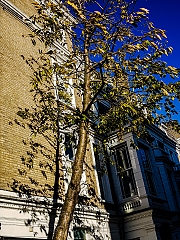
Even when the sun is not shining, this leaning tree in London’s Kensington Square is interesting enough from the visual point of view. It is amazing how much more entrancing and intriguing the scene becomes when the sun causes the tree to cast a shadow.
I ARRIVED EARLY for a committee meeting of the Anglo-Albanian Association, which was being held in a house in Walham Grove in London’s Fulham district. It was a warm afternoon, and as I did not want to disturb our host by arriving too early, I sat on a bench in the small yard next to the north side of St Johns Church – a rather unexceptional example of early 19th century church architecture.
Soon, I noticed a tree in the middle of the yard. Its trunk was growing at about 30 degrees to the ground, and was supported by a wooden prop. Branches were growing out of the trunk, more or less vertically. There was a small commemorative notice at the base of the tree – where it had been planted originally. It bore the words:
“This mulberry tree was planted by His Worship the Mayor of Fulham Councillor JF Perotti JP on Victory Day June 8 1946”
On that day, celebrations were held in London to commemorate the Allied victory in WW2, the British Commonwealth, and the Empire. The Mayor, Mr Perotti, was a fitter at London Transport’s Lots Road electricity generating station.
In my mind, mulberry trees conjure up visions of silk growing and exotic landscapes of yesteryear. To be honest, until I saw the notice by the tree in the yard in Fulham, I would not have been able to identify a tree as being a mulberry. I stood up and examined it closely. To my great delight, I saw that the tree has berries. They looked like larger than average raspberries. I have read that when they ripen, they become darker in colour and resemble elongated blackberries.
I was curiously excited to find a mulberry tree with its fruit. I had not expected to find one in a busy part of Fulham. Mulberry trees have been grown in Britain since Roman times. One of the oldest surviving examples is in the garden of Canonbury Tower in Islington. It might have survived since the 16th century. There are several other slightly younger mulberry trees in London. So, the leaning example I saw in Fulham is a youngster on the scene.
I HAVE SEEN PHOTOGRAPHS of baobab trees, but until we visited the café of the formerly named Prince of Wales Museum in Bombay, I had never seen one ‘in the flesh’. A member of the mallow family of plants, baobabs are native to Madagascar.
Baobab tree in Bombay
These trees with curious looking conical trunks were imported to India by Arab traders. Although this is the case, this baobab in Bombay is the first such tree I have seen during my 30 years of frequent visits to India.
As we sat with our cold drinks, I looked up at the high branches of the baobab, and saw something flapping about. At first, I thought it was a black plastic bag caught in the branches. Then I noticed that it was a large bat stretching its wings. I saw it was not alone, but one of a large number of bats hanging on the high branches. These large creatures had black wings and dark brown bodies.
Despite the fact we had just seen a wonderful exhibition of ancient sculptures (from India, Ancient Rome and Greece, and Assyria), finding the baobab and seeing the bats in it, made my day.
WHENEVER I THINK ABOUT Christmas trees, I envisage a smallish pine tree that is roughly conical in shape. Today, I noticed a tall conifer growing in a garden in Bangalore. Attached to it there was a metal label identifying it as “Christmas tree. Araucaria cookei.” This tree bore no resemblance to any Christmas tree I have ever seen.
I used the Internet to look up ‘Aracauria cookei’, and learned that it is commonly known as ‘Captain Cook’s Pine’. It was first ‘discovered in New Caledonia by a botanist travelling with Captain Cook on his Second Voyage (between 1772 and 1775).
One botanical website revealed that when planted in a pot, this tree can be used as an alternative to regular Christmas trees. Other websites describing this plant make no mention of this. In any case, the specimen I saw labelled in Bangalore was taller than an average three-storey building. It was far too tall to be used as a Christmas tree.
BURNHAM BEECHES IS an area of woodland not far from Slough and Windsor. Rich in beech trees, it was purchased by the Corporation of London in 1880. The German composer Felix Mendelssohn (1809-1847) visited Britain several times between 1829 and 1847. While staying in England, Felix enjoyed spending time in Burnham Beeches. It is said that there was one old beech tree under which the composer liked to sit. Legend has it that it was in the shade of this tree that he gained inspirations for some of his compositions including some of the well-known “Incidental music to ‘A Midsummer Night’s Dream’” (composed 1842). In January 1990, when the tree was about 500 years old, it fell over during a storm.
Part of the fallen tree was presented to the Barbican Horticultural Society. Like Burnham Beeches, the Barbican (a post WW2 development in the City of London) is managed by the Corporation of London. The remnant – part of the tree’s trunk – stands on a section of the elevated walkway not far from Barbican Underground Station. Next to it, there is a plaque detailing its history and its probable connection with the composer.
What I have described so far appears in many websites detailing the curiosities of London. However, not one of them mentions that there is yet another fragment of this tree within the barbican. This piece of the dead tree is smaller than that on the walkway, and can be found, somewhat hidden by vegetation, within the Barbican’s magnificent conservatory.
I wondered what had attracted Mendelssohn to Burnham Beeches. In an article by Helen J Read, published by the Buckingham Archaeological Society on its website (www.bucksas.org.uk), I learned that Felix was often a guest of Mr and Mrs Grote, who lived close to Burnham Beeches. They often entertained musical and literary figures. Amongst their many guests was the Swedish singer Jenny Lind, who first performed in London in 1847. The singer also had a favourite tree, which, like Mendelssohn’s, was destroyed in a storm.
Regarding Mendelssohn and his tree, Ms Read wrote:
“Mr and Mrs Grote also entertained the composer Felix Mendelssohn. His favourite part of the Beeches was a mossy slope between Grenville Walk and Victoria Drive, at that time covered with pollarded trees. Many maps mark this area as Mendelssohn’s slope, and it is thought that the music for Puck and Oberon from ‘A Midsummer Night’s Dream’ was inspired by this area. After Mendelssohn’s untimely death, Mrs Grote erected a headstone in his memory but the headstone was removed …
… There is no specific mention in the earlier maps or guides of any particular tree favoured by the composer, but a plaque was later erected on an old pollard tree. The tree blew over and the plaque was moved to one nearby until the storm of 1987, when this tree lost all its branches.”
Judging by what Ms Read wrote, it seems to me that there is a possibility that the fragments of tree, now commemorated at the Barbican as being Mendelssohn’s Tree, might not be remnants of the one beneath which he sat. Even if these bits of timber are not from his favourite tree, they make a charming memorial to a composer whose music gives pleasure to so many people.




 yamey
yamey 