A LIVING WALL (aka ‘green wall’) is a vertical structure covered with living plants attached to an exterior wall. Architecturally, they can add visual interest to the buildings on which they are attached. One building, whose visual interest is far from great, is the brick and concrete Kensington Town Hall, which was constructed in 1976. An attempt to improve its image has recently been completed. It is the addition of a living wall, 82 feet high and 16 feet broad.
This wall of greenery, doubtless paid for by the people living the Royal Borough of Kensington and Chelsea, has been justified by the council as being useful for providing additional natural habitats for pollinators and other friendly creatures, as well as for helping to purify the air. Attractive as it is, it does little to distract me from the overall lack of beauty of the building to which it is attached. As the saying goes …
THE DAVID LEAN cinema, where we watched a superb film called “Coming to America” (made in 1988), is within a complex known as the Croydon Clocktower. In the heart of Croydon, this cultural centre is housed in what was originally constructed as the district’s Town Hall.
The Town Hall is a magnificent – exuberant – example of Victorian brickwork. It was constructed to the designs of a local architect, Charles Henman, and inaugurated by the Prince of Wales in 1896. There is a large statue of his mother, Queen Victoria, outside the façade on Katherine Street.
Until the 1980s, the enormous edifice was used for local government purposes. In the late 1980s, and early 1990s, the interior was renovated. Areas that were no longer needed for council business were repurposed as a public library, a café, a museum, and the David Lean cinema. A large room, which retains its original interior décor, the Braithwaite Hall, continues to be used for concerts, theatrical shows, and other public functions. It looked to me that the inside of the building had been hollowed out to create a spacious central atrium with a glass roof, which can be overlooked from galleries surrounding it on each floor. The result is pleasing to the eye. From the outside of the building, you would not expect to see this kind of atrium. The Town Hall complex is now known as the Croydon Clocktower, the name referring to the building’s high brick clock tower.
The film we watched in the small David Lean cinema was wacky but wonderful – a complete contrast to an incredibly slow-moving Taiwanese film, “Days”, which we watched a few days later.
BANK HALL IN Warrington (Cheshire) was designed for the local industrialist Thomas Patten (1690-1772), who had successful copper processing works, and built in 1750. It was designed by James Gibbs (1682-1754), whose other creations include St Martin-in-the-Fields (London), Radcliffe Camera (Oxford), and the Senate House (Cambridge), to mention only a few. This elegant building with neo-classical features has served as Warrington’s Town Hall since about 1870. Impressive as the building is, its magnificence pales when it is compared to the grand gates at the entrance to its grounds.
Frederick Monks, a local ironmonger and town councillor, heard about a pair of wonderful cast-iron gates which had been made at the Coalbrookdale works at Ironbridge in Shropshire. The gates had been made to be exhibited at the International Exhibition held in South Kensington in 1862. The gates were intended for Queen Victoria’s residence at Sandringham (Norfolk). However, when she saw them at the exhibition, she noticed a statue of the regicide Oliver Cromwell behind them. This put her off the idea of installing them at Sandringham.
The gates, having been rejected by Victoria, were offered for sale by the company that had made them. Eventually, Frederick Monks purchased both the gates and the statue of Cromwell for his town, Warrington. The gates were installed in front of the Town Hall in the late 1890s. An informative website (www.warrington.gov.uk/history-golden-gates) describes features of the gates, which were recently restored beautifully:
“Because the owner was supposed to be Queen Victoria, the gates have four winged figures of Nike, the goddess of victory. They also had a Prince of Wales motif above the arch in the middle, but this was changed to Warrington’s Coat of Arms.” We had no idea that these gates with gold gilding existed. So, when we came across them during a post-prandial stroll, we were both surprised and delighted. When you see these beautiful gates, you can understand why Warrington is so lucky to have them. Incidentally, the bronze statue of Cromwell is also in the town: on Bridge Street. Before it was erected there in 1899, there was much discussion in the town council about the suitability of celebrating the regicide with the statue.
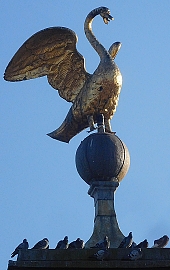
A LARGE GOLDEN SWAN with wings outstretched towers over the small town of Buckingham, once the county town of Buckinghamshire (until the 18th century, when Aylesbury took over this role) and now home to a respected private university, with whose founding my late father was to some extent involved. The gold-coloured copper swan surmounts a clock above the roof of an elegant late 18th century building on Market Square. Built in about 1783, this is The Old Town Hall, but not the oldest that the town has known.
The Old Town Hall was built to replace an even older one constructed in 1685 at the instigation of a local Member of Parliament, Sir Ralph Verney (1613-1696), during whose life the Civil War occurred. Initially on the side of the Parliamentarians, he fell out with them and fled abroad for a few years. After King Charles II gained the Throne, Verney returned to England where he served his people and the monarch.
In 1882, the clock was added above the Old Town Hall and upon this was placed the Swan of Buckingham, the borough’s crest. The wrought iron canopy over the main entrance was added early in the 20th century. The façade of the Old Town Hall faces another building, a well-known landmark and tourist attraction in the town, The Old Gaol, built in 1748 with its façade added in 1839.
The Old Town Hall was used for municipal administration until the 1960s when the local government headquarters were established elsewhere in the town. Now, the building is home to a firm of solicitors and the large metal swan high above their offices provides a nice perch for groups of the town’s pigeons.
FIRST WORLD WAR veteran William Frederick Stone died aged 108 in January 2009. He moved to Watlington in Oxfordshire in 1986 and lived the rest of his life in this small town. A popular figure in the town, he would have often passed the place’s Town Hall, which had been in existence even longer than him.
The name Watlington is probably derived from ‘tun’, meaning ‘fence’ or ‘enclosure’, and the people of ‘Wacol’ or ‘Waecol’, who also gave their name to the famous old road known as Watling Street. The town is close to another ancient cross-country route, the Icknield Way (https://en.wikipedia.org/wiki/Icknield_Way). There is evidence that there was a settlement at Watlington in the 6th century AD. The current street layout was already established by the 14th century and that there were inns in the town by the following century. During the English Civil War (1642-1651), Parliamentary troops were billeted in the town on the night before the Battle of Chalgrove Field on the 18th of June 1643, a battle in which their opponents, the Royalists, were victorious (www.britishbattles.com/english-civil-war/battle-of-chalgrove/).
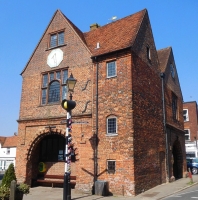
Twenty-one years after the battle, in 1664, Watlington’s town hall was built by Sir Thomas Stonor (c1626-1683). He lived at Stonor Park, which is 4.7 miles south east of Watlington. The Stonor family were Roman Catholics and retained their faith throughout the Reformation and suffered for that during the 16th and 17th centuries.
The brick town hall is unusual in that no two of its sides are equal in length and none of its corners are right angles (www.watlingtontownhall.com/history.html). Part of the ground floor is an arcade open to the outside air. This area was formerly used to hold markets. The first floor of the building served as a grammar school in the 19th century. The clock mechanism on the second floor is said to have come from the studios of the architect of St Paul’s Cathedral, Christopher Wren. This is not the only timepiece on the outside of the building. The other is a sundial, which has been gilded with 24 carat gold. The town hall was extended in the later 17th or early 18th century (https://britishlistedbuildings.co.uk/101369012-town-hall-watlington#.YH28eehKhPY) and was restored faithfully in the 20th century. Currently, the first-floor room, the former school, and beneath it, the under croft, are available for hire for social and other functions.
We came across the town hall quite by chance when driving home from visiting the Maharajah’s Well at Stoke Row. Today, we revisited the town on our way back from seeing several other places in Oxfordshire, about which I hope to tell you in the near future. Driving through England on roads other than motorways takes one through small towns and villages and many of these have features worth stopping to examine. Apart from the town hall, Watlington is a charming old place with several half-timbered buildings, cafés, and shops. Once again, a day trip to the countryside near London has proved rewarding.



 yamey
yamey 