A Nigerian who created artworks for a British daily newspaper

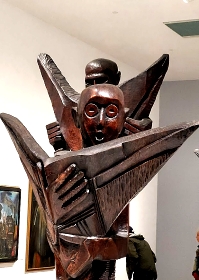
SEVEN CARVED WOODEN figures stand in a line at an exhibition in London’s Tate Modern gallery. Each of them is depicted holding something that looks like an book or a pair of wings. Their faces are all different, as are their expressions and heights. They were carved by the Nigerian artist Ben Enwonwu (1917-1994), and form part of a superb exhibition, “Nigerian Modernism”, which is showing until 10 May 2026.

Ben Enwonwu was born in Nigeria. His father was a traditional sculptor. Ben studied art first at Government College in Ibadan (Nigeria), and then at Government College Umuahia. At both places, he studied art under Kenneth Murray (1902-1972). In 1944, Ben was awarded a scholarship that allowed him to study both at The Slade School of Art in London and at The Ruskin School in Oxford. Also he undertook postgraduate studies in West African anthropology at the University of London. Thereafter, he taught art in Nigeria, where he created many of his sculptures and paintings. Since completing his education, Enwonwu has received international acclaim for his work.

In 1960, Ben proposed making a sculpture to commemorate Queen Elizabeth II’s visit to Nigeria in 1956. It was to be placed in the Nigerian House of Representatives in preparation for Nigeria’s independence in 1960. At the Tate’s exhibition, there is a photograph of Enwonwu working on this sculpture in the studio of his friend, the sculptor William Reid Dick (1878-1961), who was Sculptor in Ordinary for Scotland to Queen Elizabeth. At around this time, Ben received another commission in England.

The British newspaper, the Daily Mirror, commissioned Ben to create 7 sculptures for their headquarters. Carved in ebony, these are the works mentioned above. The diversity of their forms and expressions is supposed to represent the variety of people reading thepaper. According to a label in the exhibition, Enwonwu said:

“I tried … to represent the wings of the Daily Mirror, flying news all over the world.”

The statues were placed in the headquarters public courtyard in Holborn. Currently, they are in the Tate Modern, but after having been lost for several years, they were sold at public auction. They are now owned by Access Holdings PLC, a Nigerian company.

In addition to what I have already described, there are many more works by Enwonwu in the exhibition, both paintings and sculptures. Each one of them is wonderful. His works show the influence of European Modernism, but at the same time they reflect the artist’s African background and his involvement in the traditional art of his homeland. He was sympathetic to the Négritude movement, an anti-colonial cultural and political movement founded by African and Caribbean students in Paris in the 1930s, but was also affected by twentieth century artistic movements in Europe and the USA. It was fascinating to see how the modern art trends of the mid-twentieth century were successfully integrated with the artist’s desire to portray the life and traditions of Africa.

Walk the house on London’s South Bank

DO HO SUH is an artist who was born in South Korea in 1962. He was awarded a Bachelor of Fine Arts and Master of Fine Arts from Seoul National University, and then later, a Bachelor of Fine Arts in painting at the Rhode Island School of Design. He lived and worked in Seoul, then in New York City, and now in London. So, during his life, he has changed homes several times while moving from place to place. His exhibition that is on show in London’s Tate Modern until 19 October 2025 is called “Walk the House”. The exhibition is his artistic interpretation of what the concept of home means and of his experiences of moving from one residence to another.

A house within a house

Th artist’s works in the exhibition range from sketches, paintings, and sculptures to spectacular three-dimensional installations. Some of the installations can be entered and explored by visitors. In one of them, called “Nest/s”, the artist has stitched together a series of rooms made of translucent cloth that evoke places where he has lived in Seoul, New York, London, and Berlin. Visitors walk along a tunnel from room, thus following in the footsteps of the artist as he changed homes.  Another large installation that can be entered is a large room made of translucent, white polyester. To the walls of this structure, the artist has attached models of appliances and fittings that were in each of the homes he has lived. The items that have been attached have been colour coded: a different colour for each of the places in which he has dwelled. One other thing that particularly appealed to me is a translucent resin model of the house in which he lived in Providence, Rhode Island. Visible within this model there is a model of Suh’s childhood home in Seoul.

The Tate’s web page for this exhibition explained:

“Is home a place, a feeling, or an idea? Suh asks timely questions about the enigma of home, identity and how we move through and inhabit the world around us.

With immersive artworks exploring belonging, collectivity and individuality, connection and disconnection, Suh examines the intricate relationship between architecture, space, the body, and the memories and the moments that make us who we are.”

And this does well summarise what can be viewed in this exhibition, which is well worth visiting.

Visiting the Open Wound at the Tate Modern in London

THE HUGE TURBINE Hall that forms the entrance and centrepiece of London’s Tate Modern is used for temporary exhibitions. Until 16 March 2025, the Turbine Hall is home to a somewhat weird but visually fascinating art installation, “Open Wound, created by Mire Lee, who was born in South Korea in 1988.

At first sight, it seems that discarded skins of various shapes and sizes are hanging from the ceiling. Standing on the floor beneath some of them is a tall tower that carries what looks like a piece of ageing industrial machinery suspended from an overhead crane. This rotates slowly while drops of liquid fall from it onto some of the skins and elongated sausage-like pieces of fabric before dropping into a pool on a large piece of stretched material. Set in the lofty, rather inhuman, Turbine Hall, this installation made me feel as if I were inside an enormous abattoir.

Apart from being intriguing to look at, I was not sure what to make of it. The Tate’s website noted:

“Lee believes ‘being moved is the strongest thing you can experience through art.’ Reflecting on our current historical moment, Open Wound conjures ‘the mood of a deserted construction site’, an atmosphere of ‘futility and melancholy, where something has started to wither.’ Despite this, the collective ‘skins’ of the living factory suggest an eerie solidarity. They mutate the Hall into an intimate space of ‘dream and distant memory’, in which such feelings can be shared.”

Well, having seen the work in the Turbine Hall, these words made sense. I am not sure that I would recommend people going out of their way to see this installation, but if you had other reasons to visit the Tate Modern, then do spend a few minutes looking at Mire Lee’s creation.   

Visible but intangible works of art at London’s Tate Modern

SCULPTURE CAN BE APPRECIATED by enjoying the light reflected off it or passing through it, by touch, and sometimes by sounds it makes. Today, at London’s Tate Modern gallery, I saw an exhibition of sculpture that can be seen, but cannot be touched or even heard. The exhibits were beams of light projected onto screens through a room filled with the sort of smoke used in theatres to create haziness. All these exhibits were created by the British artist Anthony McCall, who was born in 1946.

The projected light creates often changing patterns on broad screens. What makes the exhibits really exciting is that the slowly moving smoky haze in the room allows the viewer to see the paths taken by the projected light through space. These three-dimensional envelopes of light produce interesting sculptural forms, but unlike most sculptures, the viewer can move through them unimpeded. And while moving through these space-filling light formations, the viewer modifies their shapes and what is projected onto the screens. The results are both intriguing and beautiful, apart from being quite unusual. Words cannot adequately describe what we saw at this show. You need to experience it for yourself to enjoy this intangible but intensely visual sculptural show, which is continuing until 27 April 2025.

The artist Mark Rothko in Cornwall

MANY PEOPLE MEDITATE profoundly in front of paintings by the American artist Mark Rothko (1903-1970). I am not one of those people. I can recognise his work and appreciate its originality, but he is not amongst my favourite 20th century artists.

When visiting the branch of the Tate Gallery in Cornwall’s St Ives at the beginning of July 2024, I viewed a small exhibition of painted panels created by Rothko. In 1958, he was commissioned to paint them for the Four Seasons restaurant in the Seagram Building in New York City. In the summer of 1959, he took a break from painting this series of pictures, and visited England. The painter Peter Lanyon invited Rothko to his home in St Ives in Cornwall. During his stay, he met other artists based in the West Country including Alan Davie, Paul Feiler, Patrick Heron, and Terry Frost. Rothko’s visit to St Ives was a factor that helped change his mind about displaying the paintings he was creating for the Four Seasons restaurant. It has been recorded that he said that the restaurant was:

“… a place where the richest bastards of New York will come to feed and show off.” (theartnewspaper.com, 4th of April 2024).

In 1969, Rothko donated nine of the paintings, originally destined for the restaurant, to the Tate Gallery. Seven others can be viewed at the Kawamura Museum of Modern Art in Japan, and another thirteen are housed at the National Gallery of Art in Washington DC. The rest are owned by his children.

Usually, the paintings currently being displayed at the Tate in St Ives are to be found in a dedicated room in London’s Tate Modern. Currently, the room where they are usually stored in Tate Modern is being used to host an exhibition by another artist (Joan Mitchell). The Seagram murals will remain in St Ives until January 2025.

We visit St Ives regularly. Its branch of the Tate is one of several artistic attractions we visit in the town. Although it contains some great artworks, I am not fond of its architecture. I am glad we visited again because had we not done so, I would not have known about Rothko’s holiday in St Ives, and the influence it had on his decision not to display his paintings in a fancy restaurant in New York City.

A twentieth century American artist who seemed to have lost his way

THE EARLY WORKS OF artists, who became famous for their successful experimentation in style and expression (such as Matisse, Picasso, Van Gogh, Miro, and Hockney), began by making quite conventional figurative pictures – always competently executed. Such was also the case with the artist Philip Guston (1913-1980), who was born in Canada, son of Jewish parents who had migrated from Czarist Russia. Born ‘Goldstein’, he later changed his surname to ‘Guston’. His family moved to Los Angeles (USA) in 1922. His childhood was filled with trauma: his father committed suicide, and soon after that his brother was killed in a motor accident. He began to be involved with art as a way of dealing with these sad events. In the 1930s, he engaged with political activity, fighting racism and anti-Semitism at a time when the Ku Klux Klan was enjoying some prominence. Several of his paintings depict hoods, such as were worn by the Klan.

There is a retrospective exhibition of Guston’s works at London’s Tate Modern until the 25th of February 2024. The paintings are exhibited chronologically on the walls of eleven interconnecting display areas. Like the artists listed at the beginning of this piece, Guston’s early works are figurative and very beautifully painted. Many of these powerful images reflect his concerns about the adverse political developments he observed during the 1930s. Later, in the 1940s, he became friends with artists like Mark Rothko and Willem de Kooning, and he moved successfully from figurative painting to abstraction. He became well-known as an abstract artist. After that, in the 1960s, his art seemed to my eyes to go downhill.

Guston’s later works, which are partly figurative and partly abstract, and created in and after the late 1960s, were undoubtedly created to send messages to the viewer. However, I found them to be crudely executed in comparison with his earlier abstract and much earlier figurative works. Whether this crudeness was deliberate or reflected a decline in the artist’s ability I cannot say. These later works express the artist’s personal crises and his reaction to injustices and other global catastrophes, but they did not do much for me from an aesthetic point of view. Had I left the exhibition without seeing them, my admiration for Guston would have been higher than it is having seen them.

From Zambia to the moon and Mars

UNTIL THE 14TH OF JANUARY 2024, there is a fascinating exhibition at London’s Tate Modern gallery. Called “A World in Common: Contemporary African Photography”, this is a display of a wide variety of photographic works (still and cinematographic) showing various aspects of life in the African continent past and present. Although many of the exhibits were both eye-catching and fascinating, one – a series of photographs by Cristina de Middel (born 1975) – interested me especially. Titled “Afronauts series 2012”, it commemorates a project, which few people remember outside Zambia.

Between 1960 and 1969, the founder of the Zambia National Academy of Science, Space Research and Philosophy, Edward Festus Mukuka Nkoloso (1919–1989), worked on Zambia’s space programme. During a period when the USSR and the USA were competing to make advances in space exploration, Nkoloso felt that Zambia and the rest of Africa should join the space race. His aim was to launch a rocket, which would transport two cats, an astronaut, and a Christian missionary, to the moon. 17-year-old Ms Matha Mwambwa was chosen to be the first ‘afronaut’. After landing on the moon, they were to have been sent onwards to Mars.

Nkoloso set up a training camp near Lusaka. A website (https://www.rmg.co.uk/stories/topics/zambian-space-programme) describes this:

“In an attempt to achieve this mission to the Moon Nkoloso recruited twelve astronauts, and put them through rigorous training of his own devising. He put them in an oil drum, spun them round trees and rolled them down hills in order to prepare them for weightlessness. He taught them to walk on their hands as he believed this to be the way to walk in space. He made them swing on a rope, before cutting the rope to allow them to experience freefall.”

Despite seeking funding from various countries – always unsuccessfully – the programme failed. In addition to lack of funding, other disasters hit the project before it could take-off from the ground. These are described in the website already quoted:

“Mwamba fell pregnant and returned home. Other astronauts left, reportedly going on drinking sprees and never returning or moving onto other pastimes such as tribal song and dance. And with no astronauts and no money, the Moon can seem awfully far away.”

De Middel’s exhibit at the Tate Modern is loosely based on the story of Zambia’s space programme. She has combined fact with fiction to produce a series of photographs depicting fantasy images of the failed project. Some of her photographs show afronauts wearing glass domes on their heads instead of astronauts’ helmets. De Middel’s elderly grandmother made the costumes worn by the subjects posing as afronauts. The artist’s image show simulations of space travel that are very distant from the images issued by NASA and other space exploration agencies. In a way, the exhibit asks the question: “Who is it that gets to explore space?”

I am pleased that I saw the exhibition, which is well-displayed and often thought-provoking. However, I am extremely happy that by visiting this show, I learned about an almost forgotten competitor in the space race. Recently, India landed a mission on the moon. Maybe, it is now Africa’s turn to make space exploration history.

Touchy feely: tactile art from Czechoslovakia in London

PAINTINGS, PRINTS, AND drawings cannot be fully appreciated by the partially sighted, and not at all by those who are blind. In contrast, sculptures can be enjoyed by those who have problems seeing if they are permitted to touch them. Sadly, most sculptures by famous artists are not allowed to be touched. Today (7th of June 2023), I visited an exhibition of works by the Czechoslovak artist Maria Bartuszova (1936-1996) at London’s Tate Modern gallery.

Many of Bartuszova’s intriguingly original sculptures, often with highly organic shapes are too fragile to be touched. In 1976, the 1st Sculpture Symposium for blind and partially sighted children was held at the Elementary School for Partially Sighted Children in Levoca (Slovakia). A second such event was held at the school in 1983. Bartuszova created a series of hand-sized sculptures, some of which could be taken apart and then re-assembled by the children attending the workshops. The idea was to get the visually handicapped children to appreciate shapes and textures by handling her sculptures. The exhibition at the Tate Modern shows photographs of the youngsters at these workshops, most of them with happy expressions on their faces.

Some of the artworks that these children were encouraged to touch are displayed in glass cases. However, visitors to the exhibition at the Tate Modern are not permitted to touch them.

Getting knotted at the Tate Modern

LONG AGO PEOPLE in the Andes did not write. Instead, as Chilean artist Cecilia Vicuña (born 1948) explained in a note on the Tate Gallery website:


“… they wove meaning into textiles and knotted cords. Five thousand years ago they created the quipu (knot), a poem in space, a way to remember…”


After the Europeans conquered South America, they abolished and burnt the quipus. However, as the artist explained:


“… the quipu did not die, its symbolic dimension and vision of interconnectivity endures in Andean culture today.”


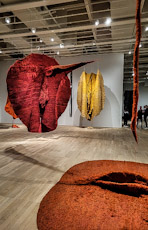
Cecilia has created two large sculptures which are hanging from the tall ceiling of the Tate Modern’s Turbine Hall until the 16th of April 2023. Each of these artworks consist of knotted strands of different materials, each of which is 27 metres long. They hang from circular metal structures looking to me rather like shredded laundry. Though they are undoubtedly deeply meaningful and attract the attention of many viewers, I felt the history underlying them was more interesting than their aesthetic qualities.

Abakanowicz

Elsewhere in the Tate Modern, we viewed an exhibition of the works of an artist, who knew how to write, but was creating during a time when the use of words had to chosen carefully to avoid being punished by the government. That artist Magdalena Abakanowicz (1930-2017), was born in Poland, where she created most of her art. After WW2, she studied painting and weaving the Academy of Plastic Arts in Warsaw. Her early works were created during a period when the Soviet-supported Stalinist regime in Poland imposed great restrictions on creative endeavours. During that harsh period, artists had to express any criticisms of the regime in a coded way in order to evade censorship. To some extent, this was necessary until Communist rule ended in Poland. In the mid-1950s, restrictions on art eased up a bit and experimentation became possible.

Magdalena moved from creating flattish conventional woven pieces to innovative three-dimensional artworks – woven sculptures of great originality. Photographs cannot do justice to these amazing creations. Videos can help the viewer appreciate the amazing way that these tapestries both fill and engulf space. However, the best way to see these works is to see them with your own eyes, which you can do at the Tate Modern until the 21st of May 2023. Included in the exhibitions are photographs of the lovely sculptures the artist created in later life and some videos of the artist talking about her work. There is also a film made in 1970 in which her tapestries are displayed on the sandy dunes of Poland’s Baltic coast. The artworks are suspended from poles and move gently in the sea breeze. It is clear from this film, which included scenes showing the fabric sculptures in galleries, that the artist seemed keen to have viewers explore them by touch as well as by vision. Sadly, and probably sensibly, the Tate forbids visitors from touching the lovely artworks.

Both the Vicuña and the Abakanowicz artworks use knotting and weaving to communicate ideas with the viewer. A window in one of the Abakanowicz exhibition rooms overlooks one of the quipu artworks. It intrigued me to see the juxtaposition of the works of the two fabric artists. Seeing these two exhibitions, one immediately after the other, made for a fascinating visit to the Tate Modern.

The stuff of dreams: an exhibition of Surrealist art

MOST NIGHTS I HAVE several dreams, all very vivid and in technicolour, often with a soundtrack. However, when I awake, I might only remember the outlines of one of them, if any at all. Much Surrealist art, often paintings, drawings, photographic images, or cinematographic sequences, depicts dreams. Whether these are the dreams that an artist has actually experienced, or they are creations that attempt to recreate the often weird ‘atmospheres’ that are produced in dreamers’ brains during slumber, it matters not because many of the Surrealist artists produce works that have the distorted realism typical of many dreams, which most viewers will recognise.

By Salvador Dali

Until the 29th of August 2022, there is an excellent exhibition of works created by Surrealist artists. Called “Beyond Borders”, it does not confine itself to well-known western artists such as Salvador Dali, De Chirico, Dorothea Tanning, Leonora Carrington, and so on, it introduces the viewer to Surrealists from as far afield as Japan, Latin America, and Africa, as well some pieces by artists who are new to me (and I suspect to many other visitors to the Tate). Most of the exhibits were paintings, graphic and cinematographic art; there were relatively few sculptures.   Well-known artists’ works are displayed alongside those of artists who are not widely recognised in this country, but deserve to be. Some might question the way that the curator (s) chose to group the artworks, but not being an art historian, this did not disturb me in the slightest. One new thing I learned from glancing at the informative notices amongst the exhibits is that Surrealist images were occasionally used by artists to convey politically subversive messaging. This reminds me of some strange (not necessarily Surreal) films that were made in parts of Europe when they were behind the so-called ‘Iron Curtain’: their oddity was supposed to disguise criticisms of the regime in power by baffling the strict but unimaginative censors.   

Overall, the exhibition provides a richly varied series of visual experiences. Wandering through the exhibition was a delight for my wife and me, and we shall try to visit the show again before it closes.